
As an experienced professional in the field of electric vehicle (EV) maintenance, I have observed that the insulation performance of high-voltage cables is a critical factor in ensuring the safety and reliability of EVs. High-voltage cables, which transmit power from the battery to components like the motor and inverter, are subjected to harsh operating conditions, including high temperatures, vibrations, and environmental exposures. In this article, I will delve into the structure, causes of insulation degradation, detection methods, and repair strategies for high-voltage cables in EVs, with a focus on practical applications in EV repair and electrical car repair. I will incorporate tables and formulas to summarize key points, aiming to provide a comprehensive guide for technicians and engineers involved in electrical car repair.
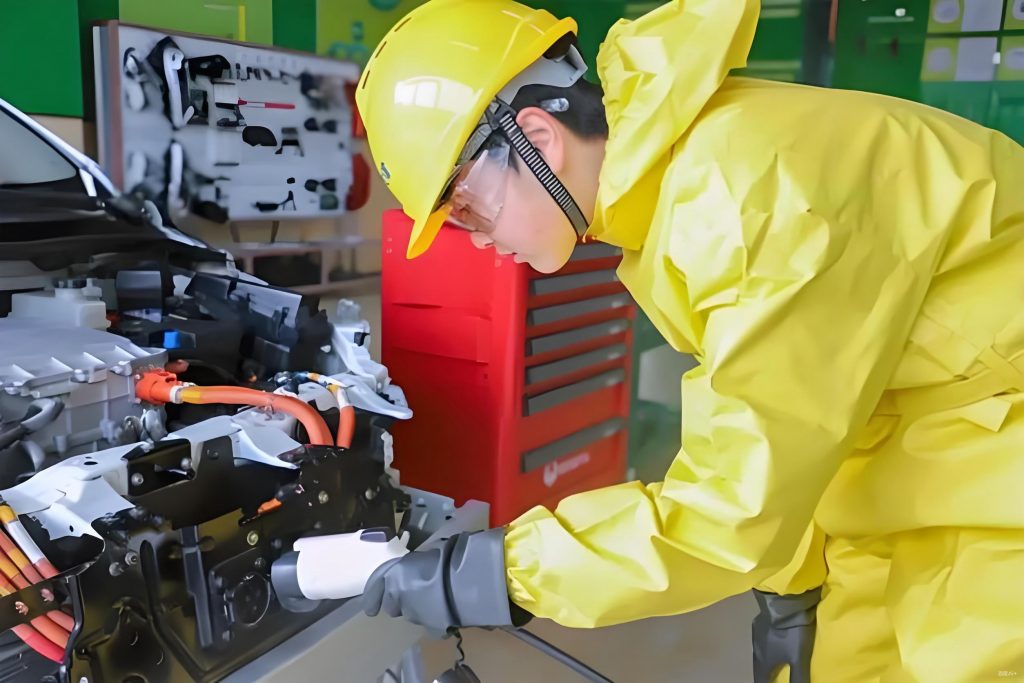
High-voltage cables in EVs are typically constructed with high-purity copper conductors to ensure excellent electrical conductivity, while the insulation layer is made from specialized materials such as cross-linked polyethylene (XLPE) or silicone rubber, which offer high temperature resistance, aging resistance, and reliable insulation protection. These cables operate in complex environments, enduring temperatures up to 120°C, constant vibrations from the engine and road, and exposure to moisture and contaminants. For instance, in rainy conditions or during washing, cables may come into contact with water, leading to potential insulation issues. Understanding these aspects is fundamental to effective EV repair, as insulation failures can result in system malfunctions, safety hazards, or even fires. The insulation layer not only prevents electrical leakage but also protects against short circuits and electromagnetic interference, making its integrity vital for the overall performance of electric vehicles.
The degradation of insulation performance in high-voltage cables can be attributed to three primary factors: material aging, mechanical damage, and environmental influences. Material aging occurs due to prolonged exposure to high temperatures, which causes molecular chain scission and reduced cross-linking in polymers, leading to a decline in dielectric strength. This process can be accelerated by ultraviolet (UV) radiation and oxidation. For example, the Arrhenius equation is often used to model thermal aging: $$ \frac{dA}{dt} = k \cdot e^{-\frac{E_a}{RT}} $$ where \( A \) represents the aging parameter, \( k \) is a pre-exponential factor, \( E_a \) is the activation energy, \( R \) is the gas constant, and \( T \) is the absolute temperature. This formula helps predict the lifespan of insulation materials under specific temperature conditions, which is crucial for planning preventive maintenance in electrical car repair. Mechanical damage includes abrasion, crushing, or friction during vehicle assembly or operation, particularly in areas where cables pass through metal holes or are subjected to vibrations. Environmental factors, such as humidity and contamination, can lead to moisture ingress or the formation of conductive paths on the insulation surface. A summary of these causes is provided in Table 1, which highlights their effects and typical scenarios in EV repair.
| Cause Category | Specific Factors | Effects on Insulation | Common Scenarios in EV Repair |
|---|---|---|---|
| Material Aging | Thermal degradation, UV exposure, oxidation | Reduced dielectric strength, cracking | Long-term operation in high-temperature environments |
| Mechanical Damage | Abrasion, crushing, vibration-induced wear | Localized thinning or breaches in insulation | Cables rubbing against body panels or components |
| Environmental Factors | Humidity, contaminants (e.g., oil, dust) | Increased leakage current, surface tracking | Exposure to rain, wash cycles, or dusty roads |
To assess insulation performance, various detection methods are employed in EV repair, each with its advantages and limitations. Direct current (DC) withstand voltage testing involves applying a DC voltage higher than the operating voltage to evaluate the insulation’s ability to withstand stress and measure leakage current. This method is straightforward and effective for identifying through-defects but may lack sensitivity to localized issues. The leakage current \( I_{leak} \) can be calculated using Ohm’s law: $$ I_{leak} = \frac{V_{test}}{R_{ins}} $$ where \( V_{test} \) is the test voltage and \( R_{ins} \) is the insulation resistance. Alternating current (AC) withstand voltage testing applies an AC high voltage to simulate real-world electric field distributions, making it more effective for detecting localized defects and aging. Partial discharge (PD) detection is a non-destructive method that monitors discharge signals within or on the insulation surface, offering high sensitivity for early defect identification but requiring specialized equipment and expertise. Table 2 compares these methods, which are integral to routine electrical car repair procedures.
| Detection Method | Principle | Advantages | Disadvantages | Application in EV Repair |
|---|---|---|---|---|
| DC Withstand Voltage Test | Applies high DC voltage to measure leakage current | Simple operation, good for through-defects | Low sensitivity to localized defects | Routine checks during electrical car repair |
| AC Withstand Voltage Test | Uses AC high voltage to mimic operational conditions | Better for localized issues and aging assessment | Requires more complex equipment | Detailed diagnostics in EV repair |
| Partial Discharge Detection | Detects discharge signals to assess insulation state | High sensitivity, early defect detection | Needs expertise and advanced tools | Preventive maintenance in electrical car repair |
When insulation issues are identified, repair strategies must be tailored based on the extent of damage, location, and vehicle usage conditions. In EV repair, we primarily use two approaches: local repair and complete replacement. Local repair is suitable for minor damages, such as small-area wear, cracks, or localized aging, and offers cost-effectiveness and simplicity. Techniques include applying high-performance insulating tapes (e.g., polytetrafluoroethylene or PTFE tapes), heat-shrink tubes for branch points or bent sections, and liquid insulating coatings for fine cracks. The repair process involves cleaning the area with solvents like ethanol, applying multiple layers of tape with 50% overlap, using heat guns to shrink tubes, and allowing coatings to cure. For instance, the insulation resistance after repair can be estimated using the formula: $$ R_{ins,new} = \frac{\rho \cdot L}{A} $$ where \( \rho \) is the resistivity of the repair material, \( L \) is the length of the repaired section, and \( A \) is the cross-sectional area. Complete replacement is necessary for extensive damage (e.g., over 10% of cable length) or severe aging, ensuring long-term reliability. This involves removing the old cable, installing a certified replacement, and securing it with proper fixtures to avoid abrasion. Table 3 outlines the decision-making criteria for these strategies, which are essential for efficient electrical car repair.
| Strategy | Applicable Scenarios | Key Steps | Advantages | Limitations |
|---|---|---|---|---|
| Local Repair | Minor wear, small cracks, localized aging | Clean, apply tape/tube/coating, test insulation | Low cost, quick implementation | May not address underlying aging; requires periodic checks |
| Complete Replacement | Extensive damage, severe aging, multiple defects | Remove old cable, install new one, secure and test | Comprehensive solution, high reliability | Higher cost and time; needs skilled EV repair technicians |
To illustrate the practical application of these methods, I will describe a case study from my experience in EV repair. A pure electric SUV exhibited a high-voltage system alarm with a fault code indicating “insulation resistance too low.” Initial diagnostics using a megohmmeter revealed an insulation resistance of only 0.5 MΩ between the battery pack and motor controller, well below the normal threshold of 20 MΩ. Upon inspection, we found significant insulation wear at a point where the cable passed through a body panel hole, caused by friction and vibration over time. The wear area measured approximately 5 cm, with the outer insulation layer penetrated, exposing the shielding. This scenario underscores the importance of regular inspections in electrical car repair to prevent such issues. The repair involved disconnecting the high-voltage battery, cleaning the area, applying multiple layers of insulating tape and a heat-shrink tube, and adding a protective sleeve to the panel hole. Post-repair testing showed insulation resistance restored to 25 MΩ, and a 30-km road test confirmed no further faults, validating the local repair approach. This case highlights how targeted EV repair strategies can resolve insulation problems efficiently, avoiding unnecessary costs.
In conclusion, the insulation performance of high-voltage cables in EVs is pivotal for safety and reliability, and its degradation stems from material aging, mechanical damage, and environmental factors. Detection methods like DC and AC withstand voltage tests, along with partial discharge detection, provide valuable tools for assessment, while repair strategies should be chosen based on damage extent and environmental conditions. Local repairs using tapes, tubes, or coatings are effective for minor issues, whereas complete replacement ensures long-term solutions for severe cases. As the EV industry evolves, future research should focus on advanced insulation materials, such as nanocomposites, and smart monitoring systems that integrate IoT sensors for real-time diagnostics. These innovations will enhance the efficiency of EV repair and electrical car repair, contributing to safer and more durable electric vehicles. By applying the insights and methods discussed here, technicians can improve their practices in electrical car repair, ultimately supporting the growth of sustainable transportation.