
In recent years, the rapid adoption of electric vehicles (EVs) has transformed the automotive landscape, driven by global sustainability goals and technological advancements. As an expert in the field of electrical car repair, I have observed that the shift from traditional internal combustion engines to electric powertrains introduces unique complexities in maintenance and repair. The core components of EVs, such as batteries, electric motors, and electronic control systems, demand specialized knowledge and tools, making EV repair a critical area for development. This article delves into the primary technical difficulties faced in electrical car repair and explores effective countermeasures, incorporating data analysis, formulas, and tables to provide a comprehensive overview. The growing market for EVs, with projections indicating continued expansion, underscores the urgency of addressing these challenges to ensure vehicle reliability, safety, and user satisfaction.
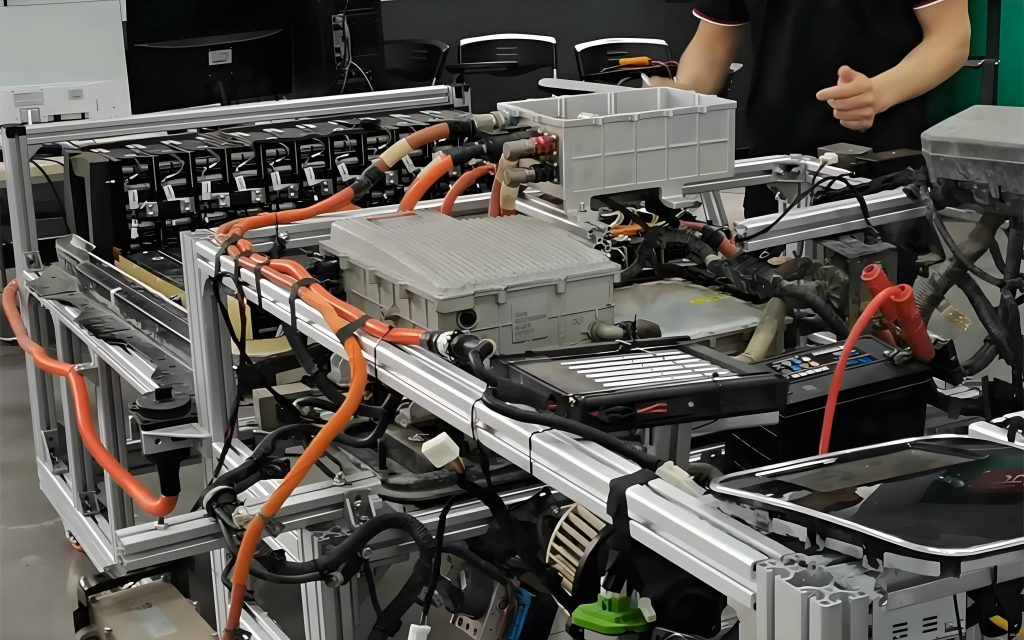
One of the most significant hurdles in EV repair revolves around battery performance degradation and lifespan issues. Lithium-ion batteries, the predominant energy storage solution in EVs, experience capacity fade over time due to electrochemical processes. For instance, the capacity decay can be modeled using the following equation: $$ C(t) = C_0 \cdot e^{-\lambda t} $$ where \( C(t) \) represents the remaining capacity at time \( t \), \( C_0 \) is the initial capacity, and \( \lambda \) is the degradation rate constant influenced by factors like temperature and charge cycles. Frequent fast charging or deep discharges accelerate this decay, leading to reduced driving range and potential safety hazards. In my analysis of EV repair scenarios, I have compiled common battery faults in the table below, which highlights the diversity of issues that technicians encounter.
| Fault Type | Description | Impact on EV Performance |
|---|---|---|
| Capacity Fade | Gradual loss of energy storage ability due to electrode material degradation | Reduced range and increased charging frequency |
| Voltage Anomalies | Irregular voltage outputs from cell imbalances or internal resistance changes | Potential system failures and safety risks |
| Thermal Runaway | Overheating leading to uncontrolled temperature rise, often triggered by short circuits | Risk of fire or explosion, requiring immediate EV repair interventions |
| Internal Short Circuits | Micro-shorts within cells causing localized heating and capacity loss | Difficult to detect with standard diagnostics, complicating electrical car repair |
Diagnosing these battery issues in EV repair often relies on multiple approaches, such as sensor-based methods that monitor parameters like voltage and temperature. However, these methods have limitations; for example, they may not capture internal structural changes. Advanced techniques, including model-based diagnostics, require accurate battery models, but the complexity of battery behavior under varying conditions makes this challenging. A more promising approach involves artificial intelligence (AI), where machine learning algorithms analyze historical data to predict faults. The effectiveness of AI in electrical car repair can be expressed through a classification accuracy formula: $$ \text{Accuracy} = \frac{\text{Number of Correct Predictions}}{\text{Total Predictions}} \times 100\% $$ Despite its potential, the scarcity of labeled fault data hinders widespread adoption in EV repair practices.
Moving beyond batteries, electric motors and electronic control systems present another layer of difficulty in EV repair. Motors, such as permanent magnet synchronous types, are prone to mechanical wear and electrical faults. For instance, bearing deterioration due to continuous operation can lead to vibrations and noise, while insulation breakdown in windings may cause short circuits. The torque output of an electric motor can be described by: $$ T = k \cdot I \cdot \phi $$ where \( T \) is torque, \( k \) is a motor constant, \( I \) is current, and \( \phi \) is magnetic flux. Deviations from expected torque values often indicate underlying issues in electrical car repair. Similarly, electronic control units (ECUs) manage critical functions like power distribution and regenerative braking, but software errors, data corruption, or compatibility problems can disrupt vehicle operations. In my experience with EV repair, diagnosing these faults requires sophisticated tools, as traditional methods may miss early signs of failure. The table below summarizes common motor and control system faults, emphasizing the need for specialized skills in electrical car repair.
| Component | Fault Type | Diagnosis Challenges |
|---|---|---|
| Electric Motor | Bearing wear, winding insulation failure | Requires disassembly and precise measurement; time-consuming in EV repair |
| ECU Software | Code errors, data loss, version conflicts | Complex debugging and need for updated programming tools in electrical car repair |
| Power Electronics | Inverter failures, gate driver issues | High-voltage risks and need for thermal management analysis |
High-voltage safety is a paramount concern in EV repair, as the powertrain operates at voltages exceeding 400V, posing risks of electric shock and arc flashes. The energy stored in a high-voltage battery can be calculated using: $$ E = \frac{1}{2} C V^2 $$ where \( E \) is energy, \( C \) is capacitance, and \( V \) is voltage. This high energy level necessitates strict protocols, such as using insulated tools and personal protective equipment (PPE). During electrical car repair, technicians must follow de-energization procedures, which involve discharging the battery and verifying zero voltage before any work. Moreover, arc flash hazards can be assessed through incident energy formulas, such as: $$ I_e = k \cdot I_{bf} \cdot t $$ where \( I_e \) is incident energy, \( k \) is a constant, \( I_{bf} \) is bolted fault current, and \( t \) is time. Implementing these safety measures reduces accidents but requires continuous training, as EV repair environments evolve with new vehicle designs.
The integration of smart and connected features in EVs adds another dimension to repair challenges. Advanced driver-assistance systems (ADAS) rely on sensors like LiDAR and cameras, which are susceptible to misalignment, contamination, or software glitches. For example, the object detection range of a sensor can be modeled as: $$ R = \frac{P_t G_t G_r \lambda^2}{(4\pi)^2 S} $$ where \( R \) is range, \( P_t \) is transmitted power, \( G_t \) and \( G_r \) are gains, \( \lambda \) is wavelength, and \( S \) is minimum detectable signal. Faults in these systems often manifest as false positives or failures in autonomous functions, complicating diagnostics in EV repair. Additionally, over-the-air software updates, while beneficial, can introduce compatibility issues or security vulnerabilities. In electrical car repair, ensuring data integrity during updates is crucial, as corrupted files may brick essential systems. The table below outlines common smart system faults, highlighting the interdisciplinary knowledge required for effective EV repair.
| System | Fault Type | Repair Implications |
|---|---|---|
| ADAS Sensors | Calibration errors, signal interference | Requires recalibration tools and software expertise in EV repair |
| Vehicle-to-Everything (V2X) | Communication delays, data breaches | Needs cybersecurity measures and network diagnostics in electrical car repair |
| Infotainment Systems | Software crashes, hardware failures | Integrates consumer electronics skills into EV repair workflows |
To address these challenges, technological innovation plays a central role in advancing EV repair capabilities. Research into solid-state batteries, for instance, promises higher energy density and safety, but requires new diagnostic techniques. The ionic conductivity in solid-state electrolytes can be expressed as: $$ \sigma = A e^{-E_a / RT} $$ where \( \sigma \) is conductivity, \( A \) is a pre-exponential factor, \( E_a \) is activation energy, \( R \) is the gas constant, and \( T \) is temperature. Developing AI-driven diagnostics for such batteries could revolutionize electrical car repair by enabling early fault detection. Similarly, improvements in motor design, such as using high-temperature superconductors, reduce losses and enhance reliability. The efficiency of an electric motor can be optimized using: $$ \eta = \frac{P_{\text{out}}}{P_{\text{in}}} \times 100\% $$ where \( P_{\text{out}} \) is output power and \( P_{\text{in}} \) is input power. By integrating these innovations, EV repair becomes more predictive and efficient, minimizing downtime for users.
Another critical strategy involves enhancing education and training for EV repair technicians. Vocational programs should cover fundamentals like electrical theory and battery chemistry, coupled with hands-on practice. For example, courses might include projects on diagnosing battery management systems (BMS) using real-world data. The relationship between state of charge (SOC) and open-circuit voltage can be approximated by: $$ \text{SOC} = \frac{V_{\text{oc}} – V_{\text{min}}}{V_{\text{max}} – V_{\text{min}}} $$ where \( V_{\text{oc}} \) is open-circuit voltage, and \( V_{\text{min}} \) and \( V_{\text{max}} \) are minimum and maximum voltages. Establishing certification standards ensures that technicians in electrical car repair meet competency benchmarks, fostering trust and safety. In my view, partnerships between academia and industry are essential to keep curricula aligned with evolving EV repair demands.
Upgrading repair equipment and tools is equally vital for overcoming EV repair obstacles. Smart diagnostic devices, for instance, can interface with vehicle networks to retrieve fault codes and performance data. The diagnostic accuracy can be quantified using: $$ \text{Precision} = \frac{\text{True Positives}}{\text{True Positives} + \text{False Positives}} $$ High-precision tools reduce misdiagnosis in electrical car repair, saving time and costs. Additionally, high-voltage insulated tools must undergo regular testing to maintain integrity, as per standards like ISO 6469-3. The table below compares traditional and advanced tools in EV repair, illustrating the shift toward智能化 solutions.
| Tool Type | Traditional Approach | Advanced EV Repair Solution |
|---|---|---|
| Diagnostic Scanner | Basic code reading for engine systems | AI-powered analyzers for battery and motor faults |
| Insulation Testers | Manual voltage checks | Automated systems with real-time data logging |
| Software Update Tools | Local installations with limited verification | Cloud-based platforms with encryption for secure electrical car repair |
In conclusion, the evolution of EV repair is intertwined with technological progress and skill development. As electric vehicles become more prevalent, addressing repair difficulties through innovation, education, and equipment upgrades will ensure sustainable mobility. From battery diagnostics to high-voltage safety, each aspect of electrical car repair demands a proactive approach. By embracing these strategies, the industry can enhance reliability and user confidence, paving the way for a greener automotive future. Continuous research and collaboration will be key to refining EV repair practices, making them as efficient and safe as possible.