
In my experience with electrical car repair, I have observed that the thermal management system of electric vehicle (EV) batteries is critical for ensuring safety, performance, and longevity. As an EV repair specialist, I focus on diagnosing and fixing issues in these systems to prevent failures like thermal runaway, which can lead to severe accidents. This article delves into the structure, fault diagnosis, repair techniques, and maintenance strategies for EV battery thermal management systems, emphasizing practical approaches for EV repair professionals. I will use tables and formulas to summarize key concepts, ensuring clarity and applicability in real-world electrical car repair scenarios.
The thermal management system in EVs regulates battery temperature to maintain optimal operating conditions, typically between 20°C and 40°C. It consists of cooling systems (e.g., liquid or air-based), heating elements, temperature sensors, and a controller. The controller processes sensor data to adjust cooling or heating, ensuring efficient heat dissipation or retention. For instance, the heat balance equation can be expressed as: $$ \frac{dT}{dt} = \frac{P_{\text{gen}} – Q_{\text{diss}}}{C_{\text{batt}}} $$ where \( T \) is the battery temperature, \( P_{\text{gen}} \) is the heat generation rate, \( Q_{\text{diss}} \) is the heat dissipation rate, and \( C_{\text{batt}} \) is the battery’s thermal capacity. This equation highlights the importance of precise control in EV repair to avoid overheating or undercooling. Common components include pumps, fans, and coolant loops, which I often inspect during electrical car repair jobs to ensure they function correctly.
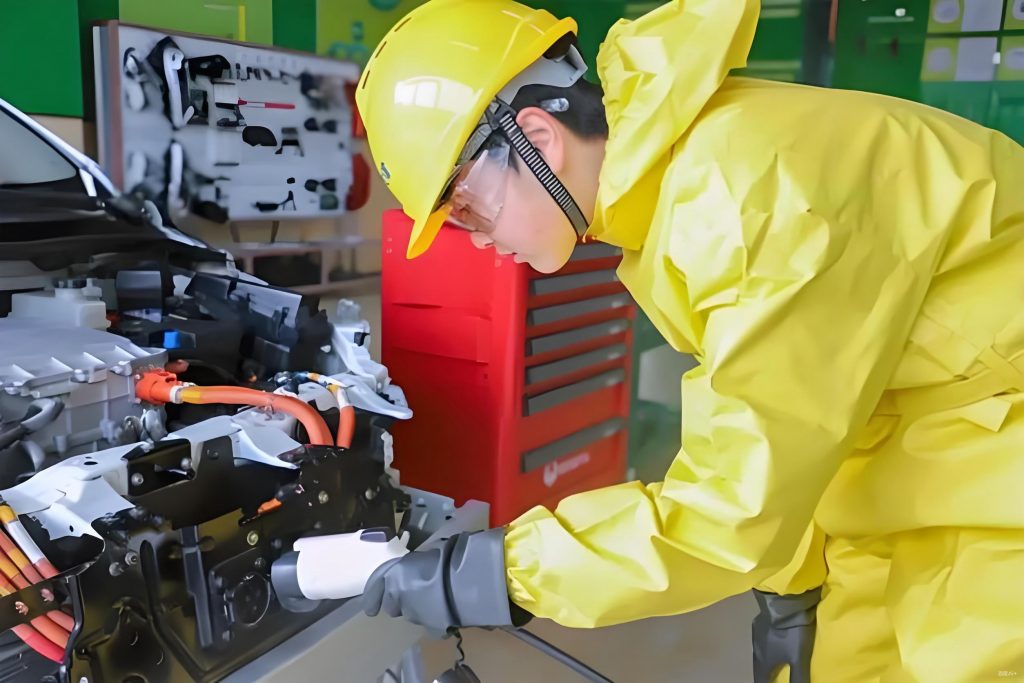
When it comes to fault diagnosis in EV repair, I follow a systematic approach to identify issues quickly. First, I use diagnostic tools to read data like temperature, voltage, and current from the battery management system. Then, I perform visual inspections for leaks, corrosion, or loose connections. For example, temperature anomalies are common and can be diagnosed by checking sensors and cooling components. I often employ statistical methods to estimate fault probabilities, such as: $$ P(\text{fault}) = 1 – e^{-\lambda t} $$ where \( \lambda \) is the failure rate and \( t \) is time. This helps prioritize inspections in electrical car repair. Below is a table summarizing common fault types and their diagnostic strategies in EV repair.
| Fault Type | Symptoms | Diagnostic Method | Tools Used |
|---|---|---|---|
| Temperature Anomaly | Battery overheating or undercooling | Check sensors, fans, and pumps; use thermal imaging | Diagnostic scanner, multimeter |
| Insulation Failure | Electrical leaks, reduced efficiency | Insulation resistance test, visual inspection | Insulation tester, ohmmeter |
| Voltage Imbalance | Uneven cell voltages, performance drop | Voltage profiling, module testing | Voltage meter, BMS software |
| Coolant Leak | Low coolant level, system pressure drop | Pressure testing, dye inspection | Pressure gauge, UV light |
In my electrical car repair practice, I have encountered numerous cases where fault diagnosis saved time and costs. For instance, in one EV repair job, a vehicle exhibited rapid battery temperature rise during high-speed driving. Using diagnostic tools, I identified a faulty coolant pump with reduced flow rate, calculated by: $$ Q = A \cdot v $$ where \( Q \) is the flow rate, \( A \) is the cross-sectional area, and \( v \) is the velocity. Replacing the pump resolved the issue, underscoring the value of accurate diagnosis in EV repair.
Repair techniques in electrical car repair require meticulous preparation and execution. Before starting any EV repair, I ensure safety by disconnecting the battery and wearing protective gear like insulated gloves and goggles. I gather tools such as diagnostic scanners, multimeters, and replacement parts. The repair process varies by fault; for sensor issues, I replace them after verifying connections, while for pump failures, I drain coolant, inspect for blockages, and install new units. A key step in EV repair is testing insulation resistance using: $$ R_{\text{ins}} = \frac{V}{I_{\text{leak}}} $$ where \( R_{\text{ins}} \) is the insulation resistance, \( V \) is the voltage, and \( I_{\text{leak}} \) is the leakage current. This ensures electrical safety post-repair. Below is a table outlining common repair steps in electrical car repair.
| Step | Action | Tools/Equipment | Safety Precautions |
|---|---|---|---|
| 1 | Disconnect battery and power down system | Insulated tools, lockout devices | Wear gloves and goggles; avoid sparks |
| 2 | Diagnose fault using scanners and tests | Diagnostic tool, multimeter | Ensure area is dry and ventilated |
| 3 | Replace or repair faulty components | Wrenches, seals, new parts | Handle coolants carefully; dispose properly |
| 4 | Reassemble and test system functionality | Pressure tester, thermal camera | Verify no leaks or shorts before power-up |
After completing an EV repair, I conduct thorough tests to validate the fix. This includes checking temperature stability, voltage consistency, and insulation integrity. For example, I might simulate operating conditions and monitor the system using: $$ \Delta T = T_{\text{max}} – T_{\text{min}} $$ where \( \Delta T \) should be within a safe range, typically under 5°C. This post-repair validation is crucial in electrical car repair to prevent recurrences and ensure customer satisfaction.
Maintenance and保养 are vital for prolonging the life of EV battery thermal management systems. In my electrical car repair routine, I advise owners on daily checks, such as inspecting coolant levels and cleaning散热 surfaces. Long-term strategies include scheduled component replacements and software updates. For instance, the degradation of cooling efficiency over time can be modeled as: $$ \eta(t) = \eta_0 \cdot e^{-kt} $$ where \( \eta(t) \) is the efficiency at time \( t \), \( \eta_0 \) is the initial efficiency, and \( k \) is a degradation constant. Regular maintenance in EV repair can slow this decay, reducing the need for costly repairs. I often use a checklist for electrical car repair maintenance, as shown in the table below.
| Maintenance Task | Frequency | Action | Expected Outcome |
|---|---|---|---|
| Coolant level check | Monthly | Top up or replace coolant | Prevent overheating and corrosion |
| Sensor calibration | Every 6 months | Test and adjust sensors | Accurate temperature monitoring |
| System cleaning | Quarterly | Remove dust and debris | Improve heat dissipation |
| Insulation test | Annually | Measure resistance | Ensure electrical safety |
In conclusion, as an EV repair expert, I emphasize that effective fault diagnosis and repair of battery thermal management systems are essential for EV safety and performance. The integration of formulas and tables in this article aids in standardizing procedures for electrical car repair. Looking ahead, I anticipate advancements in AI-driven diagnostics and solid-state batteries, which will reshape EV repair practices. By adhering to rigorous maintenance and repair protocols, we can enhance the reliability of EVs and support the growth of sustainable transportation. Through continuous learning and adaptation, electrical car repair technicians can stay ahead in this evolving field.