
As the global electric vehicle (EV) industry expands rapidly, the associated challenges in insurance, particularly high premiums and complex claims, have become a focal point. I have observed that the structural and powertrain differences between EVs and conventional vehicles lead to elevated repair costs, especially for the battery system. This issue underscores the need for design improvements to reduce consumer expenses and align with the insurance industry’s commitment to risk reduction and customer-centric principles. In this article, I will share insights based on real-world EV repair cases and experimental analyses, offering design recommendations to enhance the crashworthiness and repair economy of EV batteries. By addressing these aspects, we can mitigate risks, lower insurance costs, and promote sustainable EV adoption. The core of this discussion revolves around optimizing designs to simplify electrical car repair processes and reduce overall expenses.
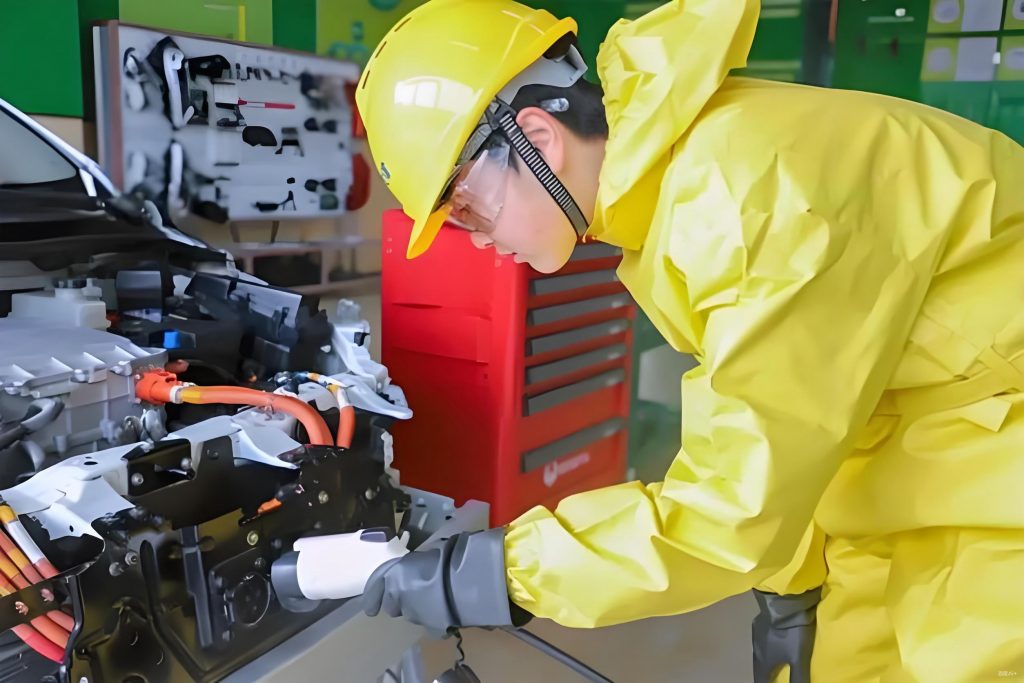
In my analysis, I have categorized the recommendations into two main areas: crashworthiness and repair economy. Crashworthiness focuses on minimizing battery damage during accidents through protective designs, while repair economy aims to streamline maintenance procedures to cut down on labor and parts costs. Both aspects are critical for improving the overall EV repair experience and making electrical car repair more accessible and affordable. I will delve into each category with detailed examples, tables, and mathematical models to illustrate the impact of these designs. Throughout this article, I emphasize the importance of integrating these principles early in the manufacturing process to achieve long-term benefits in safety and cost-efficiency.
Crashworthiness Design Recommendations for EV Batteries
Enhancing the crashworthiness of EV batteries involves structural protections that reduce damage in collisions. Based on insurance data and accident reports, I have identified several key areas where design improvements can significantly lower the risk of battery failure. These recommendations aim to prevent or minimize damage from common incidents like bottom impacts, side collisions, and environmental exposures. By implementing these changes, manufacturers can reduce the frequency and severity of claims, ultimately benefiting both insurers and consumers. In the following sections, I will outline each recommendation with supporting evidence and comparative tables.
First, the battery pack should include robust bottom and side protection. Insurance data shows that a significant portion of battery damage stems from underbody scrapes and object impacts. For instance, in a study of operational vehicles, those without reinforced underbody guards had up to 30% incidence of battery scrapes, while those with guards reported none. This highlights the importance of adding protective plates that can be individually replaced, reducing the need for full battery assembly replacements. The table below summarizes the advantages and disadvantages of this design approach.
| Positive Case | Negative Case |
|---|---|
| High-strength underbody guard prevents damage from impacts. | Lack of underbody guard leads to frequent battery casing damage. |
Second, connector protection is essential. In many EV repair cases, I have seen that minor collisions damage plastic connectors, compromising sealing and leading to water ingress or electrical faults. To address this, connectors should meet at least IP67 waterproof standards and have dedicated shields. This reduces the risk of short circuits and expands the battery’s lifespan. The mathematical representation of risk reduction can be expressed as: $$ \text{Risk Reduction} = 1 – \frac{\text{Damage Incidence with Protection}}{\text{Damage Incidence without Protection}} $$ where a lower ratio indicates better performance. Such designs are vital for reliable electrical car repair operations.
Third, the placement of liquid cooling pipe joints must be optimized. Accidents often damage these joints, causing coolant leaks and internal short circuits. I recommend positioning them in less vulnerable areas, such as the upper surface of the battery pack, or adding protective covers. This minimizes the likelihood of leaks and associated repair costs. The table below illustrates this comparison.
| Positive Case | Negative Case |
|---|---|
| Cooling pipe joints located on top, reducing damage risk. | Joints placed in forward areas, prone to impact damage. |
Fourth, high-voltage wiring requires adequate shielding. Insurance cases reveal that flying debris can sever exposed cables, leading to fires or power failures. By enclosing high-voltage wires in protective conduits, manufacturers can prevent such incidents. The cost-benefit of this can be modeled as: $$ \text{Cost Savings} = \text{Prevented Incident Cost} – \text{Protection Implementation Cost} $$ where a positive value justifies the investment. This is a critical aspect of EV repair safety.
Fifth, the high-voltage negative ground cable needs insulation and warning labels. Instances of cable cutting during accidents pose electrocution risks and system failures. Protective covers and clear identifiers can mitigate this, enhancing overall safety in electrical car repair scenarios.
Sixth, the installation of liquid cooling plates should avoid vulnerable locations. If placed at the bottom, a minimum gap of 3.5 mm from the battery casing is advised to prevent deformation. Alternatively, integrating them with the casing should include disassembly guidelines. The table below highlights this issue.
| Positive Case | Negative Case |
|---|---|
| Cooling plates on the side, minimizing impact damage. | Plates on the bottom, easily deformed in collisions. |
Seventh, cell weld points must have sufficient strength. Weak welds can break during impacts, necessitating module replacements and increasing EV repair costs. Strengthening these connections reduces failure rates, as shown in the table.
| Positive Case | Negative Case |
|---|---|
| Strong welds resist fracture under stress. | Weak welds prone to breaking, raising repair needs. |
Eighth, state monitoring sensors are crucial for early detection of issues like thermal runaway. These sensors can alert users to potential fires, but they must remain functional even during repairs. I suggest incorporating standalone monitoring for detached batteries to prevent incidents in storage or transport. The probability of avoiding a major failure can be represented as: $$ P(\text{Avoidance}) = 1 – e^{-\lambda t} $$ where $\lambda$ is the failure rate and $t$ is time, emphasizing the need for continuous monitoring.
Ninth, the electrical conductivity of cooling fluids should be limited to 100 μS/cm or less. Low-conductivity fluids reduce the risk of internal short circuits if leaks occur, thereby lowering the chance of spontaneous combustion. This is a simple yet effective measure to enhance EV repair safety and reliability.
Repair Economy Design Recommendations for EV Batteries
Improving the repair economy of EV batteries involves optimizing internal structures to simplify maintenance and reduce labor hours. From my experience with insurance claims and repair workshops, I have compiled recommendations that focus on modularity, accessibility, and standardization. These changes can significantly cut down on the time and cost associated with electrical car repair, making EVs more affordable to maintain. In this section, I will detail each recommendation with examples and tables, and introduce formulas to quantify the benefits.
First, Cell-to-Pack (CTP) and Cell-to-Chassis (CTC) designs should allow for individual cell or module replacement. Many current designs use adhesives that make disassembly difficult, often leading to total battery replacements for minor damages. By providing dissolvable adhesives and standardized repair protocols, manufacturers can enable partial repairs. The repair cost model can be expressed as: $$ \text{Repair Cost} = \text{Labor Time} \times \text{Rate} + \text{Parts Cost} $$ where modular designs reduce both time and parts expense. The table below contrasts this approach.
| Positive Case | Negative Case |
|---|---|
| Replaceable cells lower repair costs and complexity. | Adhesive-bound cells increase difficulty and risk. |
Second, the battery cover should be detachable without damage. Some designs use glued covers that require destructive removal, adding unnecessary replacement costs. Implementing bolt-on or sealable covers allows for reuse and simplifies EV repair processes. This aligns with the goal of efficient electrical car repair by minimizing waste.
Third, incorporating repair access panels can eliminate the need for full battery removal. For minor issues, such as relay replacements, these panels enable repairs through interior spaces like under seats, saving labor hours. The time savings can be calculated as: $$ \text{Time Saved} = \text{Full Removal Time} – \text{Panel Access Time} $$ resulting in lower costs. The table illustrates this advantage.
| Positive Case | Negative Case |
|---|---|
| Access panels allow repairs without disassembly. | No panels require full battery removal for minor fixes. |
Fourth, the connection method between cells/modules and the casing should permit non-destructive disassembly. Adhesive-based attachments often complicate repairs, whereas bolt-on designs facilitate easy replacements. This reduces the risk of damage during EV repair and cuts down on parts costs.
Fifth, post-airbag deployment, batteries should not be automatically replaced if undamaged. Instead, manufacturers should provide diagnostic and repair procedures, such as relay replacements, to avoid unnecessary costs. This approach supports sustainable electrical car repair by conserving resources.
Sixth, battery mounting should be from the exterior rather than the interior. Internal mounts often require dismantling interior components, increasing labor time. External fixes streamline the process, as shown in the formula: $$ \text{Labor Reduction} = \text{Interior Dismantling Time} – \text{Exterior Access Time} $$ which directly lowers EV repair expenses.
Seventh, frame straightening equipment should be compatible with battery placement. Current tools may interfere, forcing battery removal. Developing specialized equipment that works around the battery can save time and reduce costs in electrical car repair scenarios.
Eighth, individual component availability is key. Supplying parts like coolants, casings, and cells separately allows for targeted repairs, avoiding full assembly replacements. This modularity enhances the efficiency of EV repair operations.
Ninth, standardized diagnostic protocols and interfaces are essential. Uniform connectors and testing procedures across models reduce equipment costs and training time for repair shops. The benefit can be modeled as: $$ \text{Efficiency Gain} = \frac{\text{Standardized Time}}{\text{Non-Standardized Time}} $$ where a value less than 1 indicates improvement.
Tenth, universal sealing test caps should be adopted for air-tightness checks. Common caps across brands simplify post-flood assessments, reducing the tooling expenses associated with EV repair. This standardization is crucial for consistent electrical car repair quality.
Conclusion and Future Directions
In summary, the design of EV batteries plays a pivotal role in determining repair costs and insurance risks. By adopting the crashworthiness and repair economy recommendations I have outlined, manufacturers can significantly reduce the average claim loss and enhance vehicle safety. These improvements not only benefit consumers through lower premiums but also support the insurance industry’s risk management goals. Collaboration between automakers and insurers is essential to standardize repair practices and share data, fostering a more resilient EV ecosystem.
Looking ahead, future research should focus on quantifying the impact of these design changes on insurance metrics. For example, developing models that correlate structural enhancements with reduced incident rates could provide valuable insights. A potential formula for this is: $$ \text{Impact Score} = \sum (\text{Design Factor} \times \text{Risk Weight}) $$ where factors are evaluated based on real-world data. Additionally, as EV repair technologies evolve, continuous innovation in battery design will be crucial for maintaining affordability and safety in electrical car repair. I encourage industry stakeholders to prioritize these advancements to ensure the long-term success of electric mobility.