
In recent years, the rapid advancement of new energy vehicle (NEV) technologies, including battery management systems, high-voltage electrical systems, and regenerative braking systems, has significantly transformed the landscape of EV repair. As an educator in the field of electrical car repair, I have observed that traditional teaching methods, which primarily rely on theoretical lectures and basic laboratory exercises, are increasingly inadequate for preparing students to meet the dynamic demands of the industry. The fast-paced evolution of EV repair techniques necessitates a实训教学模式 that not only imparts foundational knowledge but also emphasizes hands-on experience and real-world problem-solving skills. This article explores the reform of practical training teaching modes for新能源汽车维修专业, focusing on project-driven approaches and school-enterprise cooperation to bridge the gap between academic instruction and industry requirements. By integrating these elements, we aim to cultivate a skilled workforce capable of addressing the complexities of modern electrical car repair, thereby enhancing the overall effectiveness of vocational education in this critical sector.
The current state of practical training in EV repair education reveals several pressing issues. Firstly, the swift technological updates in新能源汽车维修 mean that教学内容 often lags behind industry developments. For instance, while new battery technologies and autonomous driving features are being incorporated into vehicles, many training programs still emphasize conventional repair methods, leaving students ill-prepared for emerging challenges in electrical car repair. Secondly, the实训环境 in educational institutions frequently fails to replicate actual working conditions. Students practice in simulated settings that lack the complexity and pressure of real-world scenarios, such as diagnosing intricate faults in high-voltage systems or managing customer interactions. This disparity hinders their ability to develop the nuanced skills required for effective EV repair. Thirdly, opportunities for hands-on practice are limited due to safety concerns and resource constraints. High-voltage components in electrical car repair pose significant risks, leading institutions to restrict practical sessions, which ultimately reduces students’ exposure to critical operational experiences. These shortcomings underscore the urgent need for a reformed approach that prioritizes experiential learning and industry alignment.
To address these challenges, we have developed a project-driven and school-enterprise cooperative practical training mode for EV repair education. This model is designed to immerse students in authentic learning environments that mirror the workflows of professional electrical car repair shops. The course体系设置 is guided by principles that emphasize proximity to actual work processes and the integration of技能训练 with theoretical knowledge. For example, in designing the curriculum, we ensure that each module corresponds to a specific aspect of electrical car repair, such as battery diagnostics or motor system maintenance, allowing students to progress from basic tool usage to advanced故障诊断 in a structured manner. This approach not only enhances their practical abilities but also fosters a deeper understanding of the underlying principles, as illustrated by the formula for calculating repair efficiency: $$ \eta = \frac{T_{\text{actual}}}{T_{\text{standard}}} $$ where \( \eta \) represents efficiency, \( T_{\text{actual}} \) is the actual time taken for EV repair, and \( T_{\text{standard}} \) is the industry-standard time. By applying such mathematical concepts, students can quantitatively assess their performance and identify areas for improvement in electrical car repair tasks.
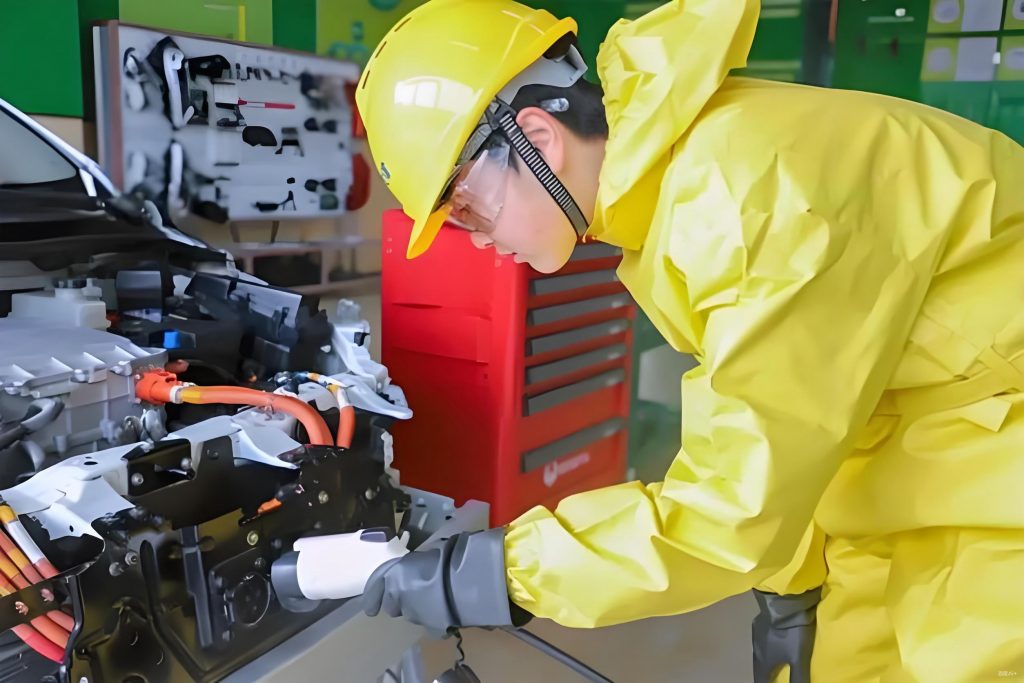
The project-driven methodology forms the core of our reformed EV repair training模式. In this approach, students engage in real-world projects that simulate common scenarios in electrical car repair, such as troubleshooting a faulty battery management system or optimizing energy efficiency in hybrid vehicles. Each project is structured into phases that align with industry practices, from initial assessment to final implementation. For instance, a typical project might involve diagnosing a high-voltage electrical issue, where students must apply theoretical knowledge to practical situations. To facilitate this, we use formulas like the one for battery degradation: $$ L = L_0 \cdot e^{-k t} $$ where \( L \) is the remaining battery life, \( L_0 \) is the initial capacity, \( k \) is the degradation rate, and \( t \) is time. This equation helps students understand the long-term implications of EV repair decisions, reinforcing the importance of accurate diagnostics in electrical car repair. Moreover, projects are designed to be collaborative, encouraging teamwork and communication—skills essential for success in the EV repair industry.
In implementing the project-driven approach, we have outlined a detailed schedule to ensure comprehensive coverage of electrical car repair competencies. The following table summarizes a 14-week practical training program, which includes theoretical sessions, hands-on activities, and evaluations. This structured timeline allows students to gradually build their expertise in EV repair, from basic concepts to complex applications, while incorporating frequent feedback loops for continuous improvement.
| Week | Hours | Main Content | Teaching Activities | Expected Outcomes |
|---|---|---|---|---|
| 1 | 2 | Project Introduction and Grouping | Background briefing, task distribution, student grouping | Understanding of project scope and team formation |
| 2 | 4 | Project Planning and Task Allocation | Development of project plans, role assignments, goal setting | Detailed project roadmap with clear responsibilities |
| 3-4 | 8 | Theoretical Knowledge and Practical Operation | Lectures on EV repair principles, initial hands-on practice | Mastery of core concepts and basic electrical car repair skills |
| 5-6 | 8 | Project Implementation and Instructor Guidance | Group work on projects, technical support from teachers | Progress in project tasks with expert advice for EV repair |
| 7 | 4 | Interim Review and Adjustments | Mid-term assessments, plan revisions based on feedback | Identification of issues and refinement of electrical car repair strategies |
| 8-9 | 8 | Industry Expert Sessions and Technical Support | Invited talks on latest EV repair trends, hands-on demonstrations | Exposure to cutting-edge technologies in electrical car repair |
| 10-11 | 8 | Project Refinement and Final Debugging | Fine-tuning of project components, system testing | Completion of all aspects of the EV repair project |
| 12 | 4 | Project Presentation and Evaluation | Group showcases, assessments by teachers and industry experts | Comprehensive feedback on electrical car repair outcomes |
| 13 | 2 | Feedback Summary and Reflection | Compilation of evaluation results, group discussions | Insights gained and lessons learned for future EV repair tasks |
| 14 | 2 | Reflection and Improvement Proposals | Debates on project experiences, suggestions for enhancements | Actionable ideas to advance electrical car repair training |
Complementing the project-driven approach, the school-enterprise cooperation mechanism plays a pivotal role in enhancing the practicality of EV repair education. This collaboration involves partnerships between educational institutions and industry players, such as automotive manufacturers and specialized electrical car repair centers, to provide students with access to real-world resources and experiences. The cooperation is established through formal agreements that outline shared goals, including joint curriculum development, internship programs, and research initiatives focused on advancing EV repair technologies. For example, students may participate in onsite training at partner enterprises, where they engage in actual electrical car repair tasks under the guidance of experienced technicians. This exposure not only solidifies their technical skills but also familiarizes them with industry standards and safety protocols, which are critical for competent EV repair. Additionally, the partnership facilitates the exchange of knowledge, as evidenced by the formula for collaborative learning efficiency: $$ E_c = \frac{S_i + E_e}{T} $$ where \( E_c \) is the collaborative efficiency, \( S_i \) represents school inputs, \( E_e \) denotes enterprise contributions, and \( T \) is the time invested. This equation highlights the synergistic benefits of integrating academic and industrial resources in electrical car repair training.
The implementation of school-enterprise cooperation follows a systematic process to ensure its effectiveness in EV repair education. First, relationships are forged through memoranda of understanding that define roles and responsibilities. Second, collaborative plans are drafted, covering aspects like talent cultivation and practical training base construction. Third, resources are shared and optimized; for instance, schools may provide theoretical frameworks, while enterprises supply advanced tools for electrical car repair. Fourth,实训与科研 activities are conducted, such as joint projects on battery life optimization or diagnostic software development. Finally, regular evaluations are performed to assess outcomes and make necessary adjustments. This iterative process ensures that the cooperation remains aligned with the evolving needs of the EV repair industry, as quantified by the improvement index: $$ I_i = \frac{R_a – R_b}{R_b} \times 100\% $$ where \( I_i \) is the improvement index, \( R_a \) is the post-cooperation performance in electrical car repair tasks, and \( R_b \) is the baseline performance. By monitoring such metrics, we can continuously refine the training模式 to produce graduates who are well-equipped for the demands of modern electrical car repair.
In addition to structural reforms, the integration of advanced teaching tools and technologies is essential for effective EV repair education. Digital simulations, virtual reality (VR) environments, and multimedia resources are employed to create immersive learning experiences that complement hands-on training. For example, VR modules can simulate high-risk scenarios in electrical car repair, such as handling high-voltage components, allowing students to practice safety procedures without physical dangers. These tools also enable the visualization of complex concepts, like the electrical flow in EV systems, which can be represented using formulas such as Ohm’s law: $$ V = I \times R $$ where \( V \) is voltage, \( I \) is current, and \( R \) is resistance. By applying this in virtual labs, students gain a practical understanding of how electrical principles underpin EV repair tasks. Furthermore, data analytics are used to track student progress, with algorithms that identify areas needing improvement in electrical car repair competencies. This technological integration not only enhances engagement but also ensures that training remains relevant to industry advancements in EV repair.
Assessment and evaluation are critical components of the reformed practical training mode for EV repair. To measure student proficiency in electrical car repair, we employ a multifaceted approach that combines practical demonstrations, written tests, and peer reviews. For instance, students might be evaluated on their ability to diagnose and fix a common issue in electric vehicles, such as a malfunctioning charging system, using the following performance metric: $$ P = \frac{A_c}{T_t} \times 100 $$ where \( P \) is the performance score, \( A_c \) is the number of accurately completed electrical car repair tasks, and \( T_t \) is the total tasks assigned. This quantitative assessment is supplemented by qualitative feedback from instructors and industry partners, ensuring a holistic view of student capabilities. Additionally, longitudinal studies are conducted to track graduates’ success in the EV repair workforce, providing insights into the long-term impact of the training reforms. By continuously refining these evaluation methods, we can maintain high standards in electrical car repair education and adapt to emerging trends.
Looking ahead, the future of practical training in EV repair will likely involve greater emphasis on sustainability and digitalization. As the automotive industry shifts toward greener technologies, electrical car repair must evolve to include modules on recycling components, optimizing energy use, and integrating smart systems. For example, training might cover the application of AI in predictive maintenance for EVs, using formulas like: $$ F_p = \frac{1}{N} \sum_{i=1}^{N} \log\left(\frac{1}{1 – D_i}\right) $$ where \( F_p \) is the failure prediction score, \( N \) is the number of data points, and \( D_i \) represents degradation indicators. This forward-looking approach ensures that students are prepared for the next generation of electrical car repair challenges. Moreover, expanding school-enterprise cooperation to include global partnerships could expose learners to international standards and innovations in EV repair. By fostering a culture of continuous learning and adaptation, we can ensure that practical training remains a cornerstone of excellence in新能源汽车维修 education.
In conclusion, the reform of practical training teaching modes for EV repair through project-driven methodologies and school-enterprise cooperation represents a significant step toward aligning education with industry needs. By simulating real-world environments, integrating theoretical and practical knowledge, and leveraging collaborative resources, we can equip students with the skills necessary for proficient electrical car repair. The use of tables, formulas, and advanced tools further enriches this learning experience, providing a comprehensive framework for addressing the complexities of modern新能源汽车维修. As technology continues to advance, ongoing refinement of these approaches will be essential to maintaining the relevance and effectiveness of EV repair training, ultimately contributing to a skilled and adaptable workforce in the evolving automotive sector.