
As an experienced professional in the field of electric vehicle repair, I have witnessed the rapid growth of the electric vehicle (EV) industry, driven by global energy challenges and environmental concerns. The power battery, often referred to as the “heart” of an electric car, plays a critical role in determining the vehicle’s range, performance, and safety. In my work, I have encountered numerous cases where battery failures lead to significant issues, from reduced driving distances to serious safety hazards like fires or electrical shocks. This article delves into the common faults in EV power batteries, their underlying causes, and effective maintenance strategies, with a focus on practical approaches for EV repair and electrical car repair. By sharing insights from hands-on experience, I aim to enhance the reliability and longevity of these essential components, ultimately supporting the broader adoption of electric vehicles.
The importance of detecting and repairing faults in EV power batteries cannot be overstated. Firstly, it directly contributes to extending battery life. Batteries naturally degrade over time due to chemical reactions and usage patterns, leading to capacity fade that shortens the driving range. Through regular maintenance and timely repairs, we can mitigate this degradation, restore performance, and reduce the frequency of costly battery replacements. This not only saves money for EV owners but also promotes sustainable vehicle use. Secondly, safety is a paramount concern in electrical car repair. Faults such as internal short circuits or insulation failures can result in thermal runaway, fires, or electric shocks, posing risks to both users and technicians. By implementing proactive fault detection and repair protocols, we can identify potential issues early, preventing accidents and ensuring a secure driving environment. Lastly, this focus on maintenance drives innovation in the EV industry. Feedback from repair scenarios informs manufacturers about common failure modes, leading to design improvements and technological advancements. This iterative process enhances overall vehicle quality, boosts consumer confidence, and accelerates the transition to cleaner transportation solutions.
In the following sections, I will explore the most common faults in EV power batteries, analyze their causes using empirical data and theoretical models, and propose detailed maintenance strategies. To make the content accessible and practical, I will incorporate tables and mathematical formulas that summarize key concepts. For instance, tables can compare fault symptoms and repair steps, while formulas can model battery behavior under different conditions. This structured approach will help technicians and enthusiasts in the EV repair community apply these insights effectively. Additionally, I will emphasize keywords like EV repair and electrical car repair throughout the discussion to highlight their relevance. Let’s begin by examining the typical faults that plague EV power batteries.
Common Faults in EV Power Batteries and Their Causes
In my years of specializing in EV repair, I have categorized power battery faults into several key types, each with distinct causes and implications. Understanding these is crucial for effective diagnosis and electrical car repair. Below, I detail the most prevalent issues, supported by tables and formulas to illustrate the underlying mechanisms.
Battery Capacity Fade
Battery capacity fade is a frequent issue in electric vehicles, where the battery’s ability to hold charge diminishes over multiple charge-discharge cycles. This results in a gradual reduction in driving range, which can frustrate users and undermine the vehicle’s utility. From my observations in electrical car repair, the causes are multifaceted. Aging is a primary factor: prolonged use leads to chemical changes within the battery, such as electrode material dissolution or structural alterations in lithium-ion cells. This reduces the battery’s capacity to store lithium ions. Environmental conditions also play a role; high temperatures accelerate chemical reactions, causing electrolyte decomposition and increased resistance, while low temperatures impair ion conductivity, weakening charge storage and discharge capabilities. Moreover, poor charging habits, like overcharging or deep discharging, can damage electrode materials and reduce reversible capacity, hastening fade. To quantify this, we can use a simple exponential decay model for capacity over time:
$$ C(t) = C_0 \cdot e^{-\alpha t} $$
where \( C(t) \) is the capacity at time \( t \), \( C_0 \) is the initial capacity, and \( \alpha \) is the decay coefficient influenced by factors like temperature and usage patterns. This formula helps in predicting battery life and planning preventive maintenance in EV repair.
| Cause | Description | Impact on Battery |
|---|---|---|
| Aging | Chemical degradation of materials over time | Reduced lithium-ion storage capacity |
| High Temperatures | Accelerated reactions and electrolyte breakdown | Faster decay and increased resistance |
| Low Temperatures | Impaired ion conduction | Weakened charge/discharge performance |
| Overcharging/Deep Discharging | Damage to electrodes and reduced reversibility | Shortened battery lifespan |
Internal Short Circuit
Internal short circuits are among the most dangerous faults in EV power batteries, often leading to rapid performance decline, thermal runaway, and even fires. In my electrical car repair practice, I have traced these to design flaws, manufacturing defects, or external damage. For example, improper battery structure or impurities in electrodes can cause direct contact between positive and negative materials, while physical impacts from collisions can deform the battery casing and displace internal components. Once a short circuit occurs, localized heating triggers thermal runaway, where heat buildup causes further material decomposition and gas generation, escalating the risk. This can spread to the entire battery pack if not contained. The energy release in such scenarios can be modeled using thermal dynamics equations, such as:
$$ \frac{dQ}{dt} = I^2 R + h A (T – T_{\text{env}}) $$
where \( \frac{dQ}{dt} \) is the heat generation rate, \( I \) is current, \( R \) is resistance, \( h \) is heat transfer coefficient, \( A \) is surface area, \( T \) is temperature, and \( T_{\text{env}} \) is environmental temperature. This highlights the importance of rapid intervention in EV repair to prevent cascading failures.
| Factor | Details | Risk Level |
|---|---|---|
| Design/Manufacturing Defects | Poor structure or contaminated materials | High |
| External Damage | Impact-induced casing deformation | Moderate to High |
| Thermal Runaway | Heat-triggered chain reaction | Critical |
Charging Faults
Charging faults are common in electric vehicles and can manifest as inability to charge, slow charging, or intermittent power supply. Based on my experience in EV repair, these often stem from issues with charging equipment, connectors, or the battery management system (BMS). Faulty charging stations may fail to convert AC to DC power properly, while worn-out or corroded connectors can lead to poor contact and charging interruptions. BMS failures are particularly problematic, as this system monitors parameters like voltage and current; if it malfunctions, it may not regulate charging correctly, causing overcharging or undercharging. Additionally, internal battery issues, such as mismatched replacements or increased cell resistance, can disrupt the charging balance. The charging efficiency \( \eta \) can be expressed as:
$$ \eta = \frac{E_{\text{stored}}}{E_{\text{supplied}}} \times 100\% $$
where \( E_{\text{stored}} \) is energy stored in the battery and \( E_{\text{supplied}} \) is energy from the charger. Optimizing this is key to effective electrical car repair, as it ensures reliable charging performance.
| Fault Type | Cause | Symptoms |
|---|---|---|
| Charging Equipment Failure | Faulty converters or power issues | No charge or erratic charging |
| Connector Problems | Loose or corroded interfaces | Intermittent charging |
| BMS Malfunction | Inaccurate monitoring or control | Overcharging/undercharging |
| Internal Battery Issues | Mismatched cells or high resistance | Slow charging or imbalance |
Insulation Faults
Insulation faults involve breakdowns in the battery’s insulating materials, leading to leakage currents and increased electrocution risks. In my electrical car repair work, I have identified causes like aging insulation, poor battery pack sealing, or physical damage. Over time, temperature and electrical stress degrade insulating layers, reducing their effectiveness. If the battery pack is not properly sealed, moisture can seep in, creating conductive paths and exacerbating leakage. External impacts from accidents can also crack or deform insulation, exposing high-voltage components. The insulation resistance \( R_{\text{ins}} \) can be modeled as:
$$ R_{\text{ins}} = \frac{V}{I_{\text{leak}}} $$
where \( V \) is voltage and \( I_{\text{leak}} \) is leakage current. Maintaining high \( R_{\text{ins}} \) is essential for safety in EV repair, and regular checks can prevent hazardous situations.
| Cause | Description | Potential Hazard |
|---|---|---|
| Insulation Aging | Material degradation over time | Increased leakage current |
| Poor Sealing | Moisture ingress into battery pack | Short circuits or corrosion |
| External Damage | Cracks or deformation from impacts | Electric shock or fires |
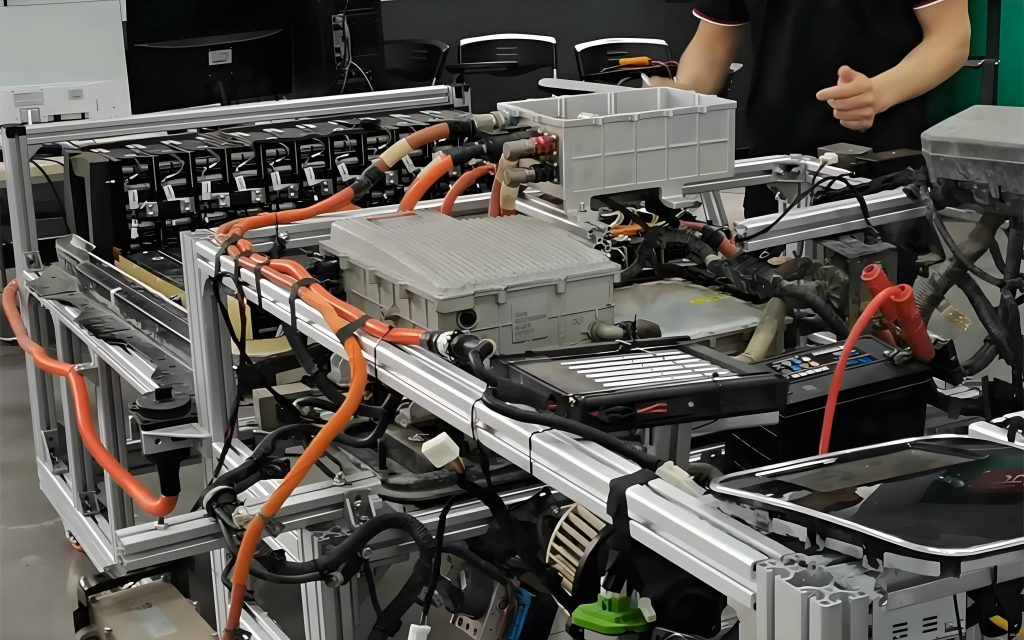
Maintenance Strategies for EV Power Battery Faults
Addressing faults in EV power batteries requires a proactive and systematic approach to EV repair. Drawing from my hands-on experience, I have developed several strategies that focus on prevention, detection, and remediation. These methods not only extend battery life but also enhance safety and performance in electrical car repair. Below, I outline key strategies, incorporating tables and formulas to guide implementation.
Developing Charging and Discharging Protocols
One of the most effective ways to prevent battery faults is through optimized charging and discharging protocols. In my electrical car repair practice, I recommend using deep charge-discharge cycles to potentially revive faded batteries, coupled with strict time controls to avoid overcharging. Implementing a smart charging management system with high-sensitivity sensors can monitor real-time parameters like voltage, current, and temperature, adjusting charging rates automatically. For instance, the system can slow down charging as the battery nears full capacity and alert users via mobile apps. This aligns with the goal of EV repair to maintain battery health. A common optimization strategy involves keeping the state of charge (SOC) between 20% and 80%, which minimizes stress on the battery. The SOC can be defined as:
$$ \text{SOC} = \frac{Q_{\text{current}}}{Q_{\text{max}}} \times 100\% $$
where \( Q_{\text{current}} \) is the current charge and \( Q_{\text{max}} \) is the maximum capacity. By tailoring protocols to battery type (e.g., lithium-ion) and environmental conditions, we can significantly reduce capacity fade and other issues in electrical car repair.
| Condition | Strategy | Expected Outcome |
|---|---|---|
| Normal Use | Maintain SOC between 20-80%, avoid fast charging | Prolonged battery life |
| High Temperatures | Reduce charging current, increase cooling | Prevent overheating and decay |
| Low Temperatures | Pre-heat battery, use slower charging rates | Improve ion conductivity |
| Aged Batteries | Periodic deep cycles under supervision | Partial capacity recovery |
Enhancing Thermal Management
Proper thermal management is critical for maintaining battery performance and preventing faults like internal short circuits. In EV repair, I emphasize regular inspections of cooling systems, including fans and heat sinks, to ensure they are free of dust and debris. Deploying an advanced thermal management system that controls temperature distribution across the battery pack can mitigate hotspots and uniform degradation. This system can use heating methods like PTC (Positive Temperature Coefficient) heaters or cooling techniques such as liquid cooling, depending on the situation. The heat transfer equation can guide this:
$$ \frac{\partial T}{\partial t} = \alpha \nabla^2 T + \frac{\dot{q}}{k} $$
where \( T \) is temperature, \( t \) is time, \( \alpha \) is thermal diffusivity, \( \dot{q} \) is heat generation rate, and \( k \) is thermal conductivity. Additionally, leveraging data analytics to track temperature trends allows for predictive maintenance in electrical car repair, enabling early detection of anomalies before they escalate into serious faults.
| Technique | Application | Benefits |
|---|---|---|
| Air Cooling | Use fans for heat dissipation | Cost-effective for mild conditions |
| Liquid Cooling | Circulate coolant through channels | Efficient heat removal, suitable for high loads |
| Phase Change Materials | Absorb and release heat during transitions | Stable temperature maintenance |
| Data-Driven Monitoring | Analyze historical temperature data | Predictive fault prevention |
Inspecting Charging Interfaces and Circuits
Charging faults often originate from issues with interfaces and circuits, making thorough inspections a cornerstone of electrical car repair. I advise performing visual checks on charging connectors for signs of looseness, corrosion, or contamination. If problems are found, cleaning with appropriate tools or replacing components may be necessary. Circuit inspections should include continuity tests using multimeters to measure resistance and identify shorts or breaks. For example, a resistance value significantly below standards indicates a potential short circuit. Furthermore, testing the synergy between charging equipment and the BMS is vital; this involves verifying communication links and parameter alignment in a controlled environment. The power loss in a circuit can be calculated as:
$$ P_{\text{loss}} = I^2 R $$
where \( I \) is current and \( R \) is resistance. By ensuring all connections are secure and functional, we can resolve common charging issues and enhance the reliability of EV repair procedures.
| Step | Action | Tools Required |
|---|---|---|
| 1. Visual Inspection | Check connectors for damage or dirt | Magnifying glass, cleaning tools |
| 2. Continuity Test | Measure circuit resistance with multimeter | Multimeter, test leads |
| 3. BMS Verification | Test communication with charging device | Diagnostic scanner, software |
| 4. Functional Testing | Simulate charging under various conditions | Power supply, load tester |
Examining Battery Pack Exterior and Selecting Repair Methods
For insulation faults and physical damage, inspecting the battery pack exterior is a crucial step in EV repair. I recommend looking for deformations, cracks, or signs of leakage, which could indicate internal issues. If damage is minor, repairs might involve reshaping the pack and applying protective coatings; for severe cases, such as electrolyte leaks, replacing individual cells or the entire pack may be necessary. Safety is paramount here, so only trained professionals should handle high-voltage components. In cases of insulation failure, using an insulation resistance tester can pinpoint leakage points, and repairs may include rewinding windings or replacing faulty parts. The repair decision can be based on a risk assessment model:
$$ \text{Risk Score} = \text{Severity} \times \text{Likelihood} $$
where severity and likelihood are rated on a scale. Post-repair, functional tests should be conducted to verify performance, ensuring that the battery meets safety standards. This methodical approach minimizes risks in electrical car repair and restores battery integrity.
| Condition | Repair Method | Safety Precautions |
|---|---|---|
| Minor Deformation | Reshape and coat with protective paint | Wear insulated gloves, work in dry area |
| Cracks or Leaks | Replace affected cells or entire pack | Disconnect power, use containment measures |
| Insulation Failure | Rewind or replace components, test resistance | Use certified tools, verify isolation |
Implementing Quality Control and Performance Tracking
Long-term reliability in EV power batteries hinges on rigorous quality control and continuous performance monitoring. From an EV repair perspective, I advocate for stringent standards during battery production, including the use of high-quality materials and advanced manufacturing techniques. Post-production, each battery should undergo testing for parameters like capacity, cycle life, and environmental resilience. Establishing a traceability system allows for accountability, where any defects can be linked back to specific production batches. Moreover, implementing a performance tracking system that logs real-time data on voltage, current, and usage patterns enables predictive maintenance. The overall quality index \( Q \) can be modeled as:
$$ Q = \sum_{i=1}^{n} w_i x_i $$
where \( w_i \) are weights and \( x_i \) are performance metrics. This proactive approach in electrical car repair helps identify potential faults early, allowing for timely interventions and reducing downtime for EV owners.
| Measure | Description | Impact on Reliability |
|---|---|---|
| Material Selection | Use high-purity electrodes and electrolytes | Reduces internal defects |
| Production Testing | Validate capacity, cycle life, and safety | Ensures compliance with standards |
| Traceability System | Assign unique IDs to track batches | Facilitates recalls and improvements |
| Performance Monitoring | Collect and analyze operational data | Enables predictive maintenance |
Conclusion
In summary, the maintenance of EV power batteries is a complex yet essential aspect of electric vehicle ownership and repair. Through my experience in EV repair and electrical car repair, I have highlighted common faults such as capacity fade, internal short circuits, charging issues, and insulation failures, along with practical strategies to address them. By adopting preventive measures like optimized charging protocols, enhanced thermal management, thorough inspections, and robust quality control, we can significantly improve battery longevity and safety. The integration of mathematical models and structured tables in this discussion provides a foundation for technicians and enthusiasts to apply these concepts effectively. As the EV industry continues to evolve, ongoing research and collaboration in electrical car repair will drive innovations that make electric vehicles more reliable and accessible. Ultimately, this commitment to excellence in maintenance not only benefits individual users but also contributes to a sustainable future for transportation.