
As the global market for electric vehicles (EVs) continues to expand rapidly, the significance of insulation faults in these vehicles has become increasingly apparent. Insulation failures can lead to degraded electrical system performance and, in severe cases, cause short circuits, fires, and pose serious risks to passenger safety. Therefore, a thorough examination of insulation fault types, diagnostic methods, and repair strategies is essential for ensuring the reliability of electric vehicles and safeguarding occupants. In this analysis, I will explore insulation fault diagnosis and repair techniques to enhance maintenance outcomes and promote safe EV operation. The field of EV repair demands precise methodologies to address these challenges effectively, and electrical car repair practices must evolve to incorporate advanced diagnostic tools.
Insulation faults in electric vehicles manifest in various forms, including diminished electrical insulation performance, aging of insulation materials in high-voltage components, and insulation damage due to manufacturing defects or environmental factors. These faults can directly impact vehicle safety; for instance, insulation failure in the battery management system might trigger short circuits or even thermal runaway, endangering passengers. Thus, effective diagnosis is crucial to mitigate potential hazards and maintain operational integrity. In my experience with EV repair, identifying these issues early through systematic approaches is key to preventing catastrophic failures.
Types of Insulation Faults in Electric Vehicles
In electric vehicles, insulation faults can be categorized into four primary types, each with distinct characteristics and implications for electrical car repair. First, electrical insulation performance degradation often results from prolonged use or environmental exposure, leading to reduced insulation resistance and increased short-circuit risks. Second, high-voltage component insulation aging occurs in parts like power batteries and motor controllers, where materials deteriorate under high loads, temperatures, and pressures. Third, insulation damage arises from manufacturing flaws—such as uneven insulation thickness or cracks—or external factors like collisions and abrasions. Fourth, design deficiencies or inappropriate material selection can cause insulation to fail under extreme conditions, such as high humidity or temperature fluctuations. These fault types not only compromise safety but also elevate the complexity and cost of EV repair. For example, in many cases of electrical car repair, I have observed that undetected insulation aging in battery systems can propagate to other components, necessitating comprehensive overhauls.
To summarize these fault types, the following table provides an overview of common insulation issues, their causes, and potential impacts on EV operation. This is instrumental in streamlining diagnostic processes in EV repair.
| Fault Type | Primary Causes | Potential Impacts |
|---|---|---|
| Electrical Insulation Degradation | Long-term use, environmental exposure | Increased short-circuit risk, system failure |
| High-Voltage Component Aging | High loads, temperature extremes | Reduced insulation resistance, thermal events |
| Insulation Damage | Manufacturing defects, external impacts | Direct exposure to high voltage, safety hazards |
| Design or Material Flaws | Inadequate standards, material incompatibility | Performance drop under extreme conditions |
Understanding these categories is fundamental to developing effective EV repair protocols. For instance, the insulation resistance $R_{ins}$ can be modeled using the formula derived from material properties: $$R_{ins} = \frac{\rho \cdot L}{A}$$ where $\rho$ is the resistivity of the insulation material, $L$ is the length of the insulating path, and $A$ is the cross-sectional area. In electrical car repair, measuring $R_{ins}$ helps quantify degradation levels and prioritize maintenance actions.
Diagnostic Techniques for Insulation Faults
Accurate diagnosis of insulation faults is a cornerstone of reliable EV repair, encompassing both electrical and non-electrical methods. These techniques enable technicians to detect issues early, reducing downtime and enhancing safety in electrical car repair operations.
Electrical Detection Methods
Electrical approaches are widely used in EV repair for their precision and direct applicability to vehicle systems. Two prominent methods include voltage drop analysis and current injection, both rooted in fundamental electrical principles.
Voltage Drop Method
The voltage drop method is a common electrical detection technique in EV repair, based on Ohm’s law. By applying a constant current to a circuit and measuring the voltage drop across it, technicians can calculate the resistance and assess insulation integrity. For example, a significant increase in voltage drop may indicate insulation wear or damage, signaling potential faults. In practice, I use specialized voltage drop testers set to specific current levels to ensure accurate identification. The relationship is given by: $$V = I \cdot R$$ where $V$ is the voltage drop, $I$ is the applied current, and $R$ is the resistance. If $R$ rises due to insulation issues, $V$ increases correspondingly, highlighting areas for intervention in electrical car repair.
To improve diagnostic accuracy, I incorporate temperature and humidity compensation into the voltage drop model. For instance, insulation resistance often decreases with temperature, which can be accounted for using the Arrhenius equation: $$R(T) = R_0 \cdot e^{\frac{E_a}{k} \left( \frac{1}{T} – \frac{1}{T_0} \right)}$$ where $R(T)$ is the resistance at temperature $T$, $R_0$ is the reference resistance at $T_0$, $E_a$ is the activation energy, and $k$ is Boltzmann’s constant. By integrating such models with data analytics, I can analyze trends from multiple tests, identify fault patterns, and optimize EV repair strategies. The table below compares key parameters in voltage drop applications for electrical car repair.
| Parameter | Typical Range | Impact on Diagnosis |
|---|---|---|
| Applied Current (I) | 1-10 mA | Higher currents improve sensitivity but risk damage |
| Voltage Drop (V) | 0.1-5 V | Larger drops indicate higher resistance and potential faults |
| Insulation Resistance (R) | >1 MΩ for safety | Values below threshold require immediate EV repair |
Current Injection Method
Current injection is another vital technique in EV repair, leveraging electromagnetic principles to evaluate insulation by injecting a known current into a circuit and analyzing the resulting voltage drop or power loss. This method excels at detecting high-impedance faults, even minor insulation declines. For example, when assessing the battery management system, I inject a controlled current into the battery loop and measure voltage changes at various points. According to Ohm’s law, anomalous voltage drops suggest insulation problems, with precision reaching milliohm levels. The power loss $P$ due to insulation faults can be expressed as: $$P = I^2 \cdot R_{fault}$$ where $I$ is the injected current and $R_{fault}$ is the fault resistance. In electrical car repair, this allows for precise localization of issues, such as in motor windings or cable harnesses, enhancing the efficiency of EV repair procedures.
Non-Electrical Detection Technologies
Non-electrical methods complement electrical approaches in EV repair by providing non-invasive insights into insulation health. Technologies like infrared thermography and ultrasonic detection are invaluable for early fault detection without direct contact.
Infrared Thermography
Infrared thermography plays a critical role in non-electrical detection for EV repair, enabling contactless monitoring of temperature distributions in electrical systems. By identifying hotspots, I can quickly locate insulation faults. For instance, in battery management systems, connectors or cables with increased resistance due to insulation degradation often exhibit localized heating. Using an infrared thermal imager, I capture real-time temperature anomalies with over 95% accuracy, significantly boosting diagnostic efficiency in electrical car repair. Moreover, integrating this data into health management platforms allows for predictive maintenance through historical comparisons and trend analysis. The Stefan-Boltzmann law relates to this: $$P = \epsilon \sigma A T^4$$ where $P$ is the radiated power, $\epsilon$ is emissivity, $\sigma$ is Stefan-Boltzmann constant, $A$ is area, and $T$ is temperature. By setting temperature thresholds, the system alerts me to potential insulation issues before they escalate, prolonging the lifespan of EV components and streamlining EV repair workflows.
Ultrasonic Detection Technology
Ultrasonic detection is a non-destructive method in EV repair that uses high-frequency sound waves to identify local discharges, cracks, or internal defects in insulation. For example, minor cracks in drive motor insulation emit ultrasonic signals due to partial discharges, enabling early warnings. In practice, I place ultrasonic sensors on charging interfaces or cables to monitor for abnormal signals during operation. If detected, I can pinpoint the fault promptly, avoiding insulation failure and associated risks. To enhance detection, I combine ultrasonic data with signal processing algorithms and machine learning, building a fault特征库 that improves over time. The sound pressure level $SPL$ in decibels can be modeled as: $$SPL = 20 \log_{10} \left( \frac{p}{p_0} \right)$$ where $p$ is the sound pressure and $p_0$ is the reference pressure. This approach refines the identification of complex insulation problems in electrical car repair, making EV repair more proactive and reliable.
Repair Techniques for Insulation Faults
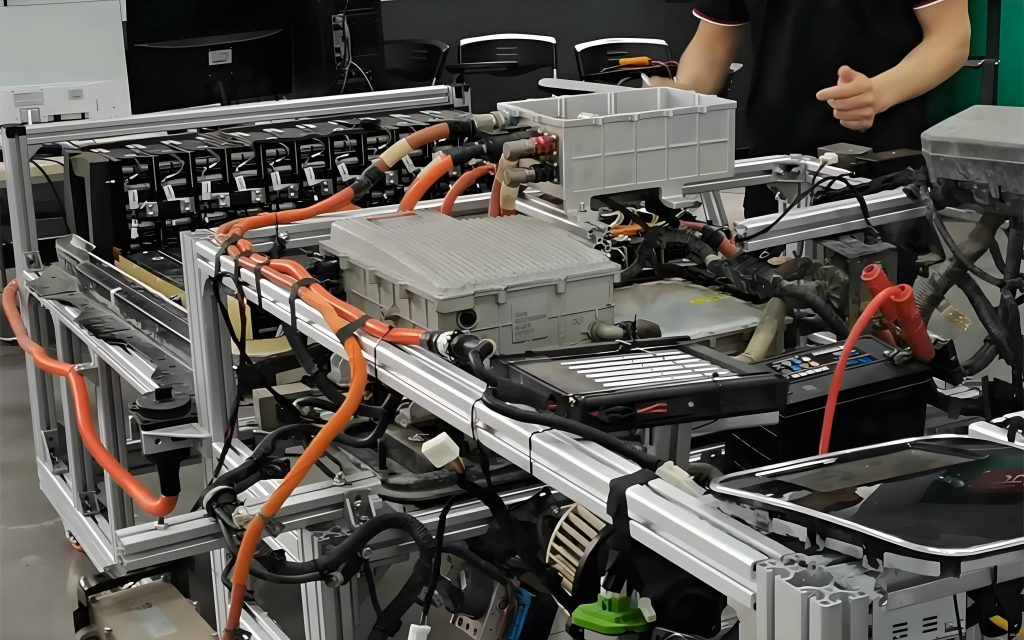
Effective repair of insulation faults is essential for maintaining EV safety and performance. In my work with EV repair, I focus on methods like insulation resistance testing and localization, high-voltage harness and connector maintenance, and battery system repairs, all tailored to address specific fault causes in electrical car repair.
Insulation Resistance Testing and Localization
Insulation resistance testing is a foundational aspect of EV repair, based on electrical measurements and data analysis. The insulation resistance $R_{ins}$ is a key indicator of electrical system health, typically measured using specialized testers that apply a voltage and measure the resulting current. According to Ohm’s law: $$R_{ins} = \frac{V}{I}$$ where $V$ is the applied voltage and $I$ is the leakage current. During testing, I ensure consistent conditions to avoid errors, such as using calibrated equipment and following safety protocols. Once $R_{ins}$ is obtained, I compare it to thresholds—for instance, values below 1 MΩ often indicate faults—and use additional methods like infrared or ultrasonic detection to pinpoint locations. This systematic approach is crucial in electrical car repair for accurate fault isolation.
For repair, I follow a step-by-step process: first, I secure the vehicle by disconnecting high-voltage power and using protective gear like insulated gloves. Next, I connect the insulation resistance tester to the circuit, set an appropriate test voltage (e.g., 500 V to 1000 V) and duration, and record results. If $R_{ins}$ is low, I analyze the data to locate the fault and undertake repairs, such as replacing insulation materials or fixing damaged sections. After repairs, I retest to verify resolution, ensuring the vehicle’s electrical safety. The table below outlines key steps in insulation resistance testing for EV repair.
| Step | Action | Considerations |
|---|---|---|
| 1 | Disconnect high-voltage power | Ensure safety with insulated tools and gear |
| 2 | Connect tester and set parameters | Use voltages that penetrate insulation without damage |
| 3 | Measure and record $R_{ins}$ | Compare to standards; values <1 MΩ require action |
| 4 | Locate fault using supplementary methods | Integrate IR thermography or ultrasonic data |
| 5 | Perform repairs and retest | Confirm $R_{ins}$ restoration to safe levels |
High-Voltage Harness and Connector Maintenance
In EV repair, high-voltage harnesses and connectors are common sources of insulation faults, requiring diligent inspection and repair. Typical issues include harness aging, connector loosening or corrosion, physical damage from impacts, and design flaws. For example, aged harnesses may have cracked insulation, increasing short-circuit risks, while loose connectors can lead to poor contact and insulation degradation. In electrical car repair, I address these through targeted methods: for aging harnesses, I replace them with materials meeting safety standards, ensuring proper routing to avoid abrasion. For loose or corroded connectors, I tighten them with suitable tools and clean surfaces with specialized agents to restore conductivity. Damaged harnesses are repaired using compatible materials or replaced entirely if severe. If design defects are identified, I collaborate with manufacturers to implement improvements, such as redesigning layouts or upgrading connectors. This proactive maintenance reduces recurrence and enhances reliability in EV repair.
To illustrate common faults and solutions, the table below summarizes issues and repair actions in high-voltage components, emphasizing the importance of systematic approaches in electrical car repair.
| Common Fault | Repair Action | Outcome |
|---|---|---|
| Harness Aging | Replace with certified insulation materials | Restored insulation resistance and safety |
| Connector Loosening/Corrosion | Tighten and clean with appropriate agents | Improved contact and reduced resistance |
| Physical Damage | Patch or replace harness sections | Eliminated exposure to high voltage |
| Design Flaws | Redesign or upgrade components | Long-term prevention of insulation issues |
Battery System Insulation Fault Repair
Battery system insulation faults pose significant risks in electric vehicles, often stemming from aging insulation separators between cells or compromised battery enclosure seals allowing moisture ingress. In my experience with EV repair, these issues can lead to reduced insulation resistance and potential thermal runaway. For instance, separator aging may result from excessive charge-discharge cycles or high-temperature operation, while seal failures arise from material degradation or external impacts. To address this, I begin with comprehensive insulation resistance testing to identify fault locations and severity. Using the formula for parallel resistance in battery modules: $$\frac{1}{R_{total}} = \sum \frac{1}{R_i}$$ where $R_i$ represents the insulation resistance of individual cells, I can isolate problematic areas. Then, I employ techniques like infrared thermography to visualize hotspots or ultrasonic detection to find internal defects.
For repairs, I follow a structured process: if insulation separators are aged or damaged, I replace them with new, compliant materials. If battery seals are faulty, I reseal enclosures or replace them entirely. Throughout, I prioritize safety by working on de-energized systems and using protective equipment. After repairs, I retest insulation resistance to confirm restoration, ensuring the vehicle meets safety standards. This methodical approach is vital in electrical car repair to prevent recurrent issues and uphold EV reliability. The integration of these techniques underscores the evolution of EV repair into a data-driven discipline, where formulas and models guide decisions for optimal outcomes in electrical car repair.
Conclusion
Insulation faults represent a critical threat to the safe operation of electric vehicles, making a deep understanding of their types, diagnostic methods, and repair strategies indispensable for ensuring vehicle reliability and passenger safety. Electrical and non-electrical detection technologies play pivotal roles in diagnosing these faults, while techniques like insulation resistance testing, high-voltage harness maintenance, and battery system repairs provide effective solutions for mitigation. In my practice, I have found that combining these approaches with advanced modeling and data analytics enhances the precision and efficiency of EV repair. As the electric vehicle industry continues to grow, ongoing refinement of these methods will be essential for addressing emerging challenges in electrical car repair, ultimately fostering a safer and more sustainable transportation ecosystem. Through diligent application of these principles, EV repair can evolve to meet the demands of modern electric mobility, safeguarding both users and infrastructure.