
As the automotive industry shifts toward green development and transformation, electric vehicles (EVs) have emerged as a critical direction. The rapid growth of the EV sector has created an urgent demand for skilled professionals in EV repair and maintenance. Vocational institutions play a vital role in cultivating such talent, but the effectiveness of these programs hinges on the capabilities of instructors. In this context, we explore the importance of advancing instructor competencies in EV repair, identify existing challenges, and propose pathways for improvement within a work-study integration framework. This approach emphasizes hands-on experience, industry collaboration, and innovative teaching methods to bridge the gap between theoretical knowledge and practical application in electrical car repair.
The significance of enhancing instructor capabilities in EV repair cannot be overstated. High-quality instructors are the cornerstone of effective education, directly influencing the development of skilled technicians who can support the evolving EV industry. For instance, instructors must possess a deep understanding of core EV systems, such as battery management, motor control, and electronic diagnostics, to deliver comprehensive training. Without this, students may struggle to address real-world issues in electrical car repair, leading to a skills gap that hampers industry progress. Moreover, as EVs incorporate advanced technologies like autonomous driving and smart connectivity, instructors need to stay abreast of innovations to prepare learners for future challenges. We believe that by strengthening instructor competencies, vocational institutions can not only improve educational outcomes but also contribute to regional economic development by supplying the workforce needed for sustainable mobility solutions.
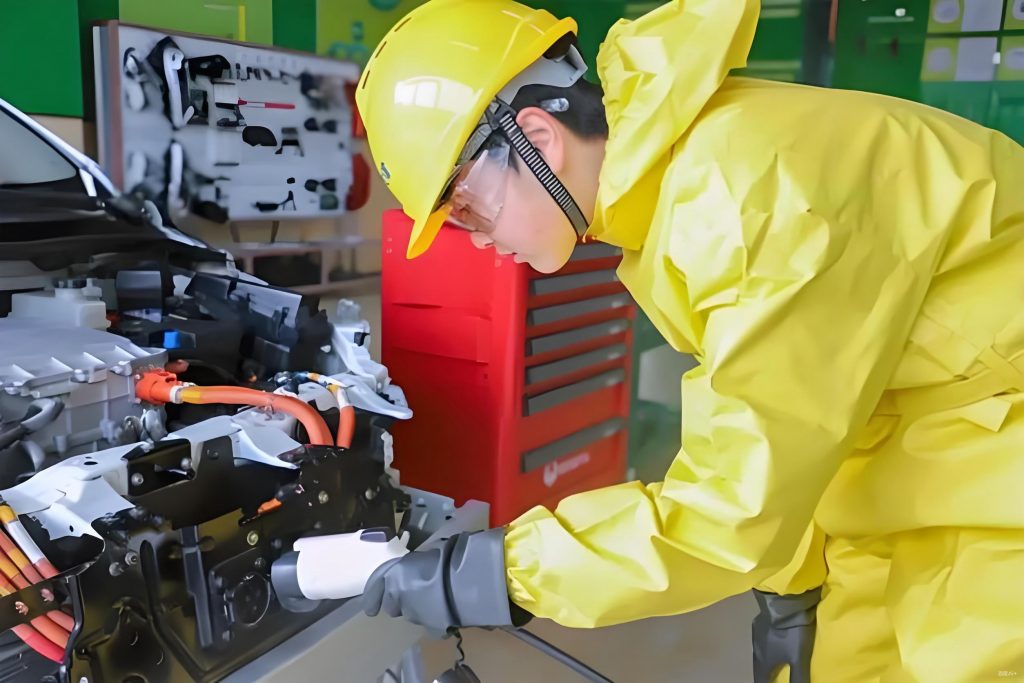
However, several challenges impede the development of EV repair instructor capacities. First, many instructors lack comprehensive expertise in key areas of EV technology. For example, a substantial portion of instructors come from traditional automotive or electrical backgrounds and may not have mastered specialized topics like lithium-ion battery diagnostics or high-voltage system safety. This knowledge gap can result in superficial teaching that fails to connect theory with practice in electrical car repair. Second, practical skills are often underdeveloped due to limited exposure to industry environments. Instructors who have not engaged in hands-on EV repair work may struggle to demonstrate complex procedures, such as troubleshooting motor controllers or performing battery pack rebalancing. This deficiency affects the quality of实训 (hands-on training) and reduces student confidence. Third, innovation awareness is frequently weak, with instructors adhering to outdated curricula and neglecting emerging trends like wireless charging or AI-driven diagnostics. This stagnation limits the ability to foster creativity and problem-solving skills essential for modern EV repair.
To quantify these challenges, consider the following table summarizing common issues and their impacts on EV repair education:
| Challenge | Description | Impact on EV Repair Training |
|---|---|---|
| Incomplete Knowledge | Gaps in understanding core EV systems (e.g., battery management, motor drives) | Reduced ability to teach diagnostics and safety protocols effectively |
| Practical Skill Deficits | Limited hands-on experience with EV components and repair techniques | Lower student proficiency in real-world electrical car repair tasks |
| Weak Innovation | Resistance to updating教学内容 with new technologies (e.g., smart grids, IoT) | Graduates ill-prepared for industry advancements in EV repair |
Addressing these issues requires a structured approach grounded in work-study integration. One effective pathway is fostering industry-education partnerships to build practical training bases. By collaborating with leading EV manufacturers and service centers, vocational institutions can establish state-of-the-art facilities equipped with real-world tools and scenarios. For instance, we have seen success in setting up实训 centers that simulate EV repair environments, allowing instructors to engage with actual components like battery modules and charging systems. These partnerships also enable the co-development of training projects based on genuine industry cases, such as diagnosing faults in electric drivetrains or optimizing energy efficiency. Through such initiatives, instructors gain valuable experience that enhances their teaching in electrical car repair, while students benefit from exposure to current practices. A key aspect of this is involving instructors in research and development projects, which broadens their perspectives and integrates cutting-edge knowledge into curricula.
Another critical element is deepening industry-education integration to create实战-oriented course systems. This involves aligning curriculum design with occupational standards and evolving industry needs in EV repair. We recommend a modular approach where courses blend foundational theory with practical modules focused on specific skills, such as battery testing or motor calibration. For example, a course on EV powertrain systems might include hands-on labs where students use diagnostic tools to measure parameters like voltage and current, applying formulas to assess performance. Consider the following equation for battery state of health (SOH), which is crucial in electrical car repair: $$ \text{SOH} = \frac{C_{\text{actual}}}{C_{\text{nominal}}} \times 100\% $$ where \( C_{\text{actual}} \) is the measured capacity and \( C_{\text{nominal}} \) is the original capacity. Incorporating such formulas into lessons helps bridge theory and practice. Additionally, updating courses with topics like smart charging and cybersecurity ensures relevance. The table below outlines a sample course structure for EV repair education:
| Course Module | Key Topics | Practical Applications in EV Repair |
|---|---|---|
| Battery Systems | Li-ion chemistry, BMS, safety protocols | Hands-on testing of battery packs for faults |
| Motor and Drivetrain | AC/DC motors, inverter diagnostics | Disassembly and repair of electric motors |
| Smart Technologies | Autonomous systems, connectivity | Simulating sensor-based diagnostics |
Implementing a “dual-mentor” system is also pivotal for cultivating dual-qualified instructors who excel in both theory and practice. This approach pairs academic instructors with industry experts, allowing for knowledge exchange and skill development. For instance, we have observed that when instructors undertake internships at EV repair shops, they learn firsthand about common issues like thermal management failures or software glitches. This experience can be encapsulated in formulas for fault probability, such as $$ P(f) = \lambda e^{-\lambda t} $$ where \( P(f) \) is the probability of a fault occurring over time \( t \), and \( \lambda \) is the failure rate derived from real data. By integrating such models into teaching, instructors make lessons more engaging and applicable. Moreover, inviting industry professionals to co-teach courses brings fresh insights into electrical car repair, fostering a dynamic learning environment. This mentorship model not only enhances instructor capabilities but also ensures that graduates are job-ready, capable of handling diverse challenges in EV repair.
In conclusion, advancing instructor competencies in EV repair through work-study integration is essential for meeting the demands of the growing electric vehicle industry. By addressing knowledge gaps, strengthening practical skills, and fostering innovation, vocational institutions can produce highly skilled technicians capable of supporting sustainable transportation. We emphasize the importance of continuous collaboration with industry, curriculum modernization, and mentorship programs to build a robust talent pipeline. As EVs evolve with technologies like solid-state batteries and V2X communication, instructors must remain adaptable, incorporating new findings and methods into their teaching. For example, future curricula might include advanced diagnostics using machine learning, where algorithms predict maintenance needs based on sensor data. Ultimately, by investing in instructor development, we can ensure that electrical car repair education keeps pace with industry advancements, driving economic growth and environmental sustainability. We encourage ongoing research and policy support to refine these pathways, ensuring that EV repair training remains relevant and effective in the years to come.