
In the context of global automotive industry evolution, the shift toward electrification has become an inevitable trend, driven by escalating environmental concerns and energy sustainability challenges. As a researcher engaged in this field, I have focused on the development of pure electric multi-purpose vehicles (electric MPV), which offer versatile functionality combining passenger comfort with cargo capacity. The electric MPV segment is gaining traction in markets worldwide due to its adaptability to family and commercial needs, and this study delves into optimizing its transmission system by integrating a two-speed reducer. This approach aims to enhance efficiency and performance while addressing the limitations of single-speed systems commonly used in electric vehicles. Through parameter matching, simulation, and experimental validation, this work provides a comprehensive analysis of the electric MPV传动系统, emphasizing the importance of component selection and system integration.
The rationale for focusing on an electric MPV stems from its growing market share and potential to reduce carbon emissions. Traditional internal combustion engine vehicles contribute significantly to pollution and resource depletion, whereas electric MPV models can leverage advanced powertrains to achieve cleaner mobility. In this study, I explore the传动系统 of a pure electric MPV equipped with a two-speed reducer, as it offers a balance between cost and performance. Multi-speed transmissions can improve motor efficiency by allowing operation in optimal ranges, but adding more gears increases complexity and expense. Thus, a two-speed reducer represents a practical compromise for current industrial capabilities. This research involves systematic parameter matching, key component selection, prototype development, and testing, with the goal of validating the design against predefined performance metrics.
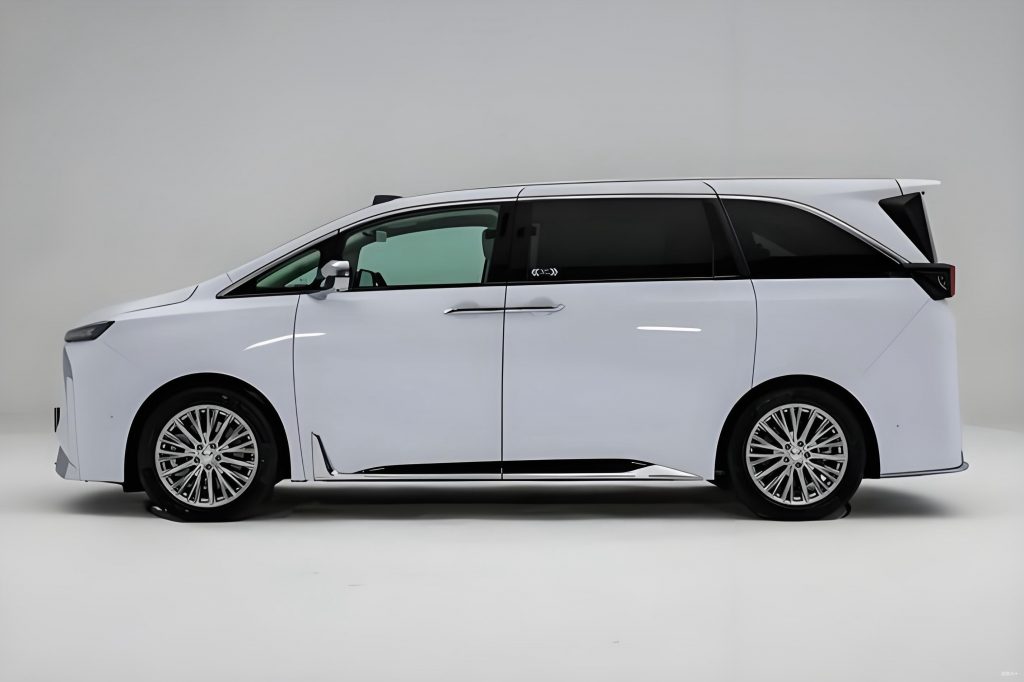
To begin, the parameter matching for the electric MPV传动系统 was conducted based on fundamental vehicle dynamics principles. The overall performance indicators, such as acceleration time, top speed, and driving range, were defined as targets. For instance, the electric MPV was required to achieve a 0-100 km/h acceleration time of less than 12 seconds, a top speed of 120 km/h, and a pure electric range exceeding 201 km. These parameters guided the selection of the battery, motor, and reducer. The power balance equation, derived from vehicle dynamics, was used to calculate the required drive power. This equation accounts for various resistances, including rolling resistance, gradient resistance, aerodynamic drag, and acceleration resistance. In mathematical terms, the power demand can be expressed as:
$$ P = \frac{1}{\eta_T} \left( \frac{mgf \cos \alpha \cdot u_a}{3600} + \frac{mg \sin \alpha \cdot u_a}{3600} + \frac{C_D A u_a^3}{76140} + \frac{\delta m u_a}{3600} \frac{du_a}{dt} \right) $$
Here, \( P \) represents the drive power in kW, \( m \) is the vehicle mass in kg, \( f \) is the rolling resistance coefficient, \( \alpha \) is the road gradient angle in radians, \( C_D \) is the drag coefficient, \( A \) is the frontal area in m², \( \delta \) is the rotational mass factor, \( u_a \) is the vehicle speed in km/h, and \( \eta_T \) is the transmission efficiency. For the electric MPV under consideration, key parameters were initialized as shown in the table below, which summarizes the vehicle’s characteristics essential for further calculations.
| Parameter | Value |
|---|---|
| Vehicle Mass (kg) | 1500 |
| Frontal Area (m²) | 2.52 |
| Drag Coefficient | 0.342 |
| Rolling Radius (mm) | 299 |
| Rolling Resistance Coefficient | 0.016 |
| Transmission Efficiency | 0.96 |
| Driving Range (km) | 210 |
Moving to the motor and two-speed reducer selection, the传动系统 must satisfy torque and speed requirements. The maximum transmission ratio for the first gear was determined based on the gradability requirement, ensuring the electric MPV can climb steep slopes. Similarly, the minimum ratio for the second gear was derived from the top speed condition. The formulas used are:
$$ i_{g \max} \geq \frac{mg (f \cos a_{\max} + \sin a_{\max}) r}{T_{e \max} \eta} $$
and
$$ i_{g \min} \leq \frac{3.6 \pi n_{\max}}{60 r V_{\max}} $$
where \( i_{g \max} \) and \( i_{g \min} \) are the maximum and minimum transmission ratios, \( a_{\max} \) is the maximum slope angle, \( r \) is the rolling radius, \( T_{e \max} \) is the maximum motor torque, \( n_{\max} \) is the maximum motor speed, and \( V_{\max} \) is the top speed. Calculations indicated that the reducer should have a maximum ratio greater than 8.76 and a minimum ratio less than 5.66. The motor specifications were then defined to meet these ratios, with requirements including a rated power over 30 kW, peak power over 90 kW, maximum output speed above 1065 rpm, and maximum torque exceeding 1570 N·m. After evaluating available options, a two-speed automated manual transmission (AMT) reducer and a high-performance motor were selected, as detailed in the following tables.
| Parameter | Value |
|---|---|
| Maximum Input Torque (N·m) | 235 |
| Maximum Input Speed (rpm) | 8900 |
| Gear Ratios | 9.05 / 5.52 |
| Parameter | Value |
|---|---|
| Voltage Level (V) | 360 |
| Rated Power (kW) | 48 |
| Maximum Power (kW) | 97 |
| Rated Torque (N·m) | 1078 |
| Peak Torque (N·m) | 2135 |
| Rated Speed (rpm) | 4380 |
| Maximum Speed (rpm) | 7200 |
The motor’s external characteristics curve illustrates its torque-speed relationship, which is crucial for simulating the electric MPV’s performance. This curve shows that the motor operates efficiently across a wide range, supporting the use of a two-speed reducer to maintain high efficiency during varying driving conditions. For the electric MPV, this combination ensures optimal power delivery and energy utilization.
Next, the battery system parameters were matched to provide sufficient energy for the desired driving range. The battery’s voltage and capacity are critical, as they directly influence the electric MPV’s range and power output. The energy consumption per kilometer under constant speed was calculated using:
$$ W = \frac{1}{\eta} \left( \frac{mgf}{3600} + \frac{C_D A u_a^2}{76140} \right) $$
where \( W \) is the energy consumption in kWh per km, and \( \eta \) is the overall system efficiency. Based on the New European Driving Cycle (NEDC) and a target range of 201 km, the battery energy requirement was found to be over 35.3 kWh. After considering market availability and integration feasibility, a lithium-ion battery pack was chosen, with specifications as follows.
| Parameter | Value |
|---|---|
| Cell Type | Lithium Nickel Manganese Cobalt Oxide |
| Rated Capacity (Ah) | 108 |
| Rated Energy (kWh) | ≥37.3 |
| Rated Voltage (V DC) | 345 |
| Total Weight (kg) | ≤330 |
| Rated Discharge Power (kW) | 50 |
| Maximum Discharge Power (kW) | 105 (for 20 seconds) |
With the components selected, simulation studies were conducted using specialized software to evaluate the electric MPV’s dynamic and economic performance. The simulation model incorporated the matched parameters to predict acceleration, gradability, and energy consumption. For dynamic performance, the 0-100 km/h acceleration was simulated, resulting in a time of 10.22 seconds with a gear shift at 85 km/h and a maximum speed of 143 km/h. The acceleration curve demonstrated smooth torque application and efficient power transition between gears. Additionally, the gradeability simulation showed that the electric MPV could achieve a maximum slope of 37% in first gear at a speed of 54 km/h, confirming the传动系统’s capability to handle steep inclines.
For economic performance, the NEDC was used to simulate energy consumption under standard driving conditions. The simulation involved varying gear-shift strategies to identify the optimal points for minimizing energy use. The results, summarized in the table below, indicate that shifting up at 50 km/h and down at 45 km/h yielded the lowest energy consumption of 17.61 kWh per 100 km. This optimization is vital for extending the range of the electric MPV and enhancing its practicality for daily use.
| Shift Speed (km/h) | Energy Consumption (kWh/100km) |
|---|---|
| 40 / 35 | 17.81 |
| 50 / 45 | 17.61 |
| 60 / 55 | 17.67 |
| 70 / 65 | 17.68 |
| 80 / 75 | 17.79 |
Following simulation, a prototype of the electric MPV was developed and subjected to rigorous testing to validate the theoretical findings. The prototype integration involved functional debugging of components such as the DC-DC converter, onboard charger, high-voltage distribution box, electric air conditioning, and electric power steering. Communication tests via Controller Area Network (CAN) ensured seamless interaction between the vehicle control unit and component controllers. The prototype, as depicted in the image, underwent dynamic and economic tests on a chassis dynamometer.
For dynamic testing, acceleration from 0 to 100 km/h was measured using data acquisition tools, yielding a time of 12.1 seconds from a standing start, with the actual acceleration phase taking 9.4 seconds after initial torque buildup. The gear shift occurred around 50 km/h, aligning with simulation predictions. This confirms that the electric MPV meets the target acceleration performance, demonstrating the effectiveness of the two-speed reducer in improving launch and mid-speed performance.
Economic testing involved running the electric MPV on the dynamometer under NEDC conditions while monitoring state of charge (SOC) and energy consumption. Over multiple cycles, the SOC decreased by approximately 5% per cycle, and from full charge to depletion, the vehicle achieved a range of 211 km with an energy consumption of 17.91 kWh per 100 km. These results closely match the simulation outcomes, validating the parameter matching process and component selection for the electric MPV.
In conclusion, this research underscores the viability of using a two-speed reducer in pure electric MPV传动系统 to enhance performance and efficiency. The parameter matching, simulation, and experimental validation collectively demonstrate that the selected components meet the predefined targets for acceleration, top speed, and range. The electric MPV represents a significant step toward sustainable transportation, and future work could focus on cost reduction and mass production adaptations. As the automotive industry evolves, the electric MPV segment is poised for growth, driven by consumer demand for versatile and eco-friendly vehicles. Continued innovation in传动系统 technology will further optimize the balance between performance, efficiency, and affordability in electric MPV applications.
Looking ahead, challenges in the electric MPV market include competition from SUVs and the need for higher comfort and configuration standards. However, the integration of advanced transmission systems like the two-speed reducer can provide a competitive edge. This study contributes to the broader effort of electrifying the automotive sector, highlighting the importance of tailored传动系统 designs for specific vehicle types such as the electric MPV. Through ongoing research and development, the electric MPV can achieve greater market penetration, supporting global goals of reduced emissions and energy independence.