
As electric vehicles (EVs) become increasingly widespread, uncoordinated charging behaviors pose significant challenges to the safety and economic operation of power grids. Vehicle-to-Grid (V2G) technology enables bidirectional energy flow between EVs and the grid, transforming EVs into mobile distributed energy storage units. This capability provides flexible regulation potential for grid support. In this article, I explore a load regulation model for V2G-enabled EV charging stations based on real-time grid state perception. The model centers on a multi-level collaborative intelligent regulation platform, utilizing spatiotemporal coupling algorithms and user-demand-driven mechanisms to optimize energy allocation while ensuring grid stability and user satisfaction. By addressing key issues such as bidirectional power dynamics and dispersed resources, this approach aims to facilitate the large-scale integration of V2G technology into modern power systems.
The traditional time-of-use pricing model for EV charging stations primarily supports unidirectional energy flow, which fails to fundamentally resolve core grid issues like peak-valley differences and local equipment overloads. V2G technology, leveraging the bidirectional discharge capability of modern EVs, allows energy to flow from vehicles back to the grid. This transforms EV charging stations into interactive nodes that can adjust charging and discharging behaviors dynamically based on grid conditions and user needs. However, maximizing energy distribution efficiency and user satisfaction under constraints such as grid safety, charging network distribution, and investment budgets remains a critical research focus. My investigation focuses on developing a regulation methodology that integrates grid state awareness to manage the load of V2G-enabled EV charging stations effectively.
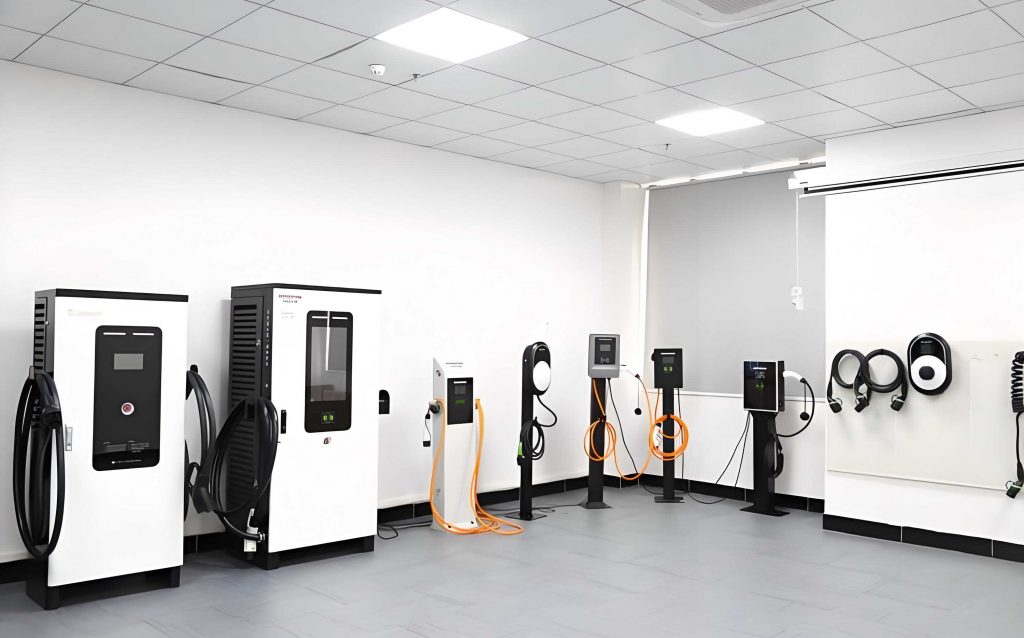
The core of V2G-enabled EV charging stations lies in facilitating bidirectional energy exchange between EVs and the power grid. When the grid supplies power to a vehicle, the EV charging station employs a high-efficiency four-quadrant converter composed of fully controlled power devices. This converter uses advanced modulation algorithms to convert AC to DC efficiently, while also possessing inversion capabilities. During grid support scenarios, the EV charging station can invert the vehicle’s DC power into AC power that matches the grid’s frequency and phase, enabling reverse power flow. This provides ancillary services such as peak shaving and frequency regulation to the grid district. The intelligent controller within the EV charging station acts as the key hub for load regulation. It interacts with grid dispatch centers or aggregator platforms via communication modules, collecting real-time data on grid status, battery state, and user parameters. Based on grid demands, electricity prices, and user strategies, the controller dynamically regulates charging and discharging power through the converter, establishing a distributed storage network that fosters interaction between the grid and EV resources.
Unlike conventional EV charging stations with unidirectional power draw, V2G loads exhibit dual characteristics of both source and load, with power direction and magnitude adjustable according to grid requirements. The load demonstrates significant temporal concentration, as user behavior patterns lead to high charging demand during evening to night hours, overlapping with grid peak periods and creating sharp load peaks. Discharge resources, however, are constrained by factors such as vehicle dwell time and state of charge (SOC), resulting in limited utilization windows. Another critical feature of V2G-enabled EV charging station loads is their highly dispersed and uneven spatial distribution. Numerous EV charging stations are deeply embedded in low-voltage grid districts, with geographical distribution often mismatched with local grid demands. Load states exhibit strong randomness and heterogeneity, as parameters like vehicle connection time, duration, current SOC, maximum charging/discharging power, user travel needs, and battery state of health (SOH) vary individually and over time. Consequently, V2G loads represent a new type of grid-interactive load with both flexible resource value and regulatory complexity. Efficient management requires overcoming technical bottlenecks in bidirectional power coordination, spatiotemporal resource matching, and multi-constraint collaborative optimization.
| Characteristic | Description | Impact on Grid |
|---|---|---|
| Temporal Concentration | High charging demand during evening peaks, discharge limited by SOC and dwell time | Increases peak load volatility |
| Spatial Dispersion | Widespread distribution in residential, commercial, and office areas | Causes local resource mismatches |
| Randomness and Heterogeneity | Variations in SOC, power limits, user behavior, and SOH | Complicates prediction and control |
| Bidirectional Power Flow | Acts as source or load based on grid signals | Offers flexibility but requires precise regulation |
The dynamic regulation of bidirectional power in V2G systems is highly complex due to the mobile nature of EVs as distributed storage units. The timing, location, and duration of grid connection are determined by user behavior, leading to massive data volumes and multiple constraints. On one hand, significant differences in SOC, maximum allowable charging/discharging power, SOH, and user behavior among vehicles mean that the regulatory capacity each vehicle can provide is time-varying. On the other hand, the grid state itself is dynamic, including local node voltage levels, line power flow distribution, system frequency, and real-time electricity prices. When numerous EV charging stations engage in charging and discharging simultaneously, the grid must handle diverse energy changes and process vast data exchanges, which can easily impact operational stability. Therefore, the V2G regulation system must process large-scale data and comprehensively evaluate multiple constraints at millisecond-level time scales to identify optimal allocation patterns.
The load regulation system for V2G-enabled EV charging stations must real-time regulate the charging and discharging states and power of numerous units while strictly meeting multidimensional requirements such as grid operation, vehicle battery safety, and user travel needs. The entire energy flow process requires seamless coordination across “data-decision-execution-guarantee” links. Failure in any环节 could lead to deviations in regulatory指令 execution, damage to user interests, or even local grid collapse. Thus, the system needs not only powerful data processing capabilities and high-reliability, low-latency communication but also fault tolerance and self-healing capabilities across all links, along with multi-dimensional risk预警 and collaborative control abilities.
Conflicts between charging and discharging demands arise from the dual attributes of EVs. Vehicle owners typically expect their EVs to replenish energy quickly after connecting to an EV charging station and reach the desired SOC by a预设 departure time to meet travel mileage needs, essentially safeguarding the vehicle’s mobility attribute. The grid, however, expects to maximize the use of vehicle power resources during peak demand periods to support grid operation or utilize vehicle charging during off-peak hours to absorb excess power, reflecting the use of the vehicle as a static storage unit. These two attributes often struggle to align perfectly in time, space, and energy dimensions. To resolve conflicts between owner charging demands and grid dispatch requirements, V2G-enabled EV charging stations must fulfill three key elements: high-precision execution capability to precisely control power flow direction and ensure charging/discharging power strictly matches grid dispatch instructions; rapid response capability to process information and make decisions instantly, adjusting operational strategies based on dynamic factors like grid signals, vehicle conditions, and user preferences; and high reliability, with stable, low-latency communication to ensure secure, accurate, and continuous data exchange between the EV charging station and grid dispatch systems or management platforms. These three key characteristics collectively form the core capability of V2G-enabled EV charging stations to effectively coordinate owner needs and grid dispatch requirements, satisfying charging/discharging demands while significantly improving the rationality of power distribution.
The dispersed distribution of massive charging resources is a core difficulty in regulating the load of V2G-enabled EV charging stations. Numerous EV charging stations are not concentrated in specific areas or sites but are widely distributed across end-user locations of the urban distribution network, such as residential areas, workplaces, and commercial centers. This deep dispersion directly leads to two key problems: grid stability issues due to complex energy flows, as大量 EVs charging simultaneously introduce intricate power patterns, and the grid processing extensive charging information can easily affect stability; and fragmentation of charging resources, as numerous dispersed EV charging stations operate in varied environments, with incomplete key data on operational status, available capacity, and response capability. These data may also experience delays or loss due to network bottlenecks during transmission. Such low-quality, fragmented data难以 support global precise scheduling.
V2G load regulation is essentially a complex system control problem that achieves multi-objective real-time collaborative optimization in a highly distributed and dynamic resource environment. The core challenge lies in efficiently aggregating and coordinating massive, dispersed, and heterogeneous EV resources to address local grid overloads or fluctuations while meeting diverse user charging needs. This requires the system to possess high-reliability, high-precision, low-latency全域 perception capabilities,实时精准 obtaining the spatiotemporal distribution status, available capacity, and user constraints of all V2G resources network-wide. Building on this, the system must rely on rapidly responsive intelligent decision-making mechanisms to achieve precise matching between vehicles and grid real-time regulation demands in spatiotemporal dimensions under the premise of meeting users’ core charging needs and minimizing travel impact, effectively resolving local resource mismatch contradictions, and ultimately ensuring the safe and economic operation of the distribution network.
To address the issue of dispersed V2G resources, a multi-level collaborative intelligent regulation platform can be constructed. The platform adopts a “cloud-edge-end” multi-level collaborative architecture. Specifically, at the cloud level, based on wide-area measurement systems to obtain macro grid states, and supported by cloud computing technology, a medium- to long-term dispatch model is built. This model, with grid safety, stability, and economic operation as core objectives, combines predictions of vehicle群体 behavior to generate day-ahead or intra-day charging/discharging power guidance curves for various distribution sub-regions. At the edge layer, edge controllers with local computing capability are deployed. They can receive regulation targets from the cloud in real-time, while integrating data such as key node voltages, line currents, transformer load rates, and real-time status of distributed resources in the distribution台区, and perform preprocessing, storage, and intelligent analysis applications on them, reducing latency and network congestion. The edge layer embeds fast rolling algorithms that, under strict compliance with distribution network safety requirements, refine cloud targets into real-time charging/discharging instructions for each V2G-enabled EV charging station within the control area and handle local emergencies. At the terminal layer, V2G intelligent EV charging stations act as execution units, receiving and executing power instructions from the edge layer, while实时 monitoring key vehicle battery parameters and user预设 constraints to ensure the execution process does not exceed safety boundaries, and feeding back execution status to the edge layer.
The platform achieves three-level interaction through high-speed communication networks: the cloud provides global optimization guidance, the edge layer addresses local constraint issues, and the terminal layer ensures precise execution. This hierarchical architecture effectively分散 computing负担, reduces communication dependency, enhances rapid response capability to local grid state changes, and provides technical support for the spatiotemporal collaborative optimization regulation of massive dispersed V2G resources.
| Level | Role | Key Functions |
|---|---|---|
| Cloud | Global Optimization | Macro grid state perception, medium-long term scheduling, power guidance curves |
| Edge | Local Coordination | Real-time data processing, fast rolling algorithms, emergency handling |
| End (EV Charging Station) | Precise Execution | Power instruction execution, safety monitoring, status feedback |
To fully leverage the effectiveness of the multi-level regulation platform, an advanced spatiotemporal coupling charging/discharging collaborative algorithm is needed to schedule massive dispersed V2G resources. This algorithm deeply integrates temporal and spatial constraints, overcoming the limitations of traditional processing methods. Specifically, the algorithm comprises three core modules. The first is the temporal coordination module, which primarily functions to精细 depict the dynamic change process of loads, establishing a millisecond-level multi-time scale rolling optimization framework. This module comprehensively considers grid load prediction curves, time-of-use electricity price signals, vehicle connection/disconnection times, SOC change trends, etc., to dynamically optimize the overall charging/discharging power targets of V2G clusters in different time periods, achieving objectives such as peak shaving, valley filling, fluctuation smoothing, and energy cost reduction. The second is the spatial coordination module, focusing on solving the problem of matching resource distribution with grid demands, embedding precise distribution network topology models, line parameters, capacity limits, and key node voltages into the optimization process. The algorithm ensures that at any调度时段, all V2G charging/discharging behaviors on each distribution台区 or line node do not cause grid violations by constructing network constraints based on DistFlow power flow equations. The third is the spatiotemporal coupling module, integrating temporal objective functions, spatial safety constraints, and massive vehicle individual constraints into a multi-dimensional, nonlinear deep learning model.
To meet real-time computation requirements, efficient solving strategies can be employed: on one hand, applying model predictive control principles to solve finite steps within a rolling time window, using feedback to correct prediction errors; on the other hand, designing distributed optimization algorithms that decompose the global problem into subproblems for the cloud, edge layer, and V2G charging station terminals to solve in parallel, then achieving global optimal or suboptimal solutions through coordination variables.
The optimization objective for the spatiotemporal coupling algorithm can be formulated as follows. Let \( P_{i,t} \) represent the charging (positive) or discharging (negative) power of EV charging station \( i \) at time \( t \). The goal is to minimize the total cost while satisfying constraints:
$$ \min \sum_{t=1}^{T} \left[ C_t^{\text{grid}} \left( \sum_{i=1}^{N} P_{i,t} \right) + \sum_{i=1}^{N} C_i^{\text{battery}} (P_{i,t}) \right] $$
subject to:
- Grid constraints: \( V_{\min} \leq V_{j,t} \leq V_{\max} \) for all nodes \( j \) and times \( t \), where \( V_{j,t} \) is the voltage at node \( j \).
- EV charging station constraints: \( P_{i,\min} \leq P_{i,t} \leq P_{i,\max} \), and SOC dynamics: \( \text{SOC}_{i,t+1} = \text{SOC}_{i,t} + \frac{\eta_i P_{i,t} \Delta t}{E_i} \), where \( \eta_i \) is efficiency, \( E_i \) is battery capacity, and \( \Delta t \) is time step.
- User需求 constraints: \( \text{SOC}_{i,T_{\text{depart}}} \geq \text{SOC}_{\text{target},i} \), ensuring the SOC meets the user’s target by departure time.
In the V2G framework, a user-demand-based charging/discharging mechanism plays a crucial role as an effective supplement to grid-state-aware V2G regulation. It focuses on addressing the potential grid impact caused by large-scale unidirectional EV charging behaviors and creating smoother initial conditions for subsequent V2G bidirectional regulation. The core of this mechanism lies in intelligently scheduling charging times and power to optimize the distribution of charging loads over the time axis while respecting user travel needs. In specific implementation, the system first collects and predicts user charging/discharging demands, including vehicle expected disconnection time, target SOC, and other information. Based on these personalized demand constraints, combined with grid-side information such as regional load forecasts, time-of-use electricity prices, renewable energy output curves, and local network capacity margins, an optimization model is constructed with objectives like peak shaving, valley filling, reducing energy costs, and alleviating network congestion. The algorithm calculates the optimal charging start time for connected vehicles, ensuring the rigid constraint that the user’s vehicle reaches the target SOC by the预设 disconnection time, while尽可能 guiding the charging process to grid load valley periods and avoiding concentrated charging during grid脆弱时段 or in network capacity-constrained areas. For example, for vehicles connected at night and departing the next morning with a target SOC of 80%, the algorithm can schedule their charging to complete during the late-night to early-morning off-peak hours, avoiding the evening residential electricity peak; for vehicles parked for long periods during the day at workplaces with high SOC, the system can guide them to discharge during午间 load peak periods based on real-time grid status and demands. Unlike traditional charging methods that only consider the grid side or are based on simple time delays, this mechanism deeply embeds user demand constraints as optimization boundaries, ensuring the feasibility of charging scheduling. Its execution relies on the communication and control capabilities of intelligent EV charging stations and the local computing capability of edge computing nodes,实时 responding to grid state changes and fine-tuning charging plans.
The user-demand mechanism can be formalized as an optimization problem. Let \( T_{\text{start},i} \) be the charging start time for EV charging station \( i \), and \( T_{\text{depart},i} \) the departure time. The charging power \( P_{i,t} \) is scheduled to minimize grid impact:
$$ \min \sum_{t=1}^{T} \left( L_t + \sum_{i=1}^{N} P_{i,t} \right)^2 $$
where \( L_t \) is the base load at time \( t \), subject to:
- \( \sum_{t=T_{\text{start},i}}^{T_{\text{depart},i}} \eta_i P_{i,t} \Delta t = E_i (\text{SOC}_{\text{target},i} – \text{SOC}_{\text{initial},i}) \) for each \( i \).
- \( P_{i,t} = 0 \) for \( t < T_{\text{start},i} \) or \( t > T_{\text{depart},i} \).
- Grid capacity constraints: \( \sum_{i \in S_j} P_{i,t} \leq C_{j,t} \) for all distribution nodes \( j \) and times \( t \), where \( S_j \) is the set of EV charging stations connected to node \( j \), and \( C_{j,t} \) is the capacity limit.
EV V2G technology is a key path to achieving maximally flexible energy utilization and building a new type of power system. In-depth analysis of the characteristics and regulation difficulties of V2G-enabled EV charging station loads reveals the complexity of bidirectional power dynamic coordination and proposes a regulation model based on grid state perception, providing a systematic solution to破解 the challenges of V2G bidirectional power dynamic coordination. This model, through precise perception of grid states, deep coordination of spatiotemporal resources, and保障 of user rigid demands, is expected to achieve safe, efficient, and economic dispatch of massive dispersed V2G resources in complex distribution network environments, promoting the large-scale implementation of V2G technology and unleashing its enormous economic benefits. The integration of advanced EV charging stations into the grid will be pivotal for future energy systems, enabling a sustainable and resilient infrastructure.
In summary, the proposed grid-state-aware load regulation framework for V2G-enabled EV charging stations addresses critical issues in bidirectional power flow, spatiotemporal distribution, and user-grid interaction. By leveraging multi-level platforms, sophisticated algorithms, and user-centric mechanisms, it enhances the coordination and stability of vehicle-grid interactions. Future work should focus on real-world implementation, scalability testing, and refining the models to adapt to evolving grid architectures and EV adoption trends. The continuous improvement of EV charging station technologies will play a vital role in this journey.