
As the adoption of electric vehicles (EVs) accelerates globally, the development of efficient and intelligent EV charging stations has become a critical focus. I believe that designing advanced EV charging station systems is essential to meet the growing demand for reliable energy replenishment, extend driving ranges, and support sustainable transportation. In this article, I will explore the comprehensive design of intelligent EV charging stations, covering hardware and software systems, key technologies, and practical considerations. Through detailed analysis, tables, and mathematical formulations, I aim to provide a thorough understanding of how these systems operate and evolve. The term “EV charging station” will be frequently referenced to emphasize its centrality in this discussion.
An intelligent EV charging station serves as a pivotal interface between the power grid and electric vehicles, enabling smart energy management. The overall design typically revolves around a microcontroller-based controller, which integrates various modules such as charging control, energy detection, temperature monitoring, display, and voice systems. For instance, the charging control module ensures stable current flow, while the display module shows real-time data like charging mode, voltage, current, power, and cost. Communication modules facilitate wireless connectivity with mobile devices, allowing users to control charging sessions and make payments remotely. This holistic approach ensures that the EV charging station is not only functional but also user-friendly and adaptable to diverse scenarios. Below is a table summarizing the core components of an intelligent EV charging station system:
| Component | Function | Key Features |
|---|---|---|
| Microcontroller | Central control unit | Processes data, manages modules, ensures stability |
| Charging Control Module | Regulates power delivery | Maintains current and voltage stability |
| Energy Detection Module | Monitors电能 input/output | Measures parameters like voltage, current, and power |
| Temperature Monitoring | Prevents overheating | Uses sensors to track thermal conditions |
| Display and Voice Modules | User interaction | Provides real-time feedback and alerts |
| Communication Module | Data exchange | Enables connectivity with servers and mobile apps |
The operational requirements of an EV charging station prioritize safety, simplicity, and cost-effectiveness. From my perspective, a well-designed EV charging station must handle high power conversions efficiently while minimizing risks such as electrical faults. The charging efficiency, denoted as $\eta$, can be expressed as the ratio of useful energy delivered to the EV battery versus the total energy drawn from the grid: $$\eta = \frac{E_{\text{output}}}{E_{\text{input}}} \times 100\%$$ where $E_{\text{output}}$ is the energy stored in the battery and $E_{\text{input}}$ is the energy supplied. High $\eta$ values indicate superior performance, reducing energy losses and operational costs. Moreover, the EV charging station must support various charging modes to accommodate different vehicle types and user needs.
Charging methods for EVs can be categorized into four primary types, each with distinct characteristics. AC charging, for example, uses an alternating current source (e.g., 220V or 380V) and is ideal for small EVs due to its stability, though it often requires longer charging times. In contrast, DC charging provides direct current to the battery, enabling rapid charging but with potential stability issues, making it suitable for large vehicles like electric buses. Battery swapping offers a quick alternative by replacing depleted batteries, but it involves higher costs and logistical challenges. Non-contact charging, based on electromagnetic induction or magnetic resonance, promises high efficiency but faces technical and economic barriers to widespread adoption. The following table compares these methods:
| Charging Method | Voltage/Current Type | Advantages | Disadvantages |
|---|---|---|---|
| AC Charging | Alternating Current (220V/380V) | Stable, suitable for small EVs | Slow charging times |
| DC Charging | Direct Current | Fast charging | Less stable, higher infrastructure cost |
| Battery Swapping | N/A | Quick battery replacement | High cost, complex operation |
| Non-contact Charging | Electromagnetic fields | High efficiency, convenience | Technical limitations, expensive |
In designing the hardware for an intelligent EV charging station, I focus on components like the central control unit, card readers, servers, and display devices. The central control unit, often based on a microcontroller, collects and processes data from various sensors to optimize charging parameters. For instance, it can adjust the charging rate based on battery state-of-charge (SOC), which is calculated as: $$\text{SOC} = \frac{Q_{\text{remaining}}}{Q_{\text{total}}} \times 100\%$$ where $Q_{\text{remaining}}$ is the remaining battery capacity and $Q_{\text{total}}$ is the total capacity. This helps in prolonging battery life and ensuring efficient energy use. Additionally, monitoring units with LED indicators provide visual feedback on charging status, enhancing user experience. The hardware must be robust to handle outdoor conditions, such as temperature fluctuations and electromagnetic interference, which I will discuss later.
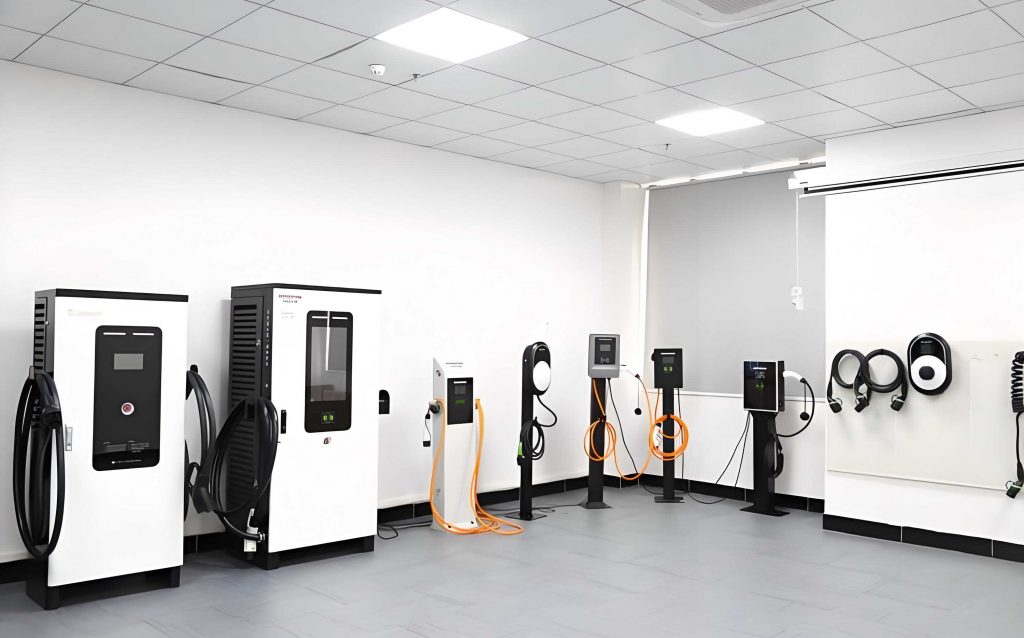
The software system of an EV charging station is equally vital, as it enables seamless interaction between the charging station, servers, and user applications. From my experience, a modular software architecture ensures that components like the host, database, and mobile app work in harmony. For example, the software can implement different billing models, such as energy-based charging (cost per kWh) or time-based charging (cost per hour). The total cost $C$ for a charging session can be modeled as: $$C = \begin{cases}
P_e \times E & \text{for energy-based billing} \\
P_t \times T & \text{for time-based billing}
\end{cases}$$ where $P_e$ is the price per unit energy, $E$ is the energy consumed, $P_t$ is the price per unit time, and $T$ is the charging duration. Communication protocols, such as MQTT or HTTP, facilitate data exchange, allowing the EV charging station to receive user commands and transmit status updates. Moreover, database management systems store historical data, enabling analytics for maintenance and optimization.
Environmental compatibility is a crucial aspect of EV charging station design, particularly since many stations are deployed outdoors. I consider factors like electromagnetic interference (EMI), weather resistance, and thermal management. For instance, the power output of an EV charging station can be affected by temperature variations, which might be modeled using a temperature-dependent efficiency function: $$\eta(T) = \eta_0 – k(T – T_0)$$ where $\eta_0$ is the nominal efficiency at reference temperature $T_0$, and $k$ is a degradation coefficient. Shielding techniques and component selection help mitigate EMI, ensuring reliable operation. Additionally, waterproof and dustproof enclosures protect the internal electronics, extending the lifespan of the EV charging station.
The development of a mobile app client for EV charging stations enhances accessibility and convenience. As I design such apps, I structure them into layers: the view layer for user interfaces, the business logic layer for processing requests, and the business entity layer for data management. The view layer might include screens for locating nearby EV charging stations, monitoring charging progress, and handling payments. The business logic layer interacts with servers to fetch data, such as available charging slots or pricing information. For example, the app can use GPS data to calculate the distance $d$ to the nearest EV charging station using the Haversine formula: $$d = 2r \arcsin\left(\sqrt{\sin^2\left(\frac{\Delta \phi}{2}\right) + \cos(\phi_1) \cos(\phi_2) \sin^2\left(\frac{\Delta \lambda}{2}\right)}\right)$$ where $r$ is Earth’s radius, $\phi$ and $\lambda$ are latitude and longitude coordinates. This integration allows users to seamlessly find, reserve, and control EV charging stations from their smartphones.
Key technologies driving intelligent EV charging stations include smart terminal applications and advanced charging algorithms. I emphasize the use of apps compatible with Android and iOS, built on client-server architectures for scalability. These apps can display real-time statuses of EV charging stations, such as “available,” “occupied,” or “under maintenance.” Smart charging technologies optimize energy distribution based on grid load and user preferences. For instance, a load-balancing algorithm might distribute power among multiple EV charging stations to prevent overloading, expressed as: $$\sum_{i=1}^{n} P_i \leq P_{\text{max}}$$ where $P_i$ is the power drawn by the $i$-th EV charging station and $P_{\text{max}}$ is the maximum grid capacity. Furthermore, predictive maintenance using machine learning models can forecast failures, reducing downtime and improving reliability.
In conclusion, the design of intelligent EV charging station systems is a multidisciplinary endeavor that integrates hardware, software, and environmental considerations. I am confident that advancements in microcontroller technology, communication protocols, and user-centric designs will continue to enhance the efficiency and adoption of EV charging stations. By prioritizing safety, flexibility, and sustainability, we can support the global transition to electric mobility and address challenges like range anxiety and infrastructure gaps. The future of EV charging stations lies in smarter, more interconnected systems that empower users and optimize energy resources.