
In the context of global efforts to achieve carbon neutrality, the new energy vehicle industry has emerged as a critical pillar of economic growth. Wireless EV charging stations, serving as essential infrastructure for electric vehicles, are experiencing surging demand. However, existing wireless EV charging stations face numerous technical challenges, including low electromagnetic coupling efficiency, unstable power transmission, and inadequate heat dissipation reliability. Market-related issues such as poor device compatibility, high installation and maintenance costs, and suboptimal user experience further hinder widespread adoption. From my perspective as a researcher in electromechanical engineering, addressing these limitations through systematic optimization is vital for advancing the industry. This article explores the technical architecture and current application status of wireless EV charging stations, proposes optimization pathways based on electromechanical engineering principles, and outlines strategies to enhance market competitiveness, ultimately contributing to the sustainable development of electric mobility.
The core electromechanical system of a wireless EV charging station comprises several integrated components that ensure efficient energy transfer from the grid to the vehicle battery. The power input module converts alternating current from the grid into stable direct current through rectification and filtering circuits, providing a reliable energy source. The electromagnetic coupling coil assembly, consisting of transmitter and receiver coils, facilitates wireless power transfer via electromagnetic induction. The power control circuit regulates transmitter current or resonant frequency to maintain consistent transmission power and prevent battery damage. Lastly, the auxiliary heat dissipation structure, incorporating heat sinks and fans, manages temperature rises during high-power operation to ensure long-term reliability. These components work in concert to enable seamless wireless charging for EV charging stations, but current implementations often fall short in real-world conditions due to alignment inaccuracies, load variations, and environmental stressors.
| Component | Primary Function | Typical Specifications |
|---|---|---|
| Power Input Module | Converts AC to DC and ensures stable input power | Rectification efficiency >95%, output voltage 400-800 V DC |
| Electromagnetic Coupling Coils | Enables wireless energy transfer via electromagnetic fields | Coupling coefficient 0.6-0.8, operating frequency 85-200 kHz |
| Power Control Circuit | Adjusts power output based on real-time conditions | PID control, PWM modulation, efficiency up to 92% |
| Heat Dissipation System | Maintains optimal operating temperatures | Thermal resistance <0.5°C/W, supports continuous 100 kW+ operation |
Current deployments of wireless EV charging stations are primarily found in public parking lots, residential communities, and dedicated EV charging hubs, with several cities implementing pilot projects. User feedback highlights critical pain points: electromagnetic coupling efficiency drops by 10-15% compared to wired charging, and misalignments exceeding 5 cm can interrupt charging. Power transmission instability, with fluctuations over 8%, leads to inconsistent charging speeds and overcharging risks. Moreover, thermal management issues arise during high-power operation (e.g., 100 kW+), where component temperatures exceed 80°C, triggering safety shutdowns. Structural vulnerabilities, such as steel enclosures cracking in sub-zero temperatures and frequent maintenance needs (over three times annually per station), coupled with high installation costs (exceeding $5,000 per parking space), underscore the urgency for optimization. These challenges emphasize the need for holistic improvements in wireless EV charging stations to boost reliability and user satisfaction.
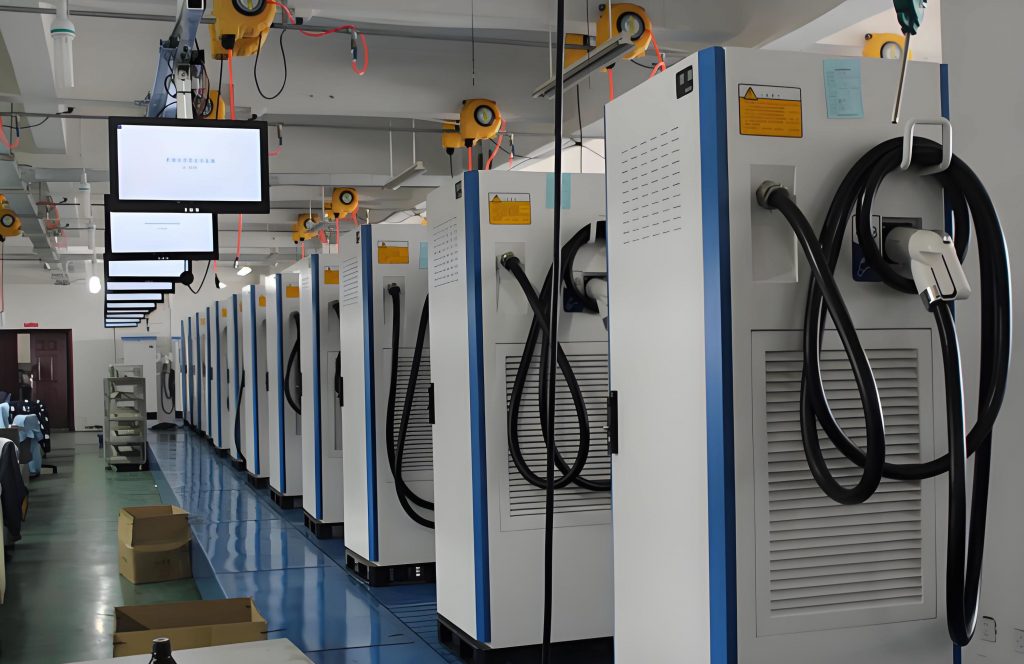
To address inefficiencies in electromagnetic coupling, I propose a multi-faceted optimization approach grounded in electromagnetic theory and mechanical actuation. First, coil structures are tailored to specific scenarios: for fixed, short-distance settings like private parking spots, planar spiral coils with 30-50 turns and 2-4 mm multi-strand litz wire are employed to minimize DC resistance. In public parking areas with variable ground clearances, square-shaped 3D windings with 10-15 mm axial height enhance magnetic field distribution, increasing the coupling coefficient by up to 20%. The coupling coefficient \( k \) is defined as $$ k = \frac{M}{\sqrt{L_1 L_2}} $$ where \( M \) is mutual inductance, and \( L_1 \) and \( L_2 \) are self-inductances of the coils. Second, magnetic core materials are selected based on frequency: for low frequencies below 100 kHz, Mn-Zn ferrites with resistivity over \( 10^4 \, \Omega \cdot \text{cm} \) and losses under 50 mW/cm³ are ideal, while for higher frequencies (100-200 kHz), Fe-Si-B-Nb-Cu nanocrystalline alloys with initial permeability of \( 1 \times 10^5 \) and 30% reduced eddy current losses are preferred. Third, an adaptive alignment system integrates stepper motor-driven platforms and infrared distance sensors (accuracy ±1 mm) to adjust coil spacing between 50-200 mm within 0.5 seconds, maintaining \( k \geq 0.7 \) and achieving system efficiency of 92%. The overall efficiency \( \eta \) of the wireless EV charging station can be expressed as $$ \eta = \frac{P_{\text{out}}}{P_{\text{in}}} \times 100\% = \frac{k^2 Q_1 Q_2}{1 + k^2 Q_1 Q_2} \times 100\% $$ where \( Q_1 \) and \( Q_2 \) are quality factors of the transmitter and receiver coils, respectively.
| Parameter | Before Optimization | After Optimization |
|---|---|---|
| Coupling Coefficient (k) | 0.5-0.6 | 0.7-0.8 |
| Transmission Efficiency | 80-85% | 90-92% |
| Alignment Tolerance | <5 cm | Up to 20 cm |
| Operating Frequency Range | 85-100 kHz | 85-200 kHz |
Power transmission control strategies are refined through a closed-loop system that integrates state monitoring, dynamic adjustment, and anomaly compensation. Utilizing CAN bus communication with the vehicle’s Battery Management System (BMS), real-time parameters such as State of Charge (SOC) with ±2% accuracy, temperature ranging from -40°C to 125°C, and voltage with ±0.5% precision are continuously sampled. A Proportional-Integral-Derivative (PID) controller modulates inverter output power based on these inputs. The PID control law is given by $$ u(t) = K_p e(t) + K_i \int_0^t e(\tau) \, d\tau + K_d \frac{de(t)}{dt} $$ with proportional gain \( K_p = 0.8 \), integral time \( T_i = 1.2 \, \text{s} \), and derivative time \( T_d = 0.3 \, \text{s} \). For instance, when SOC drops below 30%, power is set to 200 kW for fast charging, tapering linearly to 50 kW above 80% SOC; if temperature surpasses 45°C, power is halved proactively, achieving overall power control accuracy within ±3%. Additionally, a phase-locked loop (PLL) mechanism tracks resonant frequency deviations up to ±5 kHz, adjusting switching frequency in 100 Hz steps to minimize mismatch losses below 5%. For load transients, such as battery internal resistance jumping from 50 mΩ to 100 mΩ, Hall effect current sensors with over 1 MHz bandwidth enable PWM duty cycle adjustments from 10% to 90% within 200 μs, limiting output current fluctuations to ±2 A. This enhances the stability of wireless EV charging stations and prolongs battery lifespan by reducing stress during charging cycles.
Heat dissipation and structural reliability are optimized through a combined approach leveraging thermal dynamics and material science. For high-power wireless EV charging stations (150 kW and above), a liquid cooling system with sealed stainless steel channels (diameter 8-12 mm) and ethylene glycol-water coolant (freezing point -40°C, boiling point 108°C) is implemented. Using ANSYS simulations, the cooling channels are optimized to achieve a heat transfer coefficient of 150 W/(m²·K) for coils and IGBTs, improving efficiency by 40-60% compared to air cooling and supporting 72-hour continuous operation. In medium to low-power scenarios (≤100 kW), “6061 aluminum alloy fins [thermal conductivity 201 W/(m·K)] paired with axial fans [airflow 120 m³/h, noise ≤45 dB]” contain temperature rises within 60°C. Structurally, finite element analysis guides the use of 6061-T6 aluminum for enclosures and supports, yielding a 30% weight reduction and corrosion resistance exceeding 1,000 hours in salt spray tests. The heat conduction equation $$ \frac{\partial T}{\partial t} = \alpha \nabla^2 T $$ where \( \alpha \) is thermal diffusivity, models transient thermal behavior. Modular designs embed coils into high-strength resin substrates (compressive strength >50 MPa), reducing installation time to 2 hours per parking space and cutting costs by 40%. These enhancements ensure reliable performance of wireless EV charging stations across temperatures from -40°C to 85°C, with a service life exceeding 10 years.
| Dissipation Method | Max Power Supported | Temperature Rise | Noise Level |
|---|---|---|---|
| Air Cooling (Fans + Fins) | ≤100 kW | ≤60°C | ≤45 dB |
| Liquid Cooling (Closed Loop) | 150-200 kW | ≤40°C | ≤35 dB |
| Hybrid Cooling | 200 kW+ | ≤30°C | ≤40 dB |
To translate technical advancements into market competitiveness, product differentiation strategies focus on customizing wireless EV charging stations for specific use cases. In public parking lots with daily traffic exceeding 500 vehicles, high-efficiency electromagnetic coils (3D windings and nanocrystalline cores) coupled with adaptive power control enable 200 kW fast-charging models that achieve 15% faster charging, replenishing 80% of a 500 km range battery in under an hour. Overload protection and voltage compensation features reduce device failure rates by 40%, addressing reliability concerns. For residential areas, compact designs with low-noise liquid cooling (≤45 dB) and slim-profile coils (8 cm thickness) allow seamless integration without extensive electrical modifications, cutting installation to 2 hours per space. In commercial complexes, aesthetic and functional integration is achieved by embedding heat dissipation fins into ceilings or pillars, using flush-mounted planar spiral coils with anti-slip coatings (load capacity >10 kN), and offering customizable enclosures in colors like champagne gold or dark gray. Membership systems linked to charging services further enhance user engagement through loyalty points, making wireless EV charging stations not only functional but also integral to customer retention strategies.
Cost control and scalability are critical for widespread adoption of wireless EV charging stations. Material selection plays a key role: nanocrystalline alloy powder compacts replace conventional ferrites, maintaining permeability equivalent to ferrites (ensuring electromagnetic coupling efficiency ≥90%) while improving temperature and corrosion resistance, and reducing raw material and processing costs by approximately 20%. Production processes are streamlined through full modular assembly, dividing the system into power input, electromagnetic coupling coils, and power control circuits as standardized modules. This parallel production and pre-testing cut assembly time to 4 hours per unit and lower on-site labor costs by 15%. Supply chain optimizations include bulk annual procurement agreements for core components like nanocrystalline alloys, reducing costs by 8-12%, and locating component suppliers within 300 km of assembly plants to slash logistics expenses by 10%. Just-in-Time (JIT) manufacturing minimizes inventory holding, decreasing capital occupancy costs by 5%. Collectively, these measures achieve total cost reductions of 15-25%, making wireless EV charging stations more accessible for large-scale deployments. The economic viability can be modeled using a cost function $$ C_{\text{total}} = C_{\text{materials}} + C_{\text{labor}} + C_{\text{logistics}} + C_{\text{overhead}} $$ where each component is optimized through the aforementioned strategies.
| Cost Category | Traditional Approach | Optimized Approach | Savings |
|---|---|---|---|
| Materials | 60% of total cost | 48% of total cost | 20% |
| Labor | 25% of total cost | 21.25% of total cost | 15% |
| Logistics | 10% of total cost | 9% of total cost | 10% |
| Overhead | 5% of total cost | 4.75% of total cost | 5% |
Service mode innovations centered on user needs cover the entire workflow from locating to maintaining wireless EV charging stations. Through a dedicated “Wireless Charging Manager” app, users can view real-time status and power ratings of available EV charging stations, book time slots in 15-minute increments, and receive integrated navigation guidance. Upon arrival, automatic activation via license plate recognition or Bluetooth initiates charging, eliminating queues and search time. During charging, the app provides live updates on power, battery level, estimated completion time, and temperature, with alerts for anomalies such as power fluctuations exceeding 5% or upon reaching 90% charge, allowing remote pausing without physical presence. For maintenance, embedded sensors in the wireless EV charging station continuously monitor operational data, triggering backend alerts for anomalies. Response times under 2 hours ensure prompt dispatching of technicians with replacement modules, supplemented by quarterly inspections to preempt failures. This proactive service model enhances reliability and user trust, fostering higher adoption rates for wireless EV charging stations.
In conclusion, this research demonstrates that electromechanical engineering optimizations—spanning electromagnetic coupling, power control, and thermal-structural design—significantly enhance the performance and reliability of wireless EV charging stations. The proposed strategies not only address core technical issues but also facilitate market differentiation through scenario-based customization, cost efficiency, and user-centric services. Compared to prior studies, this work emphasizes the integration of technical improvements with market-driven approaches, ensuring that advancements translate into tangible benefits. However, further research is needed on the interoperability of wireless EV charging stations with smart grids to improve energy utilization, and standardization efforts must continue to enhance cross-brand compatibility. By advancing these areas, wireless EV charging stations can achieve greater market penetration and contribute substantially to the evolution of sustainable transportation.