
As the global energy landscape undergoes a significant transformation, I have observed a rapid increase in the adoption of electric vehicles (EVs) driven by growing environmental consciousness. In my analysis, the EV charging station infrastructure serves as a critical backbone for this shift, directly influencing the scalability and user experience of EVs in urban settings. The urgency to address the challenges in deploying EV charging stations cannot be overstated, as it impacts not only the EV industry but also urban sustainability and the achievement of carbon neutrality goals. Through this discussion, I aim to delve into the key issues and propose actionable solutions, leveraging data, formulas, and structured tables to provide a comprehensive perspective.
The importance of EV charging station networks cannot be emphasized enough. From my perspective, these stations are pivotal in alleviating range anxiety among EV users, thereby boosting acceptance and usage rates. Moreover, they facilitate a smoother transition to renewable energy sources by optimizing electricity distribution and reducing reliance on fossil fuels. For instance, the integration of EV charging stations with smart grids can lead to more efficient energy use, as represented by the formula for total energy demand: $$E_{\text{total}} = \sum_{i=1}^{n} P_i \cdot t_i$$ where \(E_{\text{total}}\) is the total energy consumption, \(P_i\) is the power rating of the i-th EV charging station, and \(t_i\) is the average charging time. This underscores how a well-developed EV charging station ecosystem can drive urban decarbonization efforts.
However, the deployment of EV charging stations faces several pressing issues. One major problem is the inadequacy of supporting infrastructure. In many urban areas, I have found that power grid capacities are insufficient to handle the simultaneous operation of multiple EV charging stations, leading to bottlenecks. For example, the maximum power load \(L_{\text{max}}\) that a grid can support is often exceeded by the cumulative demand from EV charging stations, calculated as \(L_{\text{max}} < \sum P_{\text{station}}\), where \(P_{\text{station}}\) is the power draw per station. This results in frequent power outages or the need for costly upgrades. Additionally, compatibility issues arise due to varying connectors and communication protocols across different EV charging station brands, hindering seamless integration. To illustrate the disparities, consider the following table summarizing common infrastructure gaps:
| Infrastructure Component | Current Status | Required Upgrade |
|---|---|---|
| Power Grid Capacity | Often inadequate for high-density EV charging station clusters | Increase transformer capacity and add substations |
| Wiring and Connectivity | Outdated lines with limited load-bearing capacity | Retrofit with high-capacity cables and standardized interfaces |
| Compatibility Standards | Fragmented protocols leading to interoperability issues | Adopt universal standards like CCS or CHAdeMO for EV charging stations |
Another critical issue is the deficiency in operation and maintenance management. Based on my experience, many EV charging stations suffer from a lack of real-time monitoring and preventive maintenance, resulting in high failure rates. The reliability of an EV charging station network can be modeled using the failure rate formula: $$\lambda = \frac{N_f}{T_{\text{total}}}$$ where \(\lambda\) is the failure rate, \(N_f\) is the number of failures, and \(T_{\text{total}}\) is the total operational time. Without proper management, \(\lambda\) increases, leading to user dissatisfaction. Moreover, the absence of skilled technicians and standardized procedures exacerbates the problem. For instance, I recommend implementing a systematic maintenance framework, as outlined in the table below, to ensure the longevity of EV charging stations:
| Maintenance Activity | Frequency | Key Metrics |
|---|---|---|
| Routine Inspections | Daily | Check for physical damage, connectivity issues, and software updates |
| Preventive Maintenance | Monthly | Replace worn components, calibrate meters, and clean equipment |
| Fault Repairs | As needed (target response time < 2 hours) | Diagnose and fix issues, with a goal of over 95% repair success rate |
Safety controls are another area where I have identified significant weaknesses. Inadequate quality assurance during the manufacturing and installation of EV charging stations can lead to hazards such as electrical leaks or fires. The risk probability \(R\) can be expressed as \(R = P \times S\), where \(P\) is the probability of a fault occurring, and \(S\) is the severity of its impact. For example, if an EV charging station uses substandard materials, \(P\) increases, elevating overall risk. Furthermore, insufficient on-site safety measures, like improper grounding, compound these dangers. To mitigate this, I advocate for rigorous safety protocols, including regular audits and the use of sensors to detect anomalies like overheating, which can be quantified by the temperature threshold formula: $$T_{\text{max}} = T_{\text{ambient}} + \Delta T_{\text{safe}}$$ where \(T_{\text{max}}\) is the maximum allowable temperature, \(T_{\text{ambient}}\) is the ambient temperature, and \(\Delta T_{\text{safe}}\) is the safe temperature rise. Implementing such measures ensures that EV charging stations operate within safe parameters.
Lastly, poor layout planning often results in an imbalance between supply and demand for EV charging stations. In my observation, this stems from a lack of foresight in urban planning, where stations are concentrated in some areas while neglected in high-demand zones. The optimization of EV charging station placement can be approached using a coverage model, such as maximizing the number of users served within a certain radius. The objective function can be defined as: $$\text{Maximize } Z = \sum_{j=1}^{m} c_j y_j$$ subject to constraints like \(\sum_{i=1}^{n} a_{ij} x_i \geq d_j y_j\) for all \(j\), where \(c_j\) is the demand at location \(j\), \(y_j\) is a binary variable indicating coverage, \(a_{ij}\) is the coverage of station \(i\) at \(j\), \(x_i\) is the decision to build station \(i\), and \(d_j\) is the demand threshold. This highlights the need for data-driven planning to distribute EV charging stations effectively. For example, the following table categorizes EV charging station types based on urban zones:
| Station Type | Primary Locations | Target Users |
|---|---|---|
| Core EV Charging Stations | Residential areas, workplaces, dedicated lots for public transport | Private EV owners, buses, taxis, and logistics fleets |
| Auxiliary EV Charging Stations | Public parking lots, temporary parking zones | General public with occasional charging needs |
| Supplementary EV Charging Stations | Highway rest areas, urban swap stations | Long-distance travelers requiring fast charging |
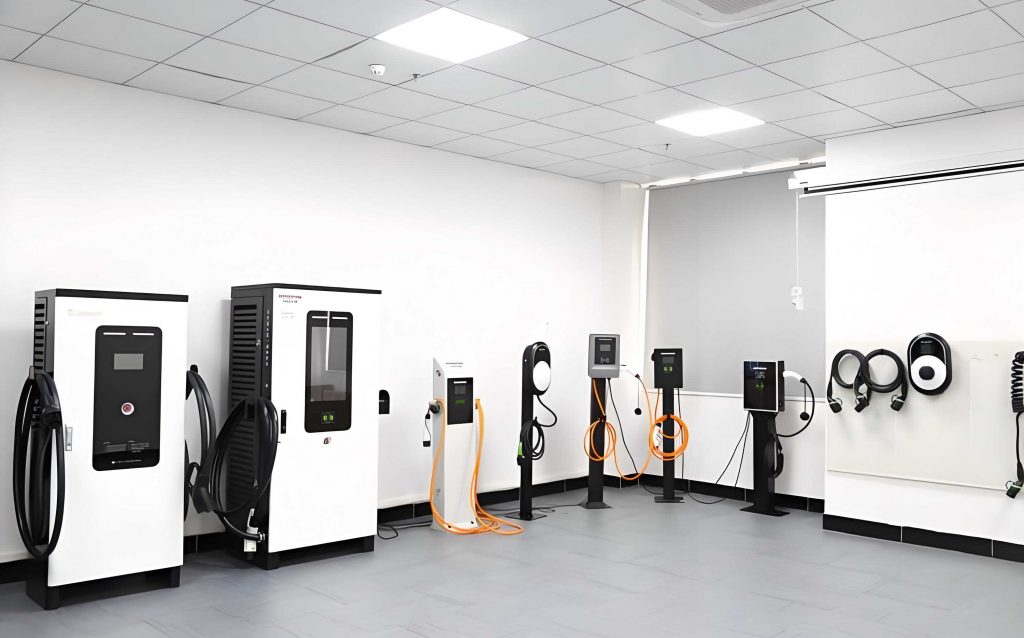
To address these challenges, I propose a multi-faceted approach. First, for enhancing supporting infrastructure, collaboration with utility companies is essential to upgrade power grids and standardize components. This includes calculating the required capacity expansion using formulas like \(\Delta C = k \cdot N_{\text{stations}}\), where \(\Delta C\) is the capacity increase, \(k\) is a scaling factor, and \(N_{\text{stations}}\) is the number of new EV charging stations. Second, strengthening operation and management involves deploying smart systems for real-time monitoring of EV charging stations, which can predict failures using algorithms based on historical data. Third, improving safety requires strict adherence to international standards and regular training for personnel. Finally, optimizing layout planning should leverage geographic information systems (GIS) and demand forecasting models to ensure EV charging stations are placed where they are most needed, thus achieving a balance between supply and demand.
In conclusion, the deployment of EV charging stations is a complex yet vital endeavor for urban sustainability. From my standpoint, by addressing infrastructure gaps, enhancing management protocols, enforcing safety measures, and adopting data-driven planning, we can build a resilient network of EV charging stations that supports the growing EV ecosystem. I believe continuous innovation, such as integrating renewable energy sources with EV charging stations, will further propel this transition. As we move forward, it is imperative to prioritize these strategies to foster a green, efficient urban mobility landscape.