
With the rapid expansion of electric vehicle (EV) adoption worldwide, the efficient planning and operation of EV charging stations have become critical to supporting sustainable transportation. However, the intermittent nature of renewable energy sources, such as solar and wind power, often leads to temporal and spatial mismatches with EV charging demands. Traditional methods for planning EV charging stations rely heavily on macroscopic data like vehicle ownership statistics and demographic surveys, which lack the granularity to capture dynamic user behaviors. In this study, we propose a novel framework that leverages mobile operator location data to predict EV charging demand accurately and designs a dynamic matching strategy to integrate renewable energy sources. By fusing real-time location information, renewable generation data, and EV charging station infrastructure details, our approach enables precise forecasting and optimal resource allocation, ultimately enhancing the utilization of green energy while improving user experience.
The proliferation of EV charging stations is essential for decarbonizing the transportation sector, yet existing planning methods face significant challenges. Conventional approaches, such as those based on geographic information systems (GIS) and static optimization models, struggle to adapt to the volatile patterns of EV usage. For instance, demand prediction often depends on outdated surveys, leading to inaccuracies in estimating regional charging needs. Moreover, the integration of renewable energy into EV charging station networks is hampered by the disconnect between energy supply and demand peaks. We address these issues by harnessing the power of mobile operator location data, which provides high-resolution insights into user mobility patterns. This data, combined with advanced machine learning techniques, allows us to develop a robust predictive model and a dynamic strategy that aligns EV charging station operations with renewable energy availability.
Our research is structured around three core components: data integration, predictive modeling, and dynamic matching. First, we collect and preprocess diverse datasets, including operator location records, renewable energy generation metrics, and EV charging station usage logs. Next, we construct a long short-term memory (LSTM) network to forecast charging demand at regional levels. Finally, we formulate a dynamic matching strategy that optimizes the allocation of charging resources based on real-time renewable energy supply and predicted demand. Experimental results demonstrate that our model significantly outperforms traditional methods in prediction accuracy, while the matching strategy boosts the local consumption of renewable energy and reduces user waiting times at EV charging stations. This holistic approach not only supports the scalable deployment of EV charging stations but also contributes to the broader goals of energy sustainability and smart city development.
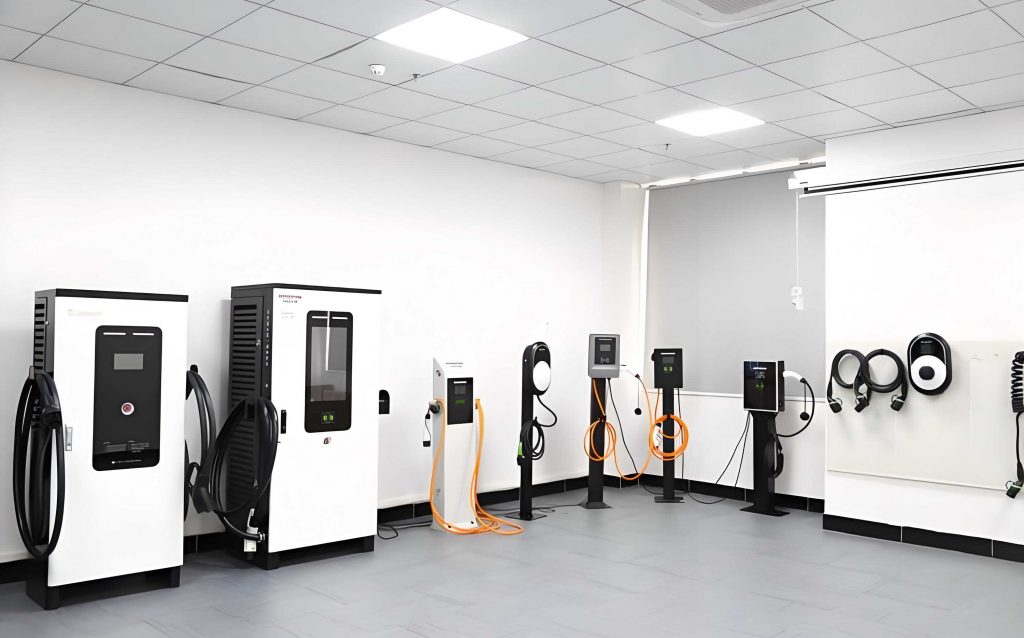
The challenges in current EV charging station planning are multifaceted. Statically designed models fail to account for the dynamic nature of user travel behaviors and fluctuating energy inputs. For example, peak charging periods often coincide with low renewable generation, resulting in reliance on non-renewable sources. Additionally, the absence of real-time data leads to suboptimal EV charging station placements and capacities. To quantify these issues, we analyze key limitations in traditional methods, as summarized in Table 1. This table compares common techniques based on data sources, prediction accuracy, and adaptability, highlighting the superiority of dynamic, data-driven approaches for EV charging station planning.
| Method | Data Sources | Prediction Accuracy (MAE in kW) | Adaptability to Dynamic Changes |
|---|---|---|---|
| Traditional Statistical Models | Surveys, Macro-economic Indicators | 7.85 | Low |
| GIS-Based Optimization | Historical Usage, Spatial Data | 6.90 | Moderate |
| Proposed LSTM with Location Data | Operator Location, Renewable Generation | 4.52 | High |
Data forms the foundation of our framework. We integrate three primary data types: mobile operator location data, renewable energy generation data, and EV charging station infrastructure data. The operator location data includes time-stamped user trajectories, such as GPS coordinates and base station handover records, which are processed to extract mobility features. For each region \( i \) at time \( t \), we define user travel indicators as a vector: $$ F_i(t) = \left[ \text{OD}_i(t), \text{Frequency}_i(t), \text{DwellTime}_i(t) \right] $$ where \( \text{OD}_i(t) \) represents the origin-destination matrix, \( \text{Frequency}_i(t) \) denotes the travel frequency, and \( \text{DwellTime}_i(t) \) indicates the average停留时间. Renewable energy data provide generation amounts, such as solar or wind output, denoted as \( R_i(t) \) in kWh for region \( i \). EV charging station data encompass the distribution, types, and historical usage of charging points. The total capacity of EV charging stations in region \( i \) is given by: $$ P_i = \sum_{c \in C_i} P_c $$ where \( C_i \) is the set of EV charging stations, and \( P_c \) is the rated power of each station. To streamline feature extraction, we compute composite indicators that combine mobility and energy factors, as shown in Table 2.
| Feature Category | Description | Mathematical Representation |
|---|---|---|
| Mobility Features | Derived from operator location data, e.g., travel frequency and dwell time | \( F_i(t) = \left[ \text{OD}_i(t), \text{Frequency}_i(t), \text{DwellTime}_i(t) \right] \) |
| Energy Supply Features | Renewable generation data, such as solar and wind output | \( R_i(t) \) (in kWh) |
| Infrastructure Features | Capacity and usage of existing EV charging stations | \( P_i = \sum_{c \in C_i} P_c \) |
| Temporal Features | Time-based attributes, including hour of day and holiday flags | \( T(t) \) |
| Environmental Features | Weather conditions and traffic flow data | \( W(t), Q_i(t) \) |
For predictive modeling, we employ an LSTM network due to its ability to capture long-term dependencies in sequential data, such as the recurring patterns in EV charging station usage. The model input at time \( t \) for region \( i \) is a feature vector: $$ X_i(t) = \left[ F_i(t), T(t), W(t), Q_i(t) \right] $$ where \( T(t) \) represents temporal attributes, \( W(t) \) denotes weather data, and \( Q_i(t) \) indicates traffic flow. The model aims to predict the future charging demand \( Y_i(t + \Delta t) \) for EV charging stations, with the predicted value \( \hat{Y}_i(t + \Delta t) \) expressed as: $$ \hat{Y}_i(t + \Delta t) = f(X_i(t); \theta) $$ where \( \theta \) denotes the model parameters. The LSTM architecture involves several gating mechanisms to regulate information flow. The key equations for a single time step \( t \) are: $$ i_t = \sigma(W_{xi} X_t + W_{hi} h_{t-1} + b_i) $$ $$ f_t = \sigma(W_{xf} X_t + W_{hf} h_{t-1} + b_f) $$ $$ o_t = \sigma(W_{xo} X_t + W_{ho} h_{t-1} + b_o) $$ $$ \tilde{c}_t = \tanh(W_{xc} X_t + W_{hc} h_{t-1} + b_c) $$ $$ c_t = f_t \odot c_{t-1} + i_t \odot \tilde{c}_t $$ $$ h_t = o_t \odot \tanh(c_t) $$ Here, \( i_t \), \( f_t \), and \( o_t \) are the input, forget, and output gates, respectively; \( c_t \) is the cell state; \( h_t \) is the hidden state; and \( \odot \) denotes element-wise multiplication. We train the model using historical data and evaluate its performance using mean absolute error (MAE) and root mean square error (RMSE): $$ \text{MAE} = \frac{1}{N} \sum_{i=1}^{N} |Y_i – \hat{Y}_i| $$ $$ \text{RMSE} = \sqrt{\frac{1}{N} \sum_{i=1}^{N} (Y_i – \hat{Y}_i)^2} $$ Through iterative training and validation, the LSTM model learns to forecast EV charging station demand with high precision, accounting for complex temporal dependencies.
The dynamic matching strategy is designed to optimize the allocation of EV charging station resources in real-time, based on predicted demand and renewable energy availability. The core objective is to maximize renewable energy utilization while minimizing user waiting times and costs. We define a matching variable \( x_{ij}(t) \), which represents the proportion of charging demand from region \( i \) allocated to EV charging station \( j \) at time \( t \). The objective function is formulated as: $$ \max_{x_{ij}(t)} U = \alpha \sum_{i,j} R_{ij}(t) x_{ij}(t) – \beta \sum_{i,j} W_{ij}(t) x_{ij}(t) – \gamma \sum_{i,j} C_{ij}(t) x_{ij}(t) $$ where \( R_{ij}(t) \) is the renewable energy available at EV charging station \( j \) for region \( i \), \( W_{ij}(t) \) is the expected waiting time for users, and \( C_{ij}(t) \) is the charging cost. The coefficients \( \alpha \), \( \beta \), and \( \gamma \) are weighting factors that balance the importance of renewable integration, user experience, and economic efficiency, respectively. These weights can be tuned based on policy priorities and user surveys; for instance, a higher \( \alpha \) emphasizes green energy use, while a higher \( \beta \) focuses on reducing delays at EV charging stations. The strategy is subject to several constraints: first, the charging demand must be fully allocated, so \( \sum_j x_{ij}(t) = 1 \) for each region \( i \); second, the total demand assigned to an EV charging station \( j \) cannot exceed its capacity, meaning \( \sum_i Y_i(t) x_{ij}(t) \leq P_j \); and third, all allocation variables must be non-negative, i.e., \( x_{ij}(t) \geq 0 \). This optimization problem can be solved using linear programming techniques, enabling real-time调度 of EV charging station resources.
To validate our approach, we conducted experiments using real-world datasets from an urban area, focusing on EV charging station usage and renewable energy generation. The LSTM model was trained on historical location data and charging records, and its performance was compared against traditional methods. As shown in Table 3, our model achieved an MAE of 4.52 kW and an RMSE of 6.31 kW, representing improvements of approximately 42.4% and 38.3%, respectively, over conventional statistical models. This demonstrates the enhanced accuracy of our demand forecasting for EV charging stations, enabling more reliable planning.
| Model | MAE (kW) | RMSE (kW) |
|---|---|---|
| Traditional Statistical Model | 7.85 | 10.23 |
| Proposed LSTM with Location Data | 4.52 | 6.31 |
In terms of the dynamic matching strategy, we simulated its impact on renewable energy utilization and user experience. Without the strategy, the local consumption rate of renewable energy for EV charging stations was around 45%. After implementation, this rate increased to approximately 53%, an improvement of about 18%. Concurrently, the average user waiting time decreased by 16%, as illustrated in Table 4. These results highlight the strategy’s effectiveness in promoting green energy use while enhancing service quality at EV charging stations. The integration of real-time data allows for adaptive调度, ensuring that EV charging stations operate efficiently even under fluctuating energy conditions.
| Metric | Without Dynamic Matching | With Dynamic Matching | Improvement |
|---|---|---|---|
| Renewable Energy Consumption Rate | 45% | 53% | 18% |
| Average User Waiting Time (minutes) | 25 | 21 | 16% |
In conclusion, our study presents a comprehensive framework for optimizing EV charging station planning and operation through mobile operator location data and renewable energy coordination. The LSTM-based prediction model accurately forecasts charging demand, while the dynamic matching strategy ensures efficient resource allocation and higher green energy integration. This approach addresses critical challenges in the EV ecosystem, such as the mismatch between energy supply and demand, and paves the way for smarter, more sustainable transportation systems. Future work could explore the integration of additional data sources, such as real-time grid conditions, and advanced AI techniques to further enhance the scalability and resilience of EV charging station networks. By continuously refining these models, we can contribute to a cleaner, more efficient future for electric mobility.