
In the context of global carbon neutrality goals, the electric vehicle industry has emerged as a pivotal sector in the economy. EV charging stations, particularly wireless ones, serve as critical infrastructure for supporting this transition. However, current wireless EV charging stations face significant technical challenges, including low electromagnetic coupling efficiency, unstable power transmission, and inadequate thermal management. These issues, compounded by market pain points like weak device compatibility, high installation costs, and suboptimal user experience, hinder the widespread adoption of EV charging stations. From my perspective as an engineer specializing in electromechanical systems, this study aims to address these limitations by proposing optimized design pathways based on electromechanical engineering principles. I will first analyze the technical architecture and application status of EV charging stations, then detail optimization strategies for electromagnetic coupling, power control, and thermal-structural reliability, and finally discuss how these technical improvements can enhance market competitiveness through product differentiation, cost control, and service innovation. By integrating theoretical analysis with practical applications, this research seeks to contribute to the advancement of EV charging station technology and its market penetration.
The core electromechanical system of an EV charging station comprises several key modules: the power input module, electromagnetic coupling coil assembly, power control circuit, and auxiliary cooling structure. The power input module converts grid AC to stable DC through rectification and filtering circuits, providing a reliable energy source. The electromagnetic coupling coils, consisting of transmitter and receiver coils, enable wireless energy transfer via electromagnetic induction. The power control circuit regulates transmitter current or resonant frequency to maintain stable power output, preventing overcurrent or undervoltage conditions that could damage batteries. The cooling structure, often combining heat sinks and fans, dissipates heat generated during high-power transmission, ensuring long-term operational reliability. These components work synergistically: the power input supplies energy, the coils facilitate spatial transfer, the control circuit ensures stability, and the cooling system maintains thermal balance, collectively completing the wireless charging process from grid to vehicle battery.
| Component | Function | Key Parameters |
|---|---|---|
| Power Input Module | Converts AC to DC, provides stable energy | Input voltage: 220V AC, Output: 400V DC |
| Electromagnetic Coupling Coils | Enables wireless energy transfer via induction | Coupling coefficient: 0.6–0.8, Efficiency: 85–92% |
| Power Control Circuit | Regulates power output, ensures stability | Control accuracy: ±3%, Frequency range: 85–200 kHz |
| Auxiliary Cooling Structure | Dissipates heat, maintains temperature | Heat dissipation coefficient: 150 W/(m²·K), Operating temp: -40–85°C |
Currently, EV charging stations are deployed in public parking lots, residential areas, and dedicated charging points, with pilot projects in urban centers covering both commercial and passenger vehicles. User feedback highlights several critical issues. For instance, electromagnetic coupling efficiency drops by 10–15% compared to wired charging due to alignment errors and varying vehicle-ground clearances. Misalignments exceeding 5 cm often cause charging interruptions, necessitating optimization of electromagnetic coupling systems for better tolerance. Power transmission instability arises from dynamic load variations, such as differences in battery state of charge (SOC) and internal resistance, leading to power fluctuations over 8% and overcharging risks. This requires refined power control strategies. Thermal and structural problems include coil and power device temperatures surpassing 80°C during high-power charging (over 100 kW), triggering overheating protection. Additionally, steel enclosures are prone to brittleness below -30°C, and ground-embedded coils suffer from low crush resistance, requiring frequent maintenance (over three times annually) and high installation costs (exceeding $700 per spot). Thus, optimizing thermal management and structural reliability is essential to overcome these bottlenecks.
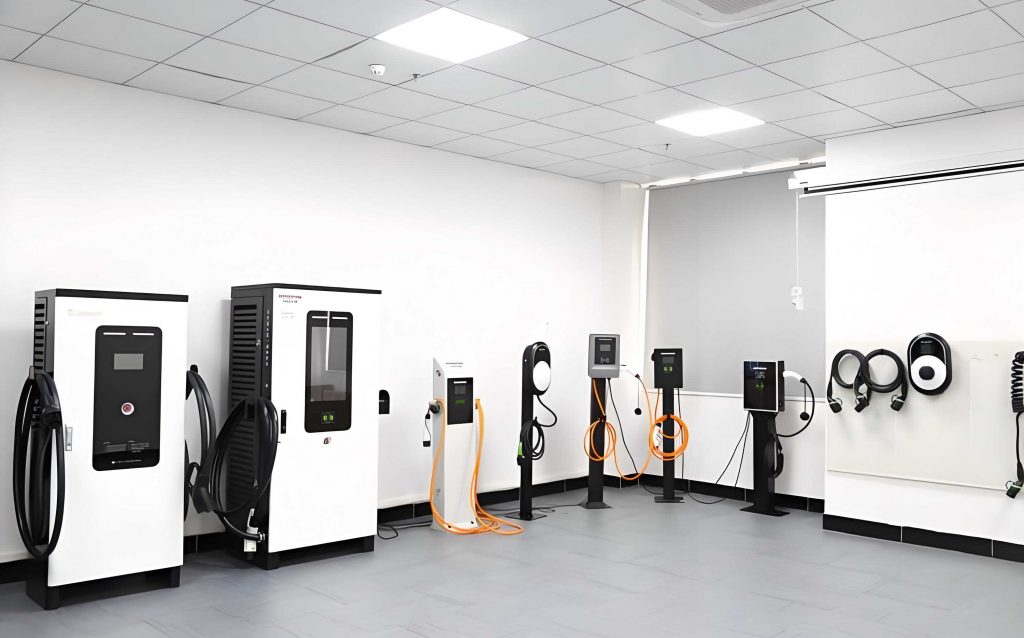
To enhance the electromagnetic coupling efficiency of EV charging stations, I propose a multi-faceted approach grounded in electromagnetic theory and mechanical actuation. First, coil structures are tailored to specific scenarios: for fixed, short-distance settings like residential spots, planar spiral coils with 30–50 turns and 2–4 mm multi-strand enamelled wire are optimized using SolidWorks to reduce DC resistance. For public parking with variable clearances, square 3D wound coils with 10–15 mm axial height expand the magnetic field, increasing the coupling coefficient by 20%. Second, magnetic core materials are selected based on frequency: Mn-Zn ferrite (resistivity > 10⁴ Ω·cm, loss < 50 mW/cm³) for low frequencies (< 100 kHz), and Fe-Si-B-Nb-Cu nanocrystalline alloy (initial permeability 1×10⁵, eddy current loss reduced by 30%) for high frequencies (100–200 kHz), leveraging powder metallurgy for complex shapes. Third, an adaptive adjustment system integrates stepper motor-driven lifting platforms and infrared distance sensors (±1 mm accuracy) to adjust coil spacing (50–200 mm range) within 0.5 seconds, stabilizing the coupling coefficient above 0.7 and achieving system energy transfer efficiency of 92%. The coupling coefficient \( k \) can be expressed as:
$$ k = \frac{M}{\sqrt{L_1 L_2}} $$
where \( M \) is mutual inductance, and \( L_1 \) and \( L_2 \) are inductances of transmitter and receiver coils. Efficiency \( \eta \) is given by:
$$ \eta = \frac{P_{\text{out}}}{P_{\text{in}}} \times 100\% $$
where \( P_{\text{out}} \) is output power to the vehicle battery and \( P_{\text{in}} \) is input power from the grid.
| Parameter | Residential Scenario | Public Parking Scenario |
|---|---|---|
| Coil Type | Planar Spiral | Square 3D Wound |
| Number of Turns | 30–50 | 20–30 |
| Wire Diameter (mm) | 2–4 | 3–5 |
| Magnetic Core Material | Mn-Zn Ferrite | Nanocrystalline Alloy |
| Coupling Coefficient | 0.65–0.75 | 0.70–0.85 |
| Efficiency (%) | 88–90 | 90–92 |
For power transmission control in EV charging stations, I have developed a closed-loop optimization strategy based on electromechanical协同 control theory and power electronics, encompassing state monitoring, dynamic regulation, and anomaly compensation. This system uses CAN bus communication with the vehicle Battery Management System (BMS) to collect real-time parameters such as battery SOC (±2% accuracy), temperature (-40–125°C range), and voltage (±0.5% accuracy). A PID control strategy (proportional gain 0.8, integral time 1.2 s, derivative time 0.3 s) dynamically adjusts inverter output power: when SOC is below 30%, charging operates at 200 kW full power, linearly decreasing to 50 kW above 80% SOC. If temperature exceeds 45°C, power is halved, achieving overall power control accuracy within ±3%. Additionally, a resonant frequency auto-tracking mechanism employs Phase-Locked Loop (PLL) technology with series-parallel sensors to detect voltage-current phase differences, correcting switching frequency in 100 Hz steps for offsets up to ±5 kHz, thereby limiting mismatch losses to 5%. To handle load transients, Hall effect current sensors with over 1 MHz bandwidth are installed on the receiver side, enabling rapid PWM duty cycle adjustments (10–90% range) within 200 μs for internal resistance jumps (e.g., from 50 mΩ to 100 mΩ), ensuring output current fluctuations remain within ±2 A. This suppresses battery stress and extends cycle life. The power control equation is:
$$ P_{\text{out}} = V_{\text{batt}} \times I_{\text{charge}} $$
where \( V_{\text{batt}} \) is battery voltage and \( I_{\text{charge}} \) is charging current. The PID controller output \( u(t) \) is given by:
$$ u(t) = K_p e(t) + K_i \int_0^t e(\tau) d\tau + K_d \frac{de(t)}{dt} $$
with \( e(t) \) as error between setpoint and actual power, and \( K_p \), \( K_i \), \( K_d \) as PID gains.
| Parameter | Value or Range | Impact on Performance |
|---|---|---|
| SOC Range for Full Power | 0–30% | Enables fast charging at 200 kW |
| SOC Range for Reduced Power | 80–100% | Prevents overcharging, power 50 kW |
| Temperature Threshold | 45°C | Triggers power reduction to 50% |
| Power Control Accuracy | ≤ ±3% | Ensures stable charging and safety |
| Frequency Tracking Range | ±5 kHz | Minimizes mismatch losses |
| Current Fluctuation Limit | ±2 A | Reduces battery stress |
Thermal and structural reliability optimization for EV charging stations involves an integrated approach based on heat transfer, structural mechanics, and materials engineering. For high-power scenarios (over 150 kW), I recommend a liquid cooling system with sealed stainless steel channels (8–12 mm diameter) and ethylene glycol-water coolant (freezing point -40°C, boiling point 108°C). ANSYS-optimized flow paths achieve a heat dissipation coefficient of 150 W/(m²·K) for coils and IGBTs, improving efficiency by 40–60% over air cooling and supporting 72-hour continuous operation. For medium to low power (≤ 100 kW) EV charging stations, a combination of 6061 aluminum alloy fins (thermal conductivity 201 W/(m·K)) and axial fans (airflow 120 m³/h, noise ≤ 45 dB) limits temperature rise to 60°C. Structurally, ANSYS simulations under multiple load cases guide the use of 6061-T6 aluminum alloy for enclosures and supports (yield strength 276 MPa), reducing weight by 30% and passing salt spray tests over 1,000 hours. Modular design integrates coils into high-strength resin substrates (compressive strength > 50 MPa), allowing ground embedding with minimal excavation. This cuts installation time to 2 hours per spot and costs by 40%, ensuring reliable operation from -40°C to 85°C and a lifespan exceeding 10 years. The heat transfer rate \( Q \) can be calculated as:
$$ Q = h A \Delta T $$
where \( h \) is the heat transfer coefficient, \( A \) is surface area, and \( \Delta T \) is temperature difference. Structural stress \( \sigma \) is given by:
$$ \sigma = \frac{F}{A} $$
where \( F \) is applied force and \( A \) is cross-sectional area.
| Aspect | High-Power (≥150 kW) | Medium/Low-Power (≤100 kW) |
|---|---|---|
| Cooling Method | Liquid Cooling | Air Cooling (Fins + Fans) |
| Coolant/ Material | Ethylene Glycol-Water | 6061 Aluminum Alloy |
| Heat Dissipation Coefficient (W/(m²·K)) | 150 | 80–100 |
| Maximum Operating Time | 72 hours | 48 hours |
| Weight Reduction | 25–30% | 20–25% |
| Installation Time | 2–3 hours | 1–2 hours |
| Temperature Range | -40°C to 85°C | -30°C to 70°C |
To enhance the market competitiveness of EV charging stations, I propose a product differentiation strategy that translates technical advantages—such as electromagnetic coupling efficiency up to 92%, power control accuracy within ±3%, and thermal reliability for 72-hour continuous operation—into tangible user benefits. For public parking lots with high daily traffic (over 500 vehicles), integrating high-efficiency electromagnetic coils (3D wound with nanocrystalline cores) and adaptive power control enables 200 kW fast-charging models, boosting efficiency by 15% and charging a 500 km range vehicle to 80% in under an hour. Overload protection and voltage compensation features allow simultaneous multi-vehicle charging, reducing failure rates by 40%. In residential settings, where space and noise are concerns, low-noise liquid cooling (≤ 45 dB) and compact 3D coils (8 cm thick, ground-embedded) with modular interfaces facilitate plug-and-play installation, eliminating major electrical modifications and cutting per-spot setup to 2 hours. For commercial complexes, aesthetic integration is key: heat sinks can be embedded in ceilings or pillars, using hidden planar spiral coils flush with anti-slip surfaces (crush resistance > 10 kN), and customizable metal finishes (e.g., champagne gold, dark gray) combined with membership systems for loyalty-based charging, blending functionality with customer engagement.
Cost control and scalability are critical for the widespread deployment of EV charging stations. I advocate for a multi-dimensional strategy covering materials, manufacturing, and supply chain. First, substituting traditional ferrite cores with powder-metallurgy nanocrystalline alloys reduces material costs by 20% while maintaining comparable permeability (coupling efficiency ≥ 90%) and enhancing temperature and corrosion resistance for cross-regional applications. Second, full-process modular assembly—dividing the system into power input, electromagnetic coils, and power control circuits—enables parallel production and pre-debugging, slashing production cycles to 4 hours per unit and cutting on-site installation to module docking, thereby increasing productivity by over 30% and reducing labor costs by 15%. Third, in supply chain management, bulk annual procurement agreements with suppliers of nanocrystalline alloys lower core component costs by 8–12%, while locating part suppliers within 300 km of assembly plants reduces logistics expenses by nearly 10%. Implementing Just-In-Time (JIT) production ensures precise inventory replenishment, decreasing capital occupancy costs by 5%. Collectively, these measures achieve total cost reductions of 15–25%, making EV charging stations more accessible for large-scale projects.
| Strategy | Implementation | Cost Saving (%) |
|---|---|---|
| Material Substitution | Nanocrystalline alloys instead of ferrite | 20 |
| Modular Assembly | Standardized modules for parallel production | 15 (labor) |
| Bulk Procurement | Annual agreements with core suppliers | 8–12 |
| Localized Supply Chain | Suppliers within 300 km radius | 10 (logistics) |
| JIT Production | On-demand inventory management | 5 (capital) |
| Total Cost Reduction | Cumulative impact | 15–25 |
Service mode innovation, driven by user needs, focuses on streamlining the entire charging process—from locating EV charging stations to maintenance. Through a “Wireless Charging Manager” app, users can view real-time station status and power levels, book slots in 15-minute increments based on travel plans, and receive integrated navigation. Upon arrival, automatic activation via license plate recognition or app Bluetooth initiates charging, addressing issues of availability and queues. During charging, the app provides live updates on power, energy, estimated completion time, and temperature, sending alerts for anomalies like power deviations over 5% or when charge reaches 90%, allowing remote pausing without physical presence. For maintenance, embedded sensors in EV charging stations monitor operational data, triggering backend alerts for abnormalities and dispatching automated service tickets (response under 2 hours). Technicians schedule visits, replace modules on-site, and conduct quarterly inspections, eliminating user-reported repairs and wait times. This end-to-end service enhances reliability and user satisfaction, fostering loyalty in the competitive EV charging station market.
In conclusion, by applying electromechanical engineering principles to optimize EV charging stations, I have addressed core technical issues through electromagnetic coupling efficiency enhancements, power transmission control refinements, and thermal-structural reliability improvements. These solutions demonstrate the critical role of integrated electromechanical system optimization in boosting the performance of EV charging stations, thereby enriching the theoretical foundation of wireless charging technology. The proposed market competitiveness strategies—including scenario-based customization, cost-effective scaling, and user-centric services—effectively translate technical gains into product distinctiveness, increasing the adaptability of EV charging stations in diverse environments. This study bridges technical innovation with market application, offering practical insights for industry deployment. Compared to prior research, my approach emphasizes the synergy between electromechanical engineering and market dynamics, not only advancing technical metrics but also ensuring commercial viability. However, further investigation into the interaction between EV charging stations and smart grids could enhance energy efficiency, and ongoing efforts in standardization are needed to improve cross-brand compatibility, ultimately strengthening the market position of EV charging stations.