
As a leading utility company, we have been at the forefront of addressing the growing demand for electric vehicle (EV) infrastructure. The rapid adoption of EVs has highlighted critical challenges in the installation process of residential EV charging stations, such as complex paperwork, multiple approvals, and low engagement from property managers. In response, we developed an innovative “online order-and-go” management model to streamline the EV charging station installation process. This approach integrates digital platforms, simplifies procedures, and enhances user experience, aligning with national strategies for sustainable transportation and smart grid development.
Our company operates across a vast service area, managing an extensive power grid that supports millions of customers. With a robust infrastructure including numerous substations and transmission lines, we are committed to advancing energy efficiency and digital transformation. The shift toward EVs is a key component of our strategy, as it reduces carbon emissions and promotes renewable energy integration. The EV charging station installation process, however, has traditionally been cumbersome, requiring applicants to submit multiple documents and obtain approvals from various entities, including property management. This often led to delays and frustration among EV owners.
The global push for EV adoption, driven by policies like China’s New Energy Vehicle Industry Development Plan, has accelerated the need for efficient charging solutions. By 2024, the number of EVs in China surpassed 24 million, with annual registrations hitting record highs. This surge underscores the urgency of building a reliable and accessible EV charging station network. In our region, we observed that residential EV charging station installations were hindered by bureaucratic hurdles, such as the need for physical submissions and coordination with property managers. To tackle this, we initiated a comprehensive reform focused on digitalization and process optimization.
Our primary goal was to create a seamless, user-friendly system for EV charging station installation. By leveraging government partnerships and digital tools, we aimed to enable “one-click” applications through online platforms, reducing the need for in-person visits and paperwork. The core concept involves integrating multiple steps—such as property approval, application submission, and technical assessment—into a single, streamlined process. This not only enhances convenience for users but also supports our broader objectives of promoting EV adoption and grid modernization.
To implement this, we established a coordinated framework involving various stakeholders. We developed an organizational structure where our company leads the effort, collaborating with housing, energy, fire safety, and data management departments. Each entity has specific roles: for instance, housing departments guide property managers on policy compliance, while energy departments oversee the EV charging station installation standards. This collaborative approach ensures that all aspects, from safety checks to data sharing, are addressed efficiently.
A key initiative was the creation of a “green channel” for communities that meet certain criteria. We conducted surveys to identify neighborhoods with suitable conditions for EV charging station installations and encouraged property managers to sign agreements simplifying the approval process. Once a community is included in this channel, residents can apply for an EV charging station without needing separate property manager consent. This list is publicly available on digital platforms, increasing transparency and accessibility. To date, we have enrolled hundreds of communities, benefiting tens of thousands of households.
We expanded the application channels for EV charging station installations to include both online and offline options. Online, users can submit requests through government service apps or websites, where forms are pre-filled using shared data to minimize input. Offline, dedicated counters at service centers provide assistance. This dual approach caters to diverse user preferences, ensuring that everyone, regardless of digital proficiency, can access the service. The integration of these channels with our internal systems allows for real-time processing and reduces manual interventions.
Simplifying the application materials was another critical step. We consolidated all required documents into a single form for EV charging station installations, eliminating redundant submissions. By utilizing electronic certifications and data sharing, we enabled “zero-proof” applications, where identities and property details are automatically verified. This reduces the burden on applicants and accelerates the process. For example, instead of providing physical copies, users can authorize digital access to their information.
To support the hardware aspects, we launched a campaign to upgrade electrical infrastructure in existing communities. This involved installing centralized meter boxes and enhancing power distribution systems to accommodate multiple EV charging stations. By adopting a “one-time construction” approach, we minimized disruptions and costs. In new developments, we enforced regulations requiring 100% of parking spaces to be EV-ready, ensuring that charging infrastructure is integrated from the outset. Upon application, our team conducts site assessments within one business day, and if conditions permit, we complete the EV charging station installation on the same day. For more complex cases involving grid upgrades, we expedite the process to finish within the shortest possible time.
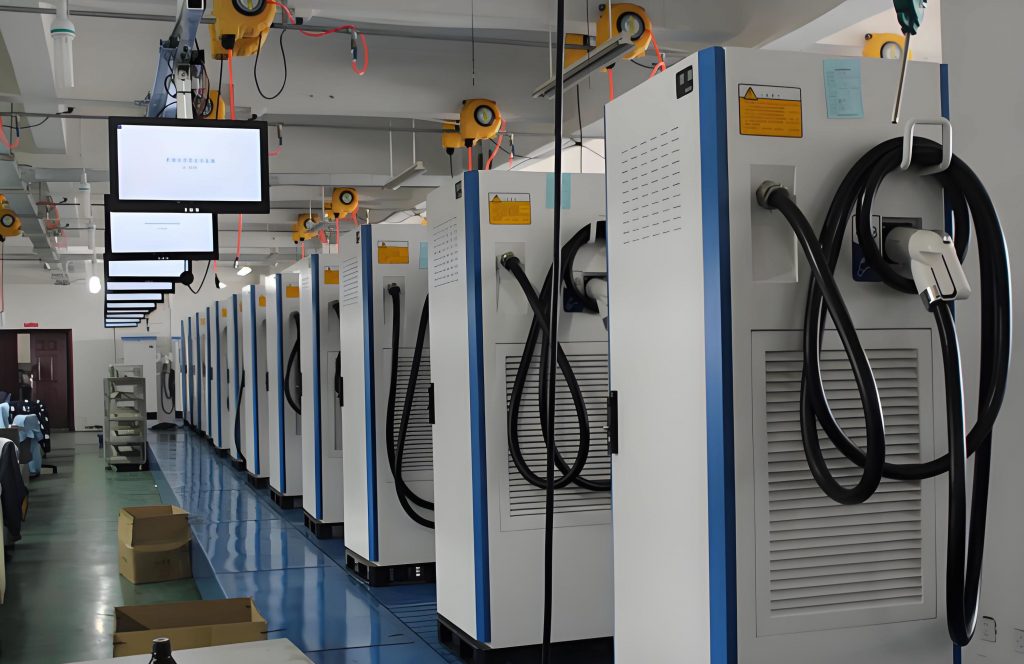
The reforms have yielded significant results in the EV charging station installation process. By streamlining procedures, we have cut down the required materials from multiple documents to virtually none, thanks to digital integration. The timeline for installation has also been drastically reduced; whereas it previously took up to seven days, we now aim for same-day service in straightforward cases. This efficiency gain is reflected in user satisfaction and operational metrics.
We have achieved system interoperability by linking government platforms with our internal management systems. This allows for automatic data transfer and eliminates duplicate entries, enhancing accuracy and speed. The widespread availability of the “green channel” list online has increased awareness and adoption. Additionally, the use of electronic certifications has made the EV charging station installation process more secure and reliable.
From an economic perspective, the simplified EV charging station installation process has led to substantial cost savings for users. Based on average driving patterns, each EV owner can save approximately $700 annually on fuel and maintenance, translating to millions of dollars in collective savings across our service area. This not only benefits individuals but also stimulates local economies by reducing transportation expenses.
Environmentally, the expansion of EV charging stations has contributed to energy conservation and reduced emissions. We estimate that the increased use of EVs, facilitated by easier installations, results in significant reductions in gasoline consumption. For instance, the annual savings in gasoline equivalent to millions of liters, coupled with enhanced utilization of renewable energy sources like wind and solar, highlight the positive impact. The following table summarizes the key outcomes of our EV charging station installation initiatives:
| Metric | Before Reform | After Reform |
|---|---|---|
| Number of Documents Required | 4 | 0 (Digital) |
| Processing Time (Days) | 7 | 1 (or same-day) |
| Communities Enrolled in Green Channel | 0 | 987 |
| Annual User Savings (Estimated) | N/A | $700 per user |
| Gasoline Savings (Annual) | N/A | 8 million liters |
To quantify the efficiency gains, we can use a simple formula for the reduction in processing time: $$ \Delta T = T_{\text{before}} – T_{\text{after}} $$ where \( \Delta T \) represents the time saved, \( T_{\text{before}} = 7 \) days, and \( T_{\text{after}} = 1 \) day. Thus, $$ \Delta T = 7 – 1 = 6 \text{ days} $$ This improvement accelerates the deployment of EV charging stations and enhances user satisfaction.
Another formula illustrates the economic impact: $$ \text{Total Savings} = N \times S $$ where \( N \) is the number of users (e.g., 60,000), and \( S \) is the annual savings per user ($700). So, $$ \text{Total Savings} = 60,000 \times 700 = 42,000,000 \text{ dollars} $$ This demonstrates how streamlined EV charging station installations contribute to broader financial benefits.
In terms of energy, the reduction in gasoline consumption can be expressed as: $$ \text{Gasoline Saved} = \text{EV Adoption Rate} \times \text{Average Fuel Displacement} $$ Assuming an EV adoption rate leading to 5,000 new EVs annually and an average displacement of 1,600 liters per EV, we get: $$ \text{Gasoline Saved} = 5,000 \times 1,600 = 8,000,000 \text{ liters} $$ This aligns with our sustainability goals and supports the integration of renewables into the grid.
The innovation in our EV charging station installation model lies in its integrated and user-centric approach. By consolidating multiple services into a single “one-stop” process, we have eliminated redundancies and improved efficiency. The use of digital platforms for “order-and-go” applications allows users to track their requests in real-time, much like online shopping. This has transformed the EV charging station installation experience, making it more transparent and responsive.
We have also pioneered the fusion of online and offline channels to ensure inclusivity. While digital applications dominate, physical service points remain available for those who need them. This balanced strategy ensures that the EV charging station installation process is accessible to all segments of society, including elderly or less tech-savvy individuals. Moreover, the proactive engagement with property managers through the “green channel” has fostered a collaborative ecosystem, reducing barriers and encouraging wider participation.
Looking ahead, we plan to further enhance the EV charging station ecosystem by extending “full-process” services. This includes partnering with automotive dealers and registration offices to promote online application channels, enabling a seamless experience from vehicle purchase to charging setup. We will also advocate for time-of-use pricing policies to optimize charging patterns and reduce costs for users. By leveraging data from charging networks, we can provide insights for efficient energy use, such as off-peak charging recommendations.
We are working toward a unified management system for EV charging stations, where all public charging points are integrated into a single information platform. This “one-network” approach will improve resource allocation, prevent overcrowding, and enhance the reliability of EV charging station services. In older neighborhoods, we will incorporate charging infrastructure into renovation projects, ensuring that installations are completed alongside other upgrades. For areas without dedicated parking, we will explore shared solutions and incentives to increase the utilization of public EV charging stations.
In rural regions, we are launching initiatives to support EV adoption by simplifying the EV charging station installation process. This involves adapting grid capacity to meet growing demands and reducing documentation requirements to a minimum—often just proof of vehicle ownership. By collaborating with local authorities, we aim to create a “purchase-install-connect” workflow that is entirely online, making EV charging stations accessible even in remote areas.
We are also exploring “vehicle-grid integration” models to optimize energy flow. This includes developing smart microgrids that combine EVs with renewable sources like solar power, enabling bidirectional charging and discharge. Such innovations could turn EV charging stations into dynamic assets that support grid stability. For example, in residential areas, we are testing ordered charging schemes that balance load and reduce peak demand. The potential benefits can be modeled using equations like: $$ P_{\text{total}} = \sum_{i=1}^{n} P_i $$ where \( P_{\text{total}} \) is the total power demand from multiple EV charging stations, and \( P_i \) is the power per station. By implementing smart controls, we can minimize \( P_{\text{total}} \) during high-demand periods.
Another area of focus is the development of “station-office integration” hubs, where EV charging stations are coupled with service centers for maintenance and user support. This holistic approach ensures that any issues with EV charging stations are resolved promptly, maintaining high service standards. We are committed to continuous improvement, driven by feedback and technological advancements.
In conclusion, our efforts in revolutionizing the EV charging station installation process have set a benchmark for utility-led innovations. By prioritizing user convenience, digital integration, and cross-sector collaboration, we have not only addressed immediate challenges but also laid the groundwork for a sustainable transportation future. As we move forward, we will continue to adapt to emerging trends, such as advancements in battery technology and smart grid capabilities, to further optimize the EV charging station ecosystem. Our commitment to excellence in service and innovation will remain unwavering, as we contribute to national goals of carbon neutrality and energy independence.