
In recent years, with the continuous advancement of national dual-carbon strategies and the rapid development of the electric vehicle industry, EVs have gradually become a key choice for urban green mobility. As the core infrastructure for energy replenishment of EVs, the intelligent scheduling and efficient management of EV charging stations directly impact user experience and the promotion of the entire vehicle industry. Despite significant progress in charging infrastructure, the expanding user base and diverse application scenarios have exposed issues such as low scheduling efficiency and uneven resource utilization in existing EV charging station systems, creating bottlenecks for further industry growth. Therefore, we need to explore future-oriented optimization paths for intelligent scheduling and collaborative management from both technical and managerial dimensions. This article systematically analyzes the importance of EV charging stations and the current challenges, proposing feasible strategies for intelligent scheduling and management optimization to build an efficient, smart, and synergistic charging service system.
The proliferation of EV charging stations is crucial for the adoption and expansion of electric vehicles. Without efficient, convenient, and widely accessible charging infrastructure, the promotion of EVs would be challenging. In urban areas, factors like “charging convenience” heavily influence consumer decisions, particularly in high-density residential zones, office parks, and highway service areas. The scientific layout and adequate supply of EV charging stations can significantly enhance user convenience and market appeal. Moreover, EV charging stations serve as a pivotal link in the EV industry chain, driving synergistic upgrades in smart grids, energy storage systems, information communication, and new materials, thereby generating substantial economic value. Policies emphasizing the acceleration of charging infrastructure construction and network optimization highlight the strategic importance of EV charging stations at the national level. With technological advancements, EV charging stations have evolved from simple devices into integrated terminals capable of smart identification, remote control, and energy management, playing a key role in building smart cities and facilitating energy transition.
EVs, with their low emissions and noise, contribute to sustainable urban transportation, and EV charging stations are essential for enabling this green mobility ecosystem. An efficient EV charging station system can improve EV utilization and promote large-scale application of clean energy, helping reduce overall carbon emissions and support urban ecological goals. Additionally, with innovations like V2G and integrated photovoltaic-storage-charging systems, EV charging stations are transforming from mere energy terminals into energy management nodes, undertaking functions such as peak shaving, distributed energy regulation, and data collection, thus becoming integral components of smart energy systems. Driven by urban energy transition and transportation intelligence, the construction of EV charging stations is critical for achieving synergy among people, vehicles, stations, grids, and clouds, and for realizing green, low-carbon urban development.
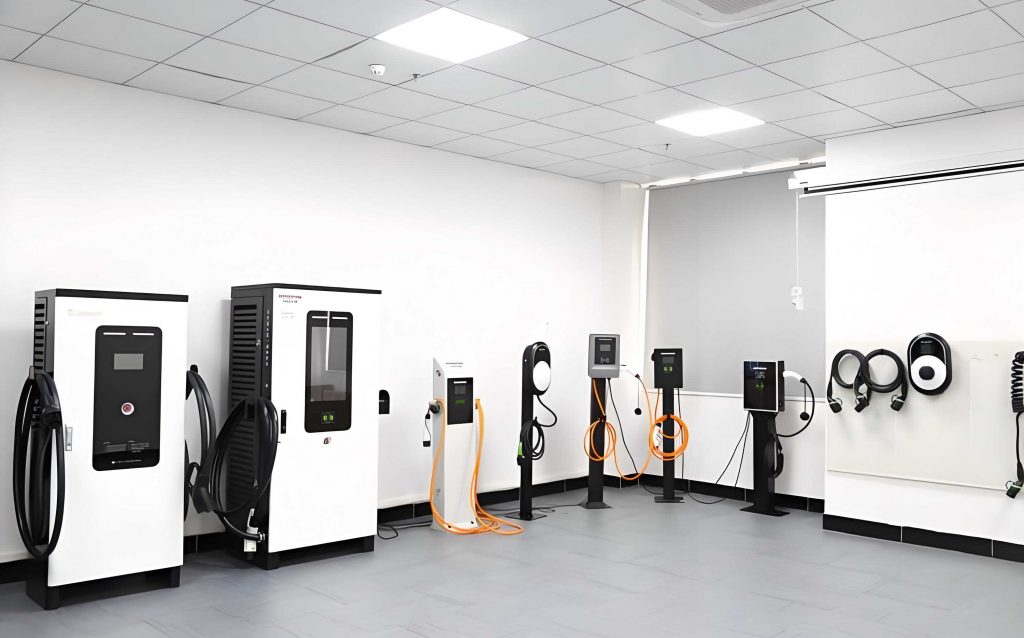
However, the scheduling and management of EV charging stations face numerous challenges in the context of rapid EV industry growth. The increasing number of EVs places higher demands on the service capacity, response efficiency, and operational management of EV charging stations across various scenarios, including urban roads, residential communities, and highways. Charging behaviors exhibit strong temporal concentration and spatial aggregation, leading to issues like long queues during peak hours (e.g., weekday rush hours and holidays) and low utilization during off-peak periods or in remote areas. This spatiotemporal mismatch complicates load management in scheduling systems. Unlike traditional refueling, the prolonged dwell time during EV charging exacerbates resource congestion. Furthermore, variations in EV usage patterns, routes, and operational models introduce high uncertainty and individuality in charging behaviors. Range anxiety among users, who tend to charge even when battery levels are sufficient, worsens the mismatch between supply and demand, making it difficult for scheduling platforms to achieve accurate predictions and efficient allocation, thereby reducing overall operational efficiency.
The current landscape of EV charging station construction is characterized by multiple stakeholders, platforms, and standards. Although the number of EV charging stations is growing rapidly, inconsistencies in layout planning, interface protocols, data formats, and communication protocols hinder interoperability. Issues such as system isolation, platform fragmentation, and data silos among different operators result in poor cross-platform user experiences, limited data sharing, and difficulties in unified scheduling. In smart connected vehicle scenarios, efficient information exchange and collaborative control between vehicles and EV charging stations are essential, but current reliance on manual operations or app-based scanning for charging initiation limits the implementation of advanced features like V2G, plug-and-charge, and automated navigation. Moreover, the distribution of EV charging stations in complex environments like public spaces and residential areas poses challenges in equipment maintenance, anomaly handling, and user complaints, increasing the pressure on scheduling systems. The insufficient integration of vehicle-to-everything and Internet of Things technologies further impedes the effectiveness of EV charging stations as key nodes in the vehicle-energy-road-grid ecosystem.
To address these challenges, we propose optimizing intelligent scheduling and management strategies for EV charging stations. This involves building a multi-dimensional data-driven intelligent scheduling system and promoting platform standardization and collaborative management mechanisms.
Building a Multi-Dimensional Data-Driven Intelligent Scheduling System
The management of EV charging station systems is evolving from traditional manual scheduling and static configuration toward data-driven, intelligent responses. Constructing a multi-dimensional data-driven intelligent scheduling system requires efforts in “global data collection and modeling” and “intelligent algorithms and platform协同 optimization” to form a closed-loop mechanism of dynamic perception, real-time response, precise decision-making, and efficient execution, thereby supporting the efficient operation of EV charging station systems in complex environments.
Intelligent scheduling relies on accurate perception. Given the highly time-varying and geographically diverse charging behaviors of EV users, it is necessary to establish a global data collection network covering the five dimensions of “vehicle-station-user-grid-site” to break the information silos in traditional charging systems. On the vehicle side, intelligent scheduling should integrate with the Battery Management System and onboard diagnostic systems to collect real-time data such as current battery level, state of health, driving range, travel routes, and charging history, building an energy consumption profile for each vehicle. For EV charging stations, data on operational status—including power levels, availability, queue lengths, pricing strategies, charging speeds, and historical utilization rates—should be incorporated to dynamically grasp resource distribution and load conditions. On the user side, data on travel patterns, charging preferences, time sensitivity, and payment habits can be gathered through apps, vehicle terminals, or smart interaction platforms to create user behavior models. By processing and dynamically modeling this structured data, multi-dimensional and multi-level charging demand prediction models can be developed to identify potential charging peaks, regional resource shortages, and user behavior trends in advance, providing robust data support for the scheduling system.
After high-quality collection and modeling of multi-dimensional data, we need to leverage technologies such as artificial intelligence, big data analytics, and edge computing to build an intelligent scheduling algorithm system, achieving an efficient transition from data perception to intelligent decision-making. Specifically, multi-objective optimization algorithms—such as genetic algorithms, particle swarm optimization, and reinforcement learning—can be introduced at the platform level to dynamically compute optimal scheduling paths and resource allocation strategies by considering factors like charging demand intensity, station availability, distance, user priority, electricity price fluctuations, and regional load. This ensures that users find the most suitable EV charging station in the shortest time, improving overall station utilization and user satisfaction. Additionally, differentiated scheduling strategy models should be constructed based on the usage characteristics of various EV types to enable personalized recommendations and tiered allocation. To further enhance the execution efficiency and user experience of the scheduling system, the platform can integrate Geographic Information Systems, high-precision maps, and route planning engines to achieve navigation-level charging guidance and real-time path optimization, forming a closed-loop intelligent scheduling system encompassing “prediction-recommendation-guidance-execution.”
For instance, the charging demand at an EV charging station can be modeled using a time-series forecasting approach. Let \( D(t) \) represent the charging demand at time \( t \), which can be expressed as:
$$ D(t) = \alpha \cdot P(t) + \beta \cdot W(t) + \gamma \cdot S(t) + \epsilon(t) $$
where \( P(t) \) denotes historical usage patterns, \( W(t) \) reflects weather conditions, \( S(t) \) indicates special events, and \( \alpha, \beta, \gamma \) are weighting coefficients. The error term \( \epsilon(t) \) accounts for random fluctuations. This model helps in predicting peaks and troughs in EV charging station usage.
To illustrate the data dimensions involved in scheduling, consider the following table summarizing key parameters for EV charging station management:
| Data Dimension | Description | Example Metrics |
|---|---|---|
| Vehicle Data | Information from EV systems | Battery level, health state, range |
| Station Data | Operational status of EV charging stations | Power output, availability, queue length |
| User Data | Behavioral and preference data | Charging frequency, time sensitivity |
| Grid Data | Electricity supply and demand | Load capacity, price variations |
| Site Data | Geographical and environmental factors | Location, traffic flow, land use |
Furthermore, the optimization of scheduling for EV charging stations can be formulated as a multi-objective problem. Let \( F \) be the objective function aiming to minimize user waiting time and maximize station utilization:
$$ \min F = \sum_{i=1}^{n} \left( w_i \cdot T_i + c_i \cdot U_i \right) $$
where \( T_i \) is the waiting time for user \( i \), \( U_i \) is the utilization rate of the assigned EV charging station, and \( w_i, c_i \) are weighting factors. Constraints include power limits and user preferences, ensuring efficient allocation across the EV charging station network.
Promoting Platform Standardization and Collaborative Management Mechanisms
In the rapid development of EV charging infrastructure, the lack of unified technical standards and insufficient collaborative management mechanisms have become key obstacles to improving the intelligent scheduling efficiency and service quality of EV charging stations. Achieving efficient integration of “people-vehicles-stations-grid-cloud” and promoting platform standardization and collaborative management mechanisms are not only essential for enhancing overall industry operational efficiency but also prerequisites for building a nationwide unified charging service ecosystem.
We should advocate for the establishment of a unified technical standard system covering multiple dimensions such as communication protocols, data interfaces, control logic, identity authentication, and billing methods for EV charging stations. This will break down information barriers between charging stations, operational platforms, and EV terminals, improving interoperability among systems. For example, adopting national standards like GB/T 27930 and GB/T 34657 for communication protocols ensures good compatibility when equipment from different manufacturers connects to a unified platform. In terms of data interfaces, open API standards should be established to facilitate third-party platforms, automakers, and energy companies in accessing and sharing data resources, thereby enhancing协同 efficiency among platforms. For billing and settlement, unified charging transaction rules and billing methods should be promoted, supporting cross-platform billing recognition and user bill integration to simplify payment processes and increase charging convenience. Standardization should also extend to emerging technology areas such as V2G, integrated photovoltaic-storage-charging, and intelligent distributed energy scheduling, laying the foundation for the deep integration of future energy and transportation systems. Relevant authorities should lead in formulating and promoting the implementation of unified standards, constructing a policy system combining mandatory and guidance-based measures to avoid redundant construction and further technical barriers, and fostering a standardized, modular, and integrated EV charging station infrastructure system nationwide.
On the basis of standardized unification, it is necessary to further improve collaborative management mechanisms to address the current management dilemmas of “information blockage, slow response, and resource fragmentation” in charging networks. Simultaneously, we should promote the establishment of regional or city-level charging协同调度 centers led by relevant departments, with participation from charging operators, EV manufacturers, grid companies, and third-party platforms. These centers would uniformly integrate data from various charging facilities and EV operations within their jurisdiction, achieving cross-platform resource coordination and unified scheduling. Based on multi-dimensional data such as real-time load, traffic flow, grid regulation, and user behavior, these调度 centers can dynamically release regional charging guidance information, enhancing the integrity and foresight of resource allocation. Additionally, a distributed collaborative architecture of “main platform + multiple nodes” should be promoted, allowing operators to retain their autonomous platforms while connecting key data and scheduling interfaces to the main platform, realizing flexible management characterized by “independent operation and协同 scheduling.” In the collaborative mechanism, blockchain-based data trust exchange mechanisms should be introduced to ensure the security, integrity, and traceability of shared data among parties, strengthening information trust and cooperation willingness among participants. The systematic construction of collaborative governance mechanisms can not only improve协同 efficiency among multiple platforms, devices, and users but also enhance the overall system’s emergency response capability to incidents such as large-scale congestion, equipment failures, and extreme weather, ensuring the resilience and stability of the EV charging station network.
Promoting platform standardization and collaborative management mechanisms is a key抓手 for achieving efficient operation of intelligent scheduling systems for EV charging stations. Unified data and communication standards can break down system barriers, improving platform compatibility and information flow efficiency; the establishment of collaborative management mechanisms provides institutional guarantees for resource sharing, strategy linkage, and risk sharing. As EV ownership continues to grow and user service demands diversify, building a standardized, mechanism-sound, and协同 efficient scheduling management system will become the foundational support for driving intelligent charging systems toward broad coverage, easy access, fast scheduling, and high quality.
The following table outlines the core elements of standardization and collaboration for EV charging stations:
| Aspect | Standardization Focus | Collaborative Mechanism |
|---|---|---|
| Communication | Unified protocols (e.g., GB/T standards) | Inter-platform data exchange |
| Data Interfaces | Open API specifications | Real-time resource sharing |
| Billing | Consistent transaction rules | Cross-operator payment integration |
| Technology | V2G and smart charging norms | Joint response to grid demands |
To quantify the benefits of standardization, consider the reduction in scheduling latency \( L \) after implementing unified protocols. If \( L_0 \) is the initial latency and \( L_s \) is the post-standardization latency, the improvement can be modeled as:
$$ \Delta L = L_0 – L_s = k \cdot \log(N) $$
where \( N \) is the number of integrated EV charging stations, and \( k \) is a constant factor. This logarithmic relationship highlights the efficiency gains as more EV charging stations adhere to common standards.
In conclusion, EV charging stations, as critical infrastructure supporting the sustainable development of electric vehicles, have made intelligent scheduling and scientific management core links in enhancing industry operational efficiency and user service experience. Faced with growing charging demands and diverse usage scenarios, we should base our efforts on data-driven approaches and platform协同 as pathways, promoting technical standard unification and management mechanism improvement to achieve efficient allocation of charging resources and intelligent, refined system operation. In the future, with the development of intelligent connected technology and the energy Internet, the management of EV charging stations will become more intelligent and efficient, providing strong support for the construction of a green, low-carbon transportation system. The continuous optimization of EV charging station networks will play a pivotal role in achieving global sustainability goals, ensuring that every EV charging station contributes maximally to energy efficiency and user convenience.