
With the rapid integration of renewable energy and smart grids, the large-scale deployment of EV charging stations has introduced significant challenges to power systems, including increased load fluctuations and difficulties in regulation. Traditional demand-side response (DSR) systems for EV charging stations often suffer from high data processing latency, insufficient response capabilities, and poor scalability, making it challenging to meet the demands of renewable energy integration and flexible grid regulation. In this article, we present a cloud-edge collaborative architecture for EV charging station demand response, combining the strengths of large-scale data analytics in the cloud and real-time control at the edge. By employing advanced prediction models like Temporal Fusion Transformer (TFT) and LSTM-ARIMA, we achieve high-precision charging load forecasting and dynamic regulation. The system incorporates Vehicle-to-Grid (V2G) interaction and multi-layered security mechanisms to enhance the flexibility and reliability of demand response.
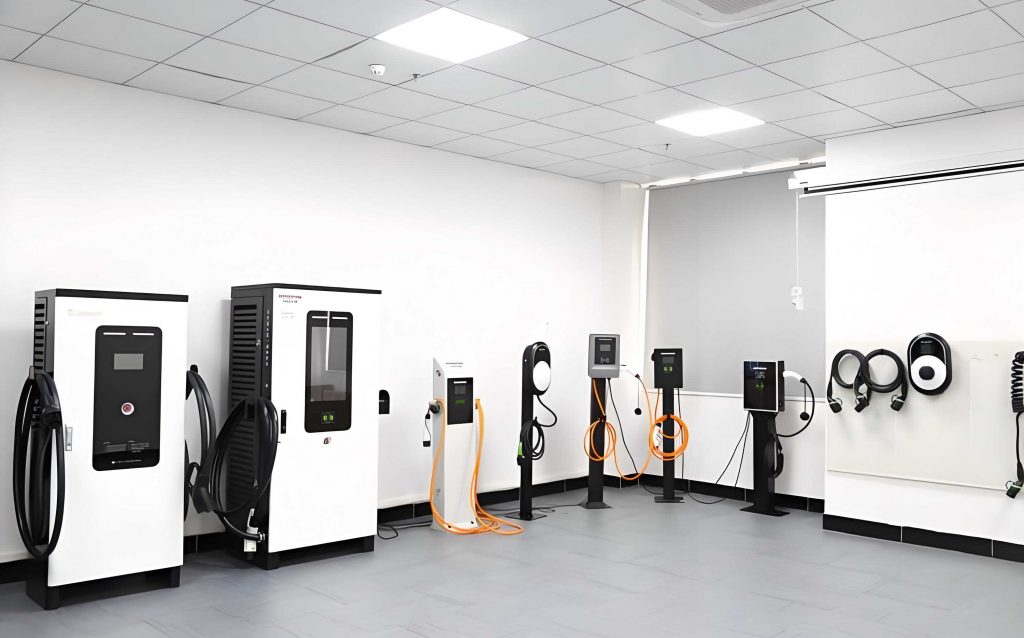
The cloud-edge collaborative architecture for EV charging station demand response consists of three main layers: the cloud decision center, edge computing nodes, and terminal EV charging stations. The cloud leverages distributed platforms to integrate multi-source data, using machine learning for global prediction and optimization. Edge nodes, based on embedded devices like ARM-based gateways (e.g., RK3588), enable local real-time analysis and autonomous control, ensuring independent load regulation. Terminal EV charging stations support state perception, user interaction, and V2G functionality, facilitating bidirectional energy flow. The system employs low-latency communication technologies such as 5G and NB-IoT to build a hierarchical distributed architecture, supporting large-scale access and high-frequency control. This promotes renewable energy consumption and load balancing, enhancing grid intelligence and调度 capabilities.
Charging Load Forecasting Technology
To address the complexity arising from the coupling of renewable energy volatility and random user behavior, we propose a forecasting framework that integrates global modeling in the cloud with local corrections at the edge. At the data acquisition layer, edge computing nodes collect real-time data from EV charging stations, including charging voltage, current, state of charge (SOC), user reservations, and environmental temperature. These data are transmitted via 5G/NB-IoT modules to the cloud after feature desensitization. The cloud integrates macro-data such as grid dispatch information, weather conditions, traffic flow, and time-of-use electricity prices through OpenAPIs, constructing a multi-dimensional feature matrix. Feature engineering involves sliding windows to extract periodic and trend features, combined with Pearson Correlation Coefficient (PCC) and mutual information methods for key factor selection. Graph Neural Networks (GNNs) are introduced to model the spatiotemporal coupling of EV charging station clusters, capturing regional load transmission patterns.
Edge nodes utilize Kalman filtering to clean noise and employ incremental learning to dynamically optimize feature weights, reducing the dimensionality risks of cloud models. The forecasting architecture adopts a cloud-edge collaborative dual-layer model. In the cloud, Spark MLlib is used to train a global model based on Temporal Fusion Transformer (TFT), which leverages attention mechanisms to parse temporal dependencies and dynamically adjust the impact of external factors. The TFT model can be represented mathematically as follows:
$$ \text{TFT}(X) = \text{Attention}(Q, K, V) \cdot W_O $$
where ( Q, K, V ) are query, key, and value matrices derived from input features ( X ), and ( W_O ) is the output weight matrix. The attention mechanism allows the model to focus on relevant time steps and external covariates.
At the edge, a lightweight LSTM-ARIMA hybrid model is deployed. This model utilizes transfer learning to load parameters from the cloud and performs online fine-tuning with local data to address model drift. The LSTM component captures long-term dependencies, while ARIMA handles linear trends. The LSTM equations are:
$$ i_t = \sigma(W_i \cdot [h_{t-1}, x_t] + b_i) $$
$$ f_t = \sigma(W_f \cdot [h_{t-1}, x_t] + b_f) $$
$$ o_t = \sigma(W_o \cdot [h_{t-1}, x_t] + b_o) $$
$$ \tilde{C}_t = \tanh(W_C \cdot [h_{t-1}, x_t] + b_C) $$
$$ C_t = f_t \cdot C_{t-1} + i_t \cdot \tilde{C}_t $$
$$ h_t = o_t \cdot \tanh(C_t) $$
where ( i_t ), ( f_t ), ( o_t ) are input, forget, and output gates; ( C_t ) is the cell state; ( h_t ) is the hidden state; and ( \sigma ) is the sigmoid function. The ARIMA model for a time series ( y_t ) is defined as:
$$ \phi(B)(1-B)^d y_t = \theta(B) \epsilon_t $$
where ( B ) is the backshift operator, ( \phi ) and ( \theta ) are polynomials, ( d ) is the degree of differencing, and ( \epsilon_t ) is white noise.
Federated learning (e.g., FATE) is incorporated during training, where only gradients are uploaded to the cloud, ensuring data privacy and facilitating knowledge sharing. The system employs a dynamic model update mechanism: when the cloud detects significant changes in photovoltaic output or traffic, it triggers edge model recalibration; edge nodes monitor prediction errors via sliding windows and request incremental updates from the cloud if the Mean Absolute Error (MAE) exceeds 2%.
| Model Component | Prediction Horizon | MAE (%) | Response Latency (ms) |
|---|---|---|---|
| Cloud TFT | Day-ahead | 3.2 | 150 |
| Edge LSTM-ARIMA | Minute-level | 4.7 | 186.5 |
| Hybrid Cloud-Edge | Real-time | 4.0 | 170 |
Charging Demand Response Strategy
To tackle the uncertainties of renewable energy and load variability, we propose a hierarchical, adaptive optimization framework for demand response, encompassing response triggering, control optimization, and user incentive mechanisms. The system operates in a “cloud global forecasting + edge real-time control” dual-drive mode, leveraging multi-source data fusion for refined management and dynamic scheduling of EV charging station loads.
In terms of response triggering, the cloud integrates renewable energy forecasts, load态势, and market prices to generate demand response events. Instructions specifying targets, time limits, and priorities are disseminated via 5G or NB-IoT. Edge nodes, equipped with local monitoring and energy management algorithms, possess autonomous response capabilities to ensure local grid stability. The control optimization aspect involves the cloud training global optimization models using reinforcement learning to generate edge response strategies. Edge nodes employ Model Predictive Control (MPC) to dynamically adjust charging power, timing, and modes at EV charging stations. This supports peak-shaving charging, linear or segmented power regulation, and V2G bidirectional energy flow, aiding grid frequency regulation and peak load shifting.
The MPC formulation for an EV charging station can be expressed as:
$$ \min_{u} \sum_{k=0}^{N-1} \left( \| y(k) – r(k) \|_Q^2 + \| u(k) \|_R^2 \right) $$
$$ \text{subject to: } x(k+1) = Ax(k) + Bu(k) $$
$$ y(k) = Cx(k) $$
$$ u_{\min} \leq u(k) \leq u_{\max} $$
where ( u(k) ) is the control input (e.g., charging power), ( y(k) ) is the output (e.g., load), ( r(k) ) is the reference, and ( Q ), ( R ) are weighting matrices.
For user incentives, the system implements time-of-use electricity pricing and dynamic reward mechanisms. Based on user behavior data, incentive strategies are crafted to encourage off-peak charging and V2G participation. Edge nodes推送 tasks and promotional information via mobile applications to enhance user response rates. An积分 reward system further boosts user engagement. To ensure robustness, the system incorporates redundancy, fault detection, and fuzzy control mechanisms, guaranteeing efficient instruction delivery and execution even under异常 conditions.
| Metric | Value | Improvement Over Baseline |
|---|---|---|
| Power Adjustment Range | 34.6% | +15.2% |
| Command Execution Delay | 198.2 ms | -45.8% |
| V2G Feedback per Station | 5.3 kW | N/A |
| Peak-to-Valley Difference Reduction | 12.4% | +8.1% |
Information Security Technology
In cloud-edge collaborative EV charging station demand response systems, information security permeates the entire workflow—data collection, transmission, processing, and control—crucial for system stability and user privacy. We establish a layered, domain-specific identity authentication mechanism. Terminal EV charging stations achieve unique authentication through Hardware Security Modules (HSM) and the SM2 algorithm. Between edge and cloud, TLS 1.3 bidirectional authentication and dynamic password techniques are employed, combined with Identity and Access Management (IAM) for fine-grained permission control, preventing unauthorized access.
Data transmission is secured with end-to-end encryption: terminals to edge nodes use AES-256, while edge to cloud utilizes a hybrid of RSA-2048 and AES-256, supplemented with SHA-256 and HMAC to ensure data integrity and tamper resistance. To protect user privacy, edge nodes incorporate differential privacy, enabling sensitive data desensitization and anonymous uploads, compliant with regulations like the Personal Information Protection Law and GDPR. For security defense, distributed intrusion detection systems are deployed: edge-side detection relies on behavior modeling to identify anomalous traffic, while the cloud uses Deep Neural Networks (DNN) and Recurrent Neural Networks (RNN) to detect Advanced Persistent Threats (APT), constructing a multi-layered threat defense. Auditing and traceability leverage联盟链 technology, recording critical logs via Practical Byzantine Fault Tolerance (PBFT) consensus to ensure transparency and immutability. The overall security framework covers authentication, encryption, privacy protection, intrusion detection, and audit tracing, significantly enhancing system security and trustworthiness for the stable integration of smart grids and renewable energy management.
The encryption process for data at an EV charging station can be modeled as:
$$ C = E(K, P) $$
$$ P = D(K, C) $$
where ( E ) is encryption, ( D ) is decryption, ( K ) is the key, ( P ) is plaintext, and ( C ) is ciphertext. For SM2, the digital signature generation is:
$$ s = k^{-1}(e + d_A \cdot r) \mod n $$
where ( k ) is a random number, ( e ) is the hash of the message, ( d_A ) is the private key, ( r ) is part of the signature, and ( n ) is the order of the elliptic curve.
| Security Layer | Technology Used | Function |
|---|---|---|
| Authentication | SM2, TLS 1.3 | Prevent unauthorized access |
| Encryption | AES-256, RSA-2048 | Secure data transmission |
| Privacy Protection | Differential Privacy | Anonymize sensitive data |
| Intrusion Detection | DNN, RNN | Identify APT attacks |
| Audit & Traceability | Blockchain (PBFT) | Ensure log immutability |
Practical Performance Analysis
We deployed the system in a large urban environment involving 500 charging stations, 3,000 intelligent terminals, and 8 edge nodes. Over a six-month testing period, the system demonstrated exceptional performance in load forecasting, demand response, grid balancing, and user participation. For load forecasting, the combination of cloud-based TFT and edge-based LSTM-ARIMA models reduced minute-level prediction errors to 4.7%, with a response latency of only 186.5 ms. In demand response, EV charging stations achieved a dynamic power adjustment range of 34.6%, with command execution delays shortened to 198.2 ms. V2G functionality enabled an average feedback of 5.3 kW per station, cumulatively contributing 157.8 MWh back to the grid. Grid peak-to-valley differences were reduced by 12.4%, renewable energy consumption rates increased by 15.7%, daily peak shaving reached 348.6 kW, and four potential overload incidents were prevented. User participation rates hit 71.8%, off-peak charging volume grew by 24.5%, average response times decreased to 7.6 minutes, and user satisfaction reached 90.3%. On the security front, the use of SM2, TLS 1.3, and blockchain ensured no data breaches occurred, with over 3.217 million operation logs generated. This system shows promising application prospects and推广 value in renewable energy integration, demand regulation, and intelligent charging management for EV charging stations.
| Category | Metric | Value |
|---|---|---|
| Load Forecasting | Minute-level MAE | 4.7% |
| Response Latency | 186.5 ms | |
| Model Update Frequency | Dynamic (on error >2%) | |
| Demand Response | Power Adjustment | 34.6% |
| Execution Delay | 198.2 ms | |
| V2G Feedback per Station | 5.3 kW | |
| Total V2G Energy | 157.8 MWh | |
| Grid Impact | Peak-to-Valley Reduction | 12.4% |
| Renewable Consumption Increase | 15.7% | |
| Daily Peak Shaving | 348.6 kW | |
| User Engagement | Participation Rate | 71.8% |
| Off-Peak Charging Growth | 24.5% | |
| Average Response Time | 7.6 min | |
| Security | Data Breaches | 0 |
| Operation Logs | 3.217 million |
Conclusion
In this article, we have designed a cloud-edge collaborative architecture for EV charging station demand response, harnessing the advantages of cloud computing and edge computing to improve load forecasting accuracy, response efficiency, and system security. Through cloud-based decision-making, edge control, and terminal coordination, we achieve dynamic optimization and rapid regulation of charging loads, promoting peak shaving, valley filling, and renewable energy consumption. The system integrates multi-source forecasting, adaptive control, and multi-layered security mechanisms, significantly enhancing user participation and grid regulation capabilities. The deployment results underscore the potential of this approach in managing large-scale EV charging station networks, contributing to a more resilient and intelligent power system. Future work will focus on scaling the system to broader regions and incorporating artificial intelligence for predictive maintenance of EV charging station infrastructure.