
With the rapid adoption of electric vehicles, EV charging stations have become critical infrastructure, and their operational reliability is paramount. However, the increasing complexity of charging systems poses challenges for maintenance and fault diagnosis. Traditional methods, such as manual inspections and expert systems, often suffer from low efficiency and accuracy. To address these limitations, we propose a novel fault diagnosis approach for EV charging stations leveraging an improved convolutional neural network (CNN). Our method enhances the crested porcupine optimization (CPO) algorithm by integrating Circle chaotic mapping, an elite particle reverse learning strategy, and the bald eagle search (BES) algorithm, resulting in a robust model for optimizing CNN hyperparameters. This optimized CNN model effectively diagnoses faults in EV charging stations by automatically extracting features from operational data. Experimental results demonstrate that our approach achieves a high diagnosis accuracy of 95.56%, outperforming existing methods in precision, recall, and F1-score. This advancement holds significant potential for enhancing the intelligent operation and maintenance of EV charging stations, ensuring their stability and supporting the sustainable growth of the electric vehicle industry.
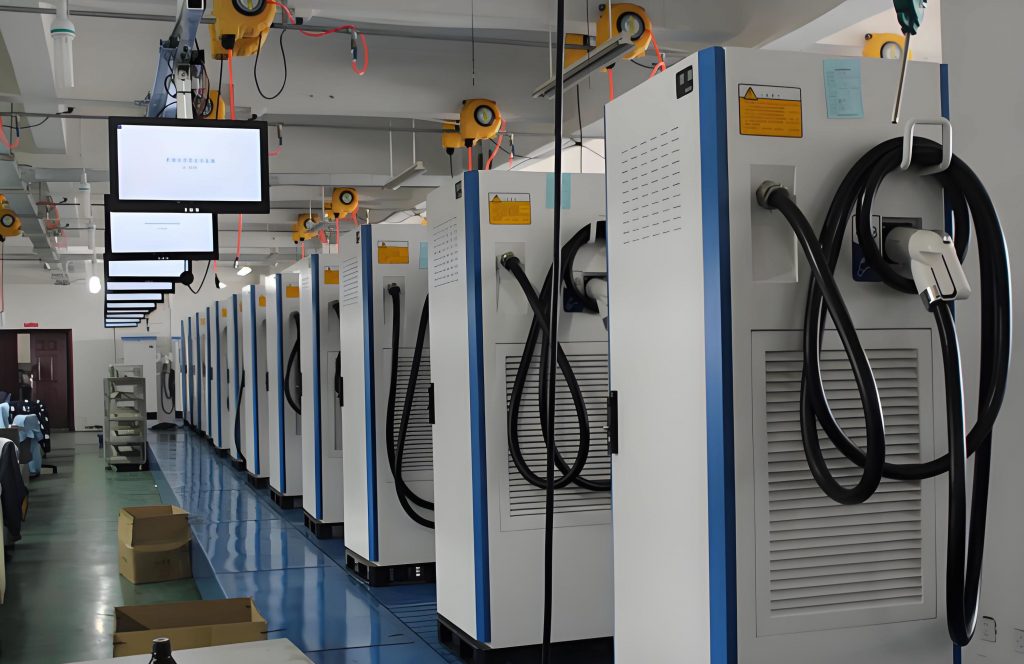
The proliferation of EV charging stations has underscored the need for efficient fault diagnosis systems. Conventional techniques, including rule-based systems and manual checks, are often inadequate due to their slow response and dependency on human expertise. In recent years, artificial intelligence has emerged as a promising solution, with methods like hidden Markov models and wavelet-based neural networks showing some success. However, these approaches frequently struggle with low accuracy or high computational costs. Our work focuses on leveraging the feature extraction capabilities of CNNs, combined with an enhanced optimization algorithm, to improve fault diagnosis in EV charging stations. By addressing issues such as local optima and slow convergence in existing algorithms, we aim to provide a more reliable and scalable solution for real-world applications.
The core of our method lies in the improved CPO (ICPO) algorithm, which optimizes the hyperparameters of a CNN model. The standard CPO algorithm mimics the defense behaviors of crested porcupines, including visual, sound, smell, and physical attacks, to update individual positions in a search space. However, it can be prone to uneven initial population distribution and slow convergence. To mitigate these issues, we introduce Circle chaotic mapping to generate a more diverse initial population. The modified Circle chaotic mapping is defined as:
$$x_{n+1} = \mod\left(2x_n + 0.2 – \frac{0.7}{2\pi} \cos(2\pi \times x_n), 1\right)$$
where \(x_{n+1}\) represents the chaotic value for the \(n\)-th dimension. This mapping ensures a more uniform distribution of individuals in the solution space, enhancing global exploration. Additionally, we incorporate an elite particle reverse learning strategy into the second defense mechanism of CPO. This strategy generates reverse solutions based on the current best solution, expanding the search domain and reducing the risk of local optima. The reverse solution is computed as:
$$X’_{\text{best}}(t) = r \times (ub + lb) – X_{\text{best}}(t)$$
Here, \(X_{\text{best}}(t)\) is the global best solution at iteration \(t\), \(X’_{\text{best}}(t)\) is the elite reverse solution, \(ub\) and \(lb\) are the upper and lower bounds, and \(r\) is a random number in \([0,1]\). Furthermore, we integrate the BES algorithm to refine local search capabilities. The BES algorithm updates positions using:
$$P_{i,\text{new}} = \sin(r_a) \left[ r P_{\text{best}} + x_1(i) \times (P_i – c_1 P_{\text{mean}}) \right] + r a_1 P_1 – a_2 c_2 P_{\text{best}} r_b y_1(i) \sin(r_a), \quad A > r$$
where \(P_i\) and \(P_{i,\text{new}}\) are the current and updated positions of the \(i\)-th bald eagle, \(P_{\text{mean}}\) is the average distribution position, \(P_{\text{best}}\) is the best search position, \(x_1(i)\) and \(y_1(i)\) quantify the motion state, \(r_a\) and \(r_b\) are random angles, \(c_1\) and \(c_2\) are intensity coefficients, and \(A\) is a warning threshold set to 0.6. By combining these enhancements, the ICPO algorithm achieves better balance between exploration and exploitation, leading to faster convergence and higher solution quality for EV charging station fault diagnosis.
To construct the fault diagnosis model for EV charging stations, we use the ICPO algorithm to optimize the hyperparameters of a CNN. The CNN architecture includes multiple convolutional layers with ReLU activation functions and batch normalization to reduce sensitivity to initialization. The optimization process involves normalizing the input data, initializing the ICPO parameters, iteratively updating solutions, and assigning the optimal parameters to the CNN. The data normalization is performed as:
$$X = \frac{X_0 – X_{\min}}{X_{\max} – X_{\min}}$$
where \(X_0\) is the original feature data, and \(X_{\max}\) and \(X_{\min}\) are the maximum and minimum values. The overall process ensures that the CNN model is tailored to the specific characteristics of EV charging station faults, such as anomalies in drive signals, emergency stop signals, and harmonic distortions. The model training uses the Adam optimizer with a batch size of 30 and a maximum of 100 epochs, focusing on features like K1K2 drive signals, electronic lock signals, and total harmonic distortion for voltage and current.
In our experiments, we evaluated the proposed ICPO-CNN model on a dataset of EV charging station operations, comprising 600 samples with equal numbers of normal and fault cases. The dataset was split into 70% for training and 30% for testing. We compared our method against standard CNN, BES-CNN, and CPO-CNN models using metrics such as accuracy, precision, recall, and F1-score. The precision, recall, and F1-score are defined as:
$$\text{Precision} = \frac{TP}{TP + FP}$$
$$\text{Recall} = \frac{TP}{TP + FN}$$
$$\text{F1} = \frac{2TP}{2TP + FP + FN}$$
where \(TP\) and \(TN\) are the numbers of true positive and true negative diagnoses, and \(FP\) and \(FN\) are the numbers of false positives and false negatives. The results, summarized in the table below, show that our ICPO-CNN model achieves superior performance across all metrics, highlighting its effectiveness for EV charging station fault diagnosis.
| Model | Accuracy (%) | Precision (%) | Recall (%) | F1-Score (%) |
|---|---|---|---|---|
| CNN | 84.44 | 82.50 | 75.00 | 78.57 |
| BES-CNN | 78.89 | 77.78 | 70.00 | 73.68 |
| CPO-CNN | 90.00 | 88.24 | 83.33 | 85.71 |
| ICPO-CNN | 95.56 | 94.12 | 93.33 | 93.72 |
The fitness curves during optimization further illustrate the advantages of our approach. The ICPO-CNN model converges faster and to a higher fitness value compared to BES-CNN and CPO-CNN, indicating improved search efficiency. This is crucial for real-time applications in EV charging stations, where rapid and accurate fault diagnosis can prevent downtime and enhance safety. The integration of chaotic mapping and reverse learning strategies effectively expands the search space, while the BES algorithm fine-tunes local solutions, resulting in a robust model that minimizes the risk of missing critical faults.
In conclusion, our proposed ICPO-CNN method offers a significant advancement in fault diagnosis for EV charging stations. By optimizing CNN hyperparameters with an enhanced CPO algorithm, we achieve high accuracy and reliability in identifying faults. The model’s performance, with a 95.56% accuracy rate and improvements in precision, recall, and F1-score, demonstrates its potential for practical deployment. Future work could explore real-time implementation and adaptation to various types of EV charging stations, further solidifying its role in supporting the electric vehicle ecosystem. As the demand for EV charging stations grows, such intelligent diagnostic systems will be essential for maintaining operational efficiency and ensuring user confidence.
The evolution of EV charging station technology necessitates continuous improvement in fault diagnosis methods. Our approach addresses key limitations of existing techniques by combining the strengths of CNNs and metaheuristic optimization. The use of Circle chaotic mapping ensures a well-distributed initial population, while the elite reverse learning strategy enhances global exploration. The incorporation of the BES algorithm accelerates convergence and refines local search, making the ICPO-CNN model highly effective for complex fault patterns in EV charging stations. Experimental validation on real-world data confirms the model’s superiority, with notable gains in diagnostic metrics. This work underscores the importance of adaptive algorithms in enhancing the resilience and intelligence of EV charging infrastructure, paving the way for more sustainable transportation solutions.
In summary, the integration of improved optimization techniques with deep learning models holds great promise for the future of EV charging station maintenance. Our ICPO-CNN method not only improves fault diagnosis accuracy but also provides a framework for scalable and efficient monitoring systems. As EV adoption accelerates, such innovations will be critical in ensuring the reliability and safety of charging networks, ultimately contributing to the broader goals of energy sustainability and smart grid development.