
As the new energy vehicle industry accelerates globally, the proliferation of EV charging stations has become a critical component of modern infrastructure. However, this rapid expansion brings forth significant fire safety challenges, including electrical faults, battery thermal runaway, and equipment failures. Traditional safety management approaches, which heavily rely on manual inspections and reactive measures, are increasingly inadequate due to their delayed response times, limited coverage, and inefficiencies. In this context, artificial intelligence (AI) emerges as a transformative force, offering innovative solutions to enhance fire safety in EV charging stations. I will delve into the multifaceted applications of AI, encompassing intelligent monitoring, predictive maintenance, emergency response, cybersecurity, and process optimization. Additionally, I will address the practical challenges such as data heterogeneity, model adaptability, and cost constraints, while outlining strategic pathways for implementation. By leveraging AI, we can construct a proactive, intelligent, and resilient safety framework for EV charging stations, ultimately supporting the sustainable growth of the electric vehicle ecosystem.
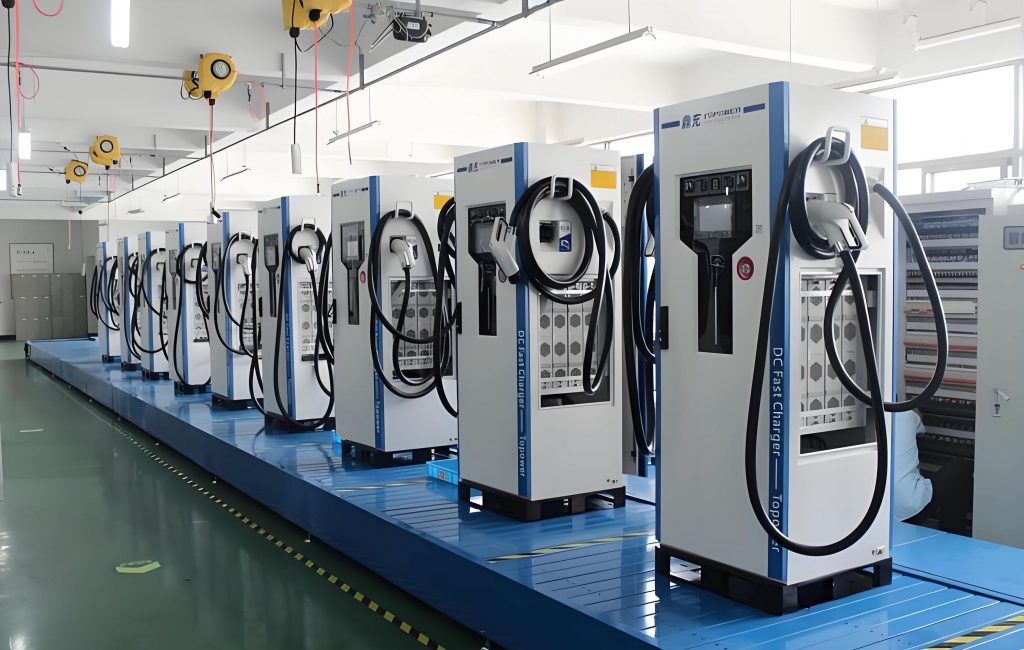
Intelligent Monitoring and Early Warning Systems
AI-driven intelligent monitoring systems are revolutionizing fire safety in EV charging stations by enabling real-time detection and preemptive actions. For instance, temperature sensors embedded within charging piles continuously collect data, which AI algorithms analyze to regulate charging power based on predefined thresholds. If temperatures exceed safe limits, the system automatically cuts off power to prevent hazards. This proactive approach significantly reduces the risk of fires in EV charging stations. Moreover, visual AI technologies, such as computer vision, integrate with thermal imaging cameras to monitor temperature variations across the station. By identifying anomalies like overheating batteries or equipment, AI can alert operators and users promptly. For example, the AI system might detect a battery with an abnormal thermal profile during charging and send notifications to both the station manager and the vehicle owner, enabling swift intervention.
In terms of behavioral analysis, AI leverages surveillance footage to recognize unsafe practices, such as improper handling of charging cables or unauthorized vehicle occupancy. Through real-time audio alerts, users are guided to adhere to safety protocols, thereby minimizing human-induced risks. Battery safety is particularly critical in EV charging stations; AI algorithms assess parameters like charging curves, internal resistance, and temperature rise to predict potential thermal runaway events. The State of Health (SOH) of batteries can be evaluated using historical data, with AI models estimating degradation levels. A common formula for SOH calculation is: $$ SOH = \frac{C_{\text{current}}}{C_{\text{initial}}} \times 100\% $$ where \( C_{\text{current}} \) represents the current battery capacity and \( C_{\text{initial}} \) is the initial capacity. By integrating these insights, AI systems provide early warnings for battery-related hazards, enhancing overall safety in EV charging stations.
Predictive Maintenance and Risk Assessment
Predictive maintenance (PdM) powered by AI transforms the maintenance paradigm in EV charging stations from reactive to proactive. By analyzing historical and real-time operational data, machine learning models forecast the remaining useful life (RUL) of critical components, such as power converters and connectors. For example, the RUL can be modeled as: $$ RUL(t) = \int_t^{t_f} f(\theta(\tau)) \, d\tau $$ where \( \theta \) denotes operational parameters like load current and temperature. This allows for optimized maintenance schedules, reducing unplanned downtime and preventing catastrophic failures in EV charging stations. Additionally, AI facilitates dynamic risk assessment by fusing multi-source data, including environmental conditions, equipment status, and incident histories. A risk score can be computed using a weighted sum: $$ \text{Risk Score} = \sum_{i=1}^n w_i \cdot x_i $$ where \( w_i \) are weights assigned to factors such as temperature fluctuations and usage frequency, and \( x_i \) are the normalized values of these factors. This enables operators to identify high-risk periods and implement measures like load shifting to mitigate dangers.
The system architecture for AI-driven safety in EV charging stations involves multiple layers, as summarized in the table below:
| Layer | Description | Examples |
|---|---|---|
| Smart Applications | User-facing platforms for monitoring and control | Web dashboards, mobile apps |
| Software Platform | Core AI algorithms and data processing | Machine learning models, digital twins |
| Computing Hardware | Edge and cloud infrastructure for computation | GPU servers, IoT gateways |
| Basic Equipment | Physical devices in EV charging stations | Charging piles, sensors, cameras |
This integrated approach ensures comprehensive coverage and efficient resource allocation, making EV charging stations safer and more reliable.
Emergency Response and Automated Handling
In emergency scenarios, AI enhances the responsiveness of EV charging stations through automated systems and intelligent alerting. When anomalies are detected, AI classifies them into tiers—such as minor warnings, severe alerts, and critical emergencies—and dispatches notifications to relevant personnel. For instance, a minor temperature rise might trigger a warning to on-site staff, while a confirmed fire event automatically activates power shutdown and fire suppression systems. The response time can be modeled probabilistically: $$ P(\text{response} \leq t) = 1 – e^{-\lambda t} $$ where \( \lambda \) is the rate parameter based on system efficiency. This ensures that EV charging stations can handle incidents with minimal human intervention, reducing potential damages.
Furthermore, AI supports emergency command centers by aggregating real-time data from cameras, sensors, and environmental monitors. For example, in the event of a fire, the AI system can display live video feeds and suggest optimal evacuation routes using graph-based algorithms: $$ \text{Shortest Path} = \arg\min_{\text{path}} \sum \text{cost}(edge) $$ where the cost considers factors like smoke density and obstruction levels. By automating these processes, EV charging stations achieve faster and more coordinated responses, safeguarding both users and infrastructure.
Cybersecurity and Process Optimization
Cybersecurity is paramount in EV charging stations, as network breaches could compromise safety systems. AI-driven threat detection analyzes network traffic patterns to identify malicious activities, such as DDoS attacks or data tampering. A threat score can be calculated using: $$ \text{Threat Level} = \frac{\sum \text{anomaly indicators}}{\text{total traffic}} \times 100\% $$ This enables preemptive blocking of threats, ensuring the integrity of EV charging stations. Additionally, AI optimizes operational processes by monitoring compliance through computer vision and IoT sensors. For instance, AI systems track maintenance activities and flag deviations from protocols, leading to continuous improvement in safety practices.
The table below compares safety metrics before and after AI implementation in EV charging stations, based on a sample dataset:
| Metric | Pre-AI (Baseline) | Post-AI Implementation | Improvement |
|---|---|---|---|
| Monthly Fire Incidents | 15.2 | 4.8 | 68% reduction |
| False Alarm Rate | 25% | 8% | 17 percentage points |
| Average Response Time (min) | 5.0 | 1.5 | 70% faster |
| Unplanned Downtime (hours/month) | 1200 | 360 | 70% reduction |
| Maintenance Cost per Station (k$) | 20.0 | 13.0 | 35% savings |
These improvements highlight the tangible benefits of AI in enhancing the safety and efficiency of EV charging stations.
Challenges in AI Implementation
Despite its advantages, deploying AI in EV charging stations faces several hurdles. Data acquisition is complex due to the diversity of equipment and sensors, leading to issues like inconsistent formats and missing values. For example, integrating data from multiple brands of charging piles requires robust ETL (Extract, Transform, Load) processes, which can be resource-intensive. Model optimization also poses challenges; AI algorithms must adapt to evolving conditions, such as new battery technologies or extreme weather. The generalization error of a model can be expressed as: $$ \text{Error} = \text{Bias}^2 + \text{Variance} + \text{Noise} $$ where high variance may lead to overfitting in dynamic environments of EV charging stations. Cost is another barrier, as high-precision sensors and computing infrastructure entail significant investments, particularly for small-scale operators. Moreover, the shortage of skilled professionals who understand both AI and EV charging station operations hinders widespread adoption. Standardization gaps, such as the lack of unified protocols for data privacy and algorithm transparency, further complicate implementation. Lastly, AI systems themselves are vulnerable to attacks, including adversarial inputs that deceive models, necessitating robust security measures.
Practical Pathways for AI Integration
To overcome these challenges, a phased approach is essential for integrating AI into EV charging stations. Initially, operators should conduct risk assessments to identify priority areas, such as fire-prone zones or high-usage equipment. By starting with pilot projects—for instance, deploying AI-based thermal monitoring in a subset of EV charging stations—organizations can validate effectiveness before scaling. Data foundation is crucial; investing in scalable sensor networks and cloud platforms ensures reliable data streams. The cost-benefit analysis can be modeled as: $$ \text{Net Benefit} = \sum (\text{risk reduction} – \text{implementation cost}) $$ which helps in justifying investments. Technology selection should favor modular AI solutions that allow incremental upgrades, reducing initial outlays. Collaborations with research institutions and AI vendors can accelerate innovation, while training programs for staff bridge the skills gap. The maturity of AI applications varies across EV charging station types, as shown below:
| Station Type | Number of Stations | Sensor Coverage | AI Accuracy | Computing Setup | Maturity Level |
|---|---|---|---|---|---|
| Public Fast Charging | 40,000 | 90% | 95% | Edge Computing | High |
| Commercial Fleet Charging | 5,000 | 80% | 88% | Hybrid Cloud | Medium |
| Residential Charging | 250,000 | 30% | 75% | Cloud-Centric | Low |
By addressing these aspects, stakeholders can progressively build resilient AI-powered safety systems for EV charging stations, fostering a safer and more efficient charging ecosystem.
Conclusion
AI technology holds immense potential to redefine fire safety in EV charging stations, offering scalable solutions for monitoring, prediction, and response. While challenges like data integration and costs persist, strategic implementation pathways—such as phased rollouts and workforce development—can mitigate these issues. The long-term benefits, including reduced incident rates and lower operational expenses, underscore the value of AI investments. As the EV charging station network expands, continuous innovation and collaboration will be key to achieving sustainable safety standards. I am confident that AI-driven approaches will become integral to the future of EV charging infrastructure, ensuring protection for users and assets alike.