
With the rapid adoption of electric vehicles globally, the metering accuracy of DC EV charging stations has become a critical factor in ensuring fair billing and user trust. As a key infrastructure component, EV charging stations must deliver precise energy measurements under varying operational conditions. This study focuses on analyzing metering errors in DC EV charging stations, drawing from the framework of JJG 1149-2022, which outlines metering performance requirements and verification methods. We investigate multiple error sources, including ripple interference, temperature drift, and hardware characteristics, and propose an advanced error analysis method integrating signal decomposition and neural networks. Through experimental validation, we demonstrate the effectiveness of our approach in enhancing metering precision, thereby supporting the optimization of EV charging station performance and the implementation of standardized inspection protocols.
The proliferation of EV charging stations has highlighted the importance of reliable metering systems. Inaccurate measurements can lead to financial losses for consumers or operators and undermine confidence in electric mobility. EV charging stations, particularly DC types, operate in diverse environments, exposing metering modules to factors like electromagnetic noise, thermal variations, and component aging. Our research addresses these challenges by developing a comprehensive error analysis methodology that leverages modern signal processing and machine learning techniques. This work not only aligns with regulatory standards but also contributes to the technological advancement of EV charging station infrastructure, promoting fairness and efficiency in the charging ecosystem.
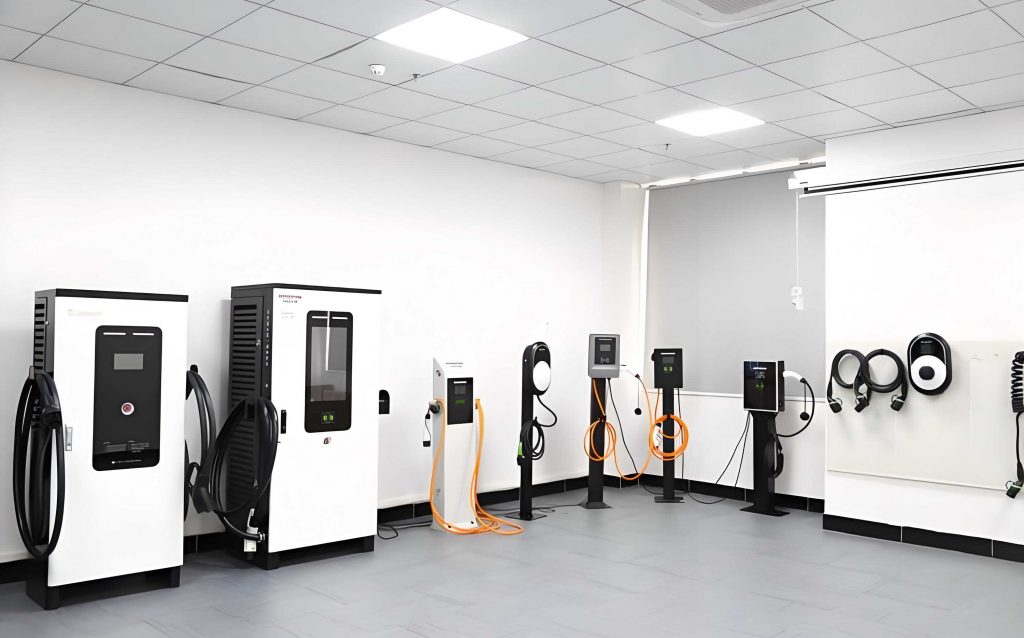
Metering Requirements and Error Source Analysis
According to JJG 1149-2022, EV charging stations must adhere to specific metering criteria to ensure accuracy and reliability. These requirements cover aspects such as working error, clock synchronization, minimum energy increment, and display resolution. For instance, Level 1 EV charging stations are mandated to have a working error within ±1.0%, while Level 2 stations allow for ±2.0%. Compliance with these standards is essential for maintaining the integrity of EV charging station operations. The table below summarizes the key metering requirements as per the regulation.
| Parameter | Technical Specification | Verification Method |
|---|---|---|
| Working Error | Level 1: ≤±1.0%, Level 2: ≤±2.0% | Real Load Method / Standard Meter Method |
| Clock Time Error | ≤±0.5s per 24 hours | Time Synchronization Device Comparison |
| Minimum Energy Increment | ≤0.001 kWh | Display Resolution Test |
| Energy Display | 6 or more digits (including 3 decimals) | Visual Inspection and Data Validation |
Error sources in EV charging stations are multifaceted, with ripple interference being a primary contributor. During operation, the output voltage and current of a DC EV charging station are not ideal DC signals; they contain high-frequency ripple components generated by switching power supplies. These ripples cause periodic fluctuations that traditional metering chips struggle to integrate accurately, leading to cumulative errors. The ripple effect is more pronounced at lower loads, where the ripple-to-DC ratio is higher. For example, as ripple amplitude increases, the metering error escalates, as illustrated in the following data derived from experimental observations.
| Ripple Voltage Amplitude (%) | Ripple Current Amplitude (%) | Metering Error (%) |
|---|---|---|
| 1.0 | 1.5 | +0.32 |
| 2.0 | 3.0 | +0.85 |
| 3.0 | 4.5 | +1.27 |
Mathematically, the total energy $E_{\text{total}}$ measured by an EV charging station can be expressed as the integral of instantaneous power over time, but ripple components introduce distortions. Let $v(t)$ and $i(t)$ represent the voltage and current signals, respectively, which include DC and ripple parts: $v(t) = V_{\text{dc}} + v_{\text{ripple}}(t)$ and $i(t) = I_{\text{dc}} + i_{\text{ripple}}(t)$. The instantaneous power $p(t)$ is given by:
$$p(t) = v(t) \cdot i(t) = (V_{\text{dc}} + v_{\text{ripple}}(t)) \cdot (I_{\text{dc}} + i_{\text{ripple}}(t))$$
Expanding this, we get:
$$p(t) = V_{\text{dc}} I_{\text{dc}} + V_{\text{dc}} i_{\text{ripple}}(t) + I_{\text{dc}} v_{\text{ripple}}(t) + v_{\text{ripple}}(t) i_{\text{ripple}}(t)$$
The metering error $\epsilon$ due to ripple can be approximated by integrating the cross-terms over time $T$:
$$\epsilon \approx \frac{1}{T} \int_0^T \left[ V_{\text{dc}} i_{\text{ripple}}(t) + I_{\text{dc}} v_{\text{ripple}}(t) \right] dt$$
This error becomes significant when ripple frequencies align with sampling rates, causing aliasing or integration inaccuracies in EV charging station metering systems.
Temperature drift is another critical error source in EV charging stations. The analog-to-digital converters (ADCs) in metering chips are sensitive to environmental temperature changes, leading to zero drift and gain errors. For every 10°C increase in temperature, the zero drift error may rise by approximately 0.15%, and the gain error by 0.08%. Additionally, parasitic parameters on circuit boards, such as resistance and capacitance, vary with temperature, introducing nonlinearities. The overall temperature-induced error $\Delta E_{\text{temp}}$ can be modeled as a function of temperature $T$:
$$\Delta E_{\text{temp}} = k_1 (T – T_0) + k_2 (T – T_0)^2$$
where $k_1$ and $k_2$ are coefficients determined by hardware characteristics, and $T_0$ is a reference temperature. In EV charging stations, these effects compound under extreme conditions, necessitating robust compensation strategies.
Metering Error Analysis Methodology
To address these errors, we developed a comprehensive methodology for analyzing metering inaccuracies in EV charging stations. This approach combines high-fidelity signal acquisition, advanced decomposition techniques, and neural network-based feature extraction to isolate and quantify error components.
Signal Acquisition and Preprocessing
We employ a multi-dimensional data acquisition system for EV charging stations, utilizing voltage and current sensors with sampling rates exceeding 10 kHz to capture dynamic signals. Temperature sensors with ±0.5°C accuracy monitor environmental conditions, and network time protocol (NTP) synchronization ensures clock errors remain below 10 ms. Data is collected at multiple load points—20%, 50%, 80%, and 100% of rated power—to simulate real-world operating scenarios for EV charging stations. Each load condition is maintained for 30 minutes to obtain stable datasets, enabling a thorough analysis of metering performance across different states.
For signal decomposition, we apply Symplectic Geometry Mode Decomposition (SGMD) to separate DC and ripple components from the acquired voltage and current signals. SGMD is a robust method that decomposes a signal into intrinsic mode functions (IMFs) and a residual component. Given a signal $x(t)$, SGMD constructs a trajectory matrix and uses symplectic geometry transformations to extract modes. The process can be summarized as:
$$x(t) = \sum_{k=1}^{K} \text{IMF}_k(t) + r(t)$$
where $\text{IMF}_k(t)$ represents the k-th mode, and $r(t)$ is the residual. For EV charging station signals, this allows isolation of ripple components for further analysis. To extract specific ripple frequencies, we apply Discrete Fourier Transform (DFT) to the decomposed signals. The DFT of a discrete signal $x[n]$ of length $N$ is given by:
$$X[k] = \sum_{n=0}^{N-1} x[n] e^{-j 2\pi kn / N}$$
where $X[k]$ provides the frequency-domain representation, enabling precise identification of ripple amplitude, frequency, and phase. This step is crucial for quantifying the impact of ripple on metering errors in EV charging stations.
Feature Parameter Extraction
After decomposition, we compute energy features accurately. The DC component energy $E_{\text{dc}}$ is calculated as:
$$E_{\text{dc}} = \sum_{n=1}^{N} V_{\text{dc}}[n] I_{\text{dc}}[n] \Delta t$$
where $\Delta t$ is the sampling interval. For ripple components, the energy $E_{\text{ripple}}$ involves integrating the product of ripple voltage and current:
$$E_{\text{ripple}} = \sum_{n=1}^{N} v_{\text{ripple}}[n] i_{\text{ripple}}[n] \Delta t$$
This detailed calculation helps in assessing the contribution of ripple to total metering error in EV charging stations.
For temperature features, we use a hybrid CNN-LSTM model to process temperature sequences. The convolutional neural network (CNN) extracts spatial features from temperature data through convolutional layers, while the long short-term memory (LSTM) network captures temporal dependencies. The CNN operation for a 1D temperature sequence $T[i]$ can be expressed as:
$$C[j] = \sum_{i} T[i] \cdot K[j-i] + b$$
where $K$ is the kernel, and $b$ is the bias. The LSTM then processes these features using gates (input, forget, output) to maintain long-term memory. The output is a temperature feature vector that encapsulates the influence of thermal variations on EV charging station metering accuracy. This model enables predictive compensation for temperature-induced errors.
Experimental Validation and Results Analysis
We constructed an experimental platform to validate our error analysis method for EV charging stations. The setup included a 120 kW DC EV charging station (Level 1 accuracy), a high-precision DC energy meter (0.2 class), temperature and humidity sensors, and a 16-bit signal acquisition card with 20 kHz sampling rate. Tests were conducted under controlled environmental temperatures of -10°C, 25°C, and 50°C, and at load levels of 24 kW (20%), 60 kW (50%), 96 kW (80%), and 120 kW (100%). Each scenario involved 1-hour charging sessions to collect sufficient data for error evaluation in EV charging stations.
Data Processing and Error Comparison
We compared the performance of traditional verification methods, an improved Elman neural network, and the standard meter method across different loads. The improved Elman neural network incorporates feedback connections and adaptive learning to model nonlinear error dynamics in EV charging stations. The output error $\epsilon_{\text{pred}}$ is computed as:
$$\epsilon_{\text{pred}} = f_{\text{network}}(V, I, T, \text{ripple params})$$
where $f_{\text{network}}$ represents the neural network function. The results, summarized in the table below, demonstrate the superiority of our approach.
| Method | 20% Load Error (%) | 50% Load Error (%) | 80% Load Error (%) | 100% Load Error (%) |
|---|---|---|---|---|
| Traditional Verification | +0.89 | +0.72 | +0.65 | +0.58 |
| Improved Elman Neural Network | +0.45 | +0.32 | +0.28 | +0.25 |
| Standard Meter Method | +0.38 | +0.29 | +0.26 | +0.23 |
The data shows that the improved Elman neural network consistently reduces metering errors compared to traditional methods, closely matching the standard meter reference. This highlights its efficacy in enhancing the accuracy of EV charging station measurements.
Temperature Sensitivity Assessment
We further investigated temperature effects on metering errors in EV charging stations at 50% load. The table below compares measured errors with those predicted by our improved Elman neural network model under different temperatures.
| Temperature (°C) | Measured Error (%) | Model Predicted Error (%) | Error Deviation (%) |
|---|---|---|---|
| -10 | +0.92 | +0.88 | -0.04 |
| 25 | +0.32 | +0.30 | -0.02 |
| 50 | +1.15 | +1.12 | -0.03 |
The small deviations between measured and predicted errors confirm the model’s accuracy in capturing temperature-related influences. Notably, errors increase with temperature, emphasizing the need for thermal compensation in EV charging station designs.
Conclusion
In this study, we have addressed the critical issue of metering errors in DC EV charging stations by developing an integrated analysis method that combines signal decomposition and neural network techniques. Our approach effectively identifies and quantifies error sources such as ripple interference and temperature drift, providing a robust framework for improving metering accuracy. Experimental results validate the method’s performance, showing significant error reduction compared to conventional techniques. This research contributes to the advancement of EV charging station technology, supporting standardized inspections and reliable operation. Future work could explore real-time implementation and broader applicability across different EV charging station models, further enhancing the fairness and efficiency of electric vehicle charging services.