
With the rapid growth of electric vehicle (EV) adoption and the advancement of smart grid technologies, optimizing the configuration and coordination of multi-type EV charging stations has become crucial for enhancing grid efficiency and stability. This study addresses the challenges associated with integrating slow, fast, and ultra-fast EV charging stations into the power grid, focusing on a collaborative vehicle-grid optimization strategy. We propose a comprehensive model that minimizes societal costs while ensuring reliable grid operation. Key contributions include the development of a two-step equivalence method to handle scenario constraints arising from interactions between different EV charging station types and the application of second-order cone relaxation to transform the complex optimization problem into a tractable mixed-integer second-order cone programming (MISOCP) formulation. Through extensive analysis, we demonstrate the economic and operational benefits of our approach, providing insights for future EV charging station deployment.
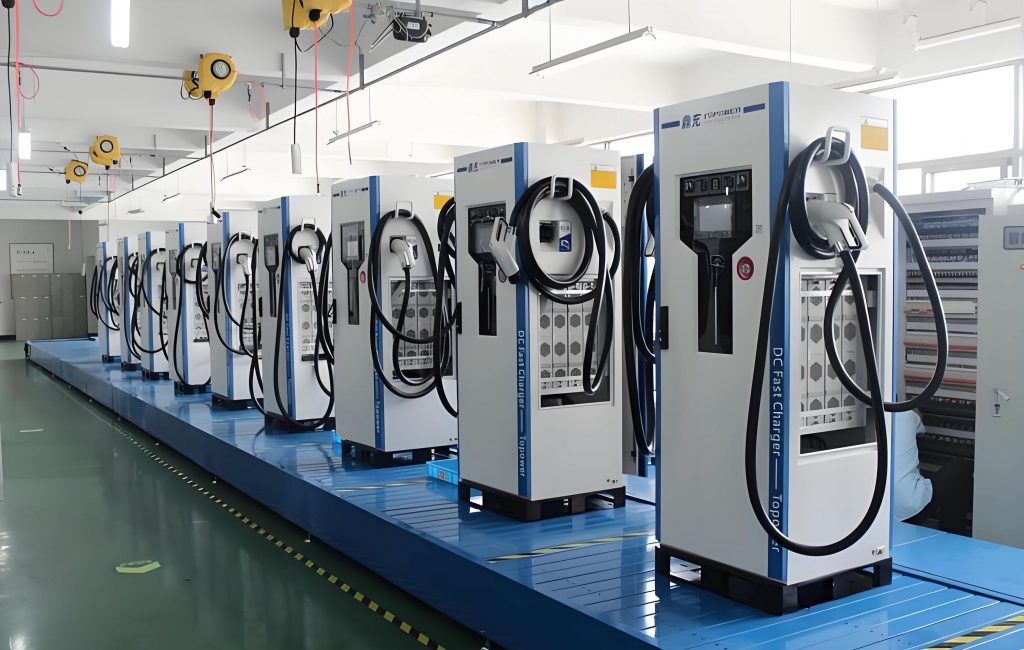
The integration of EV charging stations into the power grid introduces significant complexities due to the diverse charging characteristics and power demands of different EV types. Slow charging stations (SCS), fast charging stations (FCS), and ultra-fast charging stations (UCS) each serve distinct user needs and impose varying loads on the grid. For instance, slow EV charging stations are typically used in residential areas for overnight charging, while fast and ultra-fast EV charging stations are deployed in commercial zones or along highways to support quick top-ups. However, uncoordinated deployment of these EV charging stations can lead to grid congestion, voltage instability, and increased operational costs. Our research aims to develop a holistic optimization framework that considers the mutual influences between multiple EV charging station types, enabling efficient resource allocation and cost reduction. By leveraging advanced mathematical techniques, we ensure that the model is both computationally feasible and practically applicable, supporting the sustainable expansion of EV infrastructure.
Electric Vehicle Load Modeling
To accurately represent the load imposed by EVs on the grid, we categorize EV charging stations into three types: slow charging stations (SCS), fast charging stations (FCS), and ultra-fast charging stations (UCS). The charging power for an EV \( k \) is determined based on its battery capacity, state of charge (SoC), and available charging time. The power demand \( P_k \) for EV \( k \) is modeled as follows:
$$ P_k = \begin{cases}
P_S, & C_k \cdot (1 – \text{SoC}_k) \leq P_S \cdot T^d_k \\
P_F, & P_S \cdot T^d_k < C_k \cdot (1 – \text{SoC}_k) \leq P_F \cdot T^d_k \\
P_U, & C_k \cdot (1 – \text{SoC}_k) > P_F \cdot T^d_k
\end{cases} $$
where \( P_S \), \( P_F \), and \( P_U \) denote the rated charging powers for slow, fast, and ultra-fast EV charging stations, respectively; \( C_k \) is the battery capacity of EV \( k \); \( \text{SoC}_k \) is the state of charge; and \( T^d_k \) is the expected charging duration. This segmentation allows us to capture the heterogeneous nature of EV charging demands, which is essential for optimizing the placement and operation of EV charging stations. For example, ultra-fast EV charging stations typically serve users with urgent charging needs, such as those on long trips, while slow EV charging stations cater to daily commuters. The load profile for each type of EV charging station varies significantly over time, influencing grid stability and requiring careful coordination.
Objective Function
The primary goal of our optimization model is to minimize the average annual total societal cost, which encompasses investment costs, grid expansion costs, operational expenses, and energy loss costs associated with EV charging stations. The objective function is formulated as:
$$ \min C = C_I + C_R + C_O + t_w \cdot \sum_{s=1}^{4} \sum_{t=1}^{k_t} C_{L,s,t}^{w} + t_{wd} \cdot \sum_{s=1}^{4} \sum_{t=1}^{k_t} C_{L,s,t}^{wd} $$
Here, \( C \) represents the total annual cost; \( C_I \) is the average annual investment cost for EV charging stations; \( C_R \) is the annual grid expansion cost; \( C_O \) is the annual operational and maintenance cost for EV charging stations; and \( C_{L,s,t}^{w} \) and \( C_{L,s,t}^{wd} \) are the energy loss costs during weekdays and weekends, respectively, for season \( s \) and time period \( t \). The terms \( t_w \) and \( t_{wd} \) denote the number of weekdays and weekends in season \( s \). Each cost component is detailed below:
- Investment Cost: \( C_I = R_d \cdot \sum_{i=1}^{N} (c_I^S \cdot N_i^S + c_I^F \cdot N_i^F + c_I^U \cdot N_i^U) \), where \( R_d \) is the capital recovery factor, \( c_I^S, c_I^F, c_I^U \) are the unit investment costs for slow, fast, and ultra-fast EV charging stations, and \( N_i^S, N_i^F, N_i^U \) are the numbers of each type of EV charging station at node \( i \).
- Grid Expansion Cost: \( C_R = R_d \cdot c_R \cdot \sum_{i=1}^{N} (P_S \cdot N_i^S + P_F \cdot N_i^F + P_U \cdot N_i^U) \), where \( c_R \) is the unit capacity expansion cost coefficient.
- Operational Cost: \( C_O = \sum_{i=1}^{N} (c_O^S \cdot N_i^S + c_O^F \cdot N_i^F + c_O^U \cdot N_i^U) \), with \( c_O^S, c_O^F, c_O^U \) being the annual maintenance costs per unit for each EV charging station type.
- Energy Loss Cost: \( C_{L,s,t} = \sum_{i=1}^{N_{bus}} \sum_{j \in u(i)} c_L \cdot I_{ij}^2 \cdot R_{ij} \cdot \Delta t \), where \( c_L \) is the unit cost of energy loss, \( I_{ij} \) is the current in branch \( ij \), \( R_{ij} \) is the resistance, and \( \Delta t \) is the time interval.
This comprehensive cost structure ensures that all economic aspects of deploying and operating EV charging stations are considered, promoting cost-effective solutions.
Constraints
The optimization model is subject to several constraints that ensure physical feasibility, grid stability, and user satisfaction. These include power flow constraints, voltage and current limits, load dispatch balance, charging station capacity, and scenario-specific constraints.
Power Flow Constraints
We employ the DistFlow model to represent the power flow in the distribution network. The constraints are given by:
$$ \sum_{i \in v(j)} \left[ P_{ij} – \frac{P_{ij}^2 + Q_{ij}^2}{U_i^2} \cdot R_{ij} \right] = \sum_{l \in u(j)} P_{jl} + P_j^L + P_j^E \quad \forall j \in \Omega_N $$
$$ \sum_{i \in v(j)} \left[ Q_{ij} – \frac{P_{ij}^2 + Q_{ij}^2}{U_i^2} \cdot X_{ij} \right] = \sum_{l \in u(j)} Q_{jl} + Q_j^L \quad \forall j \in \Omega_N $$
$$ U_j^2 = U_i^2 – 2(R_{ij} P_{ij} + X_{ij} Q_{ij}) + (R_{ij}^2 + X_{ij}^2) \cdot \frac{P_{ij}^2 + Q_{ij}^2}{U_i^2} \quad \forall ij \in \Omega_L $$
where \( P_{ij} \) and \( Q_{ij} \) are the active and reactive power flows in branch \( ij \); \( U_i \) is the voltage magnitude at node \( i \); \( P_j^L \) and \( Q_j^L \) are the active and reactive loads at node \( j \); \( P_j^E \) is the EV charging load at node \( j \); and \( \Omega_N \) and \( \Omega_L \) are sets of nodes and branches, respectively. These equations ensure that power balances are maintained across the network, accounting for the additional loads from EV charging stations.
Voltage and Current Constraints
To maintain grid stability, voltage magnitudes and branch currents must remain within allowable limits:
$$ U_{\min} \leq U_i \leq U_{\max} \quad \forall i \in \Omega_N $$
$$ I_{ij}^2 = \frac{P_{ij}^2 + Q_{ij}^2}{U_i^2} \quad \forall ij \in \Omega_L $$
$$ I_{ij} \leq I_{ij,\max} \quad \forall ij \in \Omega_L $$
These constraints prevent overvoltage or undervoltage conditions and ensure that thermal limits of lines are not exceeded, which is critical when integrating high-power EV charging stations.
Load Dispatch and Capacity Constraints
The model includes constraints to balance the dispatch of EVs to different EV charging station types and to limit the distance users are willing to travel for charging. For each node \( i \), the number of EVs assigned to slow, fast, and ultra-fast EV charging stations must satisfy:
$$ N_i^{ar,S} = \sum_{j \in \Omega_c} N_{ij}^S \quad \forall i \in \Omega_N $$
$$ N_i^{ar,F} = \sum_{j \in \Omega_c} N_{ij}^F \quad \forall i \in \Omega_N $$
$$ N_i^{ar,U} = \sum_{j \in \Omega_c} N_{ij}^U \quad \forall i \in \Omega_N $$
where \( N_i^{ar,S}, N_i^{ar,F}, N_i^{ar,U} \) are the numbers of EVs requiring slow, fast, and ultra-fast charging at node \( i \), and \( N_{ij}^S, N_{ij}^F, N_{ij}^U \) are the numbers of EVs from node \( i \) charged at node \( j \) using the respective EV charging station types. Additionally, distance constraints ensure that EVs are only assigned to EV charging stations within an acceptable range \( d_l \):
$$ N_{ij}^S = 0 \quad \forall (i,j) \mid d(i,j) > d_l $$
$$ N_{ij}^F = 0 \quad \forall (i,j) \mid d(i,j) > d_l $$
$$ N_{ij}^U = 0 \quad \forall (i,j) \mid d(i,j) > d_l $$
Furthermore, the number of EV charging stations at each location must meet the peak demand:
$$ N_j^U \geq \sum_{i=1}^{N} N_{ij}^U \quad \forall j \in \Omega_c $$
$$ N_j^F + N_j^U \geq \sum_{i=1}^{N} (N_{ij}^F + N_{ij}^U) \quad \forall j \in \Omega_c $$
$$ N_j^S + N_j^F + N_j^U \geq \sum_{i=1}^{N} (N_{ij}^S + N_{ij}^F + N_{ij}^U) \quad \forall j \in \Omega_c $$
These constraints ensure that the EV charging station capacity is sufficient to handle the projected EV load, avoiding congestion and user dissatisfaction.
Scenario Constraints
We consider two primary scenarios that reflect different supply-demand conditions for EV charging stations:
- Scenario 1: All three types of EV charging stations are sufficient to meet the charging demand. This scenario is characterized by:
- Scenario 2: Fast EV charging stations are insufficient, causing some EVs to use ultra-fast EV charging stations instead. This occurs when:
$$ N_j^S \geq \sum_{i=1}^{N} N_{ij}^S, \quad N_j^F \geq \sum_{i=1}^{N} N_{ij}^F $$
The EV charging load at node \( j \) is then:
$$ P_j^E = P_S \cdot \sum_{i=1}^{N} N_{ij}^S + P_F \cdot \sum_{i=1}^{N} N_{ij}^F + P_U \cdot \sum_{i=1}^{N} N_{ij}^U $$
$$ N_j^S \geq \sum_{i=1}^{N} N_{ij}^S, \quad N_j^F < \sum_{i=1}^{N} N_{ij}^F $$
The adjusted EV charging load becomes:
$$ P_j^E = P_S \cdot \sum_{i=1}^{N} N_{ij}^S + P_F \cdot N_j^F + P_U \cdot \left( \sum_{i=1}^{N} N_{ij}^F – N_j^F \right) + P_U \cdot \sum_{i=1}^{N} N_{ij}^U $$
These scenario constraints capture the dynamic interactions between different EV charging station types, allowing the model to adapt to varying operational conditions.
Solution Methodology
To solve the complex optimization problem efficiently, we apply a two-step equivalence method and second-order cone relaxation, transforming the model into a mixed-integer second-order cone programming (MISOCP) problem.
Two-Step Equivalence for Scenario Constraints
The scenario constraints are reformulated using a two-step equivalence approach to convert equality constraints into inequalities, simplifying the optimization without affecting the solution quality. The transformed constraints for Scenarios 1 and 2 are:
$$ P_j^E \geq P_S \cdot \sum_{i=1}^{N} N_{ij}^S + P_F \cdot \sum_{i=1}^{N} N_{ij}^F + P_U \cdot \sum_{i=1}^{N} N_{ij}^U $$
$$ P_j^E \geq P_S \cdot \sum_{i=1}^{N} N_{ij}^S + P_F \cdot N_j^F + P_U \cdot \left( \sum_{i=1}^{N} N_{ij}^F – N_j^F \right) + P_U \cdot \sum_{i=1}^{N} N_{ij}^U $$
This equivalence ensures that the model remains convex and tractable, facilitating the use of standard optimization solvers.
Second-Order Cone Relaxation
To handle the non-convexities in the power flow equations, we employ second-order cone relaxation. We introduce auxiliary variables:
$$ \overline{U}_i = U_i^2, \quad \overline{I}_{ij} = I_{ij}^2 $$
Substituting these into the constraints yields the relaxed formulation:
$$ \sum_{i \in v(j)} \left[ P_{ij} – \overline{I}_{ij} \cdot R_{ij} \right] = \sum_{l \in u(j)} P_{jl} + P_j^L + P_j^E \quad \forall j \in \Omega_N $$
$$ \sum_{i \in v(j)} \left[ Q_{ij} – \overline{I}_{ij} \cdot X_{ij} \right] = \sum_{l \in u(j)} Q_{jl} + Q_j^L \quad \forall j \in \Omega_N $$
$$ \overline{U}_j = \overline{U}_i – 2(R_{ij} P_{ij} + X_{ij} Q_{ij}) + (R_{ij}^2 + X_{ij}^2) \cdot \overline{I}_{ij} \quad \forall ij \in \Omega_L $$
$$ (U_{\min})^2 \leq \overline{U}_i \leq (U_{\max})^2 \quad \forall i \in \Omega_N $$
$$ \overline{I}_{ij} \geq \frac{P_{ij}^2 + Q_{ij}^2}{\overline{U}_i} \quad \forall ij \in \Omega_L $$
$$ \left\| \begin{array}{c} 2P_{ij} \\ 2Q_{ij} \\ \overline{I}_{ij} – \overline{U}_i \end{array} \right\|_2 \leq \overline{I}_{ij} + \overline{U}_i \quad \forall ij \in \Omega_L $$
This relaxation converts the original problem into a MISOCP, which can be efficiently solved using commercial solvers like Gurobi, ensuring global optimality or near-optimal solutions for the EV charging station configuration.
Case Study and Results
We validate our model using the IEEE 33-node distribution system, categorizing nodes into residential, commercial, and office areas to reflect realistic EV charging demand patterns. The optimization is implemented in MATLAB with YALMIP and solved using Gurobi. We analyze two scenarios to evaluate the performance of our EV charging station deployment strategy.
In Scenario 1, where all EV charging station types are fully available, the optimal configuration allocates varying numbers of slow, fast, and ultra-fast EV charging stations across nodes based on localized demand. For example, residential areas show a higher concentration of slow EV charging stations, while commercial zones prioritize fast and ultra-fast EV charging stations. The resulting configuration minimizes costs while meeting all constraints. Similarly, in Scenario 2, where fast EV charging stations are undersupplied, the model dynamically reallocates EVs to ultra-fast EV charging stations, maintaining service quality. The table below summarizes the cost comparisons between the two scenarios:
| Scenario | Average Annual Total Cost (×10^4 USD) |
|---|---|
| Scenario 1 | 4.0416 |
| Scenario 2 | 4.3843 |
Scenario 1 demonstrates lower costs, highlighting the economic benefits of sufficient EV charging station capacity. Additionally, we observe that the integration of multi-type EV charging stations reduces grid losses and enhances voltage stability, as shown in the following analysis of power flow results:
| Metric | Scenario 1 | Scenario 2 |
|---|---|---|
| Total Energy Loss (MWh/year) | 12.45 | 14.78 |
| Voltage Deviation (%) | 1.2 | 1.8 |
| Peak Load Reduction (%) | 15.3 | 12.1 |
These results underscore the importance of coordinated EV charging station deployment in improving grid efficiency and reducing operational expenses.
Conclusion
This study presents a comprehensive framework for optimizing the configuration and operation of multi-type EV charging stations in a vehicle-grid collaborative system. By developing a detailed model that incorporates realistic constraints and scenarios, we demonstrate that strategic placement of slow, fast, and ultra-fast EV charging stations can significantly reduce societal costs and enhance grid reliability. The application of two-step equivalence and second-order cone relaxation techniques ensures computational efficiency without compromising solution quality. Our case study confirms that a well-planned EV charging station network not only meets evolving EV demands but also supports grid stability. Future work could explore dynamic pricing strategies and renewable energy integration to further optimize EV charging station operations. Overall, this research provides valuable insights for policymakers and grid operators aiming to foster sustainable EV adoption through intelligent infrastructure planning.