
In my extensive experience with maintaining and operating EV charging stations, I have frequently encountered issues related to DC contactor malfunctions, such as failure to operate or unintended activation. These faults are common in monitoring platforms and on-site inspections, particularly in older units or those from specific manufacturers. This article delves into the root causes of these problems and proposes effective mitigation strategies, aiming to enhance the reliability and performance of EV charging stations. The widespread adoption of electric vehicles necessitates robust charging infrastructure, and addressing these faults is crucial for minimizing downtime and ensuring user satisfaction.
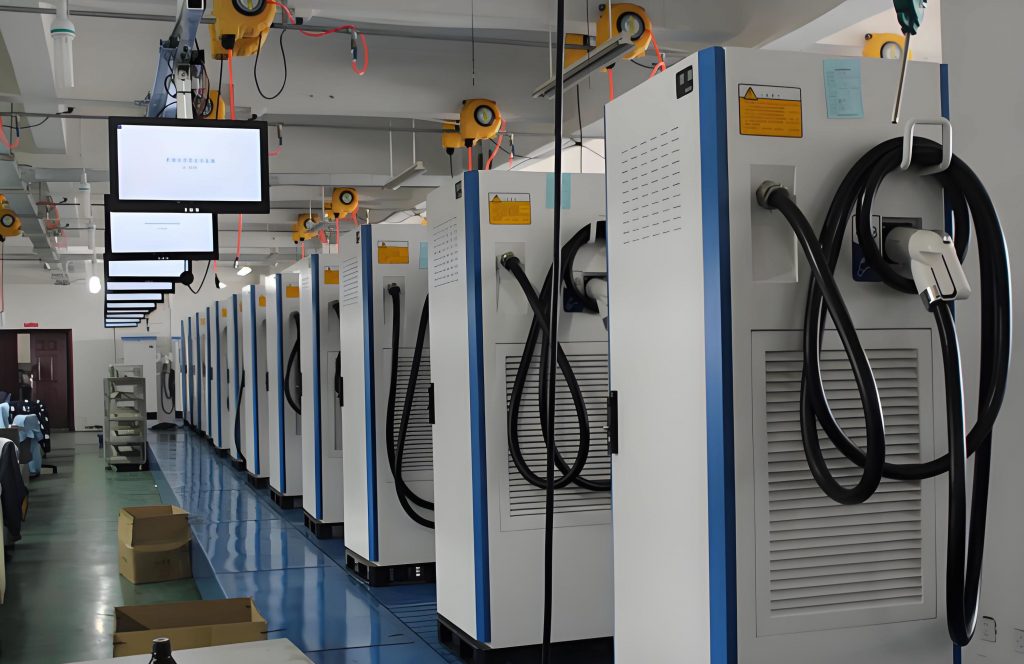
EV charging stations are critical components of the modern energy ecosystem, supporting the transition to sustainable transportation. However, the complexity of these systems, especially in DC fast-charging setups, introduces vulnerabilities like DC contactor faults. These issues can lead to operational disruptions, increased maintenance costs, and reduced user confidence. Through firsthand observations, I have identified several key factors contributing to these faults, which I will explore in detail, supplemented with analytical models and practical solutions. The goal is to provide a comprehensive resource for operators and technicians to improve the resilience of EV charging stations.
Common Causes of DC Contactor Faults in EV Charging Stations
DC contactors in EV charging stations are prone to various failures due to environmental, electrical, and operational factors. Understanding these causes is essential for developing effective countermeasures. Below, I outline the primary reasons, supported by empirical data and theoretical insights.
Power Supply Issues
One of the most prevalent causes of DC contactor faults in EV charging stations stems from power supply instability. Many EV charging stations are connected to public distribution transformers with 380 V or 220 V inputs, where load fluctuations during peak and off-peak hours cause significant voltage variations. This instability can trigger shutdowns in the DC contactor, leading to failures recorded in monitoring systems. For instance, voltage deviations beyond acceptable limits, often described by the formula for voltage fluctuation: $$\Delta V = I \times R$$ where \(\Delta V\) is the voltage change, \(I\) is the current, and \(R\) is the resistance, can exceed the operational thresholds of EV charging station components. Additionally, issues like loose connections in input power lines or terminal blocks exacerbate the problem, causing poor contact and subsequent malfunctions. In some cases, phase loss or undervoltage conditions during high-current charging sessions prevent power modules from starting correctly, resulting in contactor failures.
Intrinsic Contactor Problems
DC contactors themselves can be sources of failure due to manufacturing defects, wear and tear, or suboptimal installation. Frequent switching in EV charging stations, driven by user interactions, accelerates mechanical fatigue and internal adhesion. Over time, this can lead to burnt contacts or complete failure, evident from discolored or blackened casings. The lifetime of a DC contactor can be modeled using the Arrhenius equation for reliability: $$L = A e^{\frac{-E_a}{kT}}$$ where \(L\) is the lifetime, \(A\) is a constant, \(E_a\) is the activation energy, \(k\) is Boltzmann’s constant, and \(T\) is the temperature. This highlights how elevated temperatures in EV charging stations reduce component longevity. Moreover, loose copper connections in the contactor assembly can cause localized heating, further degrading performance.
Thermal Management Challenges
EV charging stations operate at high power levels, often exceeding 60 kW, generating substantial heat. Inadequate cooling, such as malfunctioning fans or blocked ventilation, raises internal temperatures, accelerating insulation老化 and contactor failure. The heat dissipation in an EV charging station can be approximated by Newton’s law of cooling: $$\frac{dT}{dt} = -k (T – T_{\text{env}})$$ where \(T\) is the temperature, \(t\) is time, \(k\) is a constant, and \(T_{\text{env}}\) is the ambient temperature. Persistent overheating not only affects DC contactors but also compromises other critical components, increasing the overall failure rate of the EV charging station.
Operational Misuse
User error is a significant contributor to DC contactor faults in EV charging stations. Inexperienced operators may repeatedly attempt charging without following proper protocols, leading to excessive cycling of the contactor. This repetitive stress shortens its operational life and induces faults. For example, the mean time between failures (MTBF) for a contactor under frequent switching can be expressed as: $$\text{MTBF} = \frac{1}{\lambda}$$ where \(\lambda\) is the failure rate, which increases with switching frequency. Educating users on standardized procedures for EV charging stations is vital to mitigate this issue.
Parameter Drift in Control Systems
Technical parameters in the power control modules of EV charging stations can drift over time due to software glitches or environmental factors, causing mismatches in contactor operation. This may manifest as erroneous signals for activation or deactivation, leading to faults. Regular calibration is necessary to maintain alignment with design specifications, ensuring reliable performance of the EV charging station.
| Cause Category | Specific Issues | Impact on EV Charging Station |
|---|---|---|
| Power Supply | Voltage fluctuations, loose connections, phase loss | Intermittent operation, shutdowns |
| Contactor Intrinsic | Manufacturing defects, wear, loose terminals | Reduced lifespan, complete failure |
| Thermal Factors | Overheating, poor ventilation | Accelerated degradation, safety risks |
| Operational Use | Frequent switching, user errors | Increased failure rate, downtime |
| Control Parameters | Software drift, calibration issues | Unreliable performance, false triggers |
Effective Mitigation Strategies for DC Contactor Faults
Addressing DC contactor faults in EV charging stations requires a multifaceted approach, combining preventive maintenance, technical upgrades, and user education. Based on my practical experience, I recommend the following measures to enhance the reliability and efficiency of EV charging stations.
Resolving Power Supply Instabilities
To combat voltage-related issues in EV charging stations, start by verifying the input voltage stability. If anomalies are detected, a simple reboot of the main circuit breaker often resolves temporary faults. Securing all electrical connections, including terminals and relays, minimizes resistance and prevents voltage drops. For high-power EV charging stations, dedicating a transformer can isolate them from grid fluctuations, as described by the power stability equation: $$P_{\text{stable}} = V_{\text{rated}} \times I_{\text{max}}$$ where \(P_{\text{stable}}\) is the stable power output, \(V_{\text{rated}}\) is the rated voltage, and \(I_{\text{max}}\) is the maximum current. Additionally, routine inspections for damaged components like circuit breakers or contactors ensure timely replacements, reducing fault incidences in EV charging stations.
Contactor Maintenance and Replacement
Regular checks of DC contactors in EV charging stations for visual signs of damage, such as discoloration or burns, are crucial. Using a multimeter to test for continuity can identify internal adhesion; if buzzing occurs, replacement is necessary. When installing new contactors, select high-quality units rated for the expected currents—e.g., 250 A for 60 kW EV charging stations or 350 A for 120 kW models. The contact resistance should be minimized, as per: $$R_c = \frac{V}{I}$$ where \(R_c\) is the contact resistance, which affects heating. Ensure proper torque on connections and clean contact surfaces to avoid hotspots, thereby extending the service life of EV charging stations.
Enhancing Thermal Management
Effective cooling is vital for EV charging stations to prevent overheating. Implement scheduled inspections of fans and vents, clearing any obstructions. The heat balance equation: $$Q_{\text{generated}} = Q_{\text{dissipated}}$$ where \(Q\) is heat, must be maintained to avoid temperature buildup. Upgrading to advanced cooling systems or redundant fans can provide additional safeguards, ensuring that DC contactors and other components operate within safe thermal limits in EV charging stations.
User Training and Standardization
To reduce operational misuse of EV charging stations, provide clear instructional materials, such as flowcharts, at charging points. This guides users through correct procedures, minimizing unnecessary contactor cycling. Standardizing payment and activation methods across EV charging stations simplifies the experience, lowering the likelihood of errors that lead to faults.
Control System Calibration
For parameter drift in EV charging stations, engage specialized technicians to refresh firmware or recalibrate power control modules. This restores default settings, aligning contactor operations with design parameters. Regular software updates can preemptively address such issues, enhancing the overall resilience of EV charging stations.
| Action Area | Specific Measures | Expected Outcome for EV Charging Station |
|---|---|---|
| Power Management | Voltage checks, dedicated transformers, secure connections | Stable operation, reduced downtime |
| Contactor Care | Visual inspections, timely replacements, quality upgrades | Longer lifespan, fewer failures |
| Thermal Control | Fan maintenance, vent cleaning, enhanced cooling | Lower temperatures, improved safety |
| User Guidance | Clear instructions, standardized protocols | Reduced misuse, higher success rates |
| System Calibration | Firmware updates, parameter checks | Consistent performance, fewer errors |
Technical Analysis and Modeling
To further understand DC contactor behavior in EV charging stations, I employ mathematical models that predict failure probabilities and optimize maintenance schedules. For instance, the reliability function for a contactor can be expressed as: $$R(t) = e^{-\int_0^t \lambda(\tau) d\tau}$$ where \(R(t)\) is the reliability over time \(t\), and \(\lambda(\tau)\) is the time-dependent failure rate. Incorporating environmental factors like temperature and humidity, which are common in EV charging station settings, refines these models. Additionally, power quality analysis using Fourier transforms helps identify harmonic distortions that may stress contactors: $$V(t) = \sum_{n=1}^{\infty} A_n \sin(2\pi n f t + \phi_n)$$ where \(V(t)\) is the voltage waveform, \(A_n\) is amplitude, \(f\) is frequency, and \(\phi_n\) is phase. By integrating such analyses, operators can proactively address issues in EV charging stations, reducing unplanned outages.
Conclusion
In summary, DC contactor faults in EV charging stations arise from a combination of power supply instabilities, component wear, thermal challenges, user errors, and control system drifts. Through systematic approaches—including rigorous maintenance, user education, and technical enhancements—the reliability of EV charging stations can be significantly improved. My firsthand experiences confirm that these strategies not only minimize fault frequencies but also boost user confidence and operational efficiency. As the demand for electric vehicles grows, prioritizing the robustness of EV charging stations will be essential for supporting sustainable mobility infrastructures. Future advancements in smart monitoring and predictive maintenance could further elevate the performance standards of EV charging stations, ensuring they meet the evolving needs of consumers and grid operators alike.