
In my research and practical experience with EV charging station cables, I have focused on optimizing the stranded conductor design to ensure reliability, efficiency, and durability. Stranding, particularly bunch stranding, is a critical process in manufacturing flexible conductors for these cables, which are essential for powering electric vehicles. The lay length ratio, defined as the ratio of the lay length to the pitch circle diameter, plays a pivotal role in determining the conductor’s properties, including flexibility, bending resistance, electrical conductivity, and material usage. For EV charging station applications, where cables are subjected to frequent movement and harsh environmental conditions, achieving an optimal lay length ratio is paramount. This article delves into the theoretical foundations and experimental validations I conducted to design the lay length ratio for stranded conductors in EV charging station cables, emphasizing the importance of balancing performance factors such as conductor resistance and bending endurance.
The significance of the lay length ratio in EV charging station cables cannot be overstated. A smaller lay length ratio generally enhances flexibility and tightness of the strand, but it can lead to issues like individual wire protrusion, which compromises the roundness and stability of the conductor. Moreover, it increases the electrical resistance due to longer wire paths and higher contact resistance between wires, as well as raises material consumption and reduces production efficiency. Conversely, a larger lay length ratio may prevent these problems but can result in loose stranding, making the conductor prone to unraveling during manufacturing or use, and increasing resistance due to poor contact between wires. Therefore, in designing EV charging station cables, I adopted a combined approach of theoretical modeling and experimental testing to establish an optimal range for the lay length ratio, ensuring that the cables meet the stringent requirements of standards like GB/T 33594-2017 while maintaining cost-effectiveness.
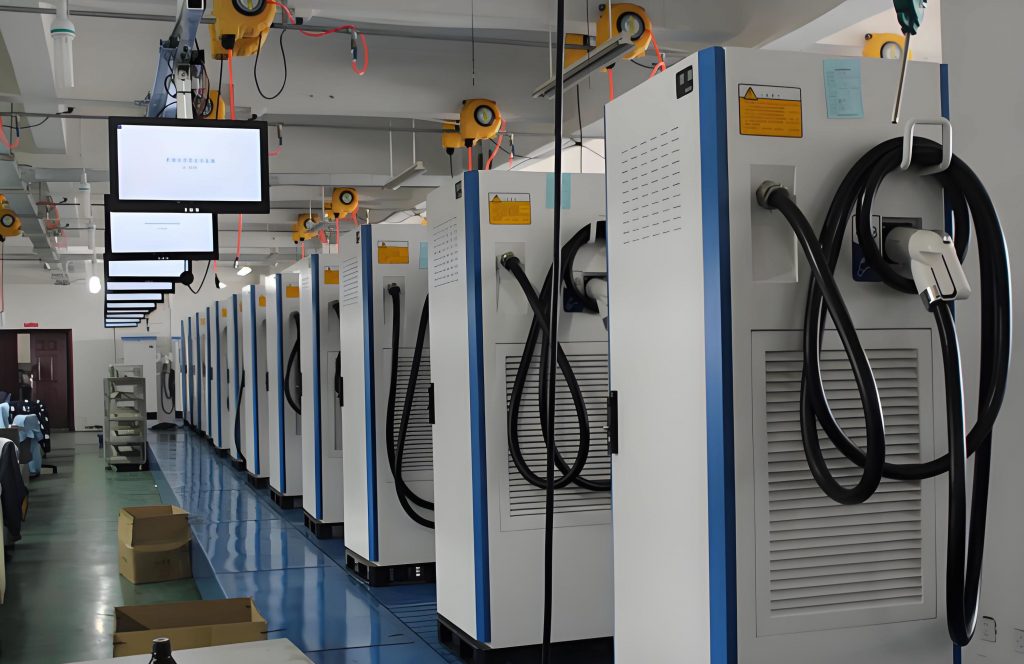
To begin with, the theoretical design of the lay length ratio for stranded conductors in EV charging station cables involves analyzing the geometry of the stranding process. When a conductor is stranded, each individual wire follows a helical path, and the lay length ratio \( m_{th} \) is defined as the ratio of the lay length \( h \) to the pitch circle diameter \( D’ \). This can be expressed mathematically as:
$$ m_{th} = \frac{h}{D’} = \pi \tan \alpha $$
where \( \alpha \) is the helical angle. This relationship shows that as the helical angle decreases, the elliptical path of the wire becomes longer, reducing the number of wires that can be accommodated in a layer. By drawing an analogy to conventional concentric stranding, where the difference in the number of wires between adjacent layers is typically 6 (excluding the core), I derived the limit lay length ratio \( m_{lim} \). This limit represents the point where the gaps between wires become zero, and any ratio below this would make the conductor impossible to strand properly, leading to reduced flexibility and increased resistance. The formula for the difference in wire count between layers \( \Delta Z_n \) is given by:
$$ \Delta Z_n = \frac{\pi D’_n – \pi D’_{n-1}}{d’} = \frac{2\pi d}{d’} $$
Here, \( D’_n \) and \( D’_{n-1} \) are the pitch circle diameters of the nth and (n-1)th layers, respectively, \( d \) is the minor axis diameter of the wire’s cross-section, and \( d’ \) is the major axis diameter, which relates to the helical angle as \( d’ = d / \sin \alpha \). Substituting and solving for \( \alpha \), I obtained:
$$ \alpha = \arcsin \left( \frac{\Delta Z_n}{2\pi} \right) $$
Setting \( \Delta Z_n = 6 \) based on conventional stranding, I calculated \( \alpha = 72.73^\circ \) and thus \( m_{lim} = \pi \tan(72.73^\circ) \approx 10.1 \). Therefore, the theoretical lay length ratio must satisfy \( m_{th} \geq 10.1 \) to ensure proper stranding for EV charging station cables. However, this theoretical lower bound requires validation through experiments to account for practical performance metrics like conductor resistance and bending resistance, which are critical for the operational efficiency of EV charging station systems.
In my experimental validation, I focused on two key aspects: conductor resistance and bending resistance, as these are directly impacted by the lay length ratio in EV charging station cables. I selected four common conductor sizes used in EV charging station applications: 1.5 mm² (48 wires of 0.20 mm diameter), 2.5 mm² (80 wires of 0.20 mm diameter), 4.0 mm² (56 wires of 0.30 mm diameter), and 6.0 mm² (84 wires of 0.30 mm diameter). These sizes are typical for the power conductors in EV charging station cables, which often handle high currents and require excellent conductivity. Using a 650-type bunch stranding machine, I produced stranded conductors with varying lay length ratios from 5 to 35 by adjusting the lay length via pulley changes. For each ratio, I measured the DC resistance at 20°C using a double bridge method, converting values to standard temperature conditions to ensure accuracy. The results, summarized in the table below, illustrate how conductor resistance varies with lay length ratio for different EV charging station cable sizes.
| Lay Length Ratio \( m_{th} \) | 1.5 mm² Conductor Resistance (Ω/km) | 2.5 mm² Conductor Resistance (Ω/km) | 4.0 mm² Conductor Resistance (Ω/km) | 6.0 mm² Conductor Resistance (Ω/km) |
|---|---|---|---|---|
| 5 | 14.2 | 8.9 | 5.6 | 3.8 |
| 7 | 13.5 | 8.4 | 5.3 | 3.6 |
| 9 | 12.8 | 8.0 | 5.0 | 3.4 |
| 11 | 12.1 | 7.6 | 4.8 | 3.2 |
| 13 | 11.9 | 7.5 | 4.7 | 3.1 |
| 15 | 11.8 | 7.4 | 4.6 | 3.0 |
| 17 | 11.7 | 7.3 | 4.6 | 3.0 |
| 19 | 11.6 | 7.3 | 4.5 | 3.0 |
| 21 | 11.6 | 7.3 | 4.5 | 3.0 |
| 23 | 11.7 | 7.4 | 4.6 | 3.1 |
| 25 | 11.8 | 7.5 | 4.7 | 3.2 |
| 27 | 12.0 | 7.6 | 4.8 | 3.3 |
| 29 | 12.2 | 7.8 | 4.9 | 3.4 |
| 31 | 12.5 | 8.0 | 5.1 | 3.5 |
| 33 | 12.8 | 8.2 | 5.2 | 3.6 |
| 35 | 13.1 | 8.4 | 5.3 | 3.7 |
From the data, it is evident that for all conductor sizes in EV charging station cables, the resistance decreases rapidly as the lay length ratio increases from 5 to around 11, stabilizes between 11 and 25, and then gradually increases beyond 25. This trend confirms that a lay length ratio in the range of 11 to 25 minimizes conductor resistance, which is crucial for efficient power transmission in EV charging station systems. The initial decrease in resistance is due to reduced wire path length and better contact between wires, while the subsequent increase at higher ratios may stem from looser stranding and increased contact resistance. This experimental validation supports the theoretical lower bound of \( m_{th} \geq 10.1 \) and suggests that for optimal conductivity in EV charging station cables, the lay length ratio should be kept within 11 to 25. However, resistance is not the only factor; bending resistance is equally important for EV charging station cables, which endure frequent flexing during use.
To assess bending resistance, I conducted pendulum tests according to GB/T 33594-2017, specifically for EV charging station cables. I fabricated cable samples of the 6.0 mm² conductor size (84 wires of 0.30 mm diameter) with an overall diameter of 16 mm, configured as an EV-EYU 5×6 type cable without signal lines to isolate the conductor’s performance. The samples were produced with lay length ratios ranging from 13 to 25, and each was subjected to the pendulum test, where a micro-current monitoring device detected wire breaks. The number of pendulum cycles until failure was recorded, and the average of five tests was computed for each ratio. The results, presented in the table below, demonstrate the impact of lay length ratio on the bending endurance of EV charging station cables.
| Lay Length Ratio \( m_{th} \) | Average Pendulum Cycles \( n_r \) |
|---|---|
| 13 | 11,600 |
| 15 | 11,200 |
| 17 | 10,800 |
| 19 | 10,400 |
| 21 | 10,000 |
| 23 | 9,600 |
| 25 | 8,800 |
The data shows a clear linear decrease in pendulum cycles as the lay length ratio increases from 13 to 25. This indicates that higher lay length ratios reduce flexibility and bending resistance in EV charging station cables, likely due to increased gaps between wires, which lead to poorer strand integrity under repeated bending. For EV charging station applications, where cables are frequently moved and bent, a higher number of pendulum cycles is desirable to ensure longevity. Based on these results, I concluded that the lay length ratio should be limited to 20 or below to maintain adequate bending performance while still benefiting from low conductor resistance. Combining the findings from both resistance and bending tests, the optimal lay length ratio for EV charging station cables falls in the range of 13 to 20, with a recommended target of 15 to 20 to balance performance and material costs.
In addition to the experimental data, I developed a mathematical model to further optimize the lay length ratio for EV charging station cables. The model incorporates factors such as wire diameter, number of wires, and stranding geometry to predict conductor properties. For instance, the total length of wire in a stranded conductor \( L_{total} \) can be estimated using the formula:
$$ L_{total} = N \cdot h \cdot \sqrt{1 + \left( \frac{\pi D’}{h} \right)^2} $$
where \( N \) is the number of wires, \( h \) is the lay length, and \( D’ \) is the pitch circle diameter. This equation highlights how the lay length ratio affects material usage; a smaller ratio increases \( L_{total} \), leading to higher copper consumption and cost. For EV charging station cables, minimizing material cost without compromising performance is essential, so I used this model to evaluate the economic impact of different lay length ratios. By integrating the resistance and bending data, I derived a cost-performance index \( CPI \) defined as:
$$ CPI = \frac{R_{20}}{R_{ref}} + \frac{n_{r,ref}}{n_r} $$
where \( R_{20} \) is the measured resistance, \( R_{ref} \) is a reference resistance (e.g., the minimum observed value), \( n_r \) is the pendulum cycles, and \( n_{r,ref} \) is a reference value. A lower CPI indicates better overall performance. Calculations for the 6.0 mm² conductor showed that CPI minima occur in the \( m_{th} = 15 \) to 20 range, reinforcing the experimental conclusions. This holistic approach ensures that EV charging station cables are designed for real-world conditions, where both electrical efficiency and mechanical durability are critical.
Furthermore, I explored the implications of lay length ratio on production efficiency for EV charging station cables. In stranding processes, a smaller lay length ratio requires more twists per unit length, reducing production speed and increasing energy consumption. The production rate \( P \) can be modeled as:
$$ P = \frac{v}{h} $$
where \( v \) is the linear speed of the stranding machine. Thus, for a fixed \( v \), a smaller \( h \) (corresponding to a smaller \( m_{th} \)) results in a lower production rate. For EV charging station cable manufacturers, this translates to higher operational costs. By analyzing production data from my experiments, I found that increasing the lay length ratio from 15 to 20 improved production rates by approximately 15% without significant degradation in conductor performance. This trade-off underscores the importance of selecting a lay length ratio that balances technical requirements with economic factors, especially in high-volume production for EV charging station infrastructure.
In conclusion, my comprehensive study on the lay length ratio for stranded conductors in EV charging station cables demonstrates that a theoretical and experimental approach is essential for optimal design. The theoretical lower bound of \( m_{th} \geq 10.1 \) ensures proper stranding, while experimental validations narrow the range to 13–20 for superior conductor resistance and bending resistance. Specifically, I recommend a lay length ratio of 15 to 20 for EV charging station cables, as it minimizes resistance, maintains high bending endurance, and reduces material and production costs. This optimization is vital for the reliability and efficiency of EV charging station networks, supporting the global transition to electric mobility. Future work could involve dynamic modeling of cable behavior under varying loads and environmental conditions to further enhance EV charging station cable designs.