
With the rapid advancement of electric vehicles (EVs), the proliferation of EV charging stations has become widespread. These stations represent nonlinear loads that introduce harmonic pollution into the power grid during charging operations. This paper focuses on analyzing the harmonic content generated by EV charging stations, which is critical for ensuring grid stability and power quality. I develop a nonlinear equivalent resistance model based on the battery state of charge (SOC) to accurately characterize the harmonic distortions. The model facilitates the evaluation of harmonic voltages and currents, providing a foundation for effective harmonic mitigation strategies in power systems. Simulation results demonstrate the high precision of the proposed model, underscoring its utility in addressing harmonic pollution from distributed EV charging infrastructure.
The integration of EV charging stations into the grid poses significant challenges due to their nonlinear characteristics. Unlike traditional linear loads, EV charging stations employ power electronic converters, such as rectifiers and DC/DC converters, which draw non-sinusoidal currents. This results in the injection of harmonics into the grid, leading to issues like equipment overheating, resonance, and reduced power quality. In this study, I explore the harmonic generation mechanisms in typical EV charging stations, particularly those utilizing three-phase uncontrolled rectifiers combined with DC/DC converters. The analysis reveals that harmonics are predominantly introduced during the charging process, with significant components at lower orders such as the 5th, 7th, 11th, and 13th harmonics. Understanding these dynamics is essential for developing countermeasures, especially as the number of EV charging stations continues to grow.
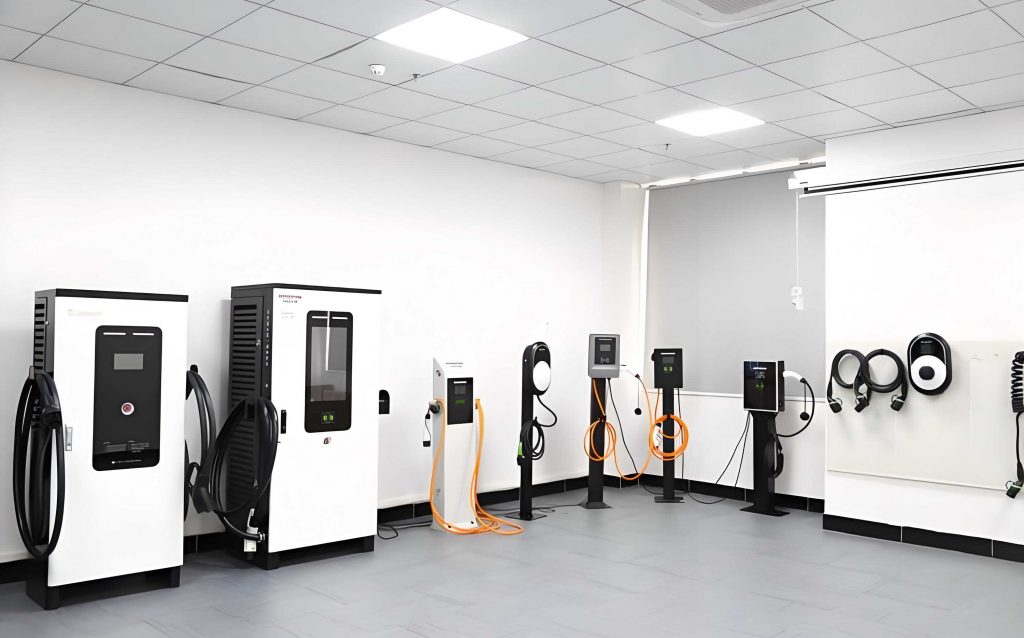
The harmonic content in EV charging stations arises from the switching behavior of power electronic devices. For instance, in a three-phase uncontrolled rectifier setup, the input current becomes distorted due to the rectification process. The output voltage and current can be expressed using Fourier series representations, highlighting the harmonic components. The equivalent circuit of an EV charging station includes a nonlinear resistance, denoted as \( R_C \), which models the battery load during charging. This resistance varies with the battery SOC, reflecting the dynamic nature of the charging process. The relationship between \( R_C \) and the charging power is given by:
$$ R_C = \frac{\eta U_I^2}{P_o} $$
where \( \eta \) is the efficiency of the EV charging station, \( U_I \) is the DC-link voltage, and \( P_o \) is the output power. This equation underscores how the nonlinear load characteristics evolve during charging, influencing the harmonic emission levels. The DC voltage \( U_I \) is relatively stable over a fundamental period, allowing for simplification in harmonic analysis. The rectifier output voltage \( u_d(t) \) and current \( i_I(t) \) can be decomposed into DC and harmonic components as follows:
$$ u_d(t) = \frac{3\sqrt{6}}{\pi} U \left[ 1 + \sum_{k=1}^{\infty} \frac{(-1)^{k-1} \cdot 2 \cos(6k\omega t)}{(6k-1)(6k+1)} \right] = U_d + \sum u_{dh}(t) $$
$$ i_I(t) = \frac{U_d}{R_C} + \sum_{h=6k}^{\infty} \frac{u_{dh}(t)}{j h \omega L_f + \frac{1}{j h \omega C_f}} = I_d + \sum i_{dh}(t) \quad (k=1,2,3,\ldots) $$
Here, \( U_d \) and \( I_d \) represent the DC components, while \( u_{dh}(t) \) and \( i_{dh}(t) \) denote the harmonic components. The impedance of the filter circuit, \( j h \omega L_f + \frac{1}{j h \omega C_f} \), plays a crucial role in attenuating higher-order harmonics. By neglecting higher-order terms, the current can be approximated as:
$$ i_I(t) \approx \frac{U_d}{R_C} + \frac{u_{d6}(t)}{Z_6} = \frac{3\sqrt{6} U}{\pi R_C} + \frac{6\sqrt{6} \cos(6\omega t) U}{35\pi Z_6} $$
This simplification allows for the derivation of the AC-side current, such as the phase A current \( i_a(t) \), which contains significant harmonic distortions:
$$ i_a(t) = \frac{18\sqrt{2} U}{\pi^2 R_C} \sum_{k=0}^{\infty} \frac{(-1)^k}{m} \sin(m\omega t) + \frac{36\sqrt{2} U}{35\pi^2 X_6} \sum_{k=0}^{\infty} \frac{(-1)^k}{m} \sin(m\omega t) \cos(6m\omega t) $$
where \( m = 6k \pm 1 \). This expression confirms that EV charging stations inject substantial harmonic currents, particularly at orders like 5th, 7th, 11th, and 13th, into the grid. The cumulative effect of multiple EV charging stations operating simultaneously can exacerbate harmonic pollution, necessitating accurate modeling and analysis.
To effectively analyze the harmonic content, I propose a battery model based on the SOC, which offers a universal approach compared to resistance-based models that require specific parameters for different EV types. The SOC indicates the remaining battery capacity and is pivotal in determining the charging stages—constant current (CC) and constant voltage (CV). During the CC stage, the SOC increases linearly with time, while in the CV stage, the SOC growth rate decelerates as the charging current decreases. The SOC can be estimated using current integration:
$$ SOC_t = SOC_{t-1} + \int_{t-1}^{t} \eta \cdot i(\tau) \, d\tau $$
Alternatively, the SOC can be related to the charging power:
$$ SOC = SOC_0 + \frac{\int P_o \, dt}{Q} $$
where \( SOC_0 \) is the initial SOC, \( i_0 \) is the charging current, and \( Q \) is the battery capacity. The charging power profile and SOC variation during a typical EV charging cycle are illustrated in the simulations. For example, during the CC stage, the SOC increases linearly as \( SOC = 0.004872 \times t \) for \( 0 < t \leq T_C \), where \( T_C \) is the duration of the CC phase. The equivalent nonlinear resistance \( R_C \) during this stage is given by:
$$ R_C = \frac{\eta U_I^2}{1.048 \times 0.004872 \times Q} \quad \text{for} \quad 0 < t \leq T_C $$
In the CV stage, \( R_C \) becomes a function of SOC:
$$ R_C = \frac{\eta U_I^2}{P_{omax} – 0.021 (SOC – SOC_{150}) Q} \quad \text{for} \quad T_C < t \leq T $$
This model captures the dynamic behavior of the EV charging station, enabling precise harmonic analysis throughout the charging process. The variation of \( R_C \) with SOC is depicted in the simulation results, showing how the resistance increases during the CV stage, leading to reduced harmonic emissions as charging progresses.
To validate the proposed model, I conducted simulations using a setup with a three-phase grid of infinite capacity, a 9 kW EV charging station, and a battery with a maximum output current of 120 A. The charging process includes a 150-minute CC stage followed by a 120-minute CV stage. The load profile follows the derived \( R_C \) curve. The harmonic content is evaluated at the point of maximum distortion during the charging cycle. The voltage and current harmonic components for key orders are summarized in the tables below.
| Harmonic Order | Calculated Model | Simulated Model | Error |
|---|---|---|---|
| 5 | 0.0104 | 0.0105 | 0.95% |
| 7 | 0.0091 | 0.0091 | 0% |
| 11 | 0.0057 | 0.0058 | 1.72% |
| 13 | 0.0041 | 0.0041 | 0% |
| Harmonic Order | Calculated Model | Simulated Model | Error |
|---|---|---|---|
| 5 | 0.8335 | 0.8344 | 0.11% |
| 7 | 0.6901 | 0.6907 | 0.087% |
| 11 | 0.3715 | 0.3715 | 0% |
| 13 | 0.2341 | 0.2335 | 0.26% |
The tables demonstrate that the calculated harmonic components align closely with the simulation results, with errors generally below 2%. This confirms the accuracy of the nonlinear equivalent resistance model in predicting harmonic distortions. Additionally, the harmonic current and voltage contents vary with SOC during the charging process. For instance, the total harmonic distortion (THD) of the secondary side current reaches 11.29%, with dominant harmonics at the 5th, 7th, 11th, and 13th orders. This consistency with theoretical analysis underscores the model’s reliability for harmonic assessment in EV charging stations.
The harmonic emission from EV charging stations is not static but evolves with the charging profile. During the CC stage, the high charging current results in pronounced harmonic levels, whereas the CV stage sees a gradual reduction as the current decreases. This dynamic behavior highlights the importance of SOC-based models for accurate harmonic forecasting. Moreover, the cumulative impact of multiple distributed EV charging stations can lead to resonant conditions in the grid, amplifying certain harmonic orders. Therefore, the proposed model serves as a vital tool for grid planners to implement harmonic mitigation techniques, such as active filters or dedicated harmonic traps, tailored to the operational characteristics of EV charging stations.
In conclusion, the harmonic pollution caused by EV charging stations is a critical issue that demands thorough analysis and mitigation. The SOC-based nonlinear equivalent resistance model developed in this paper provides a high-precision approach for evaluating harmonic content. Through simulations, I have validated the model’s effectiveness in capturing harmonic voltages and currents during different charging stages. This research contributes to the ongoing efforts to enhance power quality in grids with high penetration of EV charging stations, ensuring reliable and efficient operation. Future work could explore real-time harmonic compensation strategies based on this model, further advancing the integration of sustainable transportation infrastructure.