
With the rapid growth of the electric vehicle (EV) market and increasing charging demands, the construction and optimization of EV charging infrastructure have become critically important. Achieving a sustainable transportation system requires that charging stations not only meet users’ immediate charging needs but also effectively consider the grid’s carrying capacity and operational efficiency. Vehicle-grid collaboration, which involves the coordination between EV charging and grid dispatch, has emerged as a key research direction, offering significant benefits in areas such as the layout of EV charging stations, load management, and the utilization of renewable energy sources. The diversity of EV charging stations, including slow charging facilities (SCF), fast charging facilities (FCF), and ultra-fast charging facilities (UCF), each with distinct charging characteristics and applicable scenarios, necessitates a comprehensive approach to configuration. However, existing studies often simplify the treatment of multiple charging facility types by directly associating them with regional load types, such as linking residential areas with low-power chargers and commercial areas with higher-power chargers. This paper addresses this gap by proposing a collaborative optimization strategy for vehicle-grid integration that considers multiple types of EV charging stations, accounting for conditional scenario constraints arising from their mutual influences. By applying a two-step equivalence method and second-order cone relaxation technology, the complex optimization problem is transformed into a mixed-integer second-order cone programming (MISOCP) problem, enhancing solution efficiency while ensuring accuracy.
The proliferation of EVs has led to a surge in demand for efficient and reliable charging infrastructure. An EV charging station must be designed to handle varying power levels and user behaviors, which directly impact grid stability. In this context, optimizing the configuration of multiple types of EV charging stations is essential for minimizing costs and maximizing grid performance. This involves not only the physical placement of charging points but also the dynamic coordination of charging loads to avoid overloading the distribution network. The integration of renewable energy sources further complicates this optimization, as intermittent generation must be balanced with charging demands. Therefore, a holistic approach that considers technical, economic, and operational aspects is required to develop effective strategies for EV charging station deployment.
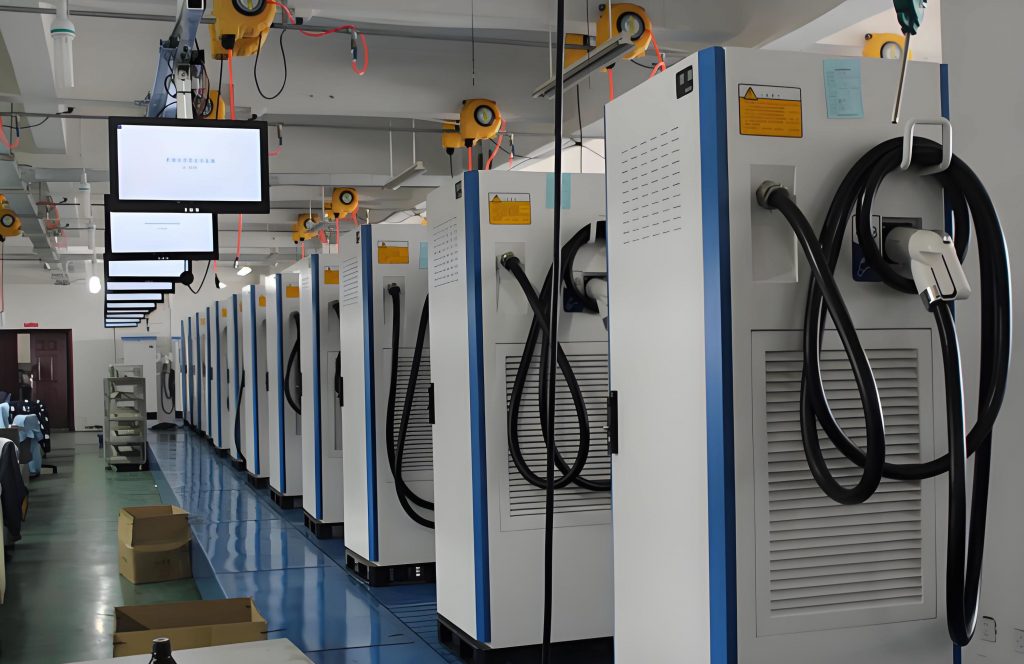
To model the load imposed by EVs on the grid, we categorize them based on the type of charging facility they utilize: slow charging, fast charging, and ultra-fast charging. The charging power for an EV k, denoted as \( P_k \), can be expressed as a function of the battery capacity \( C_k \), state of charge \( SoC_k \), and estimated charging time \( T_d^k \). The formula is given by:
$$ P_k = \begin{cases} P_S, & C_k \cdot (1 – SoC_k) \leq P_S \cdot T_d^k \\ P_F, & P_S \cdot T_d^k < C_k \cdot (1 – SoC_k) \leq P_F \cdot T_d^k \\ P_U, & C_k \cdot (1 – SoC_k) > P_F \cdot T_d^k \end{cases} $$
where \( P_S \), \( P_F \), and \( P_U \) represent the rated charging powers for slow, fast, and ultra-fast EV charging stations, respectively. This model captures the decision-making process of EV users in selecting the appropriate charging type based on their remaining battery capacity and available time, which directly influences the load profile at each EV charging station. The aggregation of these individual charging events forms the total EV load, which must be managed to prevent grid congestion and ensure reliable operation. For instance, slow charging typically occurs over longer periods, such as overnight in residential areas, while fast and ultra-fast charging are preferred in commercial or highway settings where time is critical. Understanding these patterns is crucial for optimizing the placement and capacity of EV charging stations.
The objective of the collaborative optimization model is to minimize the average annual total social cost, which encompasses investment costs, grid expansion costs, operation and maintenance expenses, and energy loss costs. The objective function is formulated as:
$$ \min C = C_I + C_R + C_O + t_w \cdot \sum_{s=1}^{4} \sum_{t=1}^{k_t} C_{L,w}^{s,t} + t_{wd} \cdot \sum_{s=1}^{4} \sum_{t=1}^{k_t} C_{L,wd}^{s,t} $$
Here, \( C_I \) is the average annual investment cost for EV charging stations, \( C_R \) is the average annual grid expansion cost, \( C_O \) is the annual operation and maintenance cost for EV charging stations, and \( C_{L,w}^{s,t} \) and \( C_{L,wd}^{s,t} \) represent the energy loss costs during weekdays and weekends, respectively, for season s and time period t. The terms \( t_w \) and \( t_{wd} \) denote the number of weekdays and weekends in season s. The investment cost \( C_I \) is calculated using the formula:
$$ C_I = R_d \cdot \sum_{i=1}^{N} (c_{I_S} \cdot N_i^S + c_{I_F} \cdot N_i^F + c_{I_U} \cdot N_i^U) $$
where \( R_d \) is the capital recovery factor given by \( R_d = \frac{d(1+d)^{y_c}}{(1+d)^{y_c} – 1} \), with d as the discount rate and \( y_c \) as the average lifespan of the EV charging station equipment. The variables \( N_i^S \), \( N_i^F \), and \( N_i^U \) represent the number of slow, fast, and ultra-fast charging points at node i, respectively, and \( c_{I_S} \), \( c_{I_F} \), \( c_{I_U} \) are their respective unit investment costs. The grid expansion cost \( C_R \) is expressed as:
$$ C_R = R_d \cdot c_R \cdot \sum_{i=1}^{N} (P_S \cdot N_i^S + P_F \cdot N_i^F + P_U \cdot N_i^U) $$
where \( c_R \) is the unit capacity expansion cost coefficient. The operation and maintenance cost \( C_O \) is:
$$ C_O = \sum_{i=1}^{N} (c_{O_S} \cdot N_i^S + c_{O_F} \cdot N_i^F + c_{O_U} \cdot N_i^U) $$
with \( c_{O_S} \), \( c_{O_F} \), \( c_{O_U} \) being the annual unit operation and maintenance costs for each type of EV charging station. The energy loss cost \( C_L^{s,t} \) for any period is computed as:
$$ C_L^{s,t} = \sum_{i=1}^{N_{bus}} \sum_{j \in u(i)} c_L \cdot I_{ij}^2 \cdot R_{ij} \cdot \Delta t $$
where \( c_L \) is the unit cost of energy loss, \( I_{ij} \) is the current on branch ij, \( R_{ij} \) is the resistance, and \( \Delta t \) is the duration of the time period. This comprehensive cost structure ensures that the optimization model balances upfront investments with long-term operational efficiencies, promoting the sustainable development of EV charging stations.
The optimization model is subject to several constraints that ensure physical feasibility and operational limits. First, the power flow constraints are modeled using the DistFlow equations:
$$ \sum_{i \in v(j)} \left[ P_{ij} – \frac{P_{ij}^2 + Q_{ij}^2}{U_i^2} \cdot R_{ij} \right] = \sum_{l \in u(j)} P_{jl} + P_j^L + P_j^E \quad \forall j \in \Omega_N $$
$$ \sum_{i \in v(j)} \left[ Q_{ij} – \frac{P_{ij}^2 + Q_{ij}^2}{U_i^2} \cdot X_{ij} \right] = \sum_{l \in u(j)} Q_{jl} + Q_j^L \quad \forall j \in \Omega_N $$
$$ U_j^2 = U_i^2 – 2(R_{ij} P_{ij} + X_{ij} Q_{ij}) + (R_{ij}^2 + X_{ij}^2) \cdot \frac{P_{ij}^2 + Q_{ij}^2}{U_i^2} \quad \forall ij \in \Omega_L $$
where \( P_{ij} \) and \( Q_{ij} \) are the active and reactive power flows on branch ij, \( U_i \) is the voltage magnitude at node i, \( P_j^L \) and \( Q_j^L \) are the active and reactive loads at node j, and \( P_j^E \) is the EV charging load at node j. The sets \( \Omega_N \) and \( \Omega_L \) represent the nodes and branches in the system, respectively. Voltage and current constraints are enforced as:
$$ U_{min} \leq U_i \leq U_{max} \quad \forall i \in \Omega_N $$
$$ I_{ij}^2 = \frac{P_{ij}^2 + Q_{ij}^2}{U_i^2} \quad \forall ij \in \Omega_L $$
$$ I_{ij} \leq I_{ij,max} \quad \forall ij \in \Omega_L $$
These constraints ensure that the grid operates within safe limits, preventing issues such as voltage drops or thermal overloading. Additionally, load dispatch constraints balance the number of EVs requiring each charging type at each node:
$$ N_i^{ar,S} = \sum_{j \in \Omega_c} N_{ij}^S \quad \forall i \in \Omega_N $$
$$ N_i^{ar,F} = \sum_{j \in \Omega_c} N_{ij}^F \quad \forall i \in \Omega_N $$
$$ N_i^{ar,U} = \sum_{j \in \Omega_c} N_{ij}^U \quad \forall i \in \Omega_N $$
where \( N_i^{ar,S} \), \( N_i^{ar,F} \), \( N_i^{ar,U} \) are the numbers of EVs arriving at node i that require slow, fast, and ultra-fast charging, respectively, and \( N_{ij}^S \), \( N_{ij}^F \), \( N_{ij}^U \) are the numbers of EVs from node i that charge at node j using the respective charging types. The set \( \Omega_c \) denotes candidate nodes for EV charging station installation. Distance constraints limit the maximum acceptable charging distance \( d_l \):
$$ N_{ij}^S = 0 \quad \forall (i,j) \in \{ (i,j) | d(i,j) > d_l \} $$
$$ N_{ij}^F = 0 \quad \forall (i,j) \in \{ (i,j) | d(i,j) > d_l \} $$
$$ N_{ij}^U = 0 \quad \forall (i,j) \in \{ (i,j) | d(i,j) > d_l \} $$
These ensure that EVs are not dispatched to charging stations beyond a practical distance, reflecting real-world user behavior. The EV charging station capacity constraints guarantee that the number of charging points meets the demand at any time:
$$ N_j^U \geq \sum_{i=1}^{N} N_{ij}^U \quad \forall j \in \Omega_c $$
$$ N_j^F + N_j^U \geq \sum_{i=1}^{N} (N_{ij}^F + N_{ij}^U) \quad \forall j \in \Omega_c $$
$$ N_j^S + N_j^F + N_j^U \geq \sum_{i=1}^{N} (N_{ij}^S + N_{ij}^F + N_{ij}^U) \quad \forall j \in \Omega_c $$
Scenario constraints address two primary situations in EV charging station configuration. In Scenario 1, all three types of charging points fully meet the EV charging demand:
$$ N_j^S \geq \sum_{i=1}^{N} N_{ij}^S \quad \text{and} \quad N_j^F \geq \sum_{i=1}^{N} N_{ij}^F $$
leading to the EV charging load at node j as:
$$ P_j^E = P_S \cdot \sum_{i=1}^{N} N_{ij}^S + P_F \cdot \sum_{i=1}^{N} N_{ij}^F + P_U \cdot \sum_{i=1}^{N} N_{ij}^U $$
In Scenario 2, fast charging points are insufficient, causing some EVs to switch to ultra-fast charging:
$$ N_j^S \geq \sum_{i=1}^{N} N_{ij}^S \quad \text{and} \quad N_j^F < \sum_{i=1}^{N} N_{ij}^F $$
with the adjusted load:
$$ P_j^E = P_S \cdot \sum_{i=1}^{N} N_{ij}^S + P_F \cdot N_j^F + P_U \cdot \left( \sum_{i=1}^{N} N_{ij}^F – N_j^F \right) + P_U \cdot \sum_{i=1}^{N} N_{ij}^U $$
These scenario constraints capture the dynamic interactions between different types of EV charging stations and their impact on grid load.
To solve the optimization model efficiently, we apply a two-step equivalence method to handle the scenario constraints. This transforms the equality constraints into inequalities without affecting the optimal configuration. For example, the scenario constraints become:
$$ P_j^E \geq P_S \cdot \sum_{i=1}^{N} N_{ij}^S + P_F \cdot \sum_{i=1}^{N} N_{ij}^F + P_U \cdot \sum_{i=1}^{N} N_{ij}^U $$
$$ P_j^E \geq P_S \cdot \sum_{i=1}^{N} N_{ij}^S + P_F \cdot N_j^F + P_U \cdot \left( \sum_{i=1}^{N} N_{ij}^F – N_j^F \right) + P_U \cdot \sum_{i=1}^{N} N_{ij}^U $$
The revised optimization model is then:
$$ \min \, (2) \quad \text{subject to} \quad (8)-(22), (27)-(28) $$
Next, we employ second-order cone relaxation to convert the model into a MISOCP problem. Variable substitutions are introduced:
$$ \overline{U_i} = U_i^2 \quad \text{and} \quad \overline{I_{ij}} = I_{ij}^2 $$
Applying these to the constraints (8)-(13) yields:
$$ \sum_{i \in v(j)} \left[ P_{ij} – \overline{I_{ij}} \cdot R_{ij} \right] = \sum_{l \in u(j)} P_{jl} + P_j^L + P_j^E \quad \forall j \in \Omega_N $$
$$ \sum_{i \in v(j)} \left[ Q_{ij} – \overline{I_{ij}} \cdot X_{ij} \right] = \sum_{l \in u(j)} Q_{jl} + Q_j^L \quad \forall j \in \Omega_N $$
$$ \overline{U_j} = \overline{U_i} – 2(R_{ij} P_{ij} + X_{ij} Q_{ij}) + (R_{ij}^2 + X_{ij}^2) \cdot \overline{I_{ij}} \quad \forall ij \in \Omega_L $$
$$ (U_{min})^2 \leq \overline{U_i} \leq (U_{max})^2 \quad \forall i \in \Omega_N $$
$$ \overline{I_{ij}} = \frac{P_{ij}^2 + Q_{ij}^2}{\overline{U_i}} \quad \forall ij \in \Omega_L $$
$$ (I_{ij,min})^2 \leq \overline{I_{ij}} \leq (I_{ij,max})^2 \quad \forall ij \in \Omega_L $$
Relaxing the equality constraint for \( \overline{I_{ij}} \) and expressing it in second-order cone form:
$$ \overline{I_{ij}} \geq \frac{P_{ij}^2 + Q_{ij}^2}{\overline{U_i}} \quad \forall ij \in \Omega_L $$
$$ \left\| \begin{bmatrix} 2P_{ij} \\ 2Q_{ij} \\ \overline{I_{ij}} – \overline{U_i} \end{bmatrix} \right\|_2 \leq \overline{I_{ij}} + \overline{U_i} \quad \forall ij \in \Omega_L $$
The final MISOCP model is:
$$ \min \, (2) \quad \text{subject to} \quad (14)-(22), (27)-(28), (31)-(34), (36)-(38) $$
This transformation reduces the complexity of the original non-convex problem, enabling efficient solution using commercial solvers like Gurobi within the YALMIP toolbox in MATLAB.
For case analysis, we utilize the IEEE 33-node distribution system, categorizing node areas into residential, commercial, and office types to reflect realistic EV charging demands. Two scenarios are studied: Scenario 1 where all charging types are fully available, and Scenario 2 where fast charging points are inadequate. The optimization results for EV charging station configuration under each scenario are summarized in the following tables. In Scenario 1, the allocation of slow, fast, and ultra-fast charging points across candidate nodes shows a balanced distribution, with higher proportions of fast and ultra-fast chargers in commercial areas. For example, at node 18, which represents a commercial zone, the configuration includes 15 slow charging points, 20 fast charging points, and 10 ultra-fast charging points, whereas node 6 in a residential area has 25 slow charging points, 5 fast charging points, and 2 ultra-fast charging points. This variation underscores the importance of tailoring EV charging station types to local demand patterns.
| Node | Slow Charging Points | Fast Charging Points | Ultra-Fast Charging Points | Total Capacity (kW) |
|---|---|---|---|---|
| 6 | 25 | 5 | 2 | 185 |
| 12 | 20 | 15 | 8 | 310 |
| 18 | 15 | 20 | 10 | 395 |
| 25 | 10 | 10 | 5 | 200 |
| 33 | 30 | 8 | 3 | 239 |
In Scenario 2, the configuration shifts due to the shortage of fast charging points, leading to an increased reliance on ultra-fast charging. For instance, at node 12, the number of fast charging points is limited to 10, while ultra-fast charging points increase to 15 to compensate. This adjustment ensures that the total charging demand is met but at a higher cost due to the more expensive ultra-fast infrastructure. The following table illustrates the optimized configuration for Scenario 2, highlighting the reallocation of charging types.
| Node | Slow Charging Points | Fast Charging Points | Ultra-Fast Charging Points | Total Capacity (kW) |
|---|---|---|---|---|
| 6 | 25 | 3 | 4 | 187 |
| 12 | 20 | 10 | 15 | 420 |
| 18 | 15 | 15 | 15 | 450 |
| 25 | 10 | 8 | 7 | 236 |
| 33 | 30 | 5 | 5 | 245 |
The cost comparison between the two scenarios reveals that Scenario 1 has a lower average annual total social cost, making it more economically favorable. Specifically, the costs are broken down as follows:
| Cost Component | Scenario 1 | Scenario 2 |
|---|---|---|
| Investment Cost (\( C_I \)) | 2.150 | 2.450 |
| Grid Expansion Cost (\( C_R \)) | 0.890 | 1.020 |
| Operation and Maintenance Cost (\( C_O \)) | 0.510 | 0.580 |
| Energy Loss Cost (\( C_L \)) | 0.4916 | 0.3343 |
| Total Cost (\( C \)) | 4.0416 | 4.3843 |
This analysis demonstrates that a well-planned EV charging station configuration, which fully meets demand with appropriate charging types, can reduce overall costs. The higher costs in Scenario 2 stem from the need for additional ultra-fast charging infrastructure, which has higher investment and operation expenses. Moreover, the energy loss costs vary due to differences in load distribution and grid congestion. These findings emphasize the importance of accurate demand forecasting and flexible planning for EV charging stations to adapt to varying scenarios.
In conclusion, this paper presents a collaborative optimization strategy for vehicle-grid integration that considers multiple types of EV charging stations. The proposed model effectively addresses the complexities of charging infrastructure configuration by incorporating scenario constraints and applying advanced mathematical techniques. The use of the two-step equivalence method and second-order cone relaxation simplifies the solution process while maintaining optimality. Case studies on the IEEE 33-node system validate the model’s effectiveness, showing that optimized configurations of multiple EV charging station types can enhance economic efficiency and grid performance. Future work could explore the integration of renewable energy sources and dynamic pricing models to further improve the resilience and sustainability of EV charging networks. Additionally, real-time data and machine learning approaches could be incorporated to adapt the optimization to evolving demand patterns, ensuring that EV charging stations remain a cornerstone of smart grid development.