
In modern power distribution systems, the proliferation of EV charging stations has introduced significant challenges related to harmonic distortion. As a nonlinear load, an EV charging station draws current in a non-sinusoidal manner, generating harmonics that propagate through the grid. These harmonics, which are integer multiples of the fundamental frequency, can degrade power quality, increase energy losses, and cause equipment malfunctions. In this analysis, I explore the harmonic issues associated with EV charging stations and evaluate various mitigation techniques to ensure grid stability and efficiency. The integration of EV charging stations into power networks is accelerating with the rise of electric vehicles, making harmonic management a critical aspect of power system design. I will delve into the specific harms caused by harmonics, the objectives of mitigation, and the technical solutions available, supported by mathematical models and comparative tables.
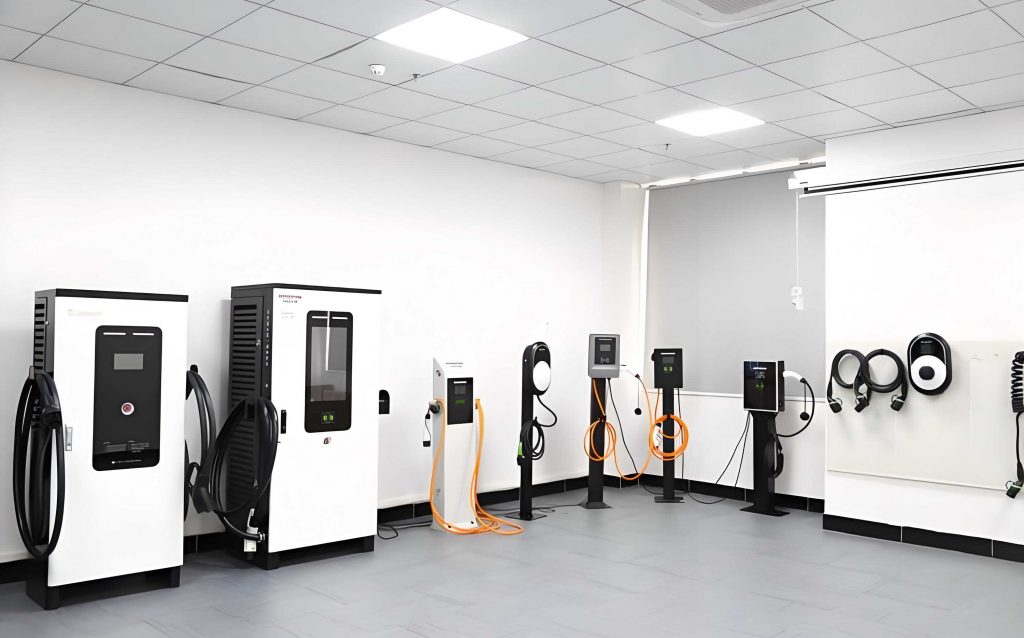
Harmonic distortion from an EV charging station primarily stems from the power electronic converters used in charging processes. These devices, such as rectifiers and inverters, switch at high frequencies, producing harmonic currents that can interfere with other grid-connected equipment. The severity of harmonics depends on factors like the charging power level, the number of simultaneous charging sessions, and the impedance of the distribution network. For instance, a high-power EV charging station operating at 50 kW or more can inject substantial harmonics into the system, leading to voltage fluctuations and increased thermal stress on components. I will discuss the quantification of harmonics using indices like Total Harmonic Distortion (THD) and Individual Harmonic Distortion (IHD), which are essential for assessing the impact of an EV charging station on power quality. The THD for current is given by:
$$ THD_I = \frac{\sqrt{\sum_{h=2}^{\infty} I_h^2}}{I_1} \times 100\% $$
where \( I_h \) represents the RMS value of the h-th harmonic current and \( I_1 \) is the RMS value of the fundamental current. Similarly, for voltage, THD_V can be defined. In practice, standards such as IEEE 519 set limits for THD to prevent excessive distortion from sources like an EV charging station. Understanding these metrics is crucial for designing effective mitigation strategies that address the unique characteristics of each EV charging station installation.
The harms caused by harmonics from an EV charging station are multifaceted and can severely impact power system operations. Firstly, harmonic currents increase the RMS current in conductors and equipment, leading to elevated temperatures and reduced lifespan. For example, transformers serving an EV charging station may experience additional losses due to eddy currents and hysteresis effects intensified by harmonics. The power loss in a transformer can be approximated by:
$$ P_{loss} = I_{rms}^2 R + \sum_{h=2}^{\infty} I_h^2 R_h $$
where \( I_{rms} \) is the total RMS current, \( R \) is the resistance at fundamental frequency, and \( R_h \) is the resistance at harmonic frequencies, which may be higher due to skin effect. This increased loss not only wastes energy but also necessitates derating of equipment, increasing capital costs. Secondly, harmonics can cause resonance conditions in capacitive circuits, such as those with power factor correction capacitors, leading to overvoltages and equipment failure. In sensitive environments like hospitals or data centers, voltage distortion from an EV charging station can disrupt精密 equipment, resulting in operational errors or shutdowns. Lastly, harmonics contribute to higher energy consumption; for instance, a study might show that an EV charging station with high THD can increase overall system losses by 5-10%, translating to significant economic and environmental costs over time.
| Harmonic Effect | Impact on EV Charging Station | Typical Mitigation Measure |
|---|---|---|
| Increased Current RMS | Overheating of cables and transformers | Use of harmonic filters |
| Voltage Distortion | Malfunction of sensitive electronics | Active power filtering |
| Resonance | Capacitor bank failures | Impedance tuning |
| Power Factor Degradation | Higher energy bills and penalties | Capacitor addition |
The primary goal of harmonic mitigation in the context of an EV charging station is to maintain power quality and ensure the reliable operation of both the charging infrastructure and the broader grid. By reducing harmonics, we can minimize energy losses, extend equipment lifespan, and comply with regulatory standards. For an EV charging station, this involves real-time monitoring and control to adapt to varying load conditions. I emphasize that effective mitigation not only protects the EV charging station itself but also prevents harmonic propagation to neighboring users, fostering a more resilient power system. Objectives include achieving THD levels below 5% for voltage and 8% for current, as per typical guidelines, and improving the power factor to near unity to reduce reactive power demand. This is particularly important for fast-charging EV charging stations, which can draw large currents and generate significant harmonics during peak operation.
Several advanced technologies are employed for harmonic mitigation in an EV charging station. Active power filtering (APF) is a prominent method that injects compensating currents to cancel out harmonics. The principle involves measuring the load current of an EV charging station, extracting harmonic components, and generating anti-phase currents using power electronic devices like IGBTs. The compensating current \( i_c(t) \) can be expressed as:
$$ i_c(t) = -\sum_{h=2}^{\infty} I_h \sin(h\omega t + \phi_h) $$
where \( I_h \) and \( \phi_h \) are the magnitude and phase of the h-th harmonic, and \( \omega \) is the fundamental angular frequency. APF systems can achieve high efficiency, with harmonic reduction rates exceeding 90% in many EV charging station applications. They are particularly suitable for dynamic environments where harmonic profiles change rapidly due to varying charging loads. Another key technology is the use of capacitors, which absorb harmonic currents and improve power factor. The impedance of a capacitor at harmonic frequency h is given by \( Z_c = \frac{1}{j h \omega C} \), allowing it to shunt harmonic currents away from sensitive equipment. In an EV charging station, capacitors are often deployed in banks with tuning reactors to avoid resonance, and their capacity is selected based on the expected harmonic spectrum. For example, a typical EV charging station might use a capacitor bank with a reactance X_c calculated to target specific harmonics, such as the 5th or 7th, which are common in three-phase systems.
| Technique | Principle | Advantages | Limitations | Applicability to EV Charging Station |
|---|---|---|---|---|
| Active Power Filter (APF) | Injects anti-phase harmonics | High accuracy, dynamic response | High cost, complexity | Ideal for high-power stations |
| Capacitor Banks | Absorbs harmonics, improves PF | Low cost, simple installation | Suitable for small to medium stations | |
| Multi-Level Transformer | Filters via winding design | Robust, handles multiple harmonics | Bulky, limited flexibility | Effective in centralized charging hubs |
| Digital Signal Processing (DSP) | Algorithm-based control | Precise, adaptable to changes | Requires high computation | Versatile for various station types |
Multi-level transformer design is another effective approach for harmonic mitigation in an EV charging station. By incorporating multiple windings with specific impedances, these transformers can selectively attenuate harmonic currents. The transfer function of a multi-level transformer for harmonic frequency h can be modeled as:
$$ H(h) = \frac{V_{out}(h)}{V_{in}(h)} = \frac{Z_{load}(h)}{Z_{source}(h) + Z_{transformer}(h)} $$
where \( Z_{transformer}(h) \) is designed to be high for dominant harmonics, thus reducing their amplitude. This method is highly reliable and can be customized for the harmonic profile of a particular EV charging station, making it a preferred choice in installations where space and cost are constraints. Additionally, digital signal processing (DSP) technology leverages advanced algorithms to analyze and compensate for harmonics in real-time. In an EV charging station, DSP systems use Fast Fourier Transform (FFT) to decompose current waveforms into harmonic components and then generate corrective signals. The discrete Fourier transform for a sampled current signal \( i[n] \) is:
$$ I[k] = \sum_{n=0}^{N-1} i[n] e^{-j 2\pi k n / N} $$
where \( I[k] \) represents the k-th harmonic component. This allows for precise control, enabling an EV charging station to maintain low THD even under fluctuating load conditions. DSP-based solutions can be integrated with other mitigation devices, such as APFs, to enhance overall performance and adaptability.
In practical applications, the combination of these technologies often yields the best results for an EV charging station. For instance, a hybrid system using APF and capacitors can provide comprehensive harmonic suppression while optimizing cost. The effectiveness of such systems can be evaluated through simulation models that consider the nonlinear behavior of an EV charging station. A typical model might use differential equations to describe the interaction between the station and the grid, such as:
$$ L \frac{di}{dt} + R i + v_c = v_s – v_h $$
where \( L \) and \( R \) are grid inductance and resistance, \( i \) is the current, \( v_c \) is the capacitor voltage, \( v_s \) is the source voltage, and \( v_h \) represents harmonic voltages. By solving these equations numerically, we can predict harmonic levels and design appropriate mitigation for an EV charging station. Furthermore, standards and guidelines play a crucial role; for example, the International Electrotechnical Commission (IEC) standards 61000-3-2 and 61000-3-12 set limits for harmonic emissions from equipment like an EV charging station, driving the adoption of mitigation technologies.
To illustrate the economic and technical benefits, consider a case where an EV charging station implements active power filtering. The reduction in harmonics can lead to lower energy losses, which in turn decreases operating costs. The savings in power losses \( \Delta P \) can be estimated as:
$$ \Delta P = P_{before} – P_{after} = I_{rms,before}^2 R – I_{rms,after}^2 R $$
where \( I_{rms,after} \) is reduced due to harmonic mitigation. For a large-scale EV charging station, this might translate to thousands of dollars in annual savings, alongside extended equipment life. Additionally, improved power quality enhances the user experience by ensuring reliable and efficient charging, which is vital for the adoption of electric vehicles. As the number of EV charging stations grows, scalable mitigation solutions will become increasingly important to maintain grid integrity.
In conclusion, harmonic mitigation is essential for the sustainable integration of EV charging stations into power distribution systems. Through technologies like active power filtering, capacitor banks, multi-level transformers, and digital signal processing, we can effectively suppress harmonics and uphold power quality. Each EV charging station presents unique challenges, but by applying a combination of these methods and adhering to standards, we can minimize the adverse effects of harmonics. Future developments may include AI-based adaptive control systems that dynamically optimize mitigation strategies for an EV charging station, further enhancing efficiency and reliability. As I have discussed, a proactive approach to harmonic management will ensure that EV charging stations contribute positively to the energy transition without compromising grid performance.