
As a professional in the automotive industry, I have dedicated significant effort to understanding and mitigating safety risks in electric vehicles (EVs). The EV battery pack is the heart of any electric vehicle, and its performance directly impacts vehicle safety, range, and longevity. Among various battery chemistries, lithium iron phosphate (LFP) batteries are widely adopted due to their thermal stability and cost-effectiveness. However, safety concerns persist, particularly those arising from voltage imbalance within the EV battery pack. This voltage imbalance, often referred to as pack voltage differential or压差, can lead to severe issues such as reduced efficiency, accelerated aging, and in extreme cases, thermal runaway, fire, or explosion. In this article, I will explore the safety implications of voltage differential in LFP-based EV battery packs through the lens of Fault Tree Analysis (FTA), a systematic method for identifying root causes of failures. I will detail investigative procedures, experimental tests, and analytical techniques, emphasizing the critical role of each component in ensuring the integrity of the EV battery pack.
The EV battery pack is a complex assembly comprising numerous individual cells, modules, busbars, wiring harnesses, and a Battery Management System (BMS). Voltage differential within an EV battery pack, denoted as $\Delta V_{\text{pack}}$, is defined as the maximum potential difference between any two cells or modules during operation. Mathematically, it can be expressed as:
$$\Delta V_{\text{pack}} = \max(V_i) – \min(V_i) \quad \text{for} \quad i = 1, 2, …, n$$
where $V_i$ represents the voltage of the $i$-th cell or module, and $n$ is the total number. A small $\Delta V_{\text{pack}}$ is desirable for optimal performance and safety. However, when this differential exceeds a threshold—often specified by manufacturers, e.g., 15 mV—it signals underlying abnormalities. Excessive voltage differential in an EV battery pack can cause uneven charging and discharging, leading to overcharge or over-discharge of individual cells, increased internal stress, and ultimately, safety hazards. The primary goal is to diagnose and address the root causes of such voltage imbalances in the EV battery pack.
To systematically analyze the safety issues stemming from voltage differential in an EV battery pack, I employ Fault Tree Analysis. FTA is a top-down, deductive approach that starts with an undesired event (the top event) and identifies all possible causes through logic gates. For this case, the top event is defined as “Excessive Voltage Differential in the EV Battery Pack Leading to Safety Risk.” The fault tree decomposes this event into intermediate and basic events, covering three major categories: cell self-discharge abnormalities, module self-discharge abnormalities, and pack-level self-discharge abnormalities. Each category branches into specific failure modes, as summarized in the following table.
| Major Category | Potential Failure Modes | Contributing Factors |
|---|---|---|
| Cell Self-Discharge Abnormalities | Internal short circuit due to dendrite formation | Lithium plating, separator integrity compromise |
| Electrolyte leakage | Sealing failure, welding defects in can or vent | |
| Overhang misalignment | Manufacturing tolerances in electrode coating | |
| Electrode tab folding (tab flipping) | Winding process anomalies, mechanical stress | |
| Module Self-Discharge Abnormalities | Busbar connection issues | Loose terminals, corrosion, welding cracks |
| Insulation failure | Damaged insulation film, foreign object penetration | |
| FPC (Flexible Printed Circuit) leakage | Short circuits, improper soldering | |
| Pack-Level Self-Discharge Abnormalities | BMS均衡漏电流 (Balancing leakage current) | BMS circuit faults, software glitches |
| Coolant leakage | Seal failure in liquid cooling pipes | |
| External contamination or ingress | Poor pack sealing, gasket failure |
The self-discharge rate of a cell, which contributes to voltage differential in the EV battery pack, can be modeled using the following empirical formula:
$$I_{\text{sd}} = k \cdot e^{\frac{-E_a}{RT}} \cdot V_{\text{cell}}$$
where $I_{\text{sd}}$ is the self-discharge current, $k$ is a constant dependent on cell chemistry and manufacturing quality, $E_a$ is the activation energy, $R$ is the universal gas constant, $T$ is the absolute temperature, and $V_{\text{cell}}$ is the cell voltage. An abnormal increase in $I_{\text{sd}}$ for certain cells directly leads to a rise in $\Delta V_{\text{pack}}$ over time, compromising the EV battery pack’s safety.
My investigation into a specific case of excessive voltage differential in an LFP EV battery pack began with a thorough external examination. The EV battery pack is the primary energy storage unit, and its external integrity is paramount. I inspected the pack’s housing for any signs of impact, corrosion, deformation, or liquid residue. No abnormalities such as cracks, dents, or water ingress were observed, ruling out external mechanical damage or environmental breach as immediate causes for the voltage differential in this EV battery pack.
Following the external check, I proceeded to disassemble the EV battery pack to examine internal connections. The internal architecture of an EV battery pack is intricate, and any loose or faulty connection can create resistance imbalances, leading to voltage discrepancies. I meticulously checked all busbars, wiring harnesses, and BMS connectors for proper engagement, corrosion, or thermal damage. All connections appeared secure and without visible defects. This step is crucial because poor electrical contacts increase internal resistance $R_{\text{contact}}$, causing a voltage drop $V_{\text{drop}} = I \cdot R_{\text{contact}}$ during current flow $I$, thereby affecting the measured voltage of individual cells in the EV battery pack.
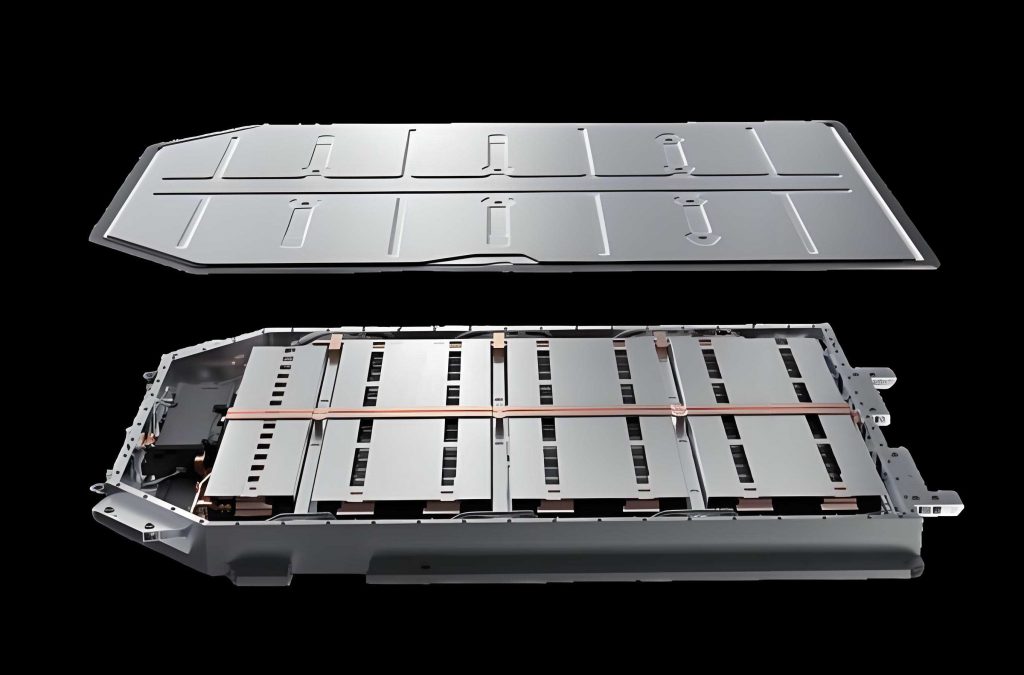
The internal view of an EV battery pack highlights its complexity, with multiple modules and interconnected components. Ensuring the seal integrity of this assembly is critical. Therefore, I conducted a helium leak test (气密性测试) on the EV battery pack to evaluate its sealing performance. The test measures the leakage rate under a specified pressure differential. The acceptable leakage threshold for this EV battery pack model was below 50 Pa. The measured leakage was 22.5 Pa, which is within specification, indicating that the pack’s enclosure was properly sealed and not the source of the voltage differential issue. The leakage rate $Q$ can be expressed as:
$$Q = \frac{\Delta P \cdot V}{t}$$
where $\Delta P$ is the pressure change, $V$ is the enclosed volume, and $t$ is time. A high $Q$ value would suggest seal failure, potentially allowing moisture ingress that could cause internal short circuits and increased self-discharge in the EV battery pack.
Next, I performed a low-voltage communication test on the EV battery pack. The BMS continuously monitors each cell’s voltage via a network of sensors and communication lines. A fault in this system can report incorrect voltages, leading to apparent voltage differentials. I connected diagnostic equipment to the BMS communication port and monitored real-time cell voltage data. The test revealed a significant voltage differential of 113 mV, far exceeding the standard limit of 15 mV. This confirmed the presence of an actual imbalance within the EV battery pack and helped isolate the problem to the cell or module level, rather than a BMS sensor fault alone. The BMS balancing current $I_{\text{bal}}$ for mitigating voltage differential in an EV battery pack is given by:
$$I_{\text{bal}} = \frac{\Delta V_{\text{cell}}}{R_{\text{bal}}}$$
where $R_{\text{bal}}$ is the balancing resistor. If the inherent self-discharge difference between cells exceeds the BMS’s balancing capability, $\Delta V_{\text{pack}}$ will grow.
With the problem localized, I focused on the individual cells within the EV battery pack. Initial visual inspection of the cells showed no major abnormalities such as swelling, electrolyte leakage, or severe outer casing damage, although minor film scratches were noted but deemed insignificant. To delve deeper, I reviewed manufacturing process data for the cells, particularly the winding parameters. The winding process determines the internal alignment of electrodes and separators. Misalignment can lead to anode-cathode overlap issues, increasing the risk of internal short circuits. The key parameters include Overhang (the extent by which the anode extends beyond the cathode) at various points. The following table summarizes data from sample cells associated with the faulty EV battery pack.
| Cell Barcode | Anode Over Cathode at Start (mm) | Anode Over Cathode at End (mm) | Bottom Overhang Mean (mm) | Top Overhang Mean (mm) | Overhang Specification (Bottom/Top mm) |
|---|---|---|---|---|---|
| 142122805650830 | 7.088 | 8.123 | 0.762 | 1.983 | 0.5–2.5 / 0.8–4.0 |
| 142122804102890 | 7.103 | 8.246 | 0.727 | 1.987 | 0.5–2.5 / 0.8–4.0 |
| 142122804752603 | 7.002 | 7.346 | 0.768 | 2.017 | 0.5–2.5 / 0.8–4.0 |
| 142122804622862 | 7.004 | 8.667 | 0.733 | 1.973 | 0.5–2.5 / 0.8–4.0 |
All recorded values fell within the specified ranges, indicating that the winding process was not the direct root cause. However, process data alone cannot reveal all internal defects. Therefore, I proceeded to dissect suspect cells from the EV battery pack for internal inspection. This involved carefully opening the cell casing to examine the jelly roll (the wound electrode assembly). Upon examination, I observed a critical anomaly at the positive electrode tab area. In several cells, the positive tab exhibited folding or flipping, where the metal tab was bent in such a way that it came into contact with the adjacent negatively charged electrode layer. This created a microscopic internal short circuit path. The contact resistance $R_{\text{short}}$ of such a short can be very low, leading to a continuous self-discharge current $I_{\text{short}} = V_{\text{cell}} / R_{\text{short}}$. This localized self-discharge causes the affected cell’s voltage to drop faster than its neighbors, resulting in a large voltage differential within the EV battery pack.
The mechanism of tab folding can be understood through the lens of mechanical stress during winding or handling. The tab, typically made of aluminum for the positive electrode, is subjected to forces that may cause plastic deformation. If the tab folds over onto the opposing electrode, it breaches the separator insulation. The risk probability $P_{\text{fold}}$ can be qualitatively expressed as a function of winding tension $T_w$, tab material yield strength $\sigma_y$, and guide alignment accuracy $\alpha$:
$$P_{\text{fold}} \propto \frac{T_w}{\sigma_y \cdot \alpha}$$
Higher winding tension or misalignment increases the likelihood of tab folding, a defect that ultimately compromises the safety of the EV battery pack.
Further evidence was found upon closer inspection of the cross-section. The negative electrode sheet in contact with the folded positive tab showed distinct burn marks, confirming that electrical arcing or resistive heating had occurred due to the short circuit. This persistent internal short acts as a constant drain, explaining the excessive self-discharge and the observed voltage differential in the EV battery pack. The energy dissipated $E_{\text{diss}}$ at the short spot over time $t$ is:
$$E_{\text{diss}} = I_{\text{short}}^2 \cdot R_{\text{short}} \cdot t$$
This energy conversion generates heat, which can degrade the surrounding materials and potentially initiate thermal runaway in the EV battery pack if unchecked.
Having identified tab folding as the root cause, I expanded the FTA to include this basic event. The fault tree now clearly links “Excessive Voltage Differential in EV Battery Pack” down through “Cell Self-Discharge Abnormalities” to “Internal Short Circuit” and finally to “Positive Electrode Tab Folding.” This analysis underscores the importance of stringent control in cell manufacturing, particularly in tab welding and winding processes, to ensure the reliability of every EV battery pack.
To generalize the findings, voltage differential management in an EV battery pack is a multi-faceted challenge. Beyond cell defects, other factors like temperature gradients can exacerbate imbalances. The temperature coefficient of cell voltage $\frac{dV}{dT}$ varies with state of charge (SOC). A temperature difference $\Delta T$ across an EV battery pack can induce a voltage difference $\Delta V_{temp} = \frac{dV}{dT} \cdot \Delta T$. Combined with internal shorts, the total voltage differential becomes:
$$\Delta V_{\text{pack, total}} = \sqrt{(\Delta V_{\text{self-discharge}})^2 + (\Delta V_{\text{temp}})^2 + (\Delta V_{\text{contact}})^2}$$
where $\Delta V_{\text{self-discharge}}$ is primarily driven by defects like tab folding. Therefore, comprehensive validation of an EV battery pack must include thermal cycle testing alongside electrical tests.
In conclusion, through a systematic Fault Tree Analysis combined with physical inspection and testing, I successfully diagnosed the safety issue of excessive voltage differential in an LFP EV battery pack to a fundamental manufacturing defect: positive electrode tab folding within individual cells. This defect creates an internal short circuit, leading to abnormal self-discharge and voltage imbalance. The investigation highlights the critical need for robust quality control at the cell production stage, precise process monitoring, and thorough validation protocols for every EV battery pack. Mitigation strategies include enhancing tab design for mechanical stability, implementing automated optical inspection during winding, and increasing the sampling rate for destructive physical analysis in quality audits. As the automotive industry continues to evolve towards electrification, ensuring the safety and reliability of the EV battery pack remains paramount. Future work should focus on developing predictive models using data from the BMS to detect early signs of such internal faults, thereby preventing safety incidents and enhancing the overall trust in electric vehicles.
The safety of an EV battery pack is non-negotiable. By understanding failure modes through tools like FTA and enforcing rigorous standards, we can advance the technology and adoption of electric vehicles while minimizing risks. The EV battery pack is not just a component; it is the cornerstone of the electric mobility revolution, and its integrity must be preserved through continuous analysis and improvement.