
In the rapidly evolving landscape of electric vehicles (EVs), the energy density of the EV battery pack stands as a critical determinant of performance, range, and overall sustainability. As an industry observer and researcher, I have delved into the multifaceted technical pathways aimed at boosting this key metric. The quest for higher energy density is not merely an engineering challenge but a pivotal endeavor to align with global policy targets, such as those outlined in “Made in China 2025” and the US Advanced Battery Consortium (USABC), which envision specific energy goals of 400-500 Wh/kg and 350 Wh/kg, respectively. Through my analysis, I explore three primary avenues: advancing cell-specific energy through material science, optimizing integration efficiency from cell to pack, and implementing lightweight designs for the EV battery pack housing. This article synthesizes these approaches, incorporating tables and formulas to elucidate trends and trade-offs, all while emphasizing the central role of the EV battery pack in the future of mobility.
The fundamental equation governing energy density is expressed as: $$ \text{Specific Energy} = \frac{E}{m} $$ where \( E \) represents the energy stored in the EV battery pack (in watt-hours, Wh) and \( m \) denotes its mass (in kilograms, kg). Enhancing this ratio directly translates to extended driving ranges without proportionally increasing the EV battery pack weight, which typically constitutes 20-30% of total vehicle mass. Currently, mainstream lithium-ion cells for EVs exhibit specific energies ranging from 200-300 Wh/kg for ternary lithium and below 200 Wh/kg for lithium iron phosphate (LFP) chemistries. However, these values are approaching theoretical limits, necessitating innovative breakthroughs. In my assessment, the evolution of the EV battery pack hinges on synergistic advancements across materials, integration, and lightweighting.
First, let us consider the enhancement of individual cell-specific energy. The core of any EV battery pack lies in its cells, which come in cylindrical, prismatic, and pouch formats, each with distinct energy density characteristics. For instance, cylindrical cells like Tesla’s 4680 offer improvements via form factor optimization, but material innovation remains paramount. The trajectory of lithium-ion batteries has seen a 3-fold increase in energy density from 1991 to 2015, with an annual growth rate of approximately 3%. Projecting linearly, one might estimate: $$ \text{Future Energy Density} = \text{Current Energy Density} \times (1 + r)^t $$ where \( r \) is the annual growth rate (0.03) and \( t \) is the time in years. By 2025, this could yield around 320 Wh/kg. Yet, practical constraints suggest a plateau, driving research into post-lithium-ion technologies such as semi-solid, solid-state, lithium-sulfur, and sodium-ion batteries. These promise dramatic leaps, with predictions of up to 1200 Wh/kg in the long term. In the near future, semi-solid batteries with 360 Wh/kg are poised for mass production, offering a tangible boost to EV battery pack performance. The table below summarizes key cell technologies and their status:
| Cell Type | Electrolyte State | Energy Density (Wh/kg) | Safety | Development Stage |
|---|---|---|---|---|
| Liquid Lithium-ion | Liquid | 250-290 | Moderate | Mass Production |
| Semi-solid | Liquid-Solid Hybrid | 300-348 | Moderate-High | Small-scale Production |
| Solid-state | Solid | High (e.g., 500+) | High | Laboratory R&D |
| Lithium-Sulfur | Varies | Potential 1200 | Challenging | Early Research |
From my perspective, material science breakthroughs are essential but gradual; thus, parallel efforts in integration and lightweighting offer immediate gains for the EV battery pack. The second pathway focuses on improving integration efficiency from cell to pack. Traditional module-to-pack (MTP) designs involve assembling cells into modules, which are then integrated into the EV battery pack. This approach offers modularity and ease of repair but suffers from low integration efficiency and space utilization. Quantitatively, integration efficiency (\( \eta_i \)) and space utilization (\( \eta_s \)) can be defined as: $$ \eta_i = \frac{\text{Number of Cells in Pack}}{\text{Total Cells Possible in Ideal Volume}} \times 100\% $$ $$ \eta_s = \frac{\text{Volume Occupied by Cells}}{\text{Total Pack Volume}} \times 100\% $$ For MTP, typical values are \( \eta_i \approx 60\% \) and \( \eta_s \approx 40\% \), meaning a significant portion of the EV battery pack is dedicated to non-energy components like housings and gaps.
Innovative integration schemes such as Cell-to-Pack (CTP), Cell-to-Chassis (CTC), and Cell-to-Body (CTB) have emerged to address these inefficiencies. In CTP, cells are directly integrated into the EV battery pack, eliminating modules and increasing \( \eta_i \) to 70-75%. CTC takes this further by embedding cells into the vehicle chassis, while CTB integrates them into the body structure. These methods can potentially elevate \( \eta_i \) to over 90% and \( \eta_s \) to above 70%, dramatically enhancing the energy density of the EV battery pack. The benefits include mass reduction, cost savings, and improved space usage. For example, CTP can reduce parts count by 40% and boost energy density by 10-15%, as seen in implementations by BYD’s blade battery, which uses elongated prismatic cells to achieve higher volumetric efficiency. The table below contrasts these integration technologies:
| Integration Technology | Description | Integration Efficiency (\( \eta_i \)) | Space Utilization (\( \eta_s \)) | Key Advantages | Challenges |
|---|---|---|---|---|---|
| MTP | Cells → Modules → Pack | ~60% | ~40% | Modular, repairable | Low efficiency, high mass |
| CTP | Cells directly to Pack | 70-75% | 50-60% | Higher energy density, fewer parts | Structural demands on cells |
| CTC | Cells integrated into Chassis | >90% | >70% | Maximized space, weight savings | Complex manufacturing, repairability |
| CTB | Cells integrated into Body | >85% | >65% | Good balance of safety and efficiency | Precision assembly required |
In my evaluation, the choice among these depends on vehicle architecture, cost targets, and lifecycle considerations. However, all contribute to a more compact and efficient EV battery pack. To visualize a typical EV battery pack structure, consider the following image, which illustrates key components like the tray, modules, and cooling systems:
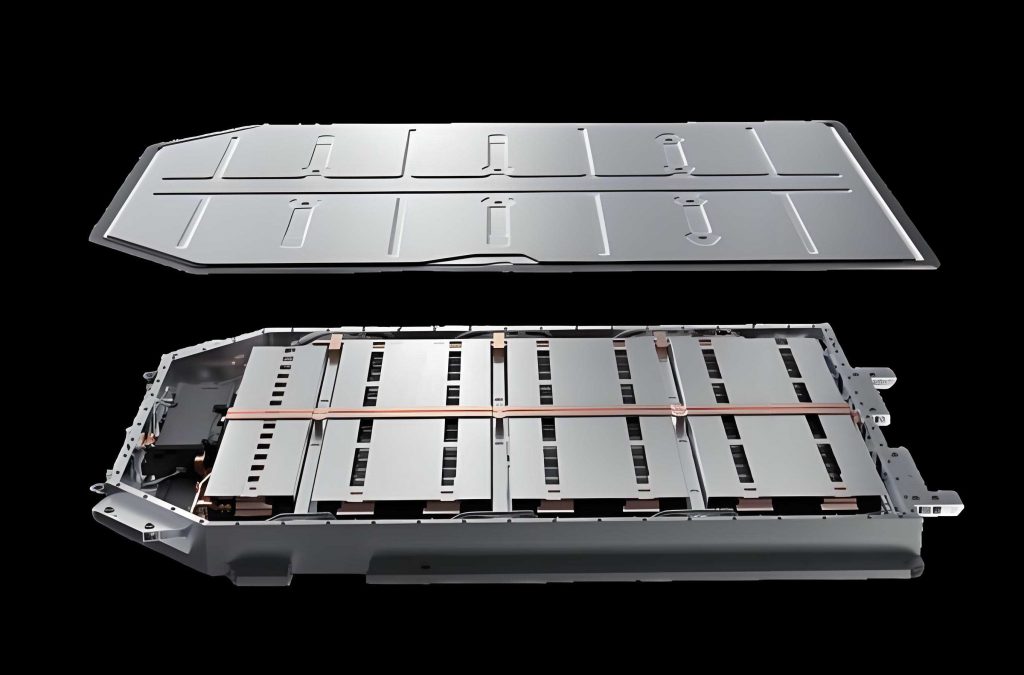
The third pathway involves lightweighting the EV battery pack housing, which accounts for 10-20% of total pack mass. Reducing this mass directly improves energy density per the specific energy formula. Lightweighting strategies encompass material selection, structural optimization, and advanced manufacturing. Common materials include aluminum alloys, ultra-high-strength steels (UHSS), and carbon fiber composites, each offering distinct trade-offs in strength, cost, and mass. For instance, the mass reduction (\( \Delta m \)) achievable by switching materials can be approximated as: $$ \Delta m = m_{\text{original}} – m_{\text{new}} = m_{\text{original}} \left(1 – \frac{\rho_{\text{new}}}{\rho_{\text{original}}} \cdot \frac{\sigma_{\text{original}}}{\sigma_{\text{new}}}\right) $$ where \( \rho \) is density and \( \sigma \) is strength. This highlights how lower-density materials like aluminum or carbon fiber can cut weight while maintaining performance.
Designs such as aluminum extruded profiles, integrated die-casting, UHSS roll-forming, and carbon fiber molding are prevalent. Aluminum extrusions offer good balance, die-casting enables complex integrated parts, UHSS provides high strength at lower cost, and carbon fiber delivers superior specific strength. From my analysis, the EV battery pack housing must meet stringent safety standards, including crash protection, sealing, and thermal management, as mandated by regulations like GB 38031-2020. Thus, lightweighting must not compromise integrity. The table below compares typical housing solutions for an EV battery pack:
| Material/Design | Density (g/cm³) | Tensile Strength (MPa) | Housing Mass (kg for reference pack) | Cost (relative units) | Manufacturing Process |
|---|---|---|---|---|---|
| Steel (Cold Stamped) | 7.85 | 340-590 | 113.5 | 1.0 (baseline) | Stamping, welding |
| UHSS Roll-formed | 7.85 | >1500 | 100.4 | 1.0 | Roll-forming, laser welding |
| Aluminum Extruded | 2.70 | 200-350 | 78.6 | 2.0 | Extrusion, friction stir welding |
| Aluminum Die-cast | 2.70 | 250-300 | 81.1 | 2.3 | High-pressure die-casting |
| Carbon Fiber Composite | 1.55 | 500-1500 | 42.4 | 5.0+ | Molding, curing |
As evident, carbon fiber composites yield the greatest mass reduction—over 70% compared to steel—but at a premium cost. Aluminum options strike a balance, popular in mid-to-high-end EVs. UHSS roll-forming is cost-effective but heavier. In practice, the EV battery pack housing often combines materials; for example, using aluminum for the tray and steel for protective structures. Structural optimization via topology analysis further refines designs, minimizing material while meeting stiffness and crash requirements. For instance, optimizing rib patterns in a die-cast tray can improve rigidity by 2% without added mass, enhancing the overall efficiency of the EV battery pack.
Integrating these three pathways—material advances, integration efficiency, and lightweighting—offers a holistic strategy for boosting EV battery pack energy density. In my view, the near-term focus should be on semi-solid cells and CTP/CTC integration, as they align with existing manufacturing infrastructures and offer tangible improvements. For example, a semi-solid EV battery pack with CTP could achieve system-level energy densities approaching 250 Wh/kg, closing in on USABC targets. Long-term, solid-state batteries coupled with full CTC and carbon fiber housings could push specific energies beyond 500 Wh/kg, revolutionizing EV range and design. However, challenges persist, including cost scalability, recyclability, and safety assurance under novel configurations.
To quantify potential gains, consider a simplified model for the EV battery pack energy density (\( ED_{\text{pack}} \)): $$ ED_{\text{pack}} = \frac{N_{\text{cells}} \cdot E_{\text{cell}}}{m_{\text{cells}} + m_{\text{housing}} + m_{\text{aux}}} $$ where \( N_{\text{cells}} \) is the number of cells, \( E_{\text{cell}} \) is the energy per cell, and \( m_{\text{cells}}, m_{\text{housing}}, m_{\text{aux}} \) are masses of cells, housing, and auxiliary components. Improvements in cell energy (\( E_{\text{cell}} \)), integration (increasing \( N_{\text{cells}} \) via higher \( \eta_i \)), and lightweighting (reducing \( m_{\text{housing}} \)) all contribute multiplicatively. For instance, moving from MTP to CTC might increase \( N_{\text{cells}} \) by 50% while cutting \( m_{\text{housing}} \) by 30%, yielding a significant \( ED_{\text{pack}} \) boost. The interplay of these factors underscores the need for coordinated R&D across disciplines.
In conclusion, the pursuit of higher energy density for the EV battery pack is a multidimensional endeavor requiring sustained innovation. Through my analysis, I emphasize that material science breakthroughs, while foundational, must be complemented by architectural optimizations like CTC and lightweight designs using advanced materials. The EV battery pack remains the cornerstone of EV advancement, and its evolution will dictate the pace of electric mobility adoption. As industry efforts intensify, we can anticipate more integrated, lighter, and higher-energy EV battery packs that deliver longer ranges, lower costs, and enhanced sustainability—key to a greener transportation future. This journey, though fraught with technical hurdles, holds immense promise for transforming the automotive landscape.