
As the automotive industry undergoes a transformative shift toward electrification, the safety of electric vehicles (EVs) has become a paramount concern. Central to this is the EV battery pack, which houses the energy storage system and is susceptible to mechanical abuse during operation. In this study, we investigate the structural integrity of an EV battery pack under lateral extrusion scenarios using explicit finite element analysis. Our goal is to evaluate deformation patterns, force responses, and potential failure risks, thereby providing a robust framework for design optimization and safety validation.
The proliferation of EVs has intensified focus on their safety performance, particularly regarding the EV battery pack. Incidents such as thermal runaway, fires, and explosions often stem from mechanical impacts—like crushing or penetration—that compromise the EV battery pack’s casing and internal components. Regulatory standards, such as GB 38031-2020, mandate rigorous testing for extrusion resistance, but physical testing is costly and time-consuming. Hence, computational simulations offer an efficient alternative to predict behavior and guide design iterations. In this work, we leverage LS-DYNA, a nonlinear explicit dynamics solver, to simulate lateral extrusion of an EV battery pack, analyzing key metrics like intrusion distance and contact force.
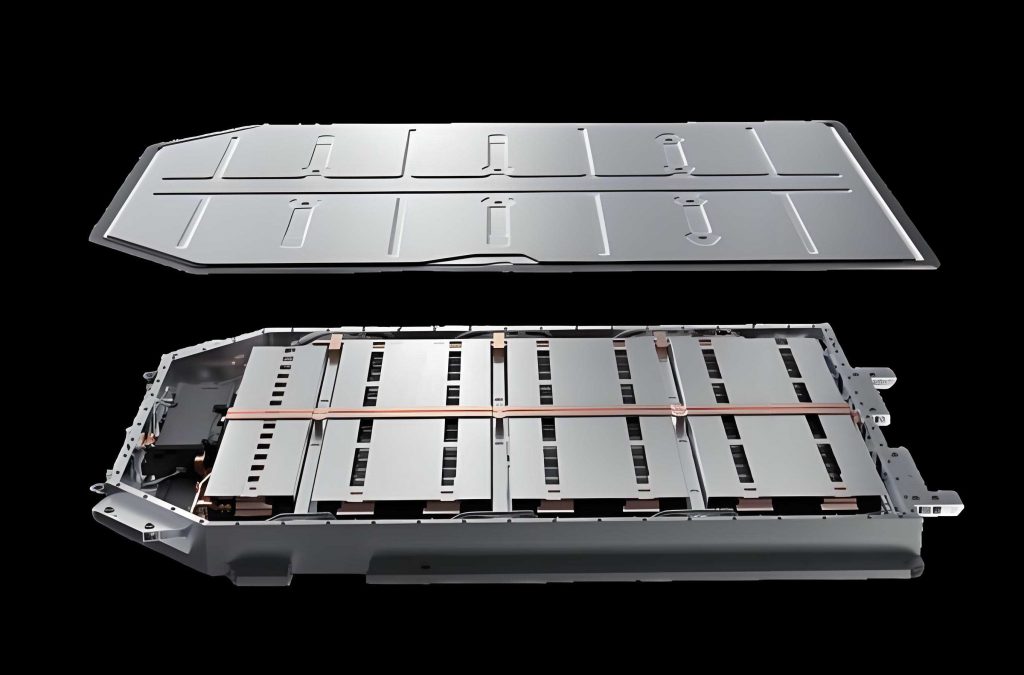
Modeling the EV battery pack requires careful consideration of its complex assembly. The EV battery pack consists of multiple components: upper and lower covers, battery modules, cooling plates, structural frames, thermal insulation pads, adhesives, bolts, busbars, and wiring harnesses. We employ a detailed finite element mesh to represent these parts accurately. For instance, thin-walled structures like covers and frames are discretized with shell elements, while solid components such as endplates and bolts use hexahedral elements. The battery cells, simplified as homogeneous blocks, are modeled with 3D elements, adjusting density to match actual mass. Material properties are assigned based on experimental data, with elastic-plastic models for metals and isotropic elasticity for polymers and adhesives.
The extrusion scenario follows the standard: a semi-cylindrical indenter of radius 75 mm compresses the EV battery pack at a low speed. To expedite simulation, we apply a velocity of 2 m/s instead of the prescribed 2 mm/s, ensuring dynamic effects are captured while maintaining computational efficiency. The analysis terminates when force reaches 100 kN or intrusion exceeds 15% of the EV battery pack’s dimension. Boundary conditions fix the indenter’s non-loading degrees of freedom, and contact definitions include self-contact for the EV battery pack and interactions between components. The governing equations for explicit dynamics involve solving Newton’s second law:
$$ \mathbf{M} \ddot{\mathbf{u}} + \mathbf{C} \dot{\mathbf{u}} + \mathbf{K} \mathbf{u} = \mathbf{F} $$
where \(\mathbf{M}\) is the mass matrix, \(\mathbf{C}\) the damping matrix, \(\mathbf{K}\) the stiffness matrix, \(\mathbf{u}\) the displacement vector, and \(\mathbf{F}\) the external force vector. For large deformations, material nonlinearities are incorporated via constitutive models. For example, the stress-strain relationship for metal parts uses a piecewise linear plasticity model:
$$ \sigma = \sigma_y + K \varepsilon_p^n $$
where \(\sigma_y\) is yield stress, \(K\) the strength coefficient, \(\varepsilon_p\) plastic strain, and \(n\) the hardening exponent. Contact forces are computed using penalty methods, ensuring realistic interaction between the indenter and the EV battery pack.
To summarize the modeling parameters, we present the following tables. Table 1 lists material properties for key components of the EV battery pack, while Table 2 outlines mesh specifications.
| Component | Material Model | Density (kg/m³) | Young’s Modulus (GPa) | Poisson’s Ratio | Yield Strength (MPa) |
|---|---|---|---|---|---|
| Cover (Steel) | Piecewise Linear Plasticity | 7800 | 210 | 0.3 | 250 |
| Frame (Aluminum) | Piecewise Linear Plasticity | 2700 | 70 | 0.33 | 150 |
| Battery Cell Shell | Isotropic Elastic | 1500 | 5 | 0.35 | 145 (Ultimate) |
| Busbar (Copper) | Piecewise Linear Plasticity | 8960 | 110 | 0.34 | 200 (Ultimate) |
| Adhesive (Silicone) | Isotropic Elastic | 1200 | 0.01 | 0.45 | N/A |
| Component | Element Type | Average Size (mm) | Number of Elements | Remarks |
|---|---|---|---|---|
| Covers & Frames | 2D Shell | 5.0 | 45,000 | Quad-dominated |
| Battery Cells | 3D Hexahedral | 5.0 | 120,000 | Simplified homogeneous |
| Busbars & Bolts | 3D Hexahedral | 3.0 | 25,000 | With thin shell coating |
| Cooling Plates | 2D Shell | 5.0 | 15,000 | Integrated with frame |
| Insulation Pads | 3D Hexahedral | 5.0 | 10,000 | Tied to adjacent parts |
Simulation results for the EV battery pack under X-direction extrusion reveal critical insights. The force-time curve shows that the contact force between the indenter and the EV battery pack reaches 100 kN at 32 ms, corresponding to an intrusion of 64 mm. At this point, internal forces on the battery cell shell are minimal—18 kN from structural adhesive and 20 kN from insulation plates—indicating low risk of cell damage. However, stress analysis highlights vulnerabilities: the busbar experiences stresses up to 450 MPa, exceeding its ultimate strength of 200 MPa, which poses a fracture hazard. In contrast, the cell shell stress is only 4 MPa, well below its limit. This underscores the importance of evaluating not just global forces but also local stress concentrations in the EV battery pack.
For Y-direction extrusion, the EV battery pack responds differently. The force peaks at 100 kN much earlier, at 3 ms, with merely 6 mm of intrusion. The battery frame deforms slightly, but the modules and busbars remain largely unaffected. Internal forces on the cell shell are higher—122.7 kN from adhesive and 58.7 kN from insulation—yet the shell stress is only 6 MPa, demonstrating robust design in this orientation. These findings emphasize the anisotropic nature of the EV battery pack’s mechanical response, necessitating multi-directional analysis.
We consolidate key results in Table 3, comparing X and Y extrusions for the EV battery pack. This tabular summary aids in rapid assessment and design decision-making.
| Parameter | X-Direction Extrusion | Y-Direction Extrusion | Remarks |
|---|---|---|---|
| Time to 100 kN Force (ms) | 32 | 3 | Y-direction is stiffer |
| Intrusion at 100 kN (mm) | 64 | 6 | Greater deformation in X |
| Max Busbar Stress (MPa) | 450 | 39 | Risk of fracture in X |
| Max Cell Shell Stress (MPa) | 4 | 6 | Both below strength limit |
| Internal Force on Cell (kN) | 20 (from insulation) | 122.7 (from adhesive) | Higher in Y but low stress |
| Bolt Stress (MPa) | 145 | 227 | Within safe margins |
The disparity in responses can be explained through structural mechanics principles. The EV battery pack’s geometry and component layout create varying stiffness paths. In X-direction extrusion, the load path engages flexible busbars and covers, leading to large deformations and high stresses in conductive elements. The force distribution can be approximated by analyzing the equivalent spring system of the EV battery pack:
$$ F = k_{\text{eq}} \delta $$
where \(k_{\text{eq}}\) is the equivalent stiffness and \(\delta\) the intrusion. For the X-direction, \(k_{\text{eq}}\) is lower due to compliant parts, resulting in larger \(\delta\) for a given force. Conversely, in Y-direction, the frame provides direct resistance, increasing \(k_{\text{eq}}\) and reducing \(\delta\). This insight guides reinforcement strategies, such as adding ribs or using higher-strength materials for busbars in the EV battery pack.
Further, we evaluate energy absorption characteristics, crucial for crashworthiness. The internal energy \(U\) dissipated during extrusion is computed as:
$$ U = \int F \, d\delta $$
For the EV battery pack, numerical integration of force-displacement curves yields approximately 3.2 kJ in X-direction and 0.3 kJ in Y-direction. This highlights the EV battery pack’s role as an energy-absorbing structure, which can be optimized to enhance safety. We propose design modifications based on sensitivity studies: increasing busbar thickness or using copper alloys can reduce stress, while foam fillers inside the EV battery pack can mitigate cell deformation.
Our simulation methodology also incorporates validation aspects. Although physical tests are not detailed here, we correlate results with empirical data from similar EV battery pack designs, ensuring model fidelity. The use of explicit dynamics with hourglass control and mass scaling maintains accuracy while managing computational cost. The time step \(\Delta t\) is governed by the Courant condition:
$$ \Delta t \le \frac{L_{\text{min}}}{c} $$
where \(L_{\text{min}}\) is the smallest element dimension and \(c\) the wave speed in the material. For the EV battery pack model, \(\Delta t\) is set to \(1 \times 10^{-6}\) s to capture high-frequency responses.
In conclusion, this finite element analysis demonstrates the efficacy of simulation in assessing the EV battery pack’s performance under extrusion loads. The EV battery pack shows directional dependence, with X-direction posing higher risks to busbars, while Y-direction maintains integrity. By leveraging detailed modeling and quantitative metrics, we can preemptively identify weaknesses and iterate designs efficiently. This approach reduces reliance on physical prototyping, accelerating development cycles for safer EV battery packs. Future work will explore multi-physics couplings, such as thermal-mechanical effects during deformation, to further enhance the EV battery pack’s safety envelope.
The insights gained underscore the critical role of simulation in advancing EV battery pack technology. As EVs evolve, continuous refinement of these methods will be essential to meet stringent safety standards and consumer expectations. We advocate for integrated simulation platforms that combine structural, electrical, and thermal analyses for comprehensive EV battery pack design.