
As the global automotive industry shifts towards sustainable energy, the development of new energy vehicles has become a pivotal strategy for many nations. In particular, the rapid growth of electric vehicles (EVs) underscores the critical need for advancements in key components, with the EV battery pack being at the heart of performance, safety, and longevity. The battery pack enclosure, or box, serves as the primary load-bearing structure for battery modules, electronic systems, and thermal management units. Its design directly influences the overall integrity of the EV battery pack under various operational and environmental stresses. In this study, I focus on the structural optimization and bottom collision safety assessment of an EV battery pack enclosure, aiming to enhance its dynamic characteristics and ensure compliance with safety standards through finite element analysis and optimization techniques.
The importance of the EV battery pack cannot be overstated; it is not merely an energy storage unit but a complex system that must withstand mechanical vibrations, impact loads, and thermal fluctuations. Recent industry reports indicate that by mid-2023, China’s cumulative production of new energy vehicles had surpassed 20 million units, highlighting the scale at which these components are manufactured and the necessity for robust design methodologies. While prior research has explored material substitution and topology optimization for lightweighting, often overlooking the influence of road-induced vibrations, this work addresses that gap by integrating modal analysis to avoid resonance with road excitation frequencies. My approach involves establishing a detailed finite element model, performing static and dynamic analyses, optimizing the enclosure structure via topography optimization, and validating collision safety through simulation. This comprehensive analysis provides a reference for designing EV battery pack enclosures that are both lightweight and durable.
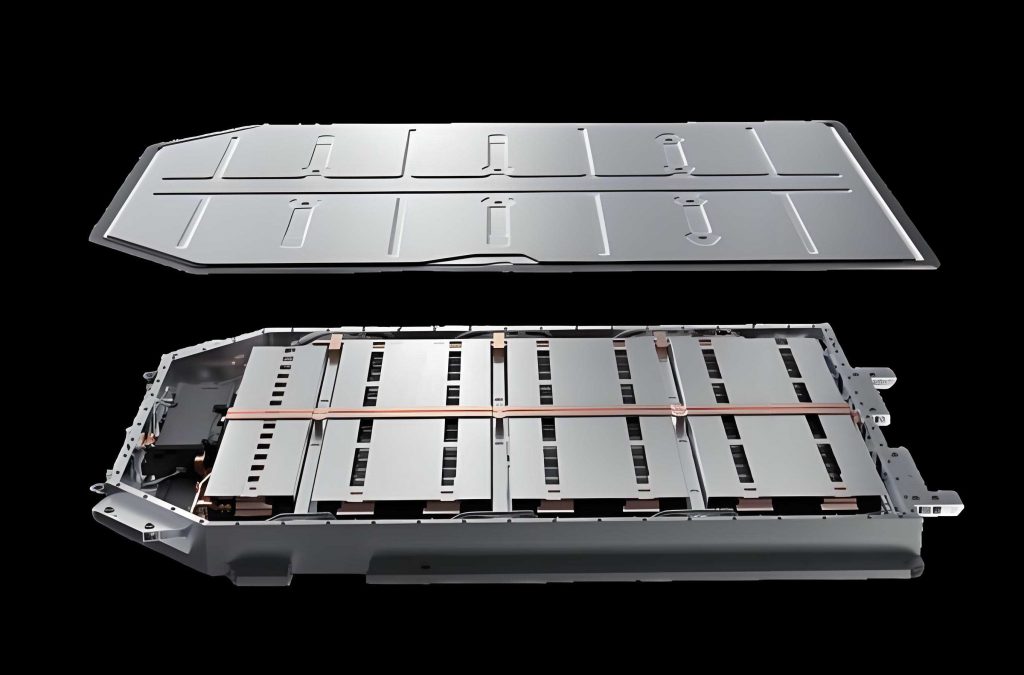
To begin, I developed a three-dimensional model of the EV battery pack enclosure based on a specific new energy vehicle model. The EV battery pack consists of multiple ternary lithium battery modules positioned centrally within the vehicle chassis, along with auxiliary components such as brackets, electrical systems, thermal management units, and cooling systems. For simulation efficiency, I simplified non-critical parts, focusing on the enclosure’s primary structural elements. The enclosure comprises an upper cover and a lower box made of aluminum alloy AT6061, with brackets and ears constructed from steel DC01. The material properties are summarized in Table 1, which I derived from standard engineering databases to ensure accuracy in the finite element model.
| Component | Material | Density (g/cm³) | Elastic Modulus (GPa) | Poisson’s Ratio |
|---|---|---|---|---|
| Upper Cover | AT6061 | 2.70 | 69 | 0.33 |
| Lower Box | AT6061 | 2.70 | 69 | 0.33 |
| Ears | DC01 | 7.85 | 210 | 0.30 |
| Brackets | DC01 | 7.85 | 210 | 0.30 |
I imported the Solidworks-generated STEP file into Hypermesh for preprocessing, where I represented individual battery modules using concentrated mass elements (CONM3) and spider elements (RBE3) to reduce computational complexity. Connection points, such as welds between the lower box and frame, bolt joints between the upper cover and lower box, and mounting points to the vehicle frame, were simulated using rigid body elements (RBE2). For meshing, I employed a shell element approach by extracting mid-surfaces of thin-walled structures, with a uniform grid size of 5 mm × 5 mm to balance precision and calculation time. The resulting finite element model consisted of 261,289 elements and 264,254 nodes, providing a detailed yet manageable representation of the EV battery pack for subsequent analyses.
The static analysis of the EV battery pack enclosure is crucial to evaluate its strength under extreme driving conditions. I considered two critical scenarios: emergency braking on bumpy roads and sharp turning on uneven surfaces. In both cases, inertial loads are applied based on vehicle dynamics, with accelerations defined in the coordinate system where the X-axis points forward, Y-axis to the left, and Z-axis upward. For emergency braking, I applied accelerations of -1g in X and 2g in Z, while for sharp turning, 0.7g in Y and 2g in Z. Constraining all degrees of freedom at the ten mounting ears, I solved the linear static equations using Optistruct. The results, shown in Table 2, indicate maximum displacements exceeding 5 mm and stresses near 90 MPa, primarily at bolt connections. According to industry standards, displacement should not exceed 2 mm under 2g acceleration, suggesting that the initial design of the EV battery pack enclosure lacks sufficient stiffness, particularly in the upper cover, risking module displacement and safety hazards.
| Loading Condition | Maximum Displacement (mm) | Maximum Stress (MPa) | Critical Location |
|---|---|---|---|
| Emergency Braking on Bumpy Road | 5.173 | 85.85 | Bolt joints at ears |
| Sharp Turning on Uneven Surface | 5.166 | 93.31 | Bolt joints at ears |
Modal analysis follows to assess the dynamic behavior of the EV battery pack. The natural frequencies and mode shapes are vital to avoid resonance with external excitations, such as road vibrations. The undamped free vibration equation for the EV battery pack system is given by:
$$ M \ddot{u} + K u = 0 $$
where \( M \) is the mass matrix, \( K \) is the stiffness matrix, and \( u \) represents the displacement vector. Assuming harmonic motion \( u = A \sin(\omega t) \), the eigenvalue problem reduces to:
$$ (K – \omega^2 M) A = 0 $$
Solving this yields natural frequencies \( f_n = \frac{\omega_n}{2\pi} \) and corresponding mode shapes. I computed the first six modes with constrained mounting points, finding frequencies as listed in Table 3. The first two modes, at 11.39 Hz and 21.96 Hz, involve resonance of the upper cover and are concerningly low. Road excitation frequencies, derived from common pavement profiles and vehicle speeds, typically range up to 25 Hz, as summarized in Table 4. The proximity of the second natural frequency to碎石路面 (gravel road) excitation at 22.52 Hz indicates a high risk of resonance, necessitating structural optimization of the EV battery pack enclosure to shift these frequencies away from critical ranges.
| Mode Order | Frequency (Hz) | Mode Shape Description |
|---|---|---|
| 1 | 11.39 | Single antinode on upper cover |
| 2 | 21.96 | Two antinodes on upper cover |
| 3 | 32.13 | Three antinodes on upper cover |
| 4 | 37.11 | One antinode on lower box |
| 5 | 41.21 | Two antinodes on lower box |
| 6 | 46.05 | Two antinodes on upper cover with alternating peaks |
| Road Type | Wavelength (m) | Vehicle Speed (km/h) | Excitation Frequency (Hz) |
|---|---|---|---|
| Gravel Road | 0.74 – 8.20 | 60 | 22.52 |
| Washboard Road | 0.42 – 6.70 | 40 | 26.46 |
| Smooth Road | 1.0 – 90.9 | 100 | 27.78 |
To address these issues, I formulated a structural optimization problem with the objective of maximizing the first natural frequency of the EV battery pack enclosure. The mathematical model is expressed as:
$$ \begin{aligned}
\text{Maximize} & \quad \Lambda(\rho) \\
\text{subject to} & \quad c(x) \leq C_T \\
& \quad x_k^l \leq x_k \leq x_k^u, \quad k = 1, 2, \dots, n
\end{aligned} $$
where \( \Lambda(\rho) \) is the first natural frequency as a function of design variables \( \rho \), \( c(x) \) represents constraints such as mass or stress, and \( x_k \) are design variables bounded between lower and upper limits. For sensitivity analysis, I used the derivative of the eigenvalue with respect to design variables, calculated via the adjoint method. The static response sensitivity is derived from the equilibrium equation \( K U = P \), leading to:
$$ \frac{\partial U}{\partial x} = K^{-1} \left( \frac{\partial P}{\partial x} – \frac{\partial K}{\partial x} U \right) $$
I applied topography optimization, a technique that determines optimal reinforcement rib layouts on shell structures, to the upper cover of the EV battery pack. Design variables were nodal perturbations normal to the shell surface, with constraints including a minimum rib width of 80 mm, a draw angle of 60°, and a maximum rib height of 10 mm. After 17 iterations, Optistruct converged to an optimal solution that increased the first natural frequency from 11.39 Hz to 30.19 Hz, a 165% improvement. The rib height distribution, however, appeared irregular for manufacturing, so I redesigned the ribs into a more practical pattern, as illustrated in Figure 7 (described textually since images are not referenced). The final rib layout features longitudinal and transverse reinforcements across the upper cover, enhancing stiffness uniformly.
Re-evaluating the optimized EV battery pack enclosure, I found the first six natural frequencies significantly elevated, as shown in Table 5. The first frequency rose to 24.25 Hz, and the second to 34.3 Hz, effectively bracketing the critical road excitation frequencies from Table 4. This shift ensures that the EV battery pack avoids resonance during typical driving conditions, thereby reducing vibration-induced stress and potential fatigue failure. The optimization process not only improved dynamic performance but also maintained structural integrity without substantial weight addition, aligning with lightweight design goals for EVs.
| Mode Order | Frequency (Hz) | Improvement Over Initial (%) |
|---|---|---|
| 1 | 24.25 | 112.9 |
| 2 | 34.30 | 56.2 |
| 3 | 44.73 | 39.2 |
| 4 | 52.71 | 42.1 |
| 5 | 61.81 | 50.0 |
| 6 | 65.30 | 41.8 |
Beyond dynamic optimization, I investigated the bottom collision safety of the EV battery pack, a critical scenario when vehicles traverse speed bumps or roadside debris. Using Ansys explicit dynamics, I modeled a conical impactor with a 45° apex angle and 50 mm tip radius to represent sharp road obstacles, impacting the lower box at 36 km/h over a 10 ms duration. The material model for AT6061 included plasticity and failure criteria to simulate realistic deformation. The governing equations for impact are based on momentum conservation and contact mechanics:
$$ m \frac{dv}{dt} = F_{\text{contact}}, \quad \sigma = E \epsilon \text{ for elastic region} $$
where \( m \) is mass, \( v \) velocity, \( F_{\text{contact}} \) the contact force, \( \sigma \) stress, \( E \) Young’s modulus, and \( \epsilon \) strain. The simulation results, detailed in Table 6, show a maximum intrusion of 0.818 mm into the lower box, well below the 4.5 mm safety threshold cited in literature for preventing battery module short circuits. The stress distribution remained within yield limits, confirming that the optimized EV battery pack enclosure can withstand such impacts without compromising safety. This analysis underscores the importance of integrating collision resilience into the design phase, especially for EVs where battery integrity is paramount.
| Parameter | Value | Safety Threshold |
|---|---|---|
| Maximum Intrusion (mm) | 0.818 | 4.5 mm |
| Peak Impact Force (kN) | 12.45 | N/A |
| Energy Absorbed (J) | 150.3 | N/A |
In conclusion, this study demonstrates a comprehensive approach to enhancing the performance and safety of an EV battery pack enclosure through finite element analysis and structural optimization. By establishing a detailed model, I identified deficiencies in static stiffness and dynamic response, particularly low natural frequencies risking resonance with road vibrations. Through topography optimization, I increased the first natural frequency from 11.39 Hz to 24.25 Hz, effectively distancing it from typical excitation frequencies, while maintaining manufacturability with redesigned reinforcement ribs. Additionally, bottom collision simulations validated that the optimized enclosure can endure impacts from sharp obstacles with minimal intrusion, far below hazardous levels. These findings provide a valuable reference for designing EV battery packs that are not only lightweight and efficient but also robust against operational and accidental loads. Future work could explore multi-material designs or advanced optimization algorithms to further reduce weight while improving crashworthiness, contributing to the ongoing evolution of electric vehicle technology.
The methodology outlined here underscores the interplay between simulation-driven design and practical engineering constraints. As the demand for EVs continues to grow, ensuring the reliability of critical components like the battery pack becomes increasingly important. By leveraging tools like Hypermesh, Optistruct, and Ansys, engineers can proactively address issues such as vibration and impact, leading to safer and more durable vehicles. This research adds to the body of knowledge on EV battery pack design, emphasizing the need for holistic approaches that consider both dynamic behavior and collision safety. Ultimately, advancements in this field will support the broader goals of sustainable transportation and energy efficiency, making EVs more accessible and reliable for consumers worldwide.