
As a participant in the automotive safety evaluation sector, I have witnessed firsthand the evolving landscape of electric vehicle (EV) technologies. The imperative to ensure the absolute safety of the EV battery pack, the heart of any electric vehicle, has never been more critical. In this detailed account, I will describe a seminal series of tests that push the boundaries of what we consider safe for an EV battery pack. This narrative is built upon a recent, highly publicized extreme challenge event designed to bridge the gap between manufacturer claims and consumer trust, focusing relentlessly on the integrity of the EV battery pack under duress.
The core initiative, known as the TOP Electric China Automotive Electric Safety Extreme Challenge, serves as a transparent platform for validating EV safety claims. Its philosophy is rooted in simulating real-world, high-risk scenarios far beyond conventional laboratory tests. The latest chapter of this program involved a comprehensive evaluation of a mainstream electric sedan, putting its EV battery pack through what can only be described as a double “inferno” of mechanical and environmental stress. The entire process was conducted under the scrutiny of a live broadcast, emphasizing transparency and real-time validation.
The challenge commenced with an immersive, real-scenario drive. Accompanied by a well-known television host and senior executives from the automaker, we embarked on a route designed to replicate severe driving conditions. This prelude was not merely for show; it was a tangible demonstration of vehicle dynamics and preliminary system resilience before the dedicated EV battery pack tortures began. The course included a 40% gradient climb, high-frequency washboard roads, and an extended deep-water wading section. The latter, in particular, was a direct prelude to the formal water-related test for the EV battery pack, set at a depth five times the national standard. This immersive segment effectively set the stage, showcasing the vehicle’s overall robustness and priming the audience for the specialized, brutal assessments targeting the EV battery pack itself.
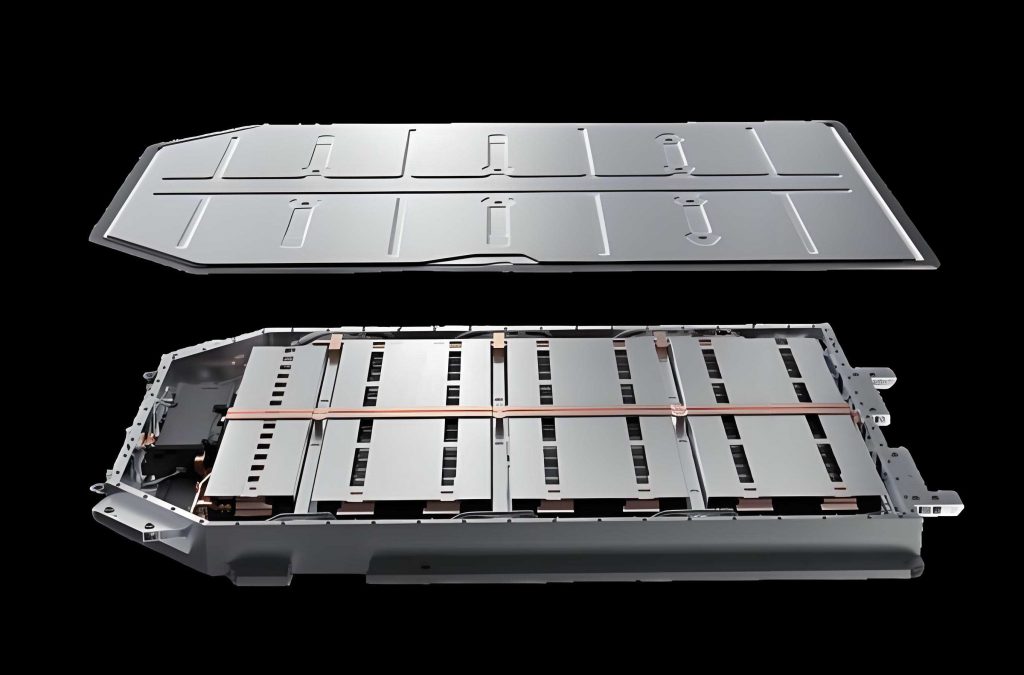
The first dedicated “hell” for the EV battery pack was the Composite Scrape and Immersion Survival Test. This test was meticulously crafted to simulate a worst-case sequence of events: a driver in a mountainous area inadvertently scrapes the vehicle’s undercarriage, including the EV battery pack, on a protruding rock. Immediately afterward, the vehicle encounters a sudden, severe flood caused by a torrential downpour or must traverse a waterlogged urban street with missing or displaced drain covers. The test protocol was rigorously quantitative. The vehicle, with its EV battery pack installed, was driven at a speed of 30 km/h over a specially designed protruding obstacle to induce a controlled 30mm intrusion scrape to the battery pack casing. Without any pause for inspection, the vehicle then entered an extended water tank. Here, it navigated through 280 meters of water at a depth of 500mm—five times the depth stipulated in common national water ingress standards—maintaining a steady 5 km/h.
The post-test inspection focused on critical electrical safety parameters of the EV battery pack. The paramount indicator is insulation resistance. A significant drop in insulation resistance can indicate water ingress or damage to the dielectric materials, posing a severe shock hazard. The safety criterion can be expressed as a condition where the insulation resistance $R_{ins}$ must remain above a safe threshold $R_{safe}$ after the test, compared to its pre-test value $R_0$:
$$ \frac{R_{ins(post)}}{R_{0}} \approx 1 \quad \text{and} \quad R_{ins(post)} > R_{safe} $$
Furthermore, the entire vehicle’s monitoring system must report no fault codes related to the high-voltage system or the EV battery pack. The subject vehicle passed unequivocally; its EV battery pack showed no alarm triggers, and the insulation resistance values were within the nominal safe operating range. This test directly addresses and alleviates a common consumer anxiety regarding EV battery pack safety during floods or deep water crossings.
The parameters and results of this first test are summarized in the table below, providing a clear, comparative view of the extreme standards applied to the EV battery pack.
| Test Phase | Simulated Scenario | Test Parameter | Standard/Reference Value | Applied Test Value | EV Battery Pack Outcome |
|---|---|---|---|---|---|
| Phase 1-A: Mechanical Impact | Undercarriage scrape on rough terrain | Impact Speed | Typical urban speed | 30 km/h | No leakage, no faults, insulation stable. |
| Phase 1-B: Deep Immersion | Urban flooding / mountain torrent | Water Depth & Distance | National Standard (e.g., 100mm) | 500mm depth for 280m |
If the first test was about environmental and mechanical ingress, the second test was about pure, unadulterated structural integrity against massive static force: the 50-Tonne Heavy-Duty Truck Roll-Over Test. In this assessment, the EV battery pack, removed from the vehicle but in a fully assembled state, was placed on a flat, solid surface. A fully loaded heavy-duty truck with a total weight of 50 metric tons was then driven slowly, at 5 km/h, with one set of wheels directly over the center of the EV battery pack. The objective was to subject the battery pack enclosure, modules, and cells to a crushing force far exceeding any conceivable traffic accident involving passenger vehicles.
The evaluation criteria post-crush are multidimensional. First and foremost is physical integrity: the casing of the EV battery pack must not exhibit catastrophic deformation that leads to rupture or leakage of electrolyte. Second is electrical stability: the open-circuit voltage (V_oc) and the State of Charge (SOC) of the battery pack must remain stable, indicating no internal short circuits. The most critical criterion is the prevention of thermal runaway, a chain reaction of overheating in lithium-ion cells. The risk of thermal runaway, often initiated by an internal short circuit with resistance $R_{short}$, generating heat at a rate $P_{gen}$, can be modeled. The condition for safety is that the generated heat is dissipated at a rate $P_{diss}$ without causing a temperature rise $\Delta T$ beyond a critical point $T_{crit}$ over time $t$:
$$ P_{gen} = I^2 R_{short} = \frac{V_{cell}^2}{R_{short}} $$
$$ P_{diss} = h A \Delta T $$
$$ \text{For safety: } \int_0^t (P_{gen} – P_{diss}) dt \quad \text{such that} \quad T_{max} < T_{crit} $$
Where $h$ is the heat transfer coefficient and $A$ is the surface area. A well-designed EV battery pack with robust internal spacing, high-strength materials, and passive safety structures ensures $R_{short}$ remains effectively infinite or $P_{diss}$ is sufficiently high even under deformation. The tested EV battery pack emerged from under the 50-tonne wheels with no visible leakage, no significant deformation, stable voltage and SOC readings, and most importantly, no signs of thermal escalation or fire. This result underscores a monumental achievement in the mechanical design of the EV battery pack, fulfilling a promise of resilience against extreme compressive forces.
The following table encapsulates the brutal mechanics of this test and the resultant validation of the EV battery pack’s design.
| Test Name | Applied Force | Contact Speed | Key Safety Metrics Monitored | Acceptance Criteria for EV Battery Pack | Test Result |
|---|---|---|---|---|---|
| 50t Truck Roll-Over | ~500 kN (estimated over contact area) | 5 km/h | 1. Structural Deformation 2. Electrolyte Leakage 3. Voltage Stability 4. SOC Stability 5. Temperature Delta |
1. No critical deformation/rupture. 2. Zero leakage. 3. ΔV < 1%. 4. ΔSOC < 2%. 5. No thermal runaway onset. |
All criteria met. EV battery pack passed. |
The success in these challenges is not accidental but a consequence of specific engineering philosophies applied to the EV battery pack. We can generalize some of the design principles that such tests validate. The overall safety factor $SF$ of an EV battery pack under a specific load $L$ (like crush force $F_c$ or water pressure $P_w$) can be considered as a function of its material yield strength $\sigma_y$, design geometry factor $G$, and safety margin $M$:
$$ SF = \frac{\sigma_y \cdot G \cdot M}{L} $$
For the crush test: $L \propto F_c$. For the immersion test: $L \propto P_w = \rho g h$. A passing result implies $SF >> 1$ for both extreme loading conditions. Furthermore, the multi-barrier approach to sealing an EV battery pack against water ingress involves gasket integrity at joints, the structural weld or bond strength of the casing, and the dielectric properties of internal potting or compartmentalization. The effectiveness $E_{seal}$ can be conceptually framed as a series of resistances to fluid penetration:
$$ \frac{1}{E_{seal}} \approx \frac{1}{R_{gasket}} + \frac{1}{R_{weld}} + \frac{1}{R_{internal}} $$
where a high $E_{seal}$ indicates superior overall sealing, preventing moisture from reaching the live components of the EV battery pack.
The broader implication of the TOP Electric Challenge lies in its methodology and its role in the industry. It operates on a “scenario-plus-high-standard” testing paradigm. This means tests are not abstract laboratory procedures but are narratives—simulating a believable, dangerous sequence a driver might encounter. The standards applied are not marginally higher but exponentially more severe, as seen in the 5x water depth and the 50-tonne load. This approach transforms the EV battery pack from a black-box component into a protagonist in a safety story that consumers can understand and trust. By conducting these tests in the full glare of a live broadcast and having certification awarded on-site by engineering authorities, the program eradicates ambiguity. It builds a cornerstone of trust, demonstrating that the EV battery pack protecting the vehicle’s occupants is not just compliant with regulations but is engineered for survivability in outlier events.
Looking forward, the trajectory for such evaluation programs is clear. They must continue to evolve, incorporating even more complex, multi-hazard scenarios—perhaps combining simultaneous thermal and mechanical stress on the EV battery pack, or simulating sequential accidents. The goal is perpetual advancement in safety benchmarks, compelling the entire industry to prioritize the inviolability of the EV battery pack. Every vehicle model that successfully endures such crucibles becomes more than just a product; it becomes a verified safe choice for the consumer. The ultimate mission is to make the exceptional safety of the EV battery pack, proven through extreme challenges, a standard expectation, thereby accelerating the confident global adoption of electric vehicles. This relentless pursuit of verifiable safety is what will define the next era of automotive mobility, with the EV battery pack at its core, tested, trusted, and triumphant.