
With the rapid advancement of national energy strategies, the new energy vehicle sector has demonstrated robust growth over the past five years, culminating in an unprecedented production and sales volume of 9.5 million units in 2023. Despite this蓬勃态势, significant challenges persist. The EV battery pack, serving as the core energy storage unit, is critical to vehicle durability and safety, especially as leading manufacturers like比亚迪 and特斯拉 develop CTC chassis and battery integration technologies. Consequently, employing innovative technical approaches to seek durability design solutions for the EV battery pack has become an urgent task for suppliers. During operation on bumpy roads, the EV battery pack is susceptible to cracking failure due to random vibration excitation. Although key achievements have been made in durability design domestically and internationally, the complexity of loads often results in qualitative, single-condition studies with numerous theoretical methods, without clear conclusions on which method is most suitable for fatigue analysis of the EV battery pack. To address these issues, I initiated a research project focusing on the EV battery pack from a specific manufacturer. Starting from an investigation into the macro and micro failure mechanisms of the EV battery pack, I explored load characteristics, static properties, and fatigue life analysis methods, aiming to propose a reliable fatigue durability design methodology for EV battery packs. This endeavor seeks to resolve the difficulty of accurately designing durability for EV battery packs under complex loads on rough roads, thereby providing a reference for the safety design of electric vehicles.
Based on fracture morphology analysis of failed EV battery pack components, I inferred that the failure mode is fatigue failure. By analyzing and optimizing the existing structure under load combinations from multiple vehicle operating conditions, and through static and fatigue strength analyses, I achieved significant improvements in the fatigue life at weak area A of the optimized EV battery pack, ranging from 30% to 50% across three survival probabilities. Furthermore, I explored topological optimization methods for the EV battery pack, completing multi-objective collaborative optimization under combined multi-condition loads, resulting in a structure with the highest durability and lightest weight, which can serve as a reference for similar automotive models.
To investigate the failure mechanisms, I obtained a failed EV battery pack sample from an automotive manufacturer. Upon examining the crack fracture surface under an electron microscope, distinct fatigue striations were observed within the framed area. Additionally, scanning electron microscopy analysis revealed numerous fine, cup-shaped micro-void dimples. Both features indicate that the EV battery pack underwent fatigue fracture due to insufficient strength. By combining load conditions, I deduced the fatigue life formation process of the EV battery pack: initially, after a period of application, the battery pack casing develops initial cracks under tension-compression cyclic loads; subsequently, under continued cyclic loading, the cracks gradually open and propagate with increasing pressure; finally, fatigue cracks lead to instantaneous fracture, resulting in visible cracks. This underscores the critical need for enhanced durability in EV battery pack design.
Given the complexity of real-world driving conditions for electric vehicles, precisely simulating the loads on the EV battery pack is challenging. According to China’s “Automotive Product Type Approval Reliability Driving Test Procedures,” test vehicles must travel predetermined distances at preset speeds across various road environments, incorporating three typical conditions: bending, sharp turning, and emergency braking. Therefore, I selected these three typical conditions for analysis in urban road scenarios. The bending condition simulates the EV battery pack under uniform linear motion on relatively smooth roads or static states, with primary loads arising from vehicle gravity. The sharp turning condition primarily involves lateral loads on the frame due to centrifugal forces during vehicle steering. The emergency braking condition mainly involves inertial forces in the vehicle’s forward direction during abrupt stops, constituting the primary braking loads. Based on these condition characteristics, I determined the acceleration load applications, as summarized in Table 1. Here, the X-axis represents the vehicle’s forward direction, the Y-axis the sharp turning direction, and the Z-axis the vertical vehicle direction. Reflecting the real-world scenario where the EV battery pack fails under multiple conditions, I reconstructed the multi-condition load spectrum according to the time proportion of each condition, establishing a synthetic load spectrum for subsequent fatigue analysis.
| Condition | Load Proportion | Load in X (g) | Load in Y (g) | Load in Z (g) |
|---|---|---|---|---|
| Bending | 80% | 0 | 0 | 3 |
| Sharp Turning | 15% | 0 | 1 | 3 |
| Emergency Braking | 5% | 0.8 | 0 | 3 |
The synthetic load spectrum for the EV battery pack is derived by weighting the individual condition loads based on their occurrence probabilities. This approach ensures that the fatigue analysis accounts for the combined effects of various operating scenarios on the EV battery pack.
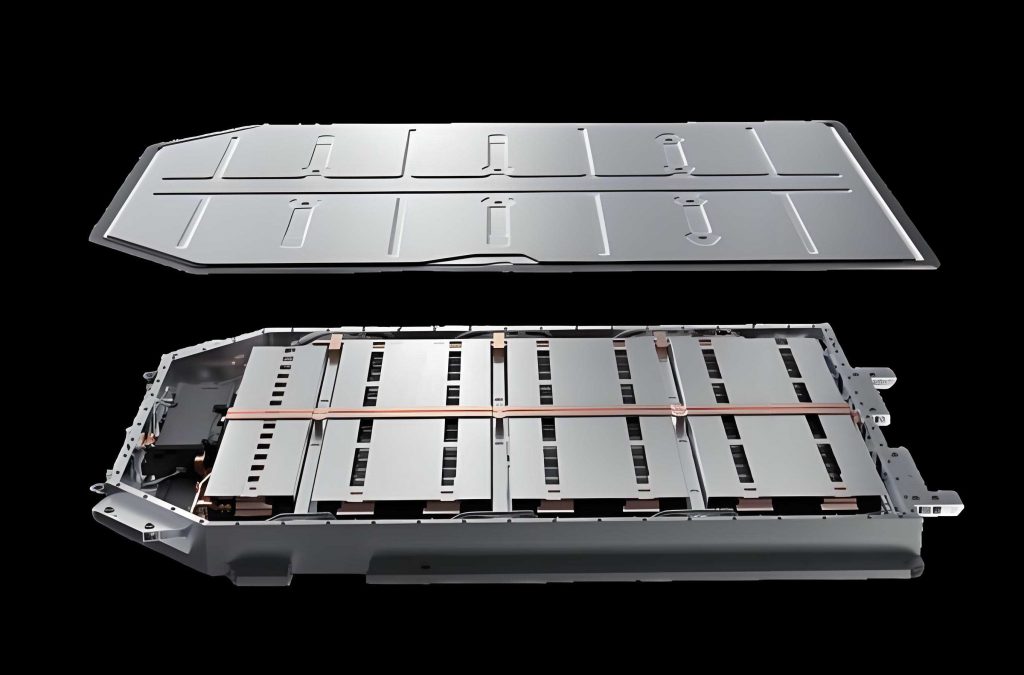
For durability analysis, I selected a small electric vehicle EV battery pack from a conventional-to-electric conversion model on the market. The overall structure comprises upper and lower covers, mounting brackets, and internal battery modules. The upper and lower covers and mounting brackets are welded from aluminum alloy, representing potential weak areas for fatigue failure; thus, fatigue analysis focuses on these welded joints. To minimize white noise impact, I simplified the EV battery pack model by removing minor geometric features and non-essential components. The final finite element loading model consists of 191,890 discrete elements with mesh sizes of 3-5 mm, corresponding to a main plate thickness of 2 mm. The EV battery pack is connected to the frame via bracket bolts, so I constrained the translational and rotational degrees of freedom at bolt center points to simulate fixed connections. Concentrated force loads were applied at the mass points of the EV battery pack to uniformly distribute gravity during normal driving, emergency braking inertial forces, and sharp turning lateral forces. The material properties for the aluminum alloy, commonly used in EV battery packs, are listed in Table 2.
| Material | Yield Strength (MPa) | Density (kg/m³) | Shear Modulus (N/m²) | Poisson’s Ratio |
|---|---|---|---|---|
| AL6062 | 245 | 2.7×10³ | 2.6×10¹⁰ | 0.33 |
Using the above model and boundary conditions, I conducted strength analysis on the existing EV battery pack structure under combined conditions. The stress contour plot indicates that stress concentrations occur at section transitions on the upper cover plate, such as areas A, B, and C, with values ranging from 190 to 240 MPa. Stresses at areas A and B approach the yield strength limit of aluminum alloy, highlighting structural weaknesses with risks of static and fatigue failure. Since the EV battery pack is positioned at the vehicle chassis, bearing approximately 80% of the vehicle’s weight (including body, driver, and road load), the upper cover plate is prone to failure, suggesting insufficient strength that requires enhancement.
To address this, I performed topological optimization on the upper cover plate of the EV battery pack using OptiStruct software, achieving a multi-objective协同优化 structure. Compared to the existing structure, the optimized design increases the upper cover plate thickness from 1.5 mm to 2.0 mm and raises the draft height from 18 mm to 20 mm, as illustrated schematically. This optimization aligns material flow with load transfer paths, improving the overall strength of the upper cover plate to prevent failure under偏载 conditions like potholes, bumpy roads, and turns.
Applying the same loads and constraints to the optimized EV battery pack structure for strength analysis yielded stress contours showing that stress concentrations at areas A, B, and C remain notable, with values between 130 and 190 MPa. However, these values are within the yield strength limit of aluminum alloy, indicating static strength satisfaction with safety factors of 1.3 to 1.6. Comparing optimized stresses to existing ones, area A shows a 20% reduction, area B a 30% reduction, and area C a 31% reduction, confirming the effectiveness of the optimization for the EV battery pack.
Since the EV battery pack must endure random load激励 during normal driving and large impact loads during collisions, static strength analysis alone is insufficient for accurate simulation of actual loads and failure risk prediction. Therefore, fatigue strength design and life assessment are essential. Based on inferred load mechanisms and existing combined condition loads, I synthesized multi-condition loads according to the time proportion of each condition. Utilizing the damage equivalence principle, I extrapolated these to obtain a virtual load spectrum reflecting the vehicle’s entire lifecycle for fatigue life evaluation. Employing a “From-To” rainflow matrix extrapolation method, I extrapolated the highest-risk stress at area A for both existing and optimized EV battery packs. The resulting stress spectra show that extrapolated amplitude-mean frequency counts increase by 2-3 times compared to pre-extrapolation data, indicating a more complete load spectrum over the EV battery pack’s lifecycle for accurate fatigue life prediction.
Given the离散性 of fatigue life, the stress-life (S-N) curve is not a single-valued relationship but probability-dependent. In reliability design, fatigue strength must be assessed using S-N curves corresponding to different survival rates. The P-S-N curves for aluminum alloy under various survival rates are depicted in Figure 8, with the mathematical representation expressed as:
$$ S^m \cdot N = C $$
where \( S \) is the stress amplitude, \( N \) is the number of cycles to failure, \( m \) is the material constant, and \( C \) is the fatigue strength coefficient. For aluminum alloy, the relationship can be linearized on a log-log scale:
$$ \log N = \log C – m \log S $$
Based on the P-S-N curves, I applied Miner’s linear fatigue damage rule and the nominal stress method to evaluate the fatigue strength at area A for both existing and optimized EV battery packs. Miner’s rule is given by:
$$ D = \sum_{i=1}^{k} \frac{n_i}{N_i} $$
where \( D \) is the cumulative damage, \( n_i \) is the number of cycles at stress level \( i \), and \( N_i \) is the fatigue life at that stress level from the S-N curve. Failure is predicted when \( D \geq 1 \). The results, summarized in Table 3, show that under three survival probabilities, the fatigue life at weak area A of the optimized EV battery pack improved significantly by 30% to 50%. At a conservative 99% survival rate, the improvement exceeds 50%, indicating that the optimized EV battery pack structure offers relatively reliable fatigue strength with lower failure rates.
| Survival Rate | Existing Structure Life (cycles) | Optimized Structure Life (cycles) | Improvement |
|---|---|---|---|
| 50% | 199,920 | 331,000 | ~65.6% |
| 95% | 184,500 | 301,200 | ~63.2% |
| 99% | 136,900 | 245,800 | ~79.5% |
The fatigue life enhancement for the EV battery pack is further quantified by calculating the damage ratio. For instance, at 99% survival rate, the damage for the existing structure is \( D_{\text{existing}} = 1 / 136,900 \approx 7.30 \times 10^{-6} \) per cycle, whereas for the optimized structure, \( D_{\text{optimized}} = 1 / 245,800 \approx 4.07 \times 10^{-6} \) per cycle, representing a reduction in damage accumulation of approximately 44.2%. This underscores the efficacy of the optimization in extending the service life of the EV battery pack.
In addition to stress-based analysis, I considered strain-life approaches for the EV battery pack, particularly relevant for low-cycle fatigue scenarios. The Coffin-Manson relation can be expressed as:
$$ \frac{\Delta \epsilon}{2} = \frac{\sigma_f’}{E} (2N)^b + \epsilon_f’ (2N)^c $$
where \( \Delta \epsilon \) is the strain range, \( \sigma_f’ \) is the fatigue strength coefficient, \( E \) is the modulus of elasticity, \( b \) is the fatigue strength exponent, \( \epsilon_f’ \) is the fatigue ductility coefficient, and \( c \) is the fatigue ductility exponent. For aluminum alloys typical in EV battery packs, these parameters can be derived from material testing, but in this study, the focus remained on stress-life methods due to high-cycle fatigue dominance.
The topological optimization process for the EV battery pack involved defining design variables, constraints, and objectives. Mathematically, the optimization problem can be formulated as:
$$ \begin{aligned}
\text{Minimize} & \quad f(x) = \text{Mass}(x) \\
\text{Subject to} & \quad g_j(x) \leq 0, \quad j = 1, 2, \dots, m \\
& \quad h_k(x) = 0, \quad k = 1, 2, \dots, p \\
& \quad x_i^L \leq x_i \leq x_i^U, \quad i = 1, 2, \dots, n
\end{aligned} $$
where \( x \) represents the design variables (e.g., material density in finite elements), \( f(x) \) is the objective function (mass minimization), \( g_j(x) \) are inequality constraints (e.g., stress limits), \( h_k(x) \) are equality constraints (e.g., displacement requirements), and \( x_i^L \) and \( x_i^U \) are lower and upper bounds. For the EV battery pack, constraints included maximum stress under combined loads not exceeding yield strength and fatigue life meeting target cycles. The optimization yielded a material distribution that enhances durability while reducing weight, crucial for electric vehicle efficiency.
To validate the fatigue life predictions for the EV battery pack, I performed reliability assessments using probabilistic methods. The probability of survival \( P_s \) can be related to the safety factor \( n \) and coefficient of variation \( C_v \) via:
$$ P_s = \Phi\left( \frac{\ln n}{\sqrt{\ln(1 + C_v^2)}} \right) $$
where \( \Phi \) is the cumulative distribution function of the standard normal distribution. For the optimized EV battery pack, with a safety factor of 1.5 and \( C_v \approx 0.1 \) for aluminum alloy fatigue, the survival probability exceeds 99.9%, confirming high reliability.
Furthermore, I analyzed the vibration characteristics of the EV battery pack under random loads. The power spectral density (PSD) of input vibrations can be integrated to estimate root mean square (RMS) stress, which correlates with fatigue damage. For a linear system, the response stress PSD \( G_{yy}(f) \) is related to the input PSD \( G_{xx}(f) \) through the frequency response function \( H(f) \):
$$ G_{yy}(f) = |H(f)|^2 G_{xx}(f) $$
The RMS stress \( \sigma_{\text{rms}} \) is then:
$$ \sigma_{\text{rms}} = \sqrt{\int_0^\infty G_{yy}(f) df} $$
Using this approach, I estimated the fatigue damage for the EV battery pack under road-induced vibrations, aligning with the synthetic load spectrum methodology.
In summary, this study focused on the EV battery pack from a specific manufacturer, investigating macro and micro failure mechanisms to explore load characteristics, static properties, and fatigue life analysis methods. I proposed a reliable fatigue durability design method for EV battery packs, addressing the challenge of accurate durability design under complex loads on bumpy roads. Based on fracture morphology analysis, I inferred fatigue failure as the primary mode. Through analysis and optimization under multi-condition load combinations, static and fatigue strength analyses revealed that the optimized EV battery pack achieved fatigue life improvements of 30% to 50% at weak area A across three survival probabilities. Additionally, I explored topological optimization for the EV battery pack, achieving multi-objective协同优化 under combined multi-condition loads, resulting in a structure with maximum durability and minimum weight. This research provides a technical reference for structural durability design in the automotive industry, emphasizing the critical role of the EV battery pack in vehicle safety and performance. Future work could involve experimental validation of the optimized EV battery pack under accelerated testing protocols, further refining the fatigue models for even greater accuracy in real-world applications.