
The rapid expansion of the electric vehicle (EV) industry has intensified focus on safety and lightweighting, particularly for EV battery packs. Bottom collisions, often caused by road debris, pose significant risks as they can lead to structural damage and potential thermal runaway. This study addresses these challenges by investigating the replacement of traditional steel base plates with prepreg compression molded (PCM) composite plates to enhance lightweighting without compromising safety. Using RADIOSS software for finite element analysis, a bottom ball-impact simulation model is developed to evaluate stress-strain distribution and module deformation. Initial results show that while steel plates meet deformation requirements, PCM plates fall short, prompting a Design of Experiments (DOE) approach to optimize material parameters. Validation through physical testing confirms simulation accuracy, and the optimized PCM design achieves a 40% weight reduction while satisfying performance criteria. This research provides a framework for designing lightweight, robust EV battery pack structures, emphasizing the importance of composite material tuning in automotive applications.
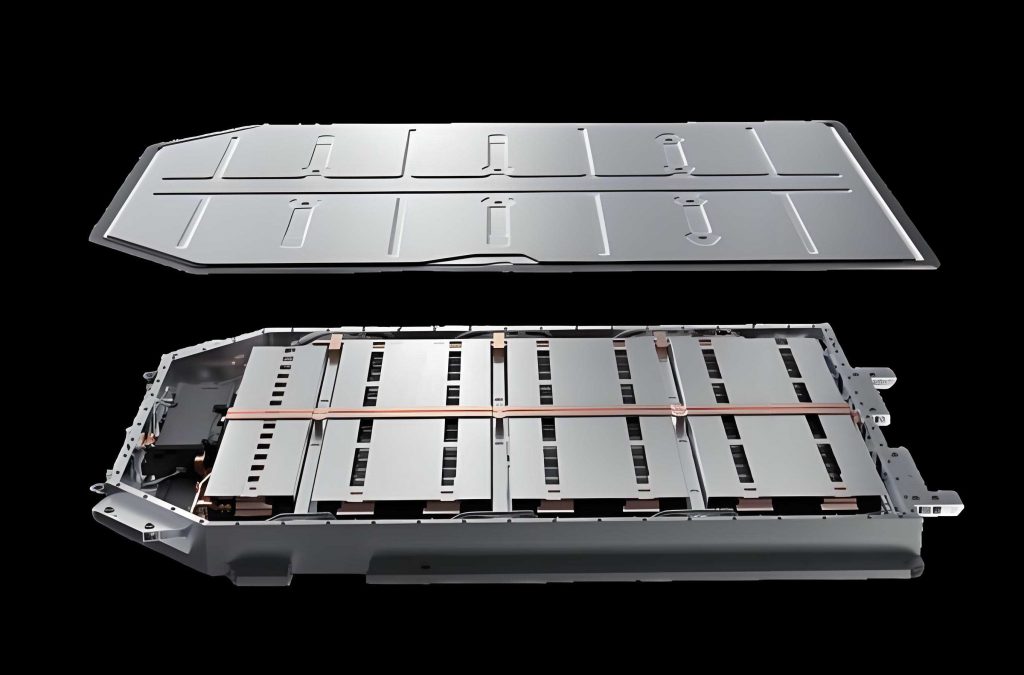
EV battery pack integrity under mechanical abuse is critical for overall vehicle safety. Bottom impacts, such as from stones or obstacles, can induce localized stresses that compromise the pack’s structural integrity, potentially leading to cell damage and fire hazards. Traditional steel base plates offer high strength but contribute significantly to weight, reducing EV range. Lightweight materials like PCM composites—continuous glass fiber-reinforced polypropylene—present an attractive alternative due to their tunable mechanical properties, corrosion resistance, and energy absorption capabilities. However, their anisotropic nature requires careful design to match steel performance. This study leverages simulation and DOE to systematically optimize PCM parameters, ensuring the EV battery pack meets stringent deformation limits under ball-impact loading.
The simulation model encompasses key EV battery pack components: an SMC upper casing, aluminum alloy lower frame, battery modules with cells and endplates, and the base plate (steel or PCM). Materials are modeled with relevant properties, as summarized in Table 1. The PCM plate is defined using layered shell elements with orthotropic material laws, while steel is isotropic. Contacts and constraints are applied to replicate real-world conditions, with a 180-mm diameter spherical impactor applying a 30 kN force vertically upward at a critical location on the base. Boundary conditions fix the pack’s mounting points to simulate vehicle attachment, and self-contact prevents penetration. The primary metric is module deformation, with a threshold of 2.5 mm to ensure cell safety.
| Component | Material | Density (kg/m³) | Poisson’s Ratio | Elastic Modulus (MPa) | Tensile Strength (MPa) | Elongation (%) |
|---|---|---|---|---|---|---|
| Lower Casing | Al6061-T6 | 2700 | 0.3 | 70,000 | 320 | 8 |
| Upper Casing | SMC | 1820 | 0.3 | 10,500 | 90 | 1 |
| Base Plate (Steel) | DP780 | 7850 | 0.3 | 210,000 | 900 | 14 |
Initial simulations reveal stark differences between steel and PCM base plates. The steel plate (1.05 mm thick) yields a module deformation of 2.03 mm, with stress concentrations up to 785.4 MPa but no failure, meeting the 2.5 mm limit. In contrast, the PCM plate (2.5 mm thick) results in 2.62 mm deformation, exceeding the threshold despite lower stresses (380 MPa in 0° direction, 361.5 MPa in 90° direction). This underscores the lower stiffness of the composite, necessitating optimization for EV battery pack applications. The PCM’s anisotropic behavior is governed by multiple parameters, which DOE can efficiently explore to identify key influencers.
DOE is employed for factor screening, using a resolution IV fractional factorial design to balance computational cost and effect discernment. Selected PCM parameters—elastic moduli (E11, E22, E33), shear moduli (G12, G23, G31), tensile strengths (YT1, YT2), compressive strengths (YC1, YC2), and planar shear strength (12YT)—are varied ±10% around baseline values (Table 2). Sixteen runs are conducted, each simulating the ball impact on a simplified PCM plate model to extract maximum displacement and energy absorption. The goal is to pinpoint parameters most affecting stiffness, thereby guiding material formulation for the EV battery pack.
| Parameter | Value |
|---|---|
| Density (kg/m³) | 1950 |
| Longitudinal Elastic Modulus, E11 (MPa) | 25,000 |
| Transverse Elastic Modulus, E22 (MPa) | 25,000 |
| Normal Elastic Modulus, E33 (MPa) | 2,500 |
| Poisson’s Ratio | 0.09 |
| Shear Modulus G12 (MPa) | 2,000 |
| Shear Modulus G23 (MPa) | 2,000 |
| Shear Modulus G31 (MPa) | 2,000 |
| Longitudinal Tensile Strength, YT1 (MPa) | 440 |
| Longitudinal Compressive Strength, YC1 (MPa) | 225 |
| Transverse Tensile Strength, YT2 (MPa) | 440 |
| Transverse Compressive Strength, YC2 (MPa) | 225 |
| Planar Shear Strength, 12YT (MPa) | 85 |
Sensitivity analysis from DOE outputs highlights dominant factors. Displacement and energy responses are modeled as functions of material inputs, with linear approximations showing effect magnitudes. For maximum displacement $D_{\text{max}}$, the relationship can be expressed as:
$$D_{\text{max}} = \beta_0 + \sum_{i=1}^{n} \beta_i X_i + \epsilon$$
where $X_i$ are normalized material parameters, $\beta_i$ are coefficients indicating sensitivity, and $\epsilon$ is error. Results, summarized in Table 3, reveal that elastic moduli (E11, E22) and shear moduli (G12, G23, G31) have the largest negative effects on displacement (i.e., increasing them reduces deformation). Strength parameters show minimal influence. This implies that to enhance EV battery pack bottom stiffness, focus should be on boosting fiber content or orientation to raise moduli, rather than prioritizing strength alone. The Pareto chart of effects confirms these findings, guiding subsequent optimization.
| Parameter | Effect on Displacement | Effect on Energy Absorption |
|---|---|---|
| E11, E22 | High Negative | Moderate Negative |
| E33 | Low Negative | Low Positive |
| G12, G23, G31 | Moderate Negative | High Negative |
| YT1, YT2 | Negligible | Negligible |
| YC1, YC2 | Negligible | Negligible |
| 12YT | Negligible | Negligible |
Validation through physical testing ensures simulation fidelity. A PCM plate sample with optimized parameters (E11 = E22 = 27,500 MPa, G12 = G23 = G31 = 3,000 MPa, others as baseline) is subjected to ball-impact testing. Force-displacement curves from experiment and simulation align closely, with a maximum force error of 6.68% at 31 mm displacement, meeting the >85% accuracy benchmark for composite modeling. The stress distribution shows no plasticity, confirming elastic behavior critical for EV battery pack durability. This step verifies that the RADIOSS model with LAW25 material formulation reliably predicts composite response, enabling confident full-pack simulation.
Integrating optimized parameters into the full EV battery pack model yields promising results. Module deformation reduces from 2.62 mm to 2.27 mm, below the 2.5 mm limit. Stress analysis indicates uniform distribution without failure risks. Weight comparison demonstrates significant lightweighting: the steel plate weighs 9.98 kg (1.05 mm thick), while the PCM plate weighs 5.90 kg (2.5 mm thick), a 40% reduction. This achievement underscores the potential of composites in EV battery pack design, balancing safety and efficiency. The deformation margin allows for further lightweighting or performance enhancements, such as increased energy density within the pack.
The optimization process illustrates a systematic approach to EV battery pack development. By coupling simulation with DOE, material parameters are tuned efficiently, reducing trial-and-error cycles. The EV battery pack’s bottom impact resistance is enhanced through stiffness-oriented adjustments, validated experimentally. Future work could explore multi-objective optimization, incorporating cost and manufacturing constraints, or extend to other loading scenarios like crush or vibration. Additionally, the methodology applies to various composite types, supporting innovation in EV battery pack structures.
In conclusion, this study demonstrates that PCM composites can effectively replace steel in EV battery pack base plates, achieving substantial weight savings while meeting mechanical performance standards. DOE-driven optimization identifies key material parameters—elastic and shear moduli—as critical levers for improving stiffness. Experimental validation confirms simulation accuracy, enabling reliable design predictions. The resulting EV battery pack design offers a 40% lighter base plate, contributing to extended vehicle range and reduced emissions. This research provides a valuable framework for automotive engineers pursuing lightweight, safe EV battery pack solutions, highlighting the synergy between advanced materials, simulation, and statistical methods in modern vehicle development.