
In the rapidly evolving landscape of electric vehicles, the EV battery pack stands as a pivotal component, dictating not only performance but also safety and reliability. As a core assembly, the EV battery pack typically accounts for 30% to 40% of the total vehicle mass, and its structural integrity under dynamic loads is paramount. Mechanical impacts, such as those encountered from road irregularities, pose significant risks, including potential thermal runaway or failure. Therefore, in this study, we employ finite element simulation to rigorously analyze the mechanical impact response of an EV battery pack, aiming to ensure compliance with safety standards like GB 38031-2020 and to optimize design efficiency early in the development cycle.
The methodology centers on creating a detailed finite element model of the EV battery pack, subjecting it to transient dynamic analysis, and evaluating stress distributions under specified impact loads. By leveraging tools like HyperMesh for meshing and OptiStruct for solving, we can predict structural behavior without physical prototyping, thereby reducing costs and time. This approach is particularly beneficial for the EV battery pack, where weight reduction and strength must be carefully balanced. Throughout this analysis, the term “EV battery pack” is emphasized to underscore its centrality in electric vehicle systems.
Introduction to EV Battery Pack and Impact Safety
Electric vehicles have gained widespread adoption due to advantages such as high efficiency, low noise, and zero emissions. However, safety concerns, especially related to the EV battery pack, have emerged with increasing vehicle numbers. Incidents of battery fires following severe impacts highlight the critical need for robust mechanical design. The EV battery pack, comprising modules, casing, and cooling systems, must withstand various loads, including mechanical shocks from road surfaces. Standards like GB 38031-2020 mandate specific tests, such as mechanical impact simulations, to validate safety. In this context, finite element analysis offers a proactive means to assess and enhance the EV battery pack’s resilience, facilitating lightweight designs without compromising performance.
Finite Element Model Development for the EV Battery Pack
We begin by constructing a 3D geometric model of the EV battery pack, representative of a typical passenger vehicle application. The EV battery pack measures approximately 1065 mm in length, 710 mm in width, and 130 mm in height, with a mass of 180 kg. It includes an upper cover, lower tray, battery modules, busbars, and cooling components. To streamline simulation, we simplify the model by focusing on key structural elements: the upper and lower casings, weld seams, module fixations, and busbars. The battery modules and cooling system are condensed into mass points, reducing computational complexity while capturing inertial effects.
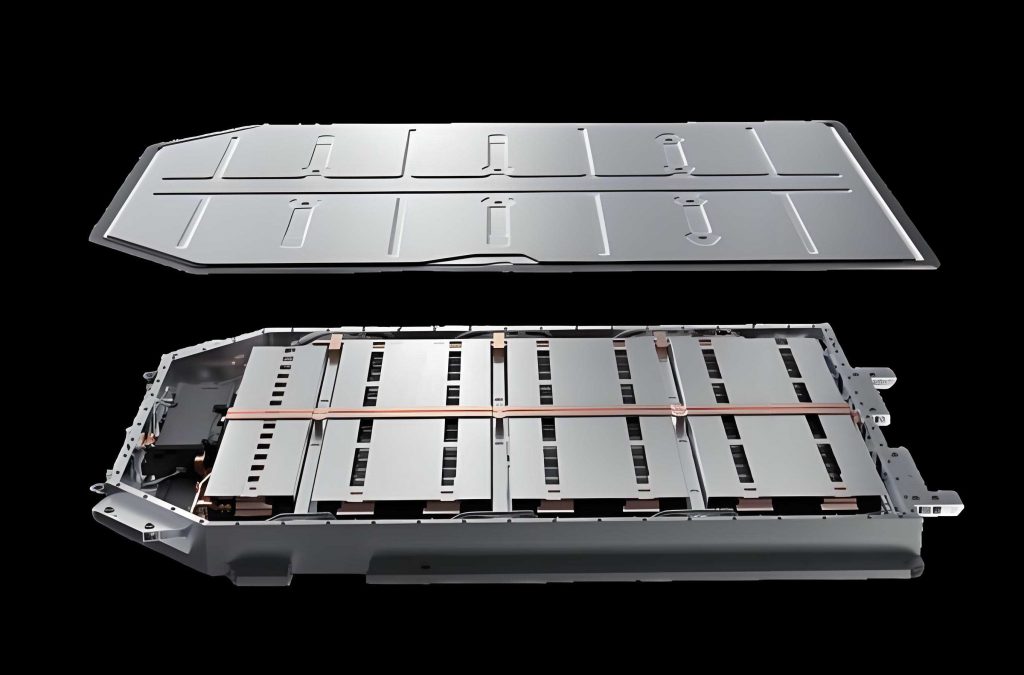
Mesh generation is performed in HyperMesh, employing 2D shell elements for thin-walled structures and 3D solid elements where necessary. The primary mesh consists of quadrilateral elements with a size of 4 mm, ensuring accuracy. Statistics of the mesh model are summarized in Table 1.
| Component | Element Type | Number of Elements | Number of Nodes | Remarks |
|---|---|---|---|---|
| Upper/Lower Casing | Shell (Quad/Tri) | 198,739 | 132,751 | Mid-surface extraction |
| Welds and Connections | Rigid and Beam | 2,639 | 2,639 | Simulated via RBE3 |
| Mass Points | Point Mass | 7 | 7 | Represent modules |
| Total | Mixed | 201,378 | 135,390 | Triangle ratio: 1.3% |
Material properties are assigned based on DC01 steel, commonly used in battery casings. The properties are defined as follows:
- Young’s Modulus, $E$: 210 GPa
- Poisson’s Ratio, $\nu$: 0.3
- Density, $\rho$: 7800 kg/m³
- Tensile Strength: 270–410 MPa
- Yield Strength: 130–260 MPa
Boundary conditions replicate the mounting of the EV battery pack to the vehicle chassis via six bolts. Constraints are applied at the lifting lugs, restricting all degrees of freedom to simulate fixed supports. This setup ensures the EV battery pack is subjected solely to inertial loads during impact.
Mechanical Impact Load Configuration
According to GB 38031-2020, the EV battery pack must endure a half-sine shock pulse of 7g acceleration over 6 ms in the vertical direction (Z-axis), applied both positively and negatively. This simulates road-induced impacts. The acceleration profile, $a(t)$, is mathematically expressed as:
$$ a(t) = A \sin\left(\frac{\pi t}{T}\right) \quad \text{for} \quad 0 \leq t \leq T $$
where $A = 7g$ (with $g = 9.81 \, \text{m/s}^2$) and $T = 6 \, \text{ms}$. For $t > T$, $a(t) = 0$. This load is applied globally to the EV battery pack model, inducing transient dynamic responses.
Transient Response Analysis: Theoretical Foundation
We utilize transient response analysis to compute the time-dependent behavior of the EV battery pack under impact. The governing equation of motion for a structural system is:
$$ [M]\{\ddot{x}(t)\} + [C]\{\dot{x}(t)\} + [K]\{x(t)\} = \{F(t)\} $$
where $[M]$, $[C]$, and $[K]$ are the mass, damping, and stiffness matrices, respectively; $\{x(t)\}$, $\{\dot{x}(t)\}$, and $\{\ddot{x}(t)\}$ are displacement, velocity, and acceleration vectors; and $\{F(t)\}$ is the external force vector. For the EV battery pack, $\{F(t)\}$ derives from the applied acceleration via D’Alembert’s principle: $\{F(t)\} = -[M]\{a(t)\}$.
We employ the direct integration method, specifically the Newmark-$\beta$ scheme, implemented in OptiStruct. This method discretizes time with a step $\Delta t$ and approximates velocities and accelerations as:
$$ \dot{x}_n = \frac{x_{n+1} – x_{n-1}}{2\Delta t} $$
$$ \ddot{x}_n = \frac{x_{n+1} – 2x_n + x_{n-1}}{\Delta t^2} $$
The Newmark-$\beta$ equations are:
$$ x_{n+1} = x_n + \Delta t \dot{x}_n + \frac{\Delta t^2}{2}[(1-2\beta)\ddot{x}_n + 2\beta \ddot{x}_{n+1}] $$
$$ \dot{x}_{n+1} = \dot{x}_n + \Delta t[(1-\gamma)\ddot{x}_n + \gamma \ddot{x}_{n+1}] $$
with parameters $\beta = \frac{1}{4}$ and $\gamma = \frac{1}{2}$ for unconditional stability. This approach efficiently solves for stresses and deformations in the EV battery pack over time.
Simulation Results and Discussion
The transient analysis is conducted from 0 to 0.5 seconds, with peak responses observed within the first 10 ms. Stress contours reveal critical areas in the EV battery pack, particularly near lifting lugs and bolt holes. At $t = 3$ ms, when acceleration peaks at 7g, the maximum von Mises stress is 40.9 MPa. However, stress continues to rise due to structural inertia, reaching 167.5 MPa at $t = 7$ ms, as shown in Table 2.
| Time (ms) | Max Stress (MPa) | Location | Acceleration (g) |
|---|---|---|---|
| 3 | 40.9 | Upper Left Lifting Lug | 7.0 |
| 6 | 167.5 | Bolt Hole Near Lug | 0.0 |
| 7 | 167.5 | Bolt Hole Near Lug | 0.0 |
| 10 | 120.3 | Upper Left Lifting Lug | 0.0 |
The stress evolution at key points, such as the lifting lug and bolt hole, is plotted in Figure 1, derived from simulation data. The time lag between peak load and peak stress underscores the dynamic nature of the EV battery pack response, attributable to its modal characteristics. The fundamental natural frequency of the EV battery pack is estimated using:
$$ f_n = \frac{1}{2\pi} \sqrt{\frac{K_{\text{eq}}}{M_{\text{eq}}}} $$
where $K_{\text{eq}}$ and $M_{\text{eq}}$ are equivalent stiffness and mass. For this EV battery pack, $f_n \approx 150$ Hz, which influences the transient behavior.
Notably, the maximum stress of 167.5 MPa remains below the tensile strength lower bound of 270 MPa for DC01 steel, indicating compliance with GB 38031-2020. However, since the stress approaches the yield strength range (130–260 MPa), design refinements might be considered for enhanced safety margins. This analysis highlights the effectiveness of finite element simulation in optimizing the EV battery pack for mechanical impacts.
Parametric Studies and Sensitivity Analysis
To further explore the EV battery pack’s behavior, we vary parameters like material thickness, damping ratios, and load durations. Results are condensed into Table 3, showing how changes affect peak stress. These insights aid in lightweighting strategies for the EV battery pack.
| Parameter | Baseline Value | Variation | Peak Stress (MPa) | Change (%) |
|---|---|---|---|---|
| Casing Thickness | 2.0 mm | 1.5 mm | 210.3 | +25.5 |
| Casing Thickness | 2.0 mm | 2.5 mm | 135.2 | -19.3 |
| Damping Ratio ($\zeta$) | 0.05 | 0.02 | 180.1 | +7.5 |
| Damping Ratio ($\zeta$) | 0.05 | 0.10 | 155.0 | -7.5 |
| Impact Duration | 6 ms | 8 ms | 140.8 | -15.9 |
| Impact Duration | 6 ms | 4 ms | 195.7 | +16.8 |
The data suggests that increasing casing thickness or damping reduces stress, but at the cost of weight. For the EV battery pack, optimal design might involve material grading or topological optimization. We also examine stress distributions using von Mises criterion:
$$ \sigma_{\text{von Mises}} = \sqrt{\frac{(\sigma_1 – \sigma_2)^2 + (\sigma_2 – \sigma_3)^2 + (\sigma_3 – \sigma_1)^2}{2}} $$
where $\sigma_1, \sigma_2, \sigma_3$ are principal stresses. This criterion effectively predicts yielding in the EV battery pack components.
Implications for EV Battery Pack Design and Manufacturing
The finite element approach enables rapid iteration during the design phase of an EV battery pack. By simulating mechanical impacts early, engineers can identify weak points, such as bolt holes or weld seams, and reinforce them proactively. This reduces reliance on physical testing, cutting development time and costs. Moreover, the EV battery pack can be tailored for specific vehicle platforms, considering factors like mass distribution and mounting configurations.
In manufacturing, insights from simulation guide material selection and joining techniques. For instance, welding processes for the EV battery pack casing can be optimized to minimize stress concentrations. Additionally, the integration of lightweight materials like aluminum alloys could be evaluated using similar methods, always ensuring the EV battery pack meets impact safety standards.
Conclusion
In this study, we have demonstrated a comprehensive finite element simulation framework for analyzing mechanical impact responses of an EV battery pack. Through detailed modeling, transient dynamic analysis, and sensitivity studies, we verify that the EV battery pack design withstands 7g, 6 ms half-sine shocks per GB 38031-2020, with stresses within allowable limits. The maximum stress of 167.5 MPa occurs at bolt holes, highlighting areas for potential improvement. This methodology not only validates safety but also supports lightweight design initiatives for the EV battery pack, contributing to enhanced electric vehicle performance. Future work may involve multi-physics simulations coupling mechanical, thermal, and electrical behaviors of the EV battery pack under combined loads.
Appendix: Mathematical Derivations and Additional Formulas
For completeness, we include key formulas used in the EV battery pack analysis. The equation of motion can be expanded for multi-degree-of-freedom systems. For a node $i$ in the EV battery pack mesh, the force balance is:
$$ m_i \ddot{x}_i + c_i \dot{x}_i + \sum k_{ij} x_j = F_i(t) $$
where $m_i$, $c_i$, and $k_{ij}$ are mass, damping, and stiffness coefficients. The global matrices assemble from element contributions. For shell elements in the EV battery pack casing, the stiffness matrix derives from:
$$ [K_e] = \int_{V_e} [B]^T [D] [B] \, dV $$
with $[B]$ as strain-displacement matrix and $[D]$ as constitutive matrix. For DC01 steel, $[D]$ is:
$$ [D] = \frac{E}{1-\nu^2} \begin{bmatrix} 1 & \nu & 0 \\ \nu & 1 & 0 \\ 0 & 0 & \frac{1-\nu}{2} \end{bmatrix} \quad \text{(for plane stress)} $$
These formulations underpin the finite element analysis of the EV battery pack, ensuring accurate stress predictions. Ultimately, the iterative design of the EV battery pack benefits from such analytical rigor, paving the way for safer and more efficient electric vehicles.