
In the pursuit of enhancing the safety of pure electric mini-trucks, particularly regarding their vulnerability during underbody scraping or grounding incidents, our study focuses on the critical component: the EV battery pack. Compared to traditional internal combustion engine vehicles, the placement of the high-voltage EV battery pack on the vehicle underbody introduces a distinct risk. When traversing rough or uneven terrain, the EV battery pack can be impacted by road debris like stones or make contact with curbs, leading to potential mechanical damage to the battery cells. Such damage can induce internal short circuits, triggering thermal runaway—a catastrophic event characterized by uncontrollable temperature rise, venting, and, in severe cases, fire, posing a significant threat to vehicle and occupant safety. While protective underbody structures for the EV battery pack are essential, over-engineering them leads to excessive weight, directly counteracting the crucial goal of high energy density in electric vehicles. Therefore, achieving an optimal balance between robust safety and efficient lightweight design is paramount. This work presents a methodology to define this balance by first identifying the mechanical threshold for cell failure and then using that threshold as a design limit for structural optimization.
The primary scenarios for underbody impact fall into two categories: first, impact from road debris such as stones, manhole covers, or other objects that are either static protrusions or become projectiles; second, scraping contact with elevated road features like high curbs, railroad tracks, or sudden changes in road gradient. For the specific pure electric mini-truck platform considered in this study—a vehicle with a ladder-frame chassis designed for off-road capability—exposure to the first category of impacts is considerably more frequent due to its intended operating environment. Consequently, developing a precise understanding of the EV battery pack’s response to stone impact is critical.
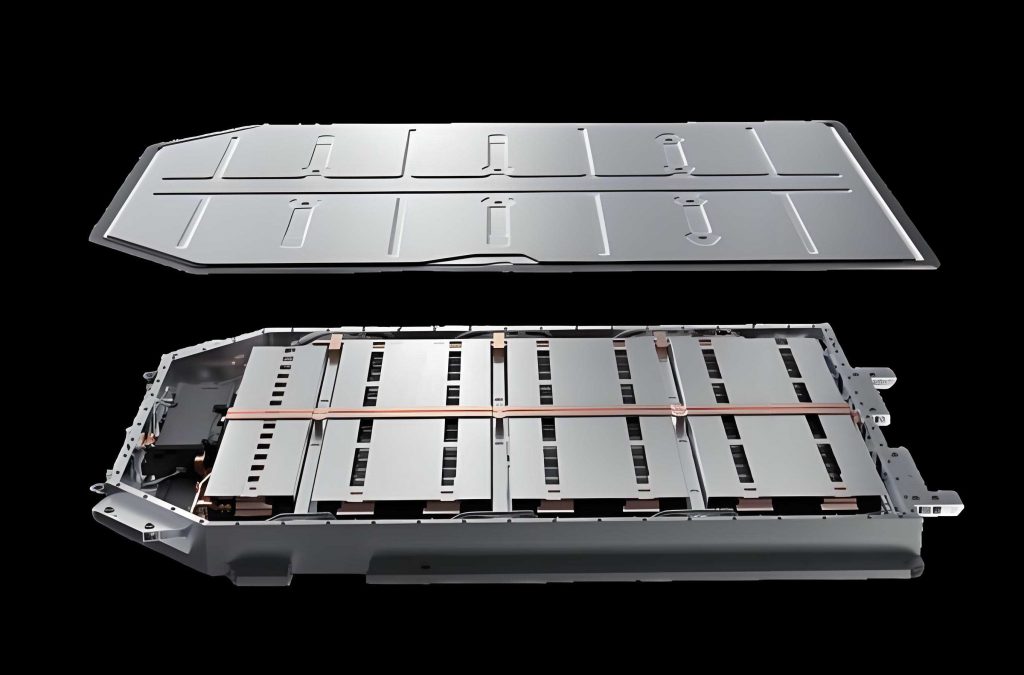
Our investigation employs a multi-physics, coupled simulation approach to dissect this problem. The core question we address is: what is the critical mechanical deformation of a battery cell within the EV battery pack that initiates thermal runaway? To answer this, we construct a high-fidelity model representing a module within the EV battery pack subjected to a localized crushing load. The simulation couples three physical domains: mechanical structural deformation, electrical response, and thermal propagation. This allows us to observe not just the physical intrusion but also the subsequent electrochemical and thermal chain of events that lead to failure.
The foundation of the analysis is a finite element model built for explicit dynamic simulation using LS-DYNA. A representative battery module, comprising 20 prismatic lithium nickel manganese cobalt oxide (NMC) cells connected in series, was modeled. Each cell had nominal dimensions of 20 mm × 70 mm × 190 mm. The module assembly was simulated with the cells bonded together. A critical aspect of the model is the material definition for the cells. The metallic terminals were modeled using a standard piecewise linear plasticity material model (*MAT_024). The jellyroll of the cell, whose mechanical behavior under compression is vital, was modeled using a low-density foam material model (*MAT_057), which can capture the compressive stress-strain curve characteristic of battery cell internals. The key parameters for these material models are summarized in the table below.
| Component | Material Model | Key Parameters |
|---|---|---|
| Terminals | *MAT_024 (Plastic Kinematic) | Density ($\rho$), Young’s Modulus (E), Yield Stress ($\sigma_y$), Tangent Modulus ($E_{tan}$) |
| Cell Jellyroll | *MAT_057 (Low Density Foam) | Density ($\rho$), Load Curve ID (for compressive stress-strain), Hysteresis unloading factor |
The mechanical crush scenario was set up with a rigid spherical indenter of 20 mm diameter impacting the bottom of a central cell within the module at a constant velocity. To transform this into a coupled mechanical-thermal-electrical simulation, several additional modeling steps were implemented. First, thermal material properties were assigned. The isotropic thermal material model required inputs for density ($\rho$), specific heat capacity ($C_p$), and thermal conductivity ($k$).
| Component | Density $\rho$ (kg/m³) | Specific Heat $C_p$ (J/kg·K) | Thermal Conductivity $k$ (W/m·K) |
|---|---|---|---|
| Cell Body | ~2700 | ~1000 | Anisotropic (e.g., $k_x$, $k_y$, $k_z$) |
| Terminals (Al/Cu) | ~2700 / ~8900 | ~900 / ~385 | ~200 / ~400 |
The solver control was set to a coupled mechanical-thermal analysis. Thermal conduction between components was activated in the contact definitions by specifying a gap conductance parameter. The initial temperature for the entire EV battery pack model was set to a standard 25°C (298 K).
The final and most crucial coupling was the electrical-thermal link to simulate internal short circuit (ISC) initiation and its Joule heating effects. An equivalent circuit model was integrated. The cell’s open-circuit voltage (OCV) as a function of state of charge (SOC) was defined. An internal short circuit was triggered based on a user-defined criterion linked to mechanical strain or deformation within the cell element. Once triggered, a resistive short circuit path was activated within the electrical network of the cell. The heat generated by this short circuit due to Joule heating is given by:
$$ Q_{isc}(t) = I_{isc}(t)^2 \cdot R_{short} $$
where $Q_{isc}$ is the heat generation rate, $I_{isc}$ is the short-circuit current, and $R_{short}$ is the short-circuit resistance. This heat source $Q_{isc}$ is then injected into the thermal model, causing localized temperature rise. The thermal model solves the heat diffusion equation:
$$ \rho C_p \frac{\partial T}{\partial t} = \nabla \cdot (k \nabla T) + \dot{q}_{gen} $$
where $T$ is temperature, $t$ is time, and $\dot{q}_{gen}$ represents internal heat generation sources, including $Q_{isc}$.
The coupled simulation was executed. The post-processing focused on the temperature evolution of the cells. According to standard safety regulations (referencing concepts from GB 38031-2020), thermal runaway is defined as the point when a monitoring point’s temperature exceeds a specified maximum or its temperature rise rate exceeds 1°C/s for longer than 3 seconds. Our simulation results clearly showed this transition. Initially, the EV battery pack was at a uniform 25°C. As the indenter crushed the cell, mechanical deformation accumulated. At a specific intrusion depth, the internal short circuit was initiated. The simulation output showed a specific cell’s temperature beginning to rise rapidly at the moment the cell was crushed by approximately 11.89 mm. Shortly after, the temperature in that cell exceeded 130°C with a high $\frac{dT}{dt}$, meeting the thermal runaway criteria. This triggered a propagating thermal event: heat diffused to adjacent cells, causing them to also go into thermal runaway, leading to temperatures exceeding 1100°C in the module—a state representing a full pack fire.
Therefore, the multi-physics simulation provided a critical design boundary: for this specific cell type and configuration within the EV battery pack, the safety limit for mechanical intrusion into the cell bottom is **11.89 mm**. To prevent thermal runaway and fire in a grounding event, the structural system protecting the EV battery pack must be designed to keep cell deformation below this threshold.
We then applied this boundary condition to a real-world scenario. A grounding test on the target mini-truck resulted in a battery pack fire. The test condition involved the vehicle driving at 30 km/h over a fixed, hard stone obstacle. Post-test measurement showed a 37 mm overlap between the stone’s highest point and the lowest point of the EV battery pack casing. A full-vehicle finite element model, including a detailed scan of the stone, was constructed to replicate this test virtually.
The simulation of this grounding event confirmed the root cause. The analysis showed that upon impact, the stone deformed the underbody protection and directly loaded the front cross-member of the EV battery pack itself. The force was transmitted through this structure to the battery modules, causing significant inward deformation of the cell bottoms at the point of first contact. The maximum recorded intrusion into the cells was **18.41 mm**, which significantly exceeded our previously established safety limit of 11.89 mm, thereby explaining the thermal runaway and fire observed in the physical test. This validated the model and pinpointed the critical load path: the stone → vehicle frame cross-member → EV battery pack front cross-member → battery modules/cells.
The optimization task became clear: modify the load-path structures to absorb more impact energy before the force reaches the cells, thereby reducing the cell intrusion from 18.41 mm to below 11.89 mm. The two key identified components were: 1) the vehicle frame cross-member directly in front of the EV battery pack (Component A), and 2) the front structural cross-member of the EV battery pack casing itself (Component B). Given manufacturing constraints, increasing material strength grade was not feasible; however, increasing the sheet metal thickness of these components was a viable option to improve their bending strength and energy absorption capacity. The moment of inertia for a rectangular section, which governs bending stiffness, is:
$$ I = \frac{w \cdot t^3}{12} $$
where $w$ is the width and $t$ is the thickness. Increasing thickness $t$ has a cubic effect on stiffness ($I \propto t^3$), making it a very effective design variable.
An orthogonal design of experiments (DoE) was conducted by varying the thickness of Component A and Component B. The baseline thickness for both was 1.0 mm. The intrusion results for the worst-case cell from the full-vehicle grounding simulation for each design combination are shown below.
| Component B Thickness (mm) | Maximum Cell Intrusion (mm) for Component A Thickness | ||
|---|---|---|---|
| 1.0 mm | 1.5 mm | 2.0 mm | |
| 1.0 | 18.41 | 16.60 | 13.93 |
| 1.5 | 15.40 | 13.10 | 11.78 |
| 2.0 | 12.97 | 10.56 | 9.36 |
The safety limit is 11.89 mm. Therefore, the design combinations that meet the requirement are: (A=2.0mm, B=1.5mm), (A=1.5mm, B=2.0mm), and (A=2.0mm, B=2.0mm). The next criterion was mass minimization. The mass increase for the three candidate solutions relative to the baseline (A=1.0mm, B=1.0mm, mass=3.093 kg) was calculated.
| Optimization Scheme | Component A Thickness | Component B Thickness | Mass Increase (kg) |
|---|---|---|---|
| 1 | 2.0 mm | 1.5 mm | +2.40 |
| 2 | 1.5 mm | 2.0 mm | +2.24 |
| 3 | 2.0 mm | 2.0 mm | +3.09 |
Based on the combined criteria of safety (intrusion < 11.89 mm) and minimal mass penalty, **Scheme 2** (Component A = 1.5 mm, Component B = 2.0 mm) was selected as the optimal design. This configuration reduces the predicted worst-case cell intrusion to 10.56 mm, safely below the thermal runaway threshold, while adding only 2.24 kg of mass to the protective structure of the EV battery pack system.
In conclusion, this study demonstrates a systematic, simulation-driven approach to enhance the bottom safety of an EV battery pack for a light commercial vehicle. By first using advanced multi-physics coupling to establish a fundamental safety boundary—the critical cell deformation leading to thermal runaway—we provided a precise and physically-grounded design target. Subsequently, applying this target to a realistic grounding simulation allowed for the identification and strategic optimization of key load-bearing structures. The final optimized design for the EV battery pack’s underbody protection system successfully mitigates the risk of fire from stone impacts by ensuring cell intrusions remain below the critical failure limit, all while conscientiously managing added weight. This methodology offers a valuable framework for engineering safe, efficient, and lightweight protection for EV battery packs across various vehicle segments.