
The rapid proliferation of electric vehicles (EVs) has placed unprecedented demands on the safety and longevity of their most critical component: the EV battery pack. As the structural carrier of the battery cells, the integrity of the battery tray or underbody is paramount. Any compromise due to mechanical impact, corrosion, or thermal events can directly threaten the safety and functionality of the entire EV battery pack. Among the various protective solutions, water-based anti-stone impact Polyvinyl Chloride (PVC) coatings have emerged as a pivotal technology. These coatings serve as a robust shield, specifically designed to protect the vulnerable underside of the EV battery pack from road debris, environmental corrosion, and enhancing overall safety. This article delves into the current state, challenges, and advanced modifications of these coatings, analyzing their key properties from the perspective of an engineer deeply involved in their development and application for modern EV platforms.
The fundamental role of a protective coating for an EV battery pack extends beyond simple abrasion resistance. It must form a resilient, adherent barrier that can withstand the harsh underbody environment. Water-based anti-stone impact PVC coatings are formulated primarily from aqueous acrylic resin emulsions or vinyl polymer dispersions. Water serves as the carrier solvent, drastically reducing Volatile Organic Compound (VOC) emissions compared to traditional solvent-borne counterparts. The formulation is completed with a blend of inorganic functional fillers (like mica, talc, silica) and water-based additives. The synergy of these components yields a coating with excellent adhesion, stone chip resistance, and corrosion protection, forming a long-term defensive layer for the EV battery pack.
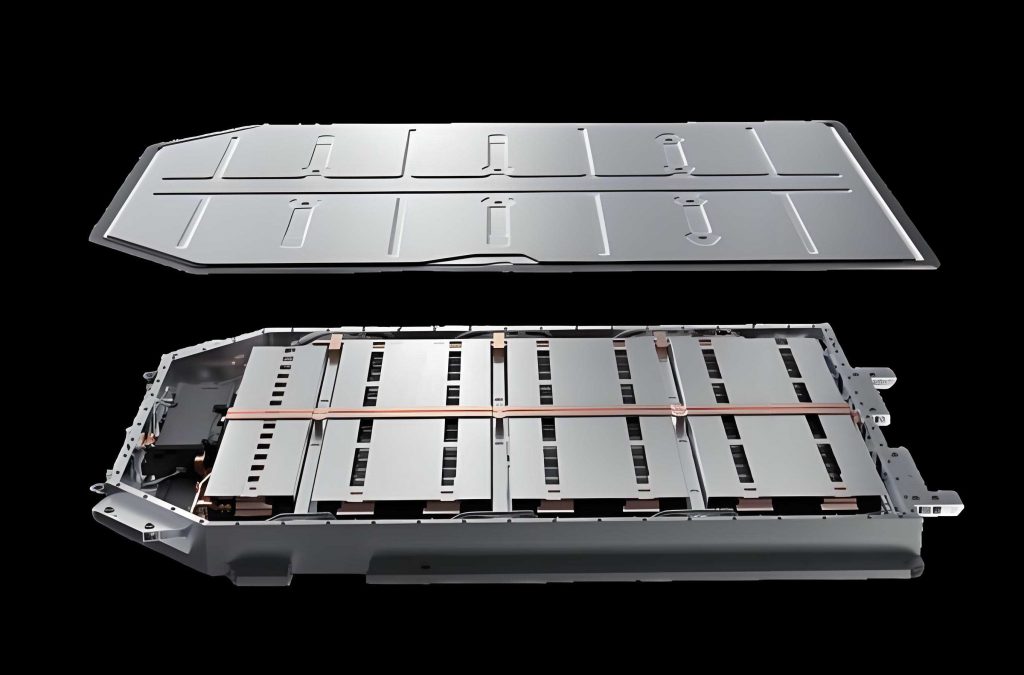
The selection of the resin system is critical and depends on the substrate material (e.g., aluminum alloy, galvanized steel) and the application process. A common choice is an acrylic resin with a glass transition temperature (Tg) in the range of 20–30°C. This Tg range offers an optimal balance between drying speed, final hardness, and coating flexibility. During the curing process, these resins undergo cross-linking, forming hydroxyl bonds with the metal substrate to ensure strong adhesion. This cross-linking continues over time, enhancing the coating’s bond strength progressively. The inorganic fillers are carefully selected for their morphology—plate-like (mica), needle-like (wollastonite), and spherical structures—to interlock and create a dense, composite matrix within the polymer. This dense structure is key to the coating’s barrier properties against corrosive agents and its mechanical strength.
A significant advantage over solvent-based or foaming PVC coatings is the inherent environmental and performance benefit. For instance, on aluminum substrates, incomplete solvent evaporation from traditional coatings can lead to poor adhesion without the possibility of secondary cross-linking. The water-based system’s cross-linking mechanism provides a more reliable bond. Furthermore, the final cured film can achieve a Shore A hardness exceeding 90, which directly translates to superior anti-chip performance. In standardized tests, such as the gravelometer test or a weighted impact test (e.g., M6 nut impact from 2m height), high-performance water-based PVC coatings can withstand impacts greater than 50 kg, significantly outperforming many traditional alternatives which may fail around 20-25 kg. This level of protection is crucial for safeguarding the sealed enclosure of the EV battery pack from penetrating damage that could lead to thermal runaway.
Despite their advantages, the evolution and mass adoption of water-based anti-stone impact PVC coatings face specific challenges that must be addressed to meet the escalating demands of the EV industry. The transition is driven by stringent global environmental regulations favoring low-VOC technologies, but practical hurdles remain. The first major challenge is production efficiency. Since water has a high boiling point (100°C) and high latent heat of vaporization, the drying/curing process typically requires more time or careful control compared to fast-evaporating solvents. This can create a bottleneck in high-throughput manufacturing settings for EV battery pack assemblies. Secondly, as safety standards evolve, there is a pressing need to move from mere “flame retardancy” to genuine “fire resistance.” A coating that merely slows ignition (UL94-V0) is different from one that can act as a thermal barrier, protecting the EV battery pack from an external fire source for a defined period (e.g., 30 minutes). Finally, the operational temperature window of lithium-ion batteries is narrow (typically 0°C to 40°C for optimal performance). Extreme ambient temperatures can reduce efficiency, capacity, and lifespan. Therefore, enhancing the thermal insulation properties of the protective coating can contribute to better thermal management of the EV battery pack, reducing energy spent on heating or cooling and protecting it from external thermal shocks.
Optimizing Drying Rate for Manufacturing Efficiency
Improving the drying kinetics of water-based coatings is a multi-faceted problem involving formulation science and process engineering. The goal is to achieve a tack-free, handleable state rapidly without inducing film defects like bubbling or cracking. The primary strategies are summarized in the table below:
| Factor | Optimization Strategy | Mechanism & Consideration |
|---|---|---|
| Process Conditions | Temperature: 80-85°C; Active Dehumidification | Temperature is high enough to accelerate water evaporation but below boiling point to prevent bubbling. Actively removing humid air from the oven lowers the partial pressure of water vapor, driving faster evaporation. The drying rate can be modeled as being proportional to the vapor pressure difference: $$ \frac{dm_w}{dt} \propto (P_{w,film} – P_{w,air}) $$ where \( dm_w/dt \) is the water evaporation rate, \( P_{w,film} \) is the vapor pressure at the film surface, and \( P_{w,air} \) is the partial pressure of water in the air. |
| Coating Solids Content | Increase Solids Content (e.g., >60%) | Higher solids content means less water to evaporate per unit volume of applied coating. This directly reduces the theoretical drying time. However, there is a trade-off: very high solids can lead to high viscosity, poor sag resistance, and rapid surface drying (“skin formation”) which can trap moisture underneath, causing later problems. |
| Resin Architecture | Select resin with Tg ~20-30°C and low-Tg shell/core morphology. | The resin’s Tg dictates the minimum film formation temperature (MFFT). A Tg around 20-30°C minimizes the need for volatile coalescing aids (which slow drying). A particle morphology with a lower Tg shell promotes rapid particle deformation and film integration upon water loss, while a harder core can maintain final hardness. This allows faster initial set time. |
| Additives | Use of controlled evaporation rate co-solvents or reactive diluents. | A small percentage of a co-solvent with a boiling point between water and standard solvents can plasticize the film initially for formation and then evaporate quickly. Advanced formulations may use reactive diluents that participate in cross-linking, reducing overall volatile content. |
By integrating these strategies, the drying time for a 1mm thick coating on an EV battery pack tray can be reduced to be competitive with solvent-based processes, thereby alleviating the production bottleneck while maintaining all performance benefits.
Enhancing Fire Resistance for Superior EV Battery Pack Safety
Protecting the EV battery pack from external fire is a critical safety frontier. The objective is to develop a coating that acts as a thermal barrier, significantly delaying heat transfer to the battery cells inside the pack. This involves a shift from additive-based flame retardancy to a system designed for intrinsic fire resistance and intumescence. The performance target might be defined as: with a standard flame (e.g., 1000-1400°C) applied to the coated side, the temperature on the uncoated (back) side of the substrate should not exceed 300°C for at least 30 minutes. This buys crucial time for occupant egress and emergency response.
The enhancement strategy employs a multi-mode action approach combining several mechanisms:
1. Endothermic Decomposition: Materials like aluminum trihydrate (ATH, Al(OH)3) or magnesium hydroxide (MDH, Mg(OH)2) are highly effective. When heated, they decompose endothermically, releasing water vapor.
$$ 2 Al(OH)_3 \xrightarrow{\Delta} Al_2O_3 + 3 H_2O \quad (\Delta H > 0) $$
$$ Mg(OH)_2 \xrightarrow{\Delta} MgO + H_2O \quad (\Delta H > 0) $$
This reaction absorbs a substantial amount of heat from the fire, cooling the substrate. The released water vapor also dilutes flammable gases.
2. Char Formation and Expansion (Intumescence): This is the key to creating a thermal barrier. The coating is formulated with three key components:
- Acid Source: e.g., Ammonium polyphosphate (APP), which decomposes to phosphoric acid upon heating.
- Carbonific Source: e.g., Pentaerythritol (PER), a polyhydric alcohol.
- Blowing Agent: e.g., Melamine, which decomposes to release inert gases like ammonia.
Upon exposure to high heat, the acid source generates a mineral acid that catalyzes the dehydration of the carbonific source. This leads to the formation of a swollen, carbonaceous char. Simultaneously, the blowing agent decomposes, inflating this char into a thick, low-density, thermally insulating foam layer. This multi-layered char acts as a protective shield over the EV battery pack substrate.
3. Synergistic Fillers: Platelet-type fillers like expandable graphite or treated mica can enhance the char’s strength and stability. Zinc borate can act as a synergistic flame retardant, promoting char formation and suppressing afterglow.
The formulation challenge lies in integrating these fire-resistant components without critically degrading the coating’s mechanical properties, adhesion, or application viscosity. A balanced formulation is essential.
| Component Type | Example Materials | Primary Role in Fire Resistance | Considerations for EV Battery Pack Coating |
|---|---|---|---|
| Endothermic Fillers | Al(OH)3, Mg(OH)2 | Heat absorption, gas dilution | High loadings (>50 phr) often needed; can affect viscosity and flexibility. |
| Intumescent System | APP, PER, Melamine | Forms insulating char foam barrier | Must be compatible with aqueous system; can be sensitive to humidity. |
| Char Reinforcer | Expandable Graphite, Mica | Stabilizes and strengthens char layer | Graphite expansion must be controlled to avoid coating defects during curing. |
| Synergist | Zinc Borate, Zinc Oxide | Promotes char, suppresses smoke/afterglow | ZnO also offers corrosion inhibition, a dual benefit. |
Improving Thermal Insulation for Battery Thermal Management
Minimizing unwanted heat exchange between the EV battery pack and its environment is a valuable goal for energy efficiency and extreme weather protection. The thermal insulation performance of a coating is inversely related to its thermal conductivity, \( k \) (W/m·K). The goal is to minimize \( k \). For a homogeneous coating, heat transfer is governed by Fourier’s law for one-dimensional conduction:
$$ q = -k \, A \, \frac{dT}{dx} $$
where \( q \) is the heat transfer rate, \( A \) is the area, and \( dT/dx \) is the temperature gradient. To reduce \( q \), we must reduce \( k \).
The thermal conductivity of a composite coating like ours is determined by the conductivity of the polymer matrix (\( k_p \sim 0.2 \) W/m·K), the conductive fillers, and most importantly, the presence of gas phases, as air has a very low \( k \) (~0.026 W/m·K). Therefore, the strategy focuses on incorporating stable, microscopic gas pockets within the cured film.
1. Hollow Microspheres: These are rigid, microscopic spheres made from glass, polymer, or ceramic, filled with inert gas. When incorporated into the coating, they create a dispersed gas phase. The effective thermal conductivity of a composite containing hollow spheres can be estimated by models like the Maxwell-Eucken equation for dispersed particles:
$$ k_c = k_m \left[ \frac{2k_m + k_f + 2\phi_f(k_f – k_m)}{2k_m + k_f – \phi_f(k_f – k_m)} \right] $$
where \( k_c \), \( k_m \), and \( k_f \) are the conductivity of the composite, matrix, and filler (the microsphere, which is itself a composite of shell and gas), and \( \phi_f \) is the volume fraction of filler. Because \( k_f \) (of the gas-filled sphere) is very low, \( k_c \) decreases significantly.
2. Aerogel Microparticles: Silica aerogel is a nanostructured material with over 90% porosity, pore sizes typically around 20-50 nm, and an extremely low solid network conductivity. Its brilliance for insulation stems from Knudsen effect: when the pore size is smaller than the mean free path of air molecules (~70 nm), gas-phase conduction is drastically suppressed. The overall thermal conductivity of aerogel can be below 0.020 W/m·K. Incorporating hydrophobic silica aerogel powder into the coating formulation introduces a nanoscale, highly porous network that severely hinders all three modes of heat transfer: solid conduction (minimal skeleton), gas conduction (Knudsen effect), and radiation (scattering by nanoparticles).
The formulation challenge is incorporating these delicate, low-density particles without crushing them during mixing and application, and ensuring they are wetted properly by the resin to avoid creating large voids that compromise mechanical integrity. A typical formulation approach for an insulating, anti-stone impact coating for an EV battery pack might look like this:
| Component | Function | Typical Loading (wt.%) | Impact on Thermal Conductivity (k) |
|---|---|---|---|
| Aqueous Acrylic Resin | Binder, Film Former | 25-35% | Provides matrix (k ~0.2). |
| Hollow Glass Microspheres | Thermal Insulation, Density Reduction | 10-20% | Significant reduction (introduces low-k gas pockets). |
| Hydrophobic Silica Aerogel Powder | Ultra-Low k Insulation | 5-15% | Major reduction via nanostructured porosity and Knudsen effect. |
| Platelet Fillers (Mica, Talc) | Barrier, Reinforcement, Anti-settling | 15-25% | Slight increase in k but necessary for mechanical strength. |
| Fire Retardant Fillers (ATH, Intumescent) | Fire Resistance | 15-25% | Variable impact; some may increase k slightly. |
| Pigments, Thickeners, Dispersants | Color, Rheology, Stability | Balance | Negligible direct impact. |
With such an optimized formulation, the coating’s overall thermal conductivity can be reduced from a typical value of ~0.4-0.5 W/m·K for a standard filled coating to below 0.15 W/m·K. This creates a tangible insulating effect, helping to buffer the EV battery pack from rapid temperature changes in the external environment.
Conclusion: A Comprehensive Shield for the Modern EV Battery Pack
The development of water-based anti-stone impact PVC coatings represents a convergence of environmental responsibility and advanced material science tailored for the protection of the EV battery pack. While their foundational benefits of low VOC emissions, excellent adhesion, and superior mechanical resistance are well-established, the pathway forward demands addressing the triad of manufacturing efficiency, active fire safety, and passive thermal management. Through strategic formulation involving resin architecture optimization, the integration of intumescent and endothermic fire-resistant systems, and the incorporation of hollow microspheres and aerogel particles, these coatings can be transformed into multifunctional protective systems. They are no longer just a chip guard; they become an integral part of the EV battery pack’s safety and thermal management strategy. Successfully overcoming these challenges ensures that the coating contributes significantly to the durability, safety, and performance of electric vehicles, ultimately supporting the broader adoption and reliability of sustainable transportation. The continued innovation in this field will undoubtedly yield even more advanced materials, further solidifying the role of specialized coatings in the evolution of the EV battery pack.