
The structural integrity of the Electric Vehicle (EV) battery pack is paramount, directly influencing vehicle safety, performance, and longevity. During operation, the EV battery pack is subjected to complex dynamic loads originating from road surface irregularities, powertrain vibrations, and other vehicle component interactions. The modal characteristics of the pack—its natural frequencies and mode shapes—fundamentally dictate its dynamic response under these vibrational conditions. If the fundamental natural frequency of the EV battery pack is too low, it risks coinciding with dominant excitation frequencies from the road (typically below 30 Hz), leading to resonance. This phenomenon can cause excessive stress amplitudes in structural components, potential fastener loosening, and accelerated fatigue failure, severely compromising the safety and reliability of the energy storage system.
Concurrently, the imperative for lightweight design is critical in electric mobility. The EV battery pack constitutes a significant portion of the total vehicle mass, ranging from 30% to 40%. Reducing vehicle mass is a primary lever for improving energy efficiency; studies indicate that a 10% reduction in vehicle mass can lead to approximately a 5.5% decrease in power loss and a corresponding increase in driving range. Therefore, achieving structural robustness while minimizing mass is a central challenge in EV battery pack engineering.
Extensive research has been conducted on optimizing EV battery pack structures. Common strategies include topology optimization to define efficient load paths, topography optimization for enhancing local stiffness through bead patterns, and multidisciplinary optimization for sizing components. These methods have demonstrated success in significantly increasing natural frequencies and reducing mass. However, integrated approaches combining parametric shape optimization (modifying cross-sectional dimensions like height and width) with traditional sizing optimization (thickness variation) are less commonly explored in a cohesive framework for modal improvement. This study focuses on such an integrated approach, employing advanced design exploration and optimization techniques to enhance the modal performance of an EV battery pack while achieving a lightweight outcome.
The core methodology of this investigation utilizes Altair HyperStudy, a powerful multi-disciplinary design exploration and optimization tool. The process involves establishing a finite element model of the EV battery pack, defining a comprehensive set of design variables encompassing both dimensional and shape parameters, conducting a Design of Experiments (DOE) screening study to identify key influencing factors, and finally, executing a constrained optimization using the Global Response Surface Method (GRSM) to maximize frequency under a mass constraint.
Finite Element Model Development for Modal Analysis
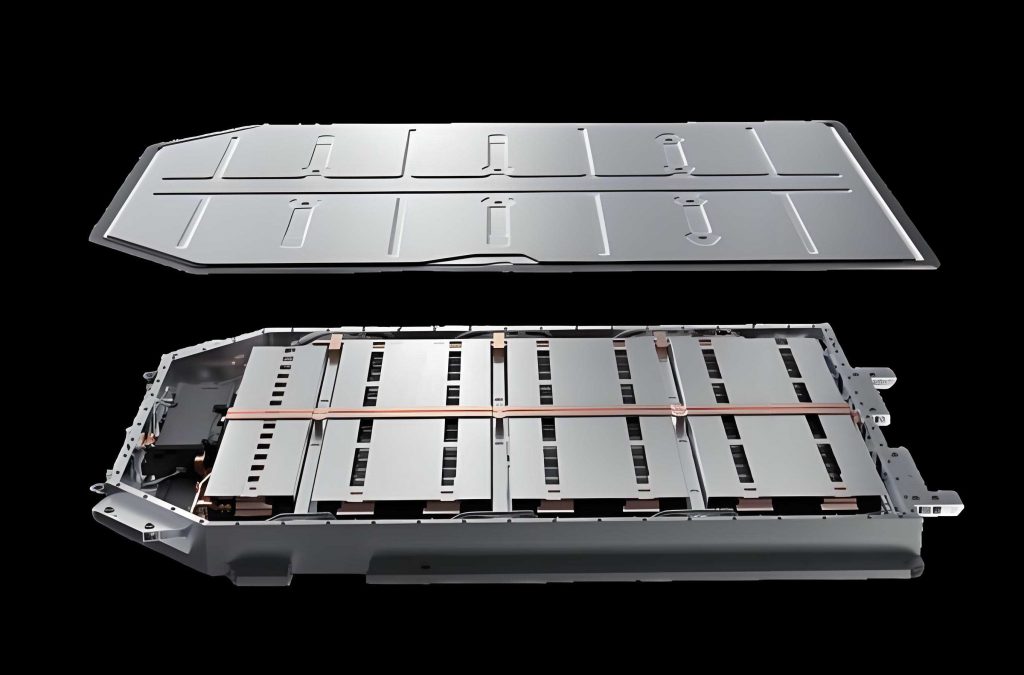
The foundation of any reliable simulation is an accurate yet computationally efficient model. The initial step involved simplifying the computer-aided design (CAD) geometry of a target EV battery pack. Non-structural components such as small brackets, cable ducts, and electronic control units, which have negligible impact on global stiffness, were omitted. The core structural assembly was retained, comprising the following key parts:
- Lower Enclosure (Tray): The primary structural container, typically fabricated from aluminum.
- Cross Members and Longitudinal Beams: Internal reinforcement structures to bolster stiffness and support module loads.
- Cooling Plate: Integrated into the structure for thermal management.
- Battery Modules: Simplified into homogenized blocks representing the collective mass and average stiffness of the cells and their internal framing.
The finite element mesh was generated using HyperMesh. The lower enclosure, cross members, and cooling plate were discretized using shell elements (primarily quadrilaterals) with a base size of 5 mm. The homogenized battery modules were meshed with solid elements at a coarser base size of 20 mm to balance model fidelity with solution time. The final model contained approximately 285,268 elements.
Connections between components were carefully modeled to represent real-world assembly. Spot welds were simulated using the Area Contact Method (ACM), adhesive bonds were represented by cohesive adhesive elements, and other bonded interfaces were treated with node-to-surface tied contacts. The materials were assigned with properties representative of their actual behavior, as summarized in the table below. Notably, the battery modules were assigned homogenized properties derived from the aggregate mass and estimated compressive stiffness of the cell stack.
| Component | Material | Density (kg/m³) | Young’s Modulus (MPa) | Poisson’s Ratio |
|---|---|---|---|---|
| Lower Enclosure | Aluminum Alloy | 2700 | 70,000 | 0.3 |
| Cross Members / Beams | AL6061-T6 | 2700 | 70,000 | 0.3 |
| Cooling Plate | AL3003 | 2700 | 70,000 | 0.3 |
| Battery Modules (Homogenized) | N/A | 2000 | 600 | 0.3 |
Modal analysis, or normal modes analysis, computes the inherent vibration characteristics of a linear system. The governing equation for undamped free vibration is the eigenvalue problem:
$$
(\mathbf{K} – \omega_i^2 \mathbf{M}) \{\phi_i\} = 0
$$
where \(\mathbf{K}\) is the stiffness matrix, \(\mathbf{M}\) is the mass matrix, \(\omega_i\) is the circular natural frequency (rad/s) for mode \(i\), and \(\{\phi_i\}\) is the corresponding mode shape vector. The natural frequency in Hertz is \(f_i = \omega_i / 2\pi\).
The analysis was performed using the OptiStruct solver with the Lanczos method, an efficient algorithm for extracting eigenvalues and eigenvectors of large systems. The boundary conditions simulated the EV battery pack mounted to the vehicle body by fixing all degrees of freedom at the mounting hole locations around the perimeter. The target for the first global natural frequency was set above 35 Hz, a common benchmark to avoid resonance with dominant road-induced excitations and to meet the spirit of vibration durability specifications.
The initial modal analysis results for the first five modes are presented below. The effective modal mass participation in each translational direction is a key metric for distinguishing global from local modes. Modes with high effective mass participation (a significant fraction of the total model mass, which was 447 kg) are considered global and critically affect the dynamic response to base excitation.
| Mode Order | Frequency (Hz) | Effective Modal Mass Participation (kg) | ||
|---|---|---|---|---|
| X-direction | Y-direction | Z-direction | ||
| 1 | 33.55 | 0.00 | 0.00 | 399.90 |
| 2 | 43.74 | 6.19 | 0.09 | 0.00 |
| 3 | 77.08 | 0.00 | 23.11 | 0.00 |
| 4 | 87.33 | 0.36 | 0.00 | 0.90 |
| 5 | 90.94 | 0.00 | 2.64 | 0.00 |
The results clearly show that Mode 1 at 33.55 Hz is the dominant global mode, with nearly 400 kg of effective mass participating in the vertical (Z) direction. This frequency is below the 35 Hz target, indicating a potential vulnerability. Modes 2 through 5 are local modes with negligible effective mass, primarily involving twisting or bending of individual beams. Therefore, the optimization objective was defined as increasing the first natural frequency of the EV battery pack to meet or exceed 35 Hz.
Establishing the Optimization Framework
To improve the dynamic performance of the EV battery pack, a parametric optimization study was formulated. The design variables were selected from structural components with significant influence on both global stiffness and mass: the lower enclosure (tray) and the internal reinforcing beams (cross members and longitudinal beam).
Design Variables
A total of 20 design variables were defined, categorized into two types:
- Size Variables (P1-P13, P20): These control the sheet metal thickness of various flanges and webs within the beam cross-sections and the thickness of the lower enclosure. Fourteen variables fell into this category.
- Shape Variables (P14-P19): These control the overall cross-sectional dimensions of the beams, specifically the height and width increments for the central, left, and right cross members. Six variables were shape variables.
The lower and upper bounds for each variable were set based on manufacturing feasibility and packaging constraints. The initial values represented the baseline design.
Screening Study Using Design of Experiments (DOE)
Before full optimization, a screening study was conducted to understand the relative influence of each design variable on the first natural frequency. This helps in focusing the optimization on the most significant parameters. A Resolution IV fractional factorial design was employed. This DOE technique is highly efficient, requiring only 40 simulation runs for the 20 factors at two levels each (low and high, corresponding to the variable bounds). A key property of a Resolution IV design is that main effects are not confounded with two-factor interactions, although two-factor interactions may be confounded with each other. This is acceptable for a screening objective focused on identifying important main effects.
The analysis of the DOE results produced Pareto charts of standardized effects. The findings revealed that all variables had a positive effect on frequency (i.e., increasing any variable increased stiffness more than it increased mass). The most influential factors were, in descending order:
- Lower enclosure thickness (P20)
- Thickness of the side flanges on the central cross member (P1)
- Thickness of the top flange on the central cross member (P2)
The thickness of side flanges on other beams and the height of the central beam were also significant. Notably, the width increments of the left and right beams (shape variables P18, P19) showed the smallest effects. This screening confirmed that the lower enclosure and the central reinforcing structure are the primary levers for modifying the global stiffness of the EV battery pack.
Formulation of the Constrained Optimization Problem
While maximizing frequency is desirable, it must be balanced against the critical goal of mass reduction for the EV battery pack. Therefore, a single-objective constrained optimization was formulated. The objective was to minimize the total mass of the EV battery pack structure. The constraint was to ensure the first natural frequency (f1) was greater than or equal to the target of 35 Hz. All design variables were constrained within their practical bounds.
The mathematical formulation is as follows:
$$
\begin{aligned}
& \text{Minimize:} & & M(\mathbf{x}) = M(x_1, x_2, …, x_{20}) \\
& \text{Subject to:} & & f_1(\mathbf{x}) \geq 35 \, \text{Hz} \\
& & & x_i^L \leq x_i \leq x_i^U \quad \text{for } i = 1, 2, …, 20
\end{aligned}
$$
where \(M\) is the total mass, \(f_1\) is the first natural frequency, \(\mathbf{x}\) is the vector of 20 design variables, and \(x_i^L\) and \(x_i^U\) are the lower and upper bounds for each variable, respectively.
Optimization Using the Global Response Surface Method (GRSM)
To solve this problem, the Global Response Surface Method (GRSM) within HyperStudy was employed. GRSM is a surrogate-based optimization algorithm. It begins by sampling the design space (e.g., using Latin Hypercube or other space-filling designs) to build initial approximate models (response surfaces) for the objective and constraint functions. These meta-models are computationally cheap to evaluate. The algorithm then uses these models to search for an optimum, iteratively refining the surfaces with new simulation points in promising regions. This method is efficient for problems with computationally expensive simulations, as it minimizes the number of direct solver calls.
The GRSM optimization was configured with 20 initial sample points and a convergence tolerance. After approximately 50 iterations (including the initial samples), the algorithm converged to an optimized design. The results for all variables, along with the final mass and frequency, are consolidated in the table below. The values have been rounded to one decimal place for clarity.
| Symbol | Design Variable Description | Lower Bound (mm) | Upper Bound (mm) | Initial Value (mm) | Optimized Result (mm) |
|---|---|---|---|---|---|
| P1 | Central Beam – Side Flange Thickness | 1.6 | 5.0 | 4.0 | 5.0 |
| P2 | Central Beam – Top Flange Thickness | 1.6 | 5.0 | 4.0 | 4.9 |
| P3 | Central Beam – Bottom Flange Thickness | 1.6 | 5.0 | 2.0 | 2.7 |
| P4 | Central Beam – Middle Web Thickness | 1.6 | 5.0 | 4.0 | 1.7 |
| P5 | Left Beam – Side Flange Thickness | 1.6 | 5.0 | 2.0 | 2.0 |
| P6 | Left Beam – Top Flange Thickness | 1.6 | 5.0 | 3.0 | 4.9 |
| P7 | Left Beam – Bottom Flange Thickness | 1.6 | 5.0 | 2.0 | 2.5 |
| P8 | Left Beam – Middle Web Thickness | 1.6 | 5.0 | 4.0 | 1.7 |
| P9 | Right Beam – Side Flange Thickness | 1.6 | 5.0 | 2.0 | 2.8 |
| P10 | Right Beam – Top Flange Thickness | 1.6 | 5.0 | 3.0 | 4.9 |
| P11 | Right Beam – Bottom Flange Thickness | 1.6 | 5.0 | 2.0 | 5.0 |
| P12 | Right Beam – Middle Web Thickness | 1.6 | 5.0 | 4.0 | 3.4 |
| P13 | Longitudinal Beam Thickness | 1.6 | 5.0 | 4.0 | 1.7 |
| P14 | Central Beam – Height Increase | 0.0 | 10.0 | 0.0 | 7.0 |
| P15 | Left Beam – Height Increase | 0.0 | 10.0 | 0.0 | 9.0 |
| P16 | Right Beam – Height Increase | 0.0 | 10.0 | 0.0 | 7.0 |
| P17 | Central Beam – Width Increase | 0.0 | 6.0 | 0.0 | 4.0 |
| P18 | Left Beam – Width Increase | 0.0 | 6.0 | 0.0 | 2.2 |
| P19 | Right Beam – Width Increase | 0.0 | 6.0 | 0.0 | 3.5 |
| P20 | Lower Enclosure Thickness | 1.4 | 3.0 | 2.5 | 2.2 |
| System Response | Initial | Optimized | |||
| Total Mass, M (kg) | 447.0 | 444.0 | |||
| 1st Natural Frequency, f1 (Hz) | 33.5 | 35.0 | |||
The optimization successfully achieved its goal. The first natural frequency of the EV battery pack was increased from 33.5 Hz to the target of 35.0 Hz. Crucially, this was accomplished while simultaneously reducing the total structural mass by 3 kg (from 447 kg to 444 kg). The algorithm found a non-intuitive design: it increased the height of the beams significantly (a very effective shape change for bending stiffness), increased certain critical flange thicknesses (P1, P2, P6, P10, P11), but reduced others (P4, P8, P13) and, notably, reduced the lower enclosure thickness (P20) from 2.5 mm to 2.2 mm. This demonstrates the power of a systematic, multi-variable optimization approach to find a balanced solution that improves performance while cutting weight.
Experimental Validation
To validate the accuracy of the finite element model and the optimization results, a physical prototype of the EV battery pack, manufactured according to the optimized dimensions (with minor rounding for production), was subjected to a modal test on a vibration shaker table. The validation of dynamic models is essential for establishing confidence in simulation-driven design.
The EV battery pack was rigidly mounted to a high-force electrodynamic shaker via a test fixture. An accelerometer was attached to the lower surface of the pack to measure its response. A sine sweep excitation was applied. The test parameters were:
- Frequency Range: 10 Hz to 200 Hz
- Acceleration Amplitude: 0.5g
- Sweep Rate: 1 octave per minute
The frequency response function (FRF), specifically the transmissibility (output acceleration / input acceleration), was derived from the measured data. The primary peak in the transmissibility curve indicates the first major resonance. The experimental test identified a clear peak at 35.6 Hz with a transmissibility value of approximately 7.6 (3.8g output for 0.5g input).
Comparing this to the final optimized simulation frequency of 35.0 Hz yields an error of only 0.6 Hz, which is within an excellent margin of error (approximately 1.7%) for complex welded structures. This close agreement validates the fidelity of the finite element model, the accuracy of the material properties and boundary condition assumptions, and by extension, the reliability of the optimization process. The correlation confirms that the predicted improvement in the dynamic stiffness of the EV battery pack was successfully realized in the physical product.
Conclusion
This study demonstrated a comprehensive and effective methodology for enhancing the dynamic performance of an EV battery pack through integrated shape and size optimization. The process began with developing a validated finite element model for modal analysis, which correctly predicted the baseline first natural frequency. A systematic DOE screening study efficiently identified the lower enclosure and central beam flange thicknesses as the most influential parameters on the global frequency.
The core of the work was formulating and solving a constrained optimization problem with the dual objectives of meeting a minimum frequency target (35 Hz) and minimizing mass. By employing the Global Response Surface Method (GRSM), an optimal design was found that successfully increased the first natural frequency by 1.5 Hz (4.5%) while achieving a mass reduction of 3 kg. This result underscores the potential of advanced optimization algorithms to navigate complex design spaces and find non-obvious solutions that improve both performance and efficiency.
The final experimental validation on a shaker table confirmed the accuracy of the simulation predictions, with a minimal error of 0.6 Hz. The presented workflow—combining DOE for insight and GRSM for efficient constrained optimization—provides a robust, simulation-driven framework for the design of EV battery packs. This approach directly contributes to developing safer, more reliable, and lighter energy storage systems, which are critical for the advancement of electric mobility. Future work could extend this methodology to include multi-disciplinary constraints such as random vibration fatigue life, crush performance, and thermal management requirements, further pushing the boundaries of EV battery pack design.