
The strategic goals of achieving “carbon peak” by 2030 and “carbon neutrality” by 2060 have catalyzed the rapid development of New Energy Vehicles (NEVs) in our country. To simultaneously enhance the safety performance of NEVs and achieve vehicle lightweighting, aluminum alloys are being increasingly adopted. Within the critical research area of NEV safety, the integrity of the EV battery pack is paramount. The 5083 aluminum alloy, renowned for its excellent formability, cost-effectiveness, corrosion resistance, and favorable strength-to-weight ratio, is predominantly used for the side guard plates of EV battery pack enclosures. During collision events, the fracture behavior of this material becomes complex, directly impacting the safety of the EV battery pack and the accuracy of full-vehicle simulation analyses. Therefore, the precise prediction of the fracture behavior for materials used in EV battery pack construction is of utmost importance.
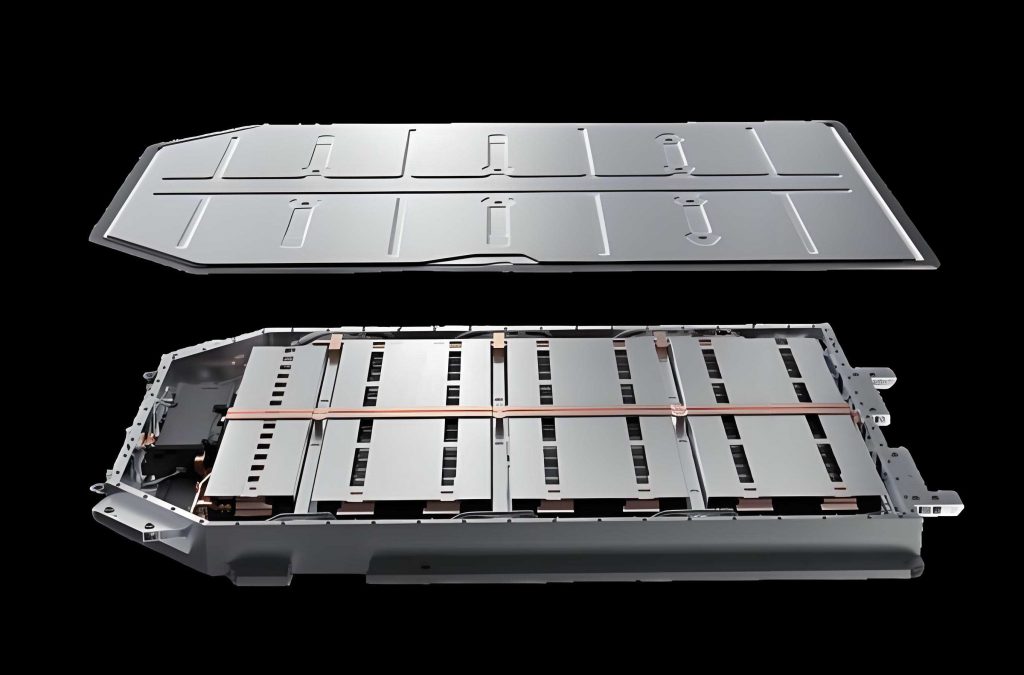
To predict material fracture, various failure criteria have been proposed. The Modified Mohr-Coulomb (MMC) fracture criterion, which considers the influence of both stress triaxiality and the Lode angle parameter, has proven effective for ductile metals. In this study, we focus on the 5083 aluminum alloy used for EV battery pack protection. A comprehensive experimental matrix was designed to obtain its mechanical and fracture properties. Based on the experimental data and the MMC criterion coupled with a damage accumulation model, a predictive failure model was developed and validated. The results demonstrate that the established model can accurately predict the fracture behavior of 5083 aluminum alloy, providing a robust material data foundation for the safety performance analysis of EV battery pack systems.
1. Material Characterization and Experimental Methodology
The material under investigation is a 1.5 mm thick sheet of 5083 aluminum alloy, a key component in EV battery pack side structures. To fully characterize its behavior, a series of mechanical and fracture tests were conducted.
1.1 Quasi-Static and Dynamic Tensile Testing
Uniaxial tensile tests were performed at strain rates of 0.001, 1, 10, 100, and 500 s-1 to evaluate the rate-dependent mechanical properties. Quasi-static tests (0.001 s-1) followed standard method A, while high strain-rate tests utilized a hydraulic servo system. Digital Image Correlation (DIC) and strain gauges were employed for accurate strain measurement. The engineering stress-strain curves obtained are shown in the consolidated plot below, revealing a notable strain hardening phenomenon characteristic of face-centered cubic metals.
The yield stresses at different strain rates are summarized in Table 1. Interestingly, the 5083 alloy exhibits low sensitivity to strain rate within the tested range, a crucial factor for crash simulation of EV battery pack components.
| Strain Rate (s-1) | Yield Stress (MPa) |
|---|---|
| 0.001 | 154.1 |
| 1 | 153.6 |
| 10 | 156.4 |
| 100 | 156.0 |
| 500 | 157.6 |
Table 1: Tensile Yield Stress of 5083 Aluminum Alloy.
1.2 Fracture Testing under Various Stress States
Ductile fracture is influenced by the stress state. To calibrate a robust failure model for EV battery pack crash scenarios, specimens inducing different stress states were designed and tested quasi-statically (2 mm/min). The test matrix included:
- Uniaxial Tension
- Notched Tension (R5 and R20 notch radii)
- Center Hole Tension
- Pure Shear
- Tensile Shear
- Marciniak (Cup) Test
DIC was used to capture full-field strain until fracture. The critical equivalent plastic strain to fracture ($\bar{\varepsilon}_f^{pl}$) for each specimen was extracted from the DIC data at the point of fracture initiation.
2. Development of the Constitutive and Failure Model
2.1 Constitutive Model Calibration
The engineering stress-strain data was converted to true stress-plastic strain using the standard relations:
$$ \varepsilon_T = \ln(1 + \varepsilon_E) $$
$$ \sigma_T = \sigma_E (1 + \varepsilon_E) $$
$$ \varepsilon^{pl} = \varepsilon_T – \frac{\sigma_T}{E} $$
where $E$ is Young’s modulus.
To describe the hardening behavior beyond necking, the Swift-Hockett-Sherby (SHS) mixed hardening law was employed due to its accuracy for aluminum alloys:
$$ \sigma(\varepsilon^{pl}) = (1-\alpha)[C (\varepsilon^{pl} + \varepsilon_0)^m] + \alpha [\sigma_{sat} – (\sigma_{sat} – \sigma_y) e^{-p \varepsilon^{pl}}] $$
where $C$, $\varepsilon_0$, $m$, $\sigma_{sat}$, $\sigma_y$, $\alpha$, and $p$ are material parameters. Using a proprietary material modeling tool, the parameters for each strain rate curve were calibrated. The *MAT_024 material model in LS-DYNA was used with the fitted curves as input. Key parameters are listed in Table 2.
| Parameter | Value |
|---|---|
| Density (kg/mm³) | 2.7e-6 |
| Young’s Modulus (GPa) | 70 |
| Poisson’s Ratio | 0.3 |
Table 2: Basic Material Parameters for the Constitutive Model.
Finite element simulations of the tensile tests using the calibrated model showed excellent agreement with experimental force-displacement curves, validating the SHS law for predicting the plastic flow of this EV battery pack alloy.
2.2 Failure Model Calibration Using the MMC Criterion
The stress state is defined by the stress triaxiality ($\eta$) and the normalized Lode angle parameter ($\bar{\theta}$).
Stress triaxiality is the ratio of hydrostatic pressure ($p$) to the von Mises equivalent stress ($\bar{\sigma}$):
$$ \eta = \frac{p}{\bar{\sigma}} $$
$$ p = -\frac{1}{3}(\sigma_1 + \sigma_2 + \sigma_3) $$
$$ \bar{\sigma} = \sqrt{\frac{1}{2}[(\sigma_1-\sigma_2)^2 + (\sigma_2-\sigma_3)^2 + (\sigma_3-\sigma_1)^2]} $$
where $\sigma_1$, $\sigma_2$, $\sigma_3$ are the principal stresses ($\sigma_1 \geq \sigma_2 \geq \sigma_3$).
The normalized Lode angle parameter is defined as:
$$ \bar{\theta} = 1 – \frac{2}{\pi} \arccos(\xi) $$
$$ \xi = \frac{27}{2} \frac{J_3}{\bar{\sigma}^3}, \quad J_3 = \det(\mathbf{s}) $$
where $J_3$ is the third invariant of the stress deviator $\mathbf{s}$.
The MMC fracture criterion defines the failure strain as a function of these parameters:
$$ \bar{\varepsilon}_f^{pl}(\eta, \bar{\theta}) = \left\{ \frac{K}{C_2} \left[ \sqrt{\frac{1+C_1^2}{3}} \cos\left(\frac{\bar{\theta}\pi}{6}\right) + C_1 \left( \eta + \frac{1}{3} \sin\left(\frac{\bar{\theta}\pi}{6}\right) \right) \right] \right\}^{-\frac{1}{n}} $$
where $K$, $C_1$, $C_2$, $n$ are material constants to be calibrated.
Damage accumulation is modeled incrementally:
$$ D = \int \frac{d\bar{\varepsilon}^{pl}}{\bar{\varepsilon}_f^{pl}(\eta, \bar{\theta})} $$
Failure is assumed to occur when the damage variable $D$ reaches 1.
For each fracture specimen, FE simulations were performed to extract the history of $\eta$ and $\bar{\theta}$ for the critical element. The average values up to the fracture point, along with the experimental $\bar{\varepsilon}_f^{pl}$, formed a data point in the $(\eta, \bar{\theta}, \bar{\varepsilon}_f^{pl})$ space. All data points were input into a proprietary failure parameter fitting system to calibrate the MMC parameters via inverse optimization with LS-OPT. The resulting 3D fracture envelope and its 2D projection under plane stress conditions are successfully generated, illustrating the strong dependence of ductility on stress state.
The calibrated MMC model was then used to simulate all fracture tests. The comparison between simulated and experimental force-displacement curves, as shown in representative plots, shows remarkable agreement. Furthermore, a visual comparison of the equivalent plastic strain fields at the onset of fracture between DIC results and FE predictions for all specimen types confirms that the model accurately captures not only the global force response but also the localized deformation and failure initiation patterns critical for EV battery pack component analysis.
3. Model Validation for EV Battery Pack Relevance
To validate the predictive capability of the calibrated constitutive and failure model for dynamic loading scenarios relevant to EV battery pack integrity, two independent validation tests were conducted: a three-point bending test and a dynamic punch test, both at an impact velocity of 1 m/s.
Detailed finite element models replicating the exact experimental setups were created. The previously developed *MAT_024 model with the integrated MMC failure criterion was assigned to the 5083 aluminum alloy specimen. The simulations accurately captured the deformation process, the initiation of cracks, and the subsequent failure progression.
The load-displacement responses from the simulations were directly compared to the experimental data. For both the three-point bending and the dynamic punch tests, the correlation between the simulated and measured curves was excellent. The model successfully predicted the peak load, the energy absorption up to failure, and the failure displacement. This robust agreement under dynamic loading conditions strongly validates the accuracy of the material model. It demonstrates that the characterized 5083 aluminum alloy properties and the calibrated MMC fracture model are reliable for use in complex crashworthiness simulations of EV battery pack structures, ensuring higher fidelity in safety assessments.
4. Conclusion
This comprehensive study establishes a robust methodology for characterizing and modeling the fracture behavior of 5083 aluminum alloy, a material strategically important for EV battery pack enclosures. The key findings are:
- The 5083 aluminum alloy exhibits relatively low strain rate sensitivity within the range of 0.001 to 500 s-1, a simplifying yet crucial factor for crash simulations of EV battery pack components.
- The Swift-Hockett-Sherby (SHS) mixed hardening law provides an excellent description of the alloy’s plastic flow behavior, enabling accurate prediction of its strength under large deformations.
- The Modified Mohr-Coulomb (MMC) ductile fracture criterion, calibrated using a suite of tests covering a wide range of stress states, effectively predicts the fracture initiation of 5083 aluminum alloy. The model’s accuracy is confirmed by its ability to replicate both the global mechanical response and local strain fields of various fracture specimens.
- The validation through independent dynamic three-point bending and punch tests confirms the model’s predictive capability under impact conditions representative of EV battery pack crash events.
The fully calibrated constitutive and failure model provides a vital and reliable material data foundation. Its integration into full-vehicle Finite Element (FE) models will significantly enhance the predictive accuracy of crash simulations, particularly for assessing the structural integrity and safety of the EV battery pack. This work directly contributes to the design of safer and more reliable battery enclosures, supporting the overarching goals of lightweighting and safety advancement in the electric vehicle industry.