
In urban traffic systems, signalized intersections are critical hotspots for vehicular emissions, particularly nitrogen oxides (NOx), due to frequent vehicle stops, accelerations, and decelerations. With the increasing adoption of hybrid electric vehicles in the automotive market, understanding their emission characteristics under different operating modes becomes essential for developing effective traffic control strategies. Traditional signal timing models often prioritize traffic efficiency metrics like delay and capacity, but environmental impacts, especially NOx emissions, are gaining attention due to public health and sustainability concerns. This study focuses on optimizing signal timing at intersections by integrating NOx emission models for both conventional fuel vehicles and hybrid electric vehicles, aiming to balance environmental benefits with traffic performance.
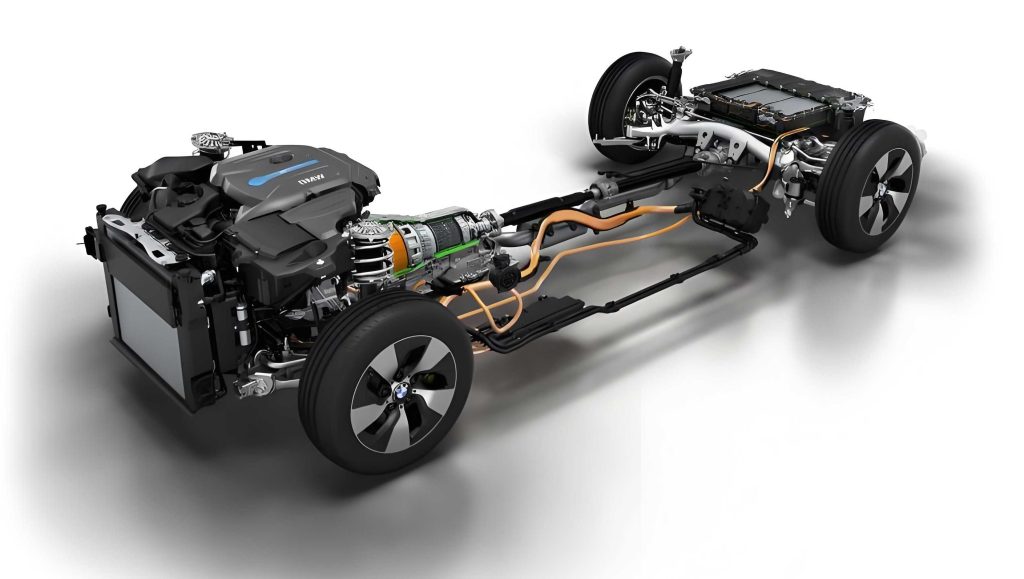
The core of this research lies in the vehicle-specific power (VSP) model, which correlates vehicle dynamics with emission rates. For conventional vehicles, such as light-duty gasoline vehicles (LDGVs) and heavy-duty diesel trucks (HDDTs), NOx emission factors are derived based on predefined VSP bins. However, hybrid electric vehicles, particularly plug-in hybrid electric vehicles (PHEVs), exhibit distinct behaviors depending on their battery state-of-charge (SOC). Specifically, PHEVs operate in charge-depleting (CD) mode when the battery is sufficiently charged, relying more on electric power, and switch to charge-sustaining (CS) mode when the SOC drops, where the internal combustion engine becomes dominant. This dual-mode operation necessitates separate NOx emission factor calculations for hybrid electric vehicles to accurately capture their environmental impact at intersections.
To address this, we develop NOx emission factor models for hybrid electric vehicles by fitting polynomial functions to real-world PEMS (Portable Emission Measurement System) data. For CD mode, the emission factor is expressed as a function of VSP: $$e_{\text{CD}} = 9.58668 \times 10^{-7} \cdot \text{VSP}^3 + 2.41489 \times 10^{-4} \cdot \text{VSP}^2 + 1.70650 \times 10^{-4} \cdot \text{VSP} + 4.07739 \times 10^{-4}$$ and for CS mode: $$e_{\text{CS}} = 8.20299 \times 10^{-7} \cdot \text{VSP}^3 + 5.18403 \times 10^{-4} \cdot \text{VSP}^2 + 1.55560 \times 10^{-4} \cdot \text{VSP} + 2.04278 \times 10^{-4}$$ where VSP is calculated as: $$\text{VSP} = \frac{0.156461v + 0.002002v^2 + 0.000493v^3 + 1.875va}{1.875}$$ with \(v\) as speed (m/s) and \(a\) as acceleration (m/s²). These models enable precise estimation of NOx emissions for hybrid electric vehicles under varying driving conditions.
For conventional vehicles, NOx emission factors are assigned based on VSP intervals, as summarized in Table 1. This approach allows for a comprehensive representation of a mixed traffic flow, including LDGVs, HDDTs, and hybrid electric vehicles, at signalized intersections.
| Vehicle Type | VSP Interval (kW/t) | NOx Emission Factor (g/s) |
|---|---|---|
| LDGV | < -2 | 0.000139501 |
| [-2, 0) | 0.000459870 | |
| [0, 1) | 0.001056453 | |
| [1, 4) | 0.001182000 | |
| [4, 7) | 0.001344693 | |
| … | … | … |
| HDDT | < -2 | 0.056210565 |
| [-2, 0) | 0.072015277 | |
| [0, 1) | 0.065285324 | |
| [1, 4) | 0.120159943 | |
| [4, 7) | 0.155863268 |
Building on these emission models, we formulate a signal timing optimization model for a signalized intersection. The optimization objective is to minimize the average NOx emission per vehicle (\(\bar{E}\)) within the intersection area, while constraining average vehicle delay (\(\bar{D}\)) and average number of stops (\(\bar{h}\)) to acceptable levels. The decision variables are the signal cycle length (\(C\)) and green times for each phase (\(g_i\)). The model considers four driving conditions: deceleration, idling, acceleration, and cruising. For each vehicle type and energy source, NOx emissions are calculated accordingly.
For conventional vehicles, emissions during deceleration and acceleration are computed as: $$E_{\delta,\alpha,1} = \sum_{k=1}^{l} e_{\delta,\alpha,1,k} \cdot t_{\delta,\alpha,1,k} \cdot h$$ where \(\delta=1\) for deceleration and \(\delta=2\) for acceleration, \(\alpha\) denotes vehicle type, \(e\) is the emission factor, \(t\) is time spent in each VSP bin, and \(h\) is the average number of stops. For hybrid electric vehicles, emissions in these conditions are: $$E_{\delta,1,2} = \left( \omega \int_{0}^{t_{\delta,1}} e_{\text{CD}}(\text{VSP}) dt + \xi \int_{0}^{t_{\delta,1}} e_{\text{CS}}(\text{VSP}) dt \right) \cdot h$$ where \(\omega\) and \(\xi\) are the proportions of hybrid electric vehicles in CD and CS modes, respectively.
Idling emissions for conventional vehicles are: $$E_{3,\alpha,1} = \left( D – (t_{1,\alpha} + t_{2,\alpha}) – \frac{x(t_{1,\alpha}) + x(t_{2,\alpha})}{v_0} \right) \cdot h \cdot e_{3,\alpha,1}$$ and for hybrid electric vehicles: $$E_{3,1,2} = \left( D – (t_{1,1} + t_{2,1}) – \frac{x(t_{1,1}) + x(t_{2,1})}{v_0} \right) \cdot h \cdot (\omega e_{3,1,2}’ + \xi e_{3,1,2}”)$$ where \(D\) is delay, \(t\) are times for deceleration and acceleration, \(x(t)\) is distance traveled, and \(v_0\) is initial speed.
Cruising emissions are: for conventional vehicles, $$E_{4,\alpha,1} = \frac{L – (x(t_{1,\alpha}) + x(t_{2,\alpha}))}{v_0} \cdot h \cdot e_{4,\alpha,1}$$ and for hybrid electric vehicles, $$E_{4,1,2} = \frac{L – (x(t_{1,1}) + x(t_{2,1}))}{v_0} \cdot h \cdot (\omega e_{4,1,2}’ + \xi e_{4,1,2}”)$$ where \(L\) is the intersection approach length.
The average NOx emission per vehicle is then: $$\bar{E} = \frac{\sum_{i=1}^{n} \sum_{j=1}^{m} \sum_{\alpha=1}^{o} \sum_{\beta=1}^{p} (E_{1,\alpha,\beta} + E_{2,\alpha,\beta} + E_{3,\alpha,\beta} + E_{4,\alpha,\beta}) \cdot q_{\alpha,\beta,ij}}{\sum_{i=1}^{n} \sum_{j=1}^{m} \sum_{\alpha=1}^{o} \sum_{\beta=1}^{p} q_{\alpha,\beta,ij}}$$ where \(q\) represents traffic flow rates.
The optimization model is formally defined as: $$\min F(C, g_i) = \bar{E}$$ subject to: $$\bar{D} \leq D_0$$ $$\bar{h} \leq h_0$$ $$\sum_{i=1}^{n} (g_i + \eta_i) = C$$ $$C_{\text{min}} \leq C \leq C_{\text{max}}$$ $$g_{i,\text{min}} \leq g_i \leq g_{i,\text{max}}$$ $$y_i \leq 0.9$$ where \(D_0\) and \(h_0\) are pre-optimization thresholds, \(\eta_i\) is lost time, \(y_i\) is flow ratio, and bounds ensure practical feasibility.
To solve this model, we employ a genetic algorithm with chromosomes encoding green times and cycle length: $$\text{Chromosome} = [g_1, g_2, g_3, C]$$ The algorithm iteratively selects, crosses, and mutates solutions to minimize \(\bar{E}\) while satisfying constraints. This approach is applied to a real-world case study of a three-phase signalized intersection during evening peak hours. The intersection has approaches with mixed traffic, including LDGVs, HDDTs, and hybrid electric vehicles. Initial data include a cycle length of 160 s, approach length of 120 m, and initial speed of 13 m/s. Traffic volumes and saturation flows are detailed in Table 2.
| Approach Direction | LDGV (veh/h) | HDDT (veh/h) | Hybrid Electric Vehicle (veh/h) | Saturation Flow (pcu/h) |
|---|---|---|---|---|
| Southbound Through | 308 | 92 | 116 | 3265 |
| Southbound Left Turn | 26 | 6 | 10 | 1555 |
| Northbound Through | 297 | 49 | 112 | 3350 |
| Northbound Left Turn | 44 | 36 | 17 | 1430 |
| Eastbound Through | 33 | 4 | 12 | 3015 |
| Eastbound Left Turn | 13 | 5 | 5 | 1405 |
| Westbound Through | 35 | 7 | 13 | 3020 |
| Westbound Left Turn | 101 | 12 | 38 | 3170 |
Results show that the optimal signal cycle length is 140 s, reducing average NOx emission per vehicle from 0.7032 g/pcu to 0.4831 g/pcu, a 31.29% decrease. Compared to the Webster model, which only considers traffic flow conditions, our model achieves superior environmental performance. Additionally, average vehicle delay decreases by 43.99% to 15.94 s/pcu, and the average number of stops drops by 28.88% to 0.98 stops per vehicle. This demonstrates that optimizing for NOx emissions simultaneously improves traffic efficiency, highlighting the synergy between environmental and operational goals in mixed traffic streams involving hybrid electric vehicles.
Further analysis reveals that heavy-duty diesel trucks contribute over 90% of total NOx emissions at the intersection, underscoring the importance of targeting these vehicles in emission reduction strategies. However, the presence of hybrid electric vehicles mitigates overall emissions, especially when operating in CD mode. This emphasizes the environmental benefits of promoting hybrid electric vehicle adoption in urban fleets.
We conduct sensitivity analyses on key parameters: traffic volume level, left-turn vehicle proportion, and hybrid electric vehicle penetration rate. For traffic volume, as flow increases from base \(q\) to \(2q\), average NOx emissions and delay rise nonlinearly, while the average number of stops decreases due to saturation effects. This suggests that under high traffic conditions, longer cycle lengths may be beneficial to reduce stop-and-go events, whereas shorter cycles suffice for low volumes.
Regarding left-turn proportion, an optimal value around 40% minimizes emissions and delay, but beyond 80%, conflicts with opposing through vehicles exacerbate both metrics. This indicates the need for signal timing adjustments or geometric improvements, such as dedicated left-turn lanes, to manage left-turn flows effectively in intersections shared with hybrid electric vehicles.
Hybrid electric vehicle penetration rate significantly impacts emissions: increasing from 10% to 25% reduces average NOx emissions across all cycle lengths, as shown in Figure 1. The reduction is more pronounced with optimized signal timing, reinforcing the value of integrating environmental considerations into traffic control systems. Policies encouraging hybrid electric vehicle use, such as subsidies or charging infrastructure development, can amplify these benefits.
In conclusion, this study presents a comprehensive signal timing optimization model that incorporates NOx emission models for conventional and hybrid electric vehicles. By minimizing average NOx emissions per vehicle, we achieve substantial reductions in both environmental pollution and traffic delay. The model’s effectiveness is validated through a case study, and sensitivity analyses provide insights for traffic management under varying conditions. Key recommendations include: adjusting cycle lengths based on traffic volume, optimizing left-turn phases to reduce conflicts, and promoting hybrid electric vehicle adoption through supportive policies. Future work could extend this approach to network-wide signal coordination or incorporate real-time SOC data from connected hybrid electric vehicles for dynamic control. Overall, this research contributes to sustainable urban transportation by aligning traffic operations with environmental objectives in the era of evolving vehicle technologies like hybrid electric vehicles.