
The global automotive industry is undergoing a profound transformation, driven by the imperative for carbon neutrality. Within this shift, the hybrid electric vehicle (HEV), particularly the Plug-in Hybrid Electric Vehicle (PHEV), has emerged as a pivotal technology. By seamlessly integrating an internal combustion engine (ICE) with one or more electric motors and a sizable rechargeable battery pack, the modern hybrid electric vehicle offers a compelling compromise, balancing the extended range and refueling convenience of conventional vehicles with the efficiency and low-local-emissions benefits of electric drive. The sophisticated architecture of a hybrid electric vehicle, however, introduces significant complexity into the development process. The ultimate success of a hybrid electric vehicle model hinges on the precise matching of its powertrain components and the rigorous simulation of its holistic performance long before physical prototypes are built.
This article, drawn from extensive engineering practice, delves into the core methodologies of parameter matching and system-level performance simulation for hybrid electric vehicles. It outlines a systematic framework that moves from theoretical component sizing to virtual validation, ensuring that the final product meets stringent targets for drivability, fuel economy, emissions, and cost. The integration of specialized tools like MATLAB/Simulink and AVL CRUISE is discussed, demonstrating how a multi-faceted simulation architecture can effectively predict real-world behavior. Furthermore, the critical role of thermal management in a hybrid electric vehicle’s performance and durability is emphasized, alongside an analysis of future trends that will shape the next generation of this technology.
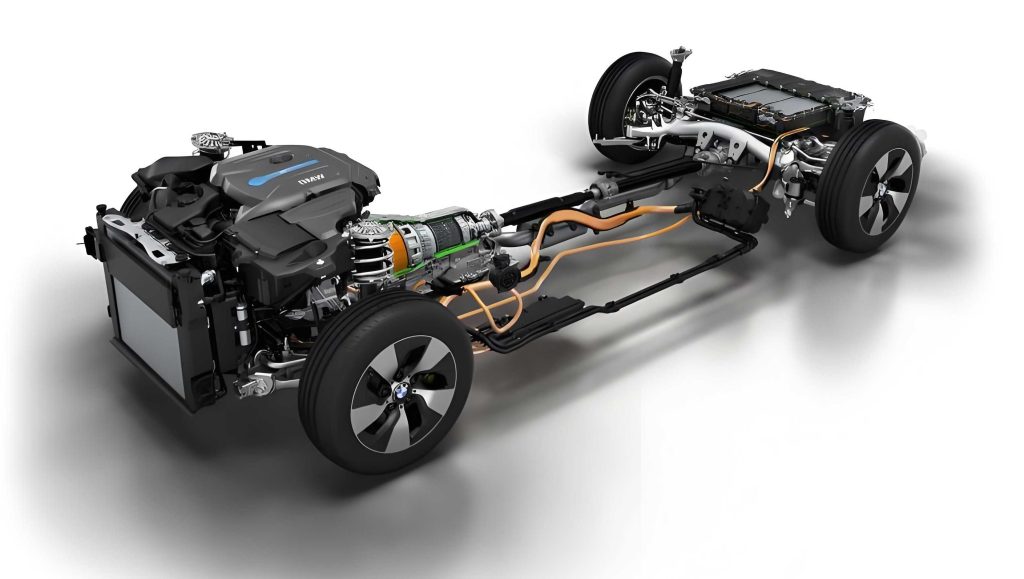
The development of a competitive hybrid electric vehicle begins with a fundamental question: how do we determine the optimal size and specifications for its core powertrain components? This process, known as parameter matching, is a multi-objective optimization problem at its heart. The primary goals can be categorized into three often-conflicting areas: dynamic performance, economic efficiency (fuel/electricity consumption), and cost control. A successful parameter matching exercise for a hybrid electric vehicle must strike an elegant balance between these pillars.
Core Performance Targets and System-Level Power Requirement
The dynamic performance of a hybrid electric vehicle is defined by key metrics such as maximum speed, acceleration time (e.g., 0-100 km/h), and maximum gradability. These metrics directly translate into requirements for the combined power output of the ICE and the electric motor(s). The total tractive power required at the wheels must satisfy the demands of all critical driving conditions. The fundamental vehicle dynamics equation governs this requirement:
$$P_{req} = \frac{v}{3600\eta_t} \left( mgf_r \cos \theta + \frac{1}{2} C_d A \rho v^2 + mg \sin \theta + m \delta \frac{dv}{dt} \right)$$
Where:
$P_{req}$ is the required power at the wheels (kW),
$v$ is the vehicle speed (m/s),
$\eta_t$ is the total driveline efficiency,
$m$ is the vehicle mass (kg),
$g$ is gravitational acceleration (9.81 m/s²),
$f_r$ is the rolling resistance coefficient,
$C_d$ is the aerodynamic drag coefficient,
$A$ is the frontal area (m²),
$\rho$ is the air density (kg/m³),
$\theta$ is the road gradient angle,
$\delta$ is the rotational inertia coefficient.
The system’s total power is then allocated between the engine and the motor(s) based on the chosen hybrid architecture (series, parallel, power-split). For a parallel hybrid electric vehicle, a common approach is to let the engine cover high-speed, steady-state cruising power while the electric motor provides peak power for acceleration and low-speed torque. The matching process must ensure that the combined peak power meets or exceeds the power calculated for the most demanding condition among maximum speed, acceleration, and gradeability.
| Performance Metric | Design Target Example | Primary Influencing Component |
|---|---|---|
| Maximum Speed | >185 km/h | Engine peak power, final drive ratio |
| 0-100 km/h Acceleration | < 8.0 s | Combined motor & engine peak torque/power |
| Maximum Gradeability | >30% at low speed | Motor peak torque, gearbox low-range ratio |
| All-Electric Range (AER) | >85 km (NEDC) | Battery usable energy capacity |
Key Component Parameter Matching
1. Electric Motor Sizing: The electric motor in a hybrid electric vehicle must fulfill dual roles: providing high torque at low speeds for launch and acceleration, and sustaining power at high speeds. Its parameters are primarily determined by peak torque and peak power requirements.
- Peak Torque: Dictated by initial acceleration and gradeability targets. The torque at the wheels needed for a target acceleration ($a$) is: $$T_{wheel} = r_w \left( mgf_r + \frac{1}{2} C_d A \rho v^2 + mg \sin \theta + m \delta a \right)$$ This wheel torque is then translated back through the transmission and final drive ratios ($i_g$, $i_0$) to find the required motor torque: $$T_{motor\_req} = \frac{T_{wheel}}{i_g i_0 \eta_t}$$ The motor’s peak torque must exceed this value.
- Peak and Rated Power: The motor’s peak power must satisfy high-speed acceleration and cruising. Its rated (continuous) power is crucial for sustained operation, such as high-speed electric driving. The power-speed characteristic, featuring a constant-torque region followed by a constant-power region, is a key design output.
2. Internal Combustion Engine Sizing: The engine in a hybrid electric vehicle is often optimized for efficiency within a specific load-speed range, as the electric motor can supplement peak power needs. Its displacement and operating points are chosen to maximize efficiency in frequent operating conditions, such as highway cruising and battery charging.
3. Battery Pack Sizing: For a Plug-in Hybrid Electric Vehicle (PHEV), the battery capacity is the defining factor for its All-Electric Range (AER). The usable energy requirement ($E_{usable}$) is calculated based on the target AER and the vehicle’s energy consumption per kilometer in electric mode ($e_{EV}$):
$$E_{usable} = AER \times e_{EV}$$
The total battery capacity ($E_{total}$) is then determined by considering the allowable Depth of Discharge (DoD):
$$E_{total} = \frac{E_{usable}}{DoD}$$
Additionally, the battery’s power capability (C-rate) must be sufficient to meet the peak discharge power demand of the electric motor and the peak charge power during regenerative braking. For a given motor peak power ($P_{motor\_peak}$) and motor efficiency ($\eta_{motor}$), the approximate peak discharge current ($I_{peak}$) from a battery with nominal voltage $V_{nom}$ is:
$$I_{peak\_discharge} \approx \frac{P_{motor\_peak}}{V_{nom} \times \eta_{motor}}$$
This C-rate requirement influences the choice of cell chemistry and the number of parallel strings in the battery pack.
4. Transmission Ratio Selection: The transmission in a hybrid electric vehicle, whether a dedicated hybrid transmission (DHT), a CVT, or a multi-speed gearbox, must be matched to keep both the engine and the motor operating in their high-efficiency zones. The gear ratios are optimized for:
- Launch and low-speed performance (using motor torque).
- Engine starting and efficient point operation.
- High-speed fuel economy.
| Component | Key Parameter | Matched Value | Rationale |
|---|---|---|---|
| Internal Combustion Engine | Peak Power | 102 kW @ 5500 rpm | Covers high-speed cruise and high-load charging efficiently. |
| Electric Traction Motor | Peak Power / Peak Torque | 145 kW / 315 Nm | Meets 0-100km/h acceleration target and provides strong torque assist. |
| Hybrid Electric Vehicle Battery | Usable Energy / Type | 18.3 kWh (LFP Chemistry) | Enables >85 km AER; LFP offers safety, cycle life, and cost benefits. |
| Transmission (e-CVT) | Ratio Range | 0.5 – 2.6 | Allows engine to operate near optimal BSFC line across a wide speed range. |
Engineering Challenges in Parameter Matching
The process is fraught with inherent trade-offs:
- Multi-Objective Conflict: Enhancing acceleration performance typically requires a more powerful motor and a larger battery, which increases cost, weight, and may impact energy consumption. Formal optimization algorithms (e.g., weighted sum, Pareto frontier analysis) are employed to navigate this space.
- Driving Cycle Dependence: A parameter set optimized for the NEDC may not perform optimally in real-world, aggressive driving or extreme climates. Robust matching requires consideration of multiple standard (WLTC, US06) and real-world driving cycles.
- Thermal Coupling: The performance and efficiency of the battery, motor, and engine are highly temperature-dependent. A matched parameter set must remain effective under both -20°C and 45°C ambient conditions, which necessitates integrated thermal management considerations from the outset.
Parameter matching provides a static “snapshot” of component capabilities. To truly predict the dynamic, interactive behavior of the complete hybrid electric vehicle system under realistic conditions, a comprehensive performance simulation framework is indispensable. This virtual prototyping phase validates the parameter matching decisions and optimizes the control strategy that governs the energy flow between components.
Simulation Platform and Toolchain Integration
A modern hybrid electric vehicle simulation workflow typically involves a co-simulation environment leveraging the strengths of different specialized tools:
- MATLAB/Simulink: Primarily used for designing, modeling, and simulating the vehicle’s supervisory control strategy (Energy Management Strategy – EMS). Its strength lies in modeling complex logic, state machines, and controller dynamics. A forward-facing simulation model is built here, where a driver model follows a speed profile, and the EMS decides torque split between the engine and motor.
- AVL CRUISE / GT-SUITE / Amesim: These are 1D system simulation tools specializing in modeling the physical powertrain components (engine maps, motor efficiency maps, detailed battery models, transmission kinematics, vehicle dynamics). They excel at calculating fuel consumption, emissions, and overall energy balance over driving cycles.
The integration is often achieved through standardized interfaces like the Functional Mock-up Interface (FMI), allowing the high-fidelity plant model from CRUISE to be coupled with the control strategy model from Simulink. This creates a closed-loop simulation that accurately reflects the interactions in a real hybrid electric vehicle.
Simulation Model Architecture and Validation
The construction of a credible simulation model follows a rigorous process:
- Modular Subsystem Modeling: Each major component is modeled with appropriate fidelity. For example, the engine may be represented by a fuel consumption map (BSFC map), the motor by an efficiency map, and the battery by a combination of an equivalent circuit model (for voltage) and a thermal model.
- Interconnection and Parameterization: The component models are connected via mechanical, electrical, and signal links. Critical parameters from the matching phase—like the motor torque curve or battery capacity—are imported.
- Control Strategy Implementation: The heart of the hybrid electric vehicle simulation, the EMS (e.g., Rule-Based, Equivalent Consumption Minimization Strategy – ECMS, or Predictive EMS), is implemented in the controller module.
- Validation and Calibration: The model must be validated at multiple levels:
- Component-Level: Comparing model outputs (e.g., motor torque vs. speed) against supplier datasheets.
- Subsystem-Level: Validating the behavior of the combined electrified driveline.
- Vehicle-Level: Tuning model parameters (like rolling resistance) so that simulated performance (coast-down, acceleration) matches available test data from mule vehicles or benchmarks.
Key Simulation Technologies for Hybrid Electric Vehicle Analysis
1. Dynamic Logic Threshold Control Strategy Simulation: This is a common, implementable strategy tested in simulation. Rules based on State of Charge (SOC), vehicle speed, and driver power demand determine the operating mode (EV, Series, Parallel, Engine Direct Drive, Regeneration). Simulation allows for fine-tuning these thresholds to optimize mode switching for comfort and efficiency.
Example rule: IF $(SOC > 0.25)$ AND $(Vehicle Power Demand < Motor Continuous Power)$ AND $(Speed < 70 km/h)$ THEN select *Pure Electric Mode*.
2. Integrated Thermal Management Simulation: The performance and longevity of a hybrid electric vehicle are critically dependent on temperature. A high-fidelity simulation integrates:
- Battery Thermal Model: Predicts heat generation from ohmic and reversible losses: $$Q_{batt} = I^2 R_{int} + I T \frac{dOCV}{dT}$$ and simulates cooling/heating system performance.
- Motor/Generator Thermal Model: Accounts for copper and iron losses that convert to heat.
- Engine Cooling and Exhaust System Model.
This integrated simulation predicts component temperatures during harsh cycles (e.g., repeated accelerations, fast charging) and evaluates the effectiveness of the cooling system, preventing thermal derating or degradation in the virtual stage.
3. Multi-Objective Optimization via Simulation: Simulation transforms the parameter matching problem into a computable optimization loop. An algorithm (e.g., Genetic Algorithm, Particle Swarm Optimization) can be set up to automatically vary key parameters (e.g., motor power rating, battery capacity, gear ratios) within defined bounds. For each candidate design, the simulation runs standard cycles (WLTC, NEDC) and calculates objective functions:
$$F_{obj} = w_1 \cdot T_{0-100} + w_2 \cdot Fuel_{WLTC} + w_3 \cdot Cost_{estimate}$$
The optimization search finds the Pareto-optimal set of designs that best balance these competing goals.
The true value of the parameter matching and simulation framework is proven in concrete engineering applications. Consider the development process for a new midsize Plug-in Hybrid Electric Vehicle with the following key targets:
- Top Speed: ≥ 185 km/h
- 0-100 km/h Acceleration: ≤ 7.8 s
- NEDC Composite Fuel Consumption: ≤ 1.5 L/100km
- All-Electric Range (NEDC): ≥ 85 km
Initial Parameter Matching and Baseline Simulation
An initial component set was defined based on textbook calculations and benchmarking. This baseline configuration was modeled in the integrated CRUISE-Simulink environment. Initial simulation results revealed a weakness: while AER was on target, the fuel consumption in charge-sustaining (CS) mode after battery depletion was higher than desired, at 5.8 L/100km under the WLTC cycle. Analysis showed the engine operating frequently outside its high-efficiency zone during urban driving.
Iterative Optimization
The simulation model was used to conduct a sensitivity analysis. The key findings were:
- The electric motor’s peak power could be slightly reduced without violating the acceleration target, as the engine torque fill was sufficient in parallel mode.
- More impactful was the optimization of the transmission’s gear-spacing and the recalibration of the Energy Management Strategy’s mode-switching logic. The simulation allowed testing of hundreds of logic threshold variations against the WLTC cycle.
- The thermal model confirmed that the proposed battery cooling system was adequate for sustaining performance during a series of aggressive accelerations, validating the cell selection and pack design from a thermal perspective.
Final Results and Physical Validation
After several virtual design iterations, an optimized parameter set and control strategy were frozen. The final simulation predictions were as follows. Subsequent physical testing of prototype vehicles yielded results that were in very close agreement, demonstrating the high predictive accuracy of the simulation framework.
| Performance Metric | Simulation Prediction | Physical Test Result | Deviation |
|---|---|---|---|
| Maximum Speed | 187 km/h | 186 km/h | +0.5% |
| 0-100 km/h Acceleration Time | 7.6 s | 7.7 s | -1.3% |
| NEDC Composite Fuel Consumption | 1.48 L/100km | 1.52 L/100km | -2.6% |
| NEDC All-Electric Range | 86 km | 84 km | +2.4% |
| WLTC Charge-Sustaining Fuel Consumption | 5.2 L/100km | 5.3 L/100km | -1.9% |
The field of hybrid electric vehicle development is continuously evolving, driven by advances in computing, data science, and material sciences. The parameter matching and simulation paradigm is poised to undergo significant transformation:
1. From Simulation to Digital Twin: The future lies in moving beyond static simulation models to creating living “Digital Twins” of hybrid electric vehicles. These twins would be continuously updated with real-world fleet data, allowing for predictive maintenance, over-the-air (OTA) optimization of control strategies for individual driving styles, and much more accurate lifetime predictions for components like the battery. The parameter matching process could then become dynamic, adapting to the vehicle’s actual usage and degradation.
2. AI-Driven Co-Design and Control: Machine Learning and Artificial Intelligence will play a larger role. AI algorithms can be used to explore the vast design space of component parameters and control strategies more efficiently than traditional optimization methods, potentially discovering non-intuitive, highly efficient designs for the next generation of hybrid electric vehicles. Furthermore, AI-based adaptive EMS, which learns from the driver and environment in real-time, will be developed and virtually validated using massive simulation campaigns.
3. Ultra-Integrated Thermal and Energy Management (ITEM): Simulation will increasingly focus on the synergistic management of all thermal and energy flows in the vehicle—waste heat from the engine and electronics used to warm the cabin or battery in cold weather, or conversely, using the battery cooling loop to assist in cabin cooling. This holistic approach, simulated in detail, is key to unlocking further efficiency gains, especially for a hybrid electric vehicle operating across diverse global climates.
4. Cloud-Based Simulation and Collaboration: The computational burden of high-fidelity, multi-physics simulation for hybrid electric vehicles is immense. Cloud computing platforms will enable faster, more complex simulations (e.g., full 3D CFD of thermal systems coupled with 1D system models) and facilitate collaboration across global engineering teams on a single, unified virtual prototype.
In conclusion, the rigorous application of parameter matching and comprehensive performance simulation is not merely a step in the development process of a hybrid electric vehicle; it is the very foundation upon which competitive, efficient, and reliable products are built. The methodology outlined here—from fundamental dynamics-based sizing through to multi-faceted virtual validation—provides a robust pathway to balancing the complex trade-offs inherent in hybrid electric vehicle design. As the industry progresses, the fusion of this established approach with emerging technologies like Digital Twins and AI promises to further accelerate innovation, reduce development costs, and ultimately deliver hybrid electric vehicles that meet the ever-growing demands for performance, efficiency, and sustainability. The journey of the hybrid electric vehicle is far from complete, and its continued evolution will be inextricably linked to the advancement of the virtual engineering tools that make its optimization possible.