
In the automotive industry, the steering trapezoidal linkage is a critical mechanism that translates the linear motion of a rack-and-pinion system into the rotational motion of wheels, directly impacting vehicle handling, stability, and safety. As hybrid electric vehicles gain prominence due to their efficiency and reduced emissions, optimizing their chassis components, such as the steering trapezoid, becomes paramount. This article presents a comprehensive study on the design and analysis of a steering trapezoidal linkage for a hybrid electric vehicle, leveraging advanced simulation tools and empirical data. I will explore the feasibility of converting a front-steering trapezoid to a rear-steering trapezoid within the same front suspension system, aiming to achieve platform compatibility and cost reduction. Through parameterized modeling and motion simulation, I demonstrate a methodical approach to meet key performance metrics like Ackermann rate, steering ratio, and rack force, while ensuring the unique demands of hybrid electric vehicles are addressed.
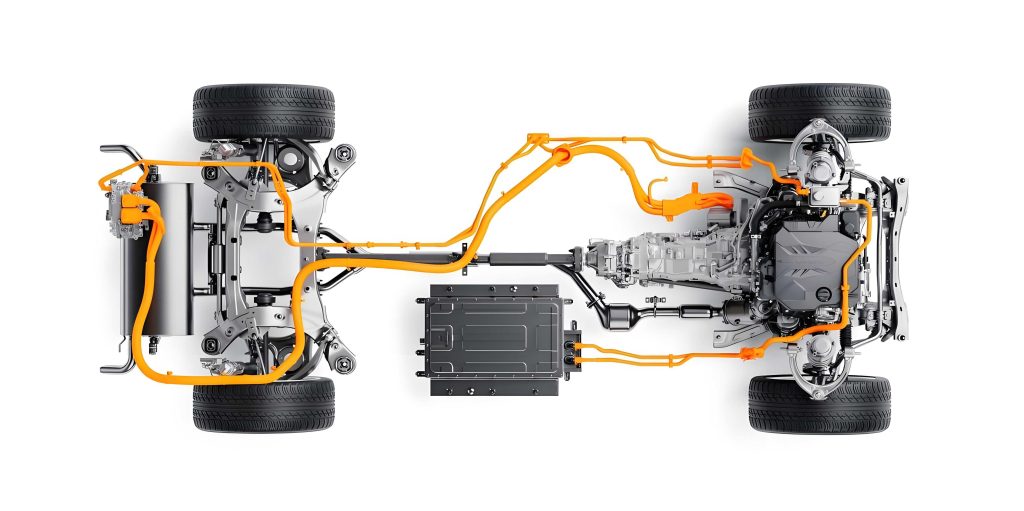
The steering trapezoid in a hybrid electric vehicle acts as a link mechanism driven by a rack-and-pinion assembly, working in tandem with the suspension to control tire steering and jounce. Its design influences several steering characteristics, including the Ackermann rate, which dictates the difference in turning angles between inner and outer wheels; the steering gear ratio, affecting responsiveness; and the rack force, related to steering effort. For hybrid electric vehicles, which often integrate complex powertrains and battery packs altering weight distribution, a well-designed steering trapezoid is essential to maintain optimal performance. Based on extensive benchmark data from various sedan and SUV models, including those tailored for hybrid electric vehicles, I have compiled a set of design parameters that serve as guidelines. These parameters ensure that the steering system can be tuned effectively during chassis development, leveraging existing components to accelerate the design process for hybrid electric vehicles.
To understand the steering trapezoid, it is composed of key points and links. In a front-steering trapezoid configuration, typical for longitudinal engine layouts with double-wishbone suspensions, the rack inner disconnect point (A’) is located ahead of the wheel center. Conversely, in a rear-steering trapezoid, common in transverse engine layouts with MacPherson struts, the rack inner disconnect point (A) is positioned behind the wheel center. The linkage includes the steering rack centerline (AD or A’D’), the tie-rod (AB or A’B’), the steering knuckle arm (BC or B’C’), and the kingpin axis (CC’). Angles such as the trapezoidal arm transmission angle (α or α’) and the rack transmission angle (β or β’) play vital roles in force transmission and motion efficiency. For hybrid electric vehicles, the choice between front and rear configurations depends on packaging constraints and performance goals, often requiring adaptation from existing platforms.
The design of a steering trapezoid for a hybrid electric vehicle involves multiple objectives influenced by tire characteristics and steering system components. Through kinematic and compliance (KC) bench tests on various vehicles, including hybrid electric vehicles, I have derived contemporary design targets. These targets are summarized in the table below, which serves as a reference for optimizing the linkage in hybrid electric vehicles.
| Parameter | Design Target | Influencing Factors |
|---|---|---|
| Kingpin Caster Angle (°) | 3–7 | High-speed returnability, suspension anti-dive, camber change |
| Kingpin Inclination Angle (°) | 10–14 | Low-speed returnability, suspension roll characteristics |
| Trapezoidal Arm Length (mm) | 120–154 | Angle transmission ratio, rack force, steering wheel effort |
| Trapezoidal Arm Transmission Angle α at Design Position (°) | Front: 76 ± 2; Rear: 100 ± 2 | Ackermann rate |
| Trapezoidal Arm Transmission Angle α at Limit Position (°) | >35–145 | Maximum wheel angle, rack force, steering wheel effort |
| Rack Transmission Angle β (°) | <10 | Rack force, toe change during suspension travel |
| Ackermann Rate at 20° Wheel Angle (%) | 42–58 | Inner-outer wheel angle difference, lateral force in turns, tire wear |
| Ackermann Rate at 35° Wheel Angle (%) | 60–75 | Inner-outer wheel angle difference, lateral force in turns, tire wear |
| Rack-and-Pinion Linear-Angular Transmission Ratio (mm/rev) | 50 ± 5 | Steering sensitivity, rack force, steering wheel effort, pinion diameter |
| Steering Wheel to Wheel Angle Ratio | 15–17 | Steering sensitivity, rack force, steering wheel effort |
| Tie-Rod Length | Determined by packaging and suspension | Toe change during suspension travel |
To evaluate the feasibility of interchanging front and rear steering trapezoids in a hybrid electric vehicle, I conducted a comparative study using a double-wishbone suspension model. By creating a DMU kinematic model in Catia V5, I simulated both configurations. For a front-steering trapezoid, the trapezoidal arm transmission angle α’ is acute and decreases during left turns, reaching a limit of 35° at a maximum wheel angle of 42.5°. In contrast, for a rear-steering trapezoid, α is obtuse and increases, achieving a limit of 145° (equivalent to 35° acute) at a maximum wheel angle of 45°. This indicates that a rear-steering trapezoid can allow slightly larger wheel angles, beneficial for reducing the turning diameter in hybrid electric vehicles, which often prioritize maneuverability in urban environments.
The Ackermann rate, defined as the ratio of actual to ideal inner-outer wheel angle difference, is crucial for tire wear and lateral force generation. The simulation results show that the Ackermann rate curve for a rear-steering trapezoid has a higher rate of change, facilitating larger Ackermann values at bigger wheel angles. This enhances tire life by promoting true rolling during sharp turns. Mathematically, the Ackermann rate is expressed as:
$$ \text{Ackermann Rate (\%)} = \frac{\theta_{\text{inner}} – \theta_{\text{outer, actual}}}{\theta_{\text{inner}} – \theta_{\text{outer, ideal}}} \times 100 $$
where θ represents wheel angles. For hybrid electric vehicles, which may have different weight distributions due to battery placement, optimizing this rate is key to balancing stability and agility. The front-steering trapezoid yields a flatter curve, offering precise steering but potentially increasing tire wear. Thus, for hybrid electric vehicles aiming for efficiency and durability, the rear-steering trapezoid presents advantages.
Based on sensitivity analyses using Adams/Car and Adams/Insight, I derived general design principles applicable to both front and rear steering trapezoids in hybrid electric vehicles. These principles guide the adjustment of key points:
- Trapezoidal Arm Transmission Angle at Design Position: This angle influences the trend of the Ackermann rate curve. By modifying the Y-coordinate of the tie-rod outer ball joint point (B), the Ackermann rate can be tuned to desired values for hybrid electric vehicles.
- Z-coordinate of Tie-Rod Outer Ball Joint Point: This coordinate affects toe change during wheel travel. Adjusting it allows control over toe variation across suspension jounce, with minimal impact on other suspension parameters in hybrid electric vehicles.
- Tie-Rod Length: It should match the suspension design, influencing the curvature of the toe change curve. For a given toe trend, a higher rack position in a MacPherson suspension requires a longer tie-rod, whereas a double-wishbone suspension requires a shorter one, a consideration for hybrid electric vehicles with varied layouts.
- Trapezoidal Arm Length: With a fixed rack-and-pinion drive, longer trapezoidal arms reduce the maximum wheel angle for a given rack travel. This parameter is critical for achieving target steering ratios in hybrid electric vehicles.
To implement these principles, I developed a design method using Catia V5 for parameterized modeling and Adams for suspension motion simulation. The core of this method is determining the rack inner disconnect point (A) and tie-rod outer ball joint point (B) for a hybrid electric vehicle. The steps are as follows, applied to a hybrid electric vehicle converting from a front-steering to rear-steering trapezoid:
- Establish Suspension Model: Create a front suspension motion model in Adams based on the prototype vehicle, which serves as a reference for the hybrid electric vehicle.
- Determine Rack Inner Disconnect Point (A): In Catia V5, define the kingpin axis and initially set point A considering engine and suspension packaging. For the hybrid electric vehicle, point A is shifted 300 mm rearward and 30 mm upward from the prototype, keeping the rack length unchanged.
- Define Ackermann Adjustment Point (B1): Draw a line through A parallel to the prototype’s tie-rod axis. Create point B1 on this line to adjust the trapezoidal arm transmission angle α, thereby controlling the Ackermann rate. The length AB1 is initially set to 305 mm, based on similar rear-steering hybrid electric vehicles.
- Determine Tie-Rod Outer Ball Joint Point (B): From B1, drop a perpendicular to the kingpin axis, and offset B1 along this line to point B. The offset value, initially zero, is varied to change the trapezoidal arm length BC, ensuring the same maximum wheel angle as the prototype for identical rack travel.
- Adjust Trapezoidal Arm Length: Using the Adams model, simulate steering motion while varying the offset of B in 1 mm increments. The goal is to match the prototype’s maximum wheel angle. A shorter arm increases the angle, and vice versa.
- Adjust Ackermann Rate: Modify point B1 to change α, starting from 100° for rear-steering. Simulate in Adams and target an Ackermann rate of 44% at 20° and 64% at 35°, based on comparable hybrid electric vehicles. Adjust α by 0.5° steps until targets are met.
- Adjust Toe Change During Wheel Travel: Alter the Y-coordinate of A and Z-coordinate of B to match the prototype’s toe variation trend. For the hybrid electric vehicle, with the rack raised 30 mm, the tie-rod is shortened. Simulate suspension jounce in 5 mm increments for A’s Y-coordinate, ensuring trapezoidal arm length and α remain within acceptable ranges.
This iterative process, supported by parameterized models, ensures all performance objectives are achieved for the hybrid electric vehicle. The final design parameters are summarized in the table below, comparing the prototype and the hybrid electric vehicle.
| Parameter | Prototype Vehicle | Hybrid Electric Vehicle |
|---|---|---|
| Steering Trapezoid Type | Front-steering | Rear-steering |
| Kingpin Caster Angle (°) | 6.3 | 6.3 |
| Kingpin Inclination Angle (°) | 11.2 | 11.2 |
| Trapezoidal Arm Length (mm) | 151 | 153 |
| Trapezoidal Arm Transmission Angle α (°) | 74.3 | 100 |
| Rack Transmission Angle β (°) | 7.1 | 5.6 |
| Tie-Rod Length (mm) | 386 | 299 |
| Steering Wheel Turns | 3.3 | 3.3 |
| Rack Travel (mm) | 82.5 | 82.5 |
| Ackermann Rate at 20° (%) | 48.9 | 44 |
| Ackermann Rate at 35° (%) | 55 | 64 |
| Maximum Inner Wheel Angle (°) | 37.6 | 37.6 |
| Maximum Outer Wheel Angle (°) | 32.4 | 31.3 |
The results demonstrate a successful conversion to a rear-steering trapezoid for the hybrid electric vehicle. The rack transmission angle β decreased by 1.5°, reducing rack force and steering friction, which enhances efficiency—a critical factor for hybrid electric vehicles where energy conservation is prioritized. The Ackermann rate curve shows that the hybrid electric vehicle achieves higher Ackermann values at larger wheel angles, promoting true rolling and tire longevity. At common steering angles around ±25°, the rate is lower, increasing the actual outer wheel angle to provide greater lateral force for stability during turns, beneficial for hybrid electric vehicles that may experience varied load conditions. Additionally, the toe change during wheel travel aligns with the prototype, ensuring consistent suspension kinematics. This allows for the reuse of existing components, such as tires and steering gears, with minor modifications like adjusting tie-rod length or pinion geometry to fine-tune sensitivity and effort for hybrid electric vehicles.
In conclusion, this study confirms the feasibility of integrating either front or rear steering trapezoids into the same front suspension system for hybrid electric vehicles. The rear-steering configuration offers advantages such as a larger maximum wheel angle for reduced turning diameter and improved tire wear characteristics, aligning with the efficiency goals of hybrid electric vehicles. The design method, utilizing Catia V5 and Adams software, provides a systematic approach to meet key performance targets through parameter adjustment and simulation. For hybrid electric vehicles, this methodology supports platform sharing, reduces development costs, and accelerates time-to-market. Future work should involve full-vehicle simulations and road testing to further refine the design process, enhancing the chassis development capabilities for hybrid electric vehicles. By focusing on the steering trapezoid, engineers can contribute to the overall performance and sustainability of hybrid electric vehicles, ensuring they meet the demands of modern mobility.
The integration of advanced simulation tools with empirical data enables a robust design framework for hybrid electric vehicles. As the automotive industry evolves, such approaches will be crucial in optimizing components like the steering trapezoid, balancing performance, cost, and adaptability. For hybrid electric vehicles, which represent a significant step toward greener transportation, every aspect of design must be meticulously engineered to achieve excellence in handling, safety, and efficiency.