
As an industry analyst with years of experience tracking automotive trends, I have witnessed firsthand the transformative shifts in the global and regional vehicle markets. The data from Shandong Province in 2011-2012 serves as a compelling microcosm of broader industry movements, particularly highlighting the nascent yet critical role of hybrid electric vehicles. In this comprehensive analysis, I will explore the economic indicators, production metrics, and technological innovations shaping this sector, with a dedicated focus on the advancements and integration of hybrid electric vehicle technologies. The convergence of traditional manufacturing data and emerging component developments, such as battery cooling systems, paints a vivid picture of an industry in transition.
The automotive industry is a complex ecosystem where macroeconomic factors, consumer preferences, and technological breakthroughs continuously interact. My examination begins with the economic performance of Shandong’s automotive sector during the period leading up to 2012. The data reveals nuanced challenges: a contraction in industrial output value and profits juxtaposed with growth in certain cost and tax indicators. This suggests a period of margin compression and competitive intensity, a context in which innovation—especially in fuel-efficient and alternative powertrain technologies like the hybrid electric vehicle—becomes a strategic imperative for survival and growth.
Let us first dissect the key economic indicators from the reported period. The following table summarizes the cumulative performance through November 2011, compared to the previous year’s同期 (same period).
| Indicator Name | Unit | Cumulative Current Period | Cumulative Same Period Last Year | Year-on-Year Change (%) |
|---|---|---|---|---|
| Gross Industrial Output Value (Current Price) | 10k Yuan | 28,109,420.8 | 31,213,069.0 | -9.9 |
| Of Which: New Product Output Value | 10k Yuan | 11,844,513.0 | 13,905,079.0 | -14.8 |
| Industrial Value Added (Current Price) | 10k Yuan | 4,741,530.7 | 5,408,068.8 | -12.3 |
| Main Business Revenue | 10k Yuan | 31,990,356.1 | 32,757,161.0 | -2.3 |
| Of Which: Main Business Cost | 10k Yuan | 27,351,661.3 | 26,261,180.8 | +4.2 |
| Selling Expenses | 10k Yuan | 761,598.2 | 812,973.7 | -6.3 |
| Main Business Taxes and Surcharges | 10k Yuan | 187,177.5 | 174,529.0 | +7.2 |
| Total Profits and Taxes | 10k Yuan | 2,785,402.2 | 3,547,218.3 | -21.5 |
| Total Profits | 10k Yuan | 2,140,985.9 | 2,646,777.7 | -19.1 |
| Industrial Sales Output Value (Current Price) | 10k Yuan | 28,070,600.8 | 30,533,247.0 | -8.1 |
| Of Which: Export Delivery Value | 10k Yuan | 2,571,303.0 | 1,970,614.0 | +30.5 |
The data indicates a broad-based decline in output and profitability. The significant drop in new product output value (-14.8%) is particularly alarming, as it signals a potential slowdown in innovation cycles. In my assessment, this environment pressures manufacturers to pivot towards high-value, next-generation products. This is precisely where the hybrid electric vehicle represents a beacon of opportunity. A hybrid electric vehicle combines an internal combustion engine with an electric propulsion system, offering improved fuel efficiency and lower emissions. The development and production of such vehicles, along with their critical components, could be a key driver for reversing the negative trends in new product value and overall industrial growth.
The relationship between cost, revenue, and profit can be modeled to understand the pressure points. We can express the profit margin \( M \) as:
$$ M = \frac{R – C}{R} $$
where \( R \) is Main Business Revenue and \( C \) is Main Business Cost. From the data, the year-on-year change in cost (+4.2%) outpaced the change in revenue (-2.3%), implying a shrinking margin. This squeeze makes efficiency gains paramount. The hybrid electric vehicle, with its potential for lower operational costs for consumers and differentiated value propositions, can help manufacturers command better margins if the technology is mastered and scaled effectively.
Turning to production volumes, the picture is mixed, with certain segments showing resilience while others contract sharply. The production and sales data for various vehicle types is crucial for understanding market demand and capacity utilization. The next table details the cumulative production and sales figures, along with sales-to-production ratios and growth rates.
| Product Name | Unit | Cumulative Production | Cumulative Sales | Sales-to-Production Ratio (%) | Year-on-Year Sales Growth (%) |
|---|---|---|---|---|---|
| Passenger Vehicles Total | units | 698,182 | 697,465 | ~100 | +7.95 |
| – Passenger Car (Sedan) | units | 338,199 | 336,609 | ~99.5 | +0.20 |
| – SUV | units | 12,635 | 11,327 | ~89.6 | -16.31 |
| – Cross-type Passenger Vehicle | units | 347,348 | 346,449 | ~99.7 | -9.41 |
| Commercial Vehicles Total | units | 808,623 | 805,750 | ~99.6 | -18.15 |
| – Trucks | units | 803,757 | 800,678 | ~99.6 | -18.32 | — Heavy-duty Trucks | units | 239,867 | 230,394 | ~96.0 | -22.38 |
| — Medium-duty Trucks | units | 17,234 | 18,053 | ~104.8 | -26.37 |
| — Light-duty Trucks | units | 546,656 | 552,231 | ~101.0 | -16.11 |
| – Buses | units | 4,866 | 5,072 | ~104.2 | +25.45 |
| Modified Vehicles | units | 183,980 | 184,235 | ~100.1 | -7.40 |
| Automotive Internal Combustion Engines | units | 1,317,803 | 1,339,813 | ~101.7 | +25.05 |
| Motorcycles | units | 1,756,457 | 1,515,101 | ~86.3 | -5.11 |
| Automotive Parts | 10k Yuan | 3,630,860.0 | 3,803,623.6 | ~104.8 | +18.07 |
The steep decline in commercial vehicle sales, especially trucks, contrasts with the relative stability of passenger vehicles. This divergence likely reflects broader economic cycles affecting freight and construction. However, within the passenger vehicle segment, the near-stagnation of sedan growth and declines in SUV and cross-type vehicles suggest a market ripe for disruption. This is the ideal breeding ground for new powertrain architectures. I believe the hybrid electric vehicle can address multiple pressures: regulatory demands for lower emissions, consumer desire for fuel economy, and the industry’s need for technological differentiation. The growth in automotive parts output value (+18.07%) is a bright spot, indicating robust activity in the supply chain. This component sector is where transformative technologies for the hybrid electric vehicle, such as advanced batteries, power electronics, and thermal management systems, are developed.
The sales-to-production ratio, or产销率, is a key efficiency metric. We can define it as \( \lambda = \frac{S}{P} \times 100\% \), where \( S \) is sales volume and \( P \) is production volume. A ratio close to 100% indicates balanced inventory. Deviations, like the 86.3% for motorcycles, signal overproduction or weak demand. For emerging vehicle types like the hybrid electric vehicle, managing this ratio in early production phases is critical to avoid capital inefficiency. The formula for inventory change \( \Delta I \) over a period is:
$$ \Delta I = P – S = P \left(1 – \frac{\lambda}{100}\right) $$
Optimizing \( \lambda \) for a hybrid electric vehicle production line requires precise demand forecasting and flexible manufacturing—a significant operational challenge.
Now, let’s pivot to the heart of modern automotive innovation: electrification. The development of the hybrid electric vehicle is not just about combining two power sources; it’s a complex integration of mechanical, electrical, and thermal systems. One of the most critical challenges is battery thermal management. The performance, longevity, and safety of the high-voltage battery pack in a hybrid electric vehicle are intensely dependent on maintaining an optimal temperature range. Excessive heat accelerates degradation and poses safety risks, while low temperatures reduce power output and efficiency.
This is where breakthroughs in component technology become enablers. Recent advancements in battery cooling systems are pivotal for the next generation of hybrid electric vehicles. An effective cooling system must dissipate heat generated during charging and discharging cycles. The heat generation rate \( \dot{Q}_{gen} \) in a battery cell can be approximated using Joule heating and entropic heat contributions:
$$ \dot{Q}_{gen} = I^2 R_{int} + I T \frac{\partial U_{ocv}}{\partial T} $$
where \( I \) is the current, \( R_{int} \) is the internal resistance, \( T \) is the absolute temperature, and \( U_{ocv} \) is the open-circuit voltage. The cooling system must remove this heat to maintain a steady-state temperature. The required cooling capacity \( \dot{Q}_{cool} \) must satisfy:
$$ \dot{Q}_{cool} \geq \dot{Q}_{gen} – \dot{Q}_{diss} $$
where \( \dot{Q}_{diss} \) is passive dissipation. For a hybrid electric vehicle undergoing aggressive drive cycles, \( \dot{Q}_{gen} \) can be substantial, necessitating active cooling solutions.
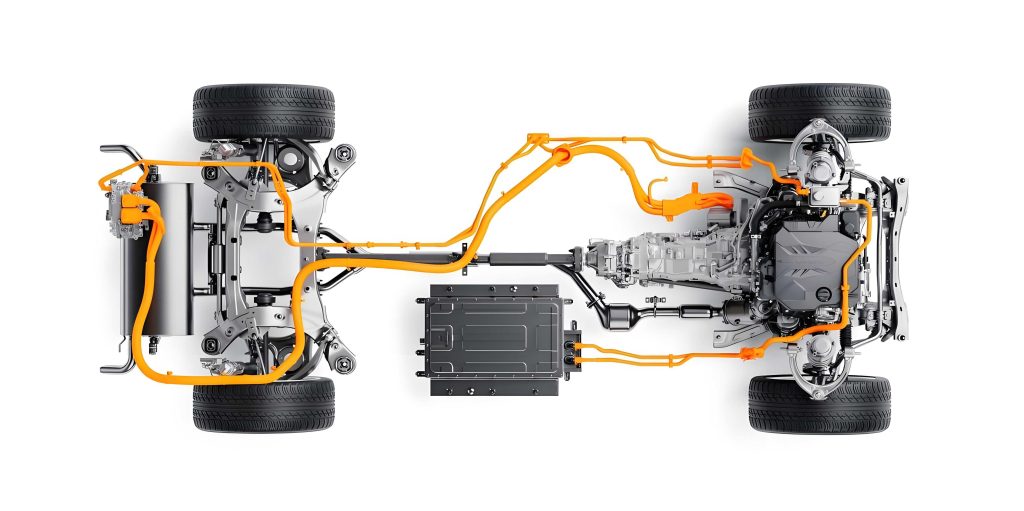
The image above symbolizes the integrated nature of a modern hybrid electric vehicle, where advanced components work in harmony. In this context, the development of specialized cooling fan assemblies marks significant progress. These components are designed to provide variable airflow, precisely controlled by the vehicle’s electronic control unit (ECU), to regulate battery pack temperature. For a hybrid electric vehicle, thermal management is even more complex than for a pure battery electric vehicle due to the additional heat sources from the internal combustion engine. The cooling system must manage multiple thermal zones efficiently.
The performance of such a cooling fan can be characterized by its airflow rate \( \dot{V} \) (e.g., 30-70 L/s) and static pressure rise \( \Delta P_s \) (e.g., up to 600 Pa). The useful cooling power \( P_{cool} \) provided by airflow can be related to these parameters and the temperature difference \( \Delta T \) between the battery and the coolant air. A simplified model for convective heat removal is:
$$ \dot{Q}_{conv} = \dot{m} c_p \Delta T = \rho \dot{V} c_p (T_{batt} – T_{air,in}) $$
where \( \dot{m} \) is the mass flow rate, \( c_p \) is the specific heat capacity of air, \( \rho \) is air density, and \( T_{batt} \) and \( T_{air,in} \) are battery surface and inlet air temperatures, respectively. The fan assembly must generate sufficient \( \dot{V} \) and \( \Delta P_s \) to overcome system flow resistance and deliver the required \( \dot{m} \). The efficiency \( \eta_{fan} \) of the fan system is crucial for minimizing parasitic power draw from the hybrid electric vehicle’s battery, which otherwise would detract from the vehicle’s overall efficiency gain.
Integrating such advanced thermal management systems is a key step in enhancing the reliability and appeal of the hybrid electric vehicle. Longer battery life, consistent performance in extreme climates, and reduced risk of thermal runaway are direct benefits that address consumer concerns. As an analyst, I see these component-level innovations as foundational to achieving the promised total cost of ownership advantages for a hybrid electric vehicle over conventional vehicles.
Returning to the broader industry data, the decline in “New Product Output Value” is a metric that deserves scrutiny in light of technological progress. One could hypothesize that the reported period (2011) was a trough before a new wave of innovation centered on electrification. The hybrid electric vehicle and its cousin, the plug-in hybrid electric vehicle, were gaining serious R&D traction globally. I suspect that subsequent years would show a recovery in this indicator as these new product lines reached commercialization. The relationship between R&D investment \( I_{R\&D} \) and new product value \( V_{new} \) can be modeled with a time lag \( \tau \):
$$ V_{new}(t) \propto \int_{0}^{t} I_{R\&D}(t – \tau) e^{-\alpha \tau} d\tau $$
where \( \alpha \) is a decay factor representing the obsolescence of knowledge. A strategic shift towards hybrid electric vehicle platforms represents a significant \( I_{R\&D} \) injection, the benefits of which would materialize in future periods.
Furthermore, the strong growth in export delivery value (+30.5%) is a telling sign. It suggests that Shandong’s automotive industry was finding international markets for its products. For the hybrid electric vehicle ecosystem to thrive, global market access is essential to achieve economies of scale. Component manufacturers, like those producing advanced cooling systems, inherently operate in a global supply chain. A successful hybrid electric vehicle model often relies on sourcing best-in-class components from specialized suppliers worldwide. The positive export trend bodes well for the province’s potential to integrate into the global value chain for hybrid and electric vehicle components.
Let’s delve deeper into the production dynamics using a more analytical lens. We can examine the growth rates of different segments. The year-on-year change for a metric \( X \) is given by \( g_X = \frac{X_{2011} – X_{2010}}{X_{2010}} \times 100\% \). The data shows wide dispersion: from +25.45% for buses to -26.37% for medium-duty trucks. This volatility underscores the cyclicality of the traditional vehicle market. In contrast, the value proposition of a hybrid electric vehicle often includes reduced sensitivity to fuel price volatility, which can dampen demand cycles for personal transportation. The demand \( D_{HEV} \) for hybrid electric vehicles might be modeled as a function of fuel price \( P_f \), vehicle price \( P_v \), government incentives \( G \), and consumer environmental awareness \( E \):
$$ D_{HEV} = f(P_f, P_v, G, E) \approx \beta_0 + \beta_1 \ln(P_f) + \beta_2 P_v + \beta_3 G + \beta_4 E $$
where \( \beta_1 \) is expected to be positive (higher fuel prices increase HEV demand), and \( \beta_2 \) negative. As battery costs decline—a key trend—\( P_v \) decreases, boosting \( D_{HEV} \).
The data on automotive internal combustion engine production (+25.05% growth) seems counterintuitive amidst talk of electrification. However, it’s important to remember that the hybrid electric vehicle itself often incorporates an internal combustion engine, albeit a more efficient, possibly smaller one optimized for specific operating points. This growth could reflect production for conventional vehicles still dominating the market, or it could be early sourcing for hybrid powertrains. The evolution towards the hybrid electric vehicle does not immediately eliminate the internal combustion engine but transforms its role within a more complex system.
To fully appreciate the systemic change, we must consider the entire value chain. The automotive parts sector’s robust growth (output value up 18.07%) is a leading indicator. This sector encompasses everything from traditional mechanical parts to sophisticated electronic controls. The development of power control units, battery management systems, electric motors, and yes, advanced thermal management modules like the battery cooling fan assembly, all fall under this category. The growth here signals investment and capacity building that will underpin the future production of hybrid electric vehicles. The compound annual growth rate (CAGR) for such a component sector can be projected forward. If \( V_0 \) is the initial value and \( V_n \) the value after \( n \) years with a constant growth rate \( r \), then:
$$ V_n = V_0 (1 + r)^n $$
Sustained growth in the parts sector, driven by hybrid electric vehicle and electric vehicle demand, could see \( r \) remain elevated for a decade.
In my professional opinion, the period captured by this data represents an inflection point. The declines in traditional output metrics are the growing pains of an industry on the cusp of a technological paradigm shift. The hybrid electric vehicle is not merely one product among many; it is a transitional architecture that blends the existing manufacturing base (for engines, transmissions) with the new electric drive competencies. This makes it a strategically vital stepping stone for regions with strong traditional automotive industries, like Shandong.
Moreover, the importance of the hybrid electric vehicle extends beyond passenger cars. Commercial vehicles, which showed severe declines in the data, are also targets for hybridization. Hybrid electric trucks and buses can offer significant fuel savings in stop-start urban duty cycles, directly addressing operating cost concerns for fleet operators. The growth in bus sales (+25.45%) might even hint at early adoption of more efficient models. The potential for a hybrid electric vehicle platform in commercial applications is immense and could be a key area for rejuvenating that segment.
The synergy between data analysis and technological insight is powerful. By examining the economic indicators, we identify the need for value-added innovation. By examining the production data, we see which vehicle segments are most stressed and potentially most receptive to new solutions. And by examining component innovations like the battery cooling system, we see the tangible engineering progress that makes the hybrid electric vehicle viable and superior. Each hybrid electric vehicle that rolls off the assembly line represents a complex integration of these economic, market, and technological forces.
Looking forward, the trajectory for the hybrid electric vehicle is intertwined with policy, infrastructure, and consumer acceptance. Government policies promoting new energy vehicles will directly stimulate hybrid electric vehicle adoption. The development of charging infrastructure, while more critical for pure electric vehicles, also supports plug-in hybrid electric vehicles, enhancing their utility. From an industry perspective, the lessons from Shandong’s 2011 data are clear: navigate cost pressures through technological differentiation, monitor inventory and production balance closely, and invest decisively in the component technologies that enable next-generation powertrains.
In conclusion, the automotive industry’s journey is one of constant evolution. The data snapshot from 2011-2012 reveals a sector confronting challenges but also, implicitly, preparing for transformation. The hybrid electric vehicle stands at the center of this transformation, offering a pragmatic path to improved efficiency and sustainability. The advancements in enabling technologies, such as sophisticated thermal management systems, are the building blocks that will allow the hybrid electric vehicle to fulfill its promise. As an analyst, I am convinced that the continued focus on and development of the hybrid electric vehicle platform will be a dominant narrative in the automotive industry’s story for years to come, driving recovery in metrics like new product value and overall industrial growth while shaping a more resilient and efficient mobility future.