
As an engineer specializing in structural fatigue and durability testing, I have been involved in numerous projects aimed at enhancing the reliability of automotive components. In recent years, the rapid development of new energy vehicles, particularly hybrid electric vehicles, has presented unique challenges. One such challenge emerged with a series of field failures involving engine radiator coolant leakage in a certain hybrid electric vehicle model. Interestingly, the same radiator design performed flawlessly in traditional internal combustion engine vehicles. This discrepancy prompted a comprehensive investigation into the operational characteristics of hybrid electric vehicles and their impact on cooling system components. Through this study, I aim to share the methodology and findings that led to the optimization and validation of radiator thermal fatigue performance, ensuring robustness for hybrid electric vehicle applications.
The core issue stemmed from the distinct operating mode of hybrid electric vehicles. Unlike conventional vehicles where the engine runs continuously, hybrid electric vehicles employ a parallel hybrid system where the internal combustion engine frequently starts and stops based on driving conditions. During urban driving with low loads, the vehicle primarily relies on the power battery, but the engine activates during high-load scenarios such as climbing or high-speed cruising. This intermittent operation subjects the cooling system to repeated thermal shocks. When the engine is off, the radiator temperature drops due to cooling fans and incoming airflow; upon engine restart, hot coolant rapidly enters the radiator, causing a sharp temperature rise. This cyclic thermal loading, absent in traditional vehicles, was hypothesized as the root cause of the radiator failures.
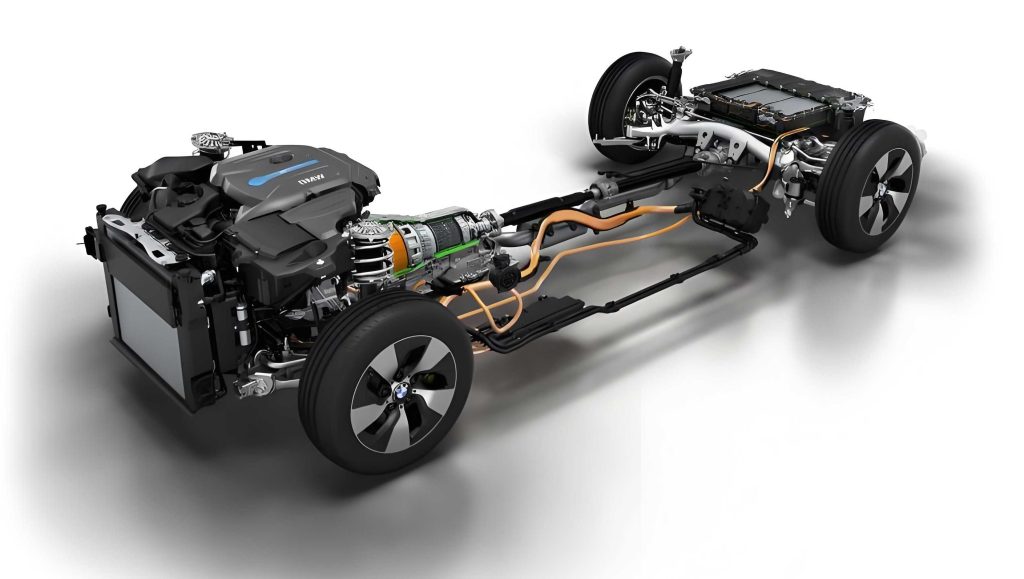
To understand the real-world conditions, customer usage data was analyzed. The affected vehicles were primarily used in ride-hailing services, characterized by high daily mileage and extensive engine start-stop cycles. Statistical comparison revealed stark contrasts: typical users averaged about 10 engine start-stop events per day, while ride-hailing users averaged 354 events. This intensive usage pattern, combined with the hybrid electric vehicle’s operational logic, suggested that the radiator endured far more severe thermal fatigue than in conventional applications. A preliminary test on a chassis dynamometer simulated these conditions by cyclically heating the radiator to above 95°C and cooling it to below 20°C. After approximately 10,000 such cycles, simulating around 20,000 km, the radiator exhibited leakage failures identical to field reports, confirming thermal shock as the failure mechanism.
To quantitatively assess the radiator’s performance under actual hybrid electric vehicle usage, a road load data acquisition (RLDA) test was conducted. A hybrid electric vehicle equipped with a 1.5T gasoline engine was instrumented with sensors on the radiator. Given the radiator had 49 flat tubes, eight tubes were selected across different zones (top, middle, bottom). On each selected tube, strain gauges and thermocouples were mounted on both windward and leeward sides at the inlet and outlet, totaling 32 strain and 32 temperature measurement points. Additional data such as vehicle speed, engine speed, GPS coordinates, and ambient temperature were recorded. The test route was designed to mimic customer driving patterns, focusing on urban and suburban roads, with a total distance of 1,100 km collected over various times and drivers to ensure randomness.
Customer speed distribution was analyzed to guide the test. Speed data from multiple affected users was segmented into 11 ranges (e.g., 0-5 km/h, 5-15 km/h, up to >95 km/h). The median speed within each range was used as a target, with 90% confidence intervals defining upper and lower bounds. This target distribution ensured the RLDA test represented real hybrid electric vehicle usage. The collected data was then processed to align with this target through a mileage coefficient optimization, as detailed below.
The RLDA data was divided into 110 segments of 10 km each. Let $a_{i,j}$ denote the percentage of time spent in speed range $j$ for data segment $i$, where $i = 1, 2, \ldots, n$ ($n=110$) and $j = 1, 2, \ldots, m$ ($m=11$). The speed percentage matrix $\mathbf{A}$ is defined as:
$$\mathbf{A} = \begin{bmatrix}
a_{1,1} & a_{1,2} & \cdots & a_{1,m} \\
a_{2,1} & a_{2,2} & \cdots & a_{2,m} \\
\vdots & \vdots & \ddots & \vdots \\
a_{n,1} & a_{n,2} & \cdots & a_{n,m}
\end{bmatrix}$$
The target speed distribution bounds are given by vectors $\mathbf{B}_U$ and $\mathbf{B}_L$ for upper and lower limits, respectively:
$$\mathbf{B}_U = [b_{U1}, b_{U2}, \ldots, b_{Um}]^T, \quad \mathbf{B}_L = [b_{L1}, b_{L2}, \ldots, b_{Lm}]^T$$
The mileage coefficients $\mathbf{X} = [x_1, x_2, \ldots, x_n]^T$ represent the weighting of each data segment. The optimization problem is formulated as a linear programming task to minimize an arbitrary objective while satisfying the target distribution:
$$\text{minimize} \quad f(\mathbf{X}) = \sum_{i=1}^{n} q_i x_i$$
$$\text{subject to} \quad \mathbf{A} \mathbf{X} \leq \mathbf{B}_U, \quad \mathbf{A} \mathbf{X} \geq \mathbf{B}_L, \quad x_i \geq 0, \quad \sum_{i=1}^{n} x_i = 1$$
where $q_i > 0$ are random numbers. Solving this yielded optimized mileage coefficients, aligning the test data with customer speed profiles. The comparison showed good agreement, enabling representative analysis of hybrid electric vehicle radiator behavior.
With optimized data, temperature time histories for each radiator tube were analyzed. Rainflow counting was applied to quantify thermal shock cycles. For each tube, a rainflow matrix tabulated the number of cycles for various temperature ranges. The results indicated that tubes on the inlet side experienced significantly more thermal shocks than those on the outlet side. Specifically, the topmost tube on the inlet side (tube 49) endured the highest number of shocks, correlating with the common failure location in field incidents. The table below summarizes the thermal shock counts for key tubes:
| Tube Location | Approx. Thermal Shock Counts (per 1,100 km) | Relative Ranking |
|---|---|---|
| Inlet Side, Top Tube (Tube 49) | 1,850 | Highest |
| Inlet Side, Middle Tube | 1,200 | High |
| Inlet Side, Bottom Tube | 950 | Medium |
| Outlet Side, Top Tube | 600 | Low |
| Outlet Side, Bottom Tube | 400 | Lowest |
Strain data required correction for thermal output, as strain gauges produce spurious signals due to temperature changes. The actual thermal strain $\varepsilon_T$ is computed from the indicated strain $\varepsilon_I$ and the gauge’s thermal output $\varepsilon_{T/O}$:
$$\varepsilon_T = \varepsilon_I – \varepsilon_{T/O}$$
The thermal output is typically a 5th-order polynomial function of temperature $T$:
$$\varepsilon_{T/O} = a_0 + a_1 T + a_2 T^2 + a_3 T^3 + a_4 T^4 + a_5 T^5$$
where coefficients $a_i$ are specific to each strain gauge. After correction, the pseudo-damage was calculated using an S-N curve with slope $k = 3.5$. The damage distribution across tubes confirmed that tube 49 on the inlet side sustained the highest damage, consistent with field failures. The damage values were extrapolated to a target customer mileage of 160,000 km, representing the expected life for a hybrid electric vehicle in severe service. The extrapolation yielded a cumulative damage target and equivalent thermal shock cycles, forming the basis for bench test development.
To replicate these conditions in a controlled environment, a thermal shock bench test was devised. The test rig circulates hot and cold fluids through the radiator to simulate temperature cycles from 20°C to 95°C, mimicking hybrid electric vehicle engine start-stop events. Data from bench tests showed temperature and strain responses similar to road data. Based on damage equivalence, the number of bench test cycles required to represent 160,000 km of customer usage was determined. Let $D_{\text{road}}$ be the damage from road data extrapolated to 160,000 km, and $D_{\text{bench}}$ be the damage per bench test cycle. The required cycles $N_{\text{bench}}$ satisfy:
$$D_{\text{road}} = N_{\text{bench}} \cdot D_{\text{bench}}$$
Analysis indicated $N_{\text{bench}} = 3,100$ cycles for the initial test condition. However, reliability requirements must be considered. For reliability $R$ at confidence level $C$ with $n$ test samples, the relationship is:
$$R^n \leq 1 – C$$
For a target of $R90C90$ (90% reliability with 90% confidence), at least 22 samples are needed. To reduce sample size to $n’ = 6$, assuming a Weibull distribution for fatigue life, the scale parameter $\theta$ and shape parameter $\beta$ are involved. The reliability function is:
$$R(t) = e^{-(t/\theta)^\beta}$$
At confidence level $C$, the reliability at time $t$ for $n$ samples is:
$$R = (1 – C)^{1/n} = e^{-(t/\theta)^\beta}$$
For $n’$ samples to achieve the same reliability at time $t’$, we have:
$$R’ = (1 – C)^{1/n’} = e^{-(t’/\theta)^\beta}$$
Equating $R = R’$ and solving for $t’$ yields:
$$\frac{n}{n’} = \left( \frac{t’}{t} \right)^\beta$$
Assuming $\beta = 4$ based on historical data, for $n=22$, $t=3,100$ cycles, and $n’=6$, the required cycles per sample become:
$$t’ = t \cdot \left( \frac{n}{n’} \right)^{1/\beta} = 3,100 \cdot \left( \frac{22}{6} \right)^{1/4} \approx 4,300 \text{ cycles}$$
Thus, the bench test specification was set at 4,300 cycles per sample with 6 samples to meet reliability goals for hybrid electric vehicle radiators.
With the test method established, the focus shifted to optimizing the radiator design. A Design of Experiment (DOE) approach was employed to identify critical factors influencing thermal fatigue resistance. Five control factors were selected, each at two levels, as shown in the table below:
| Factor Symbol | Factor Name | Level 1 | Level 2 |
|---|---|---|---|
| A | Core Plate Material | B5A4 | BNJ4 |
| B | Local Tube Reinforcement | Absent | Present |
| C | Tube Thickness | 0.25 mm | 0.26 mm |
| D | Fin Thickness | 0.07 mm | 0.08 mm |
| E | Side Plate Stress Relief Slot | Absent | Present |
A fractional factorial design with 8 runs was conducted, and each radiator variant was subjected to the thermal shock bench test until failure. The number of cycles to failure was recorded as the response. The results are summarized below:
| Run | A | B | C | D | E | Cycles to Failure |
|---|---|---|---|---|---|---|
| 1 | 1 | 1 | 1 | 1 | 1 | 2,600 |
| 2 | 1 | 1 | 1 | 2 | 2 | 3,250 |
| 3 | 1 | 2 | 2 | 1 | 1 | 3,400 |
| 4 | 1 | 2 | 2 | 2 | 2 | 4,100 |
| 5 | 2 | 1 | 2 | 1 | 2 | 3,000 |
| 6 | 2 | 1 | 2 | 2 | 1 | 2,800 |
| 7 | 2 | 2 | 1 | 1 | 2 | 4,800 |
| 8 | 2 | 2 | 1 | 2 | 1 | 4,000 |
The average response for each factor level was computed to assess effects. For factor B (local tube reinforcement), the average cycles for Level 1 (absent) was 2,913, and for Level 2 (present) was 4,075. Similarly, for factor E (stress relief slot), the averages were 3,200 (absent) and 3,788 (present). Statistical analysis via p-values indicated that factors B and E had the most significant influence, with p-values of 0.016 and 0.060, respectively. Thus, incorporating local reinforcements and stress relief slots markedly improved thermal fatigue life. The interaction effects were also considered, but the main factors dominated. This DOE guided the design of an optimized radiator for hybrid electric vehicles.
The optimized radiator, featuring local reinforcements on critical tubes and stress relief slots on side plates, was manufactured. Six samples each of the old (baseline) and new (optimized) designs underwent the bench test at 4,300 cycles per sample. The results were striking: all new design samples survived 4,300 cycles without failure, whereas the old design samples failed earlier. The reliability of the new design was estimated using Weibull analysis. For zero failures in 6 samples tested at 4,300 cycles, the reliability at 90% confidence is given by:
$$R = (1 – 0.90)^{1/6} \approx 0.999655 \text{ or } 99.9655\%$$
This far exceeds the target, confirming the optimization’s effectiveness. Field deployment of the new radiators in hybrid electric vehicles, including those previously affected, has been monitored for over two years with no recurrence of leakage issues, validating the approach.
In conclusion, this study underscores the importance of tailoring component validation to the unique demands of hybrid electric vehicles. The intermittent operation of the internal combustion engine in a hybrid electric vehicle imposes severe thermal shock loading on the radiator, a condition not prevalent in conventional vehicles. Through systematic road data acquisition, analysis, and damage modeling, we established a representative bench test protocol. The DOE-driven design optimization, focusing on local reinforcement and stress relief, yielded a radiator capable of withstanding the rigorous thermal fatigue environment of hybrid electric vehicle service. The methodology presented here—rooted in customer usage data—provides a robust framework for developing durable components for hybrid electric vehicles and other advanced powertrains. Future work may extend to other thermal management systems in hybrid electric vehicles, ensuring overall vehicle reliability and customer satisfaction.
The integration of real-world data into engineering validation is paramount for hybrid electric vehicles, as their operational profiles differ significantly from traditional vehicles. This project highlights how data-driven insights can lead to targeted improvements, ultimately enhancing the durability and performance of hybrid electric vehicles. As the automotive industry continues to evolve towards electrification, such approaches will be critical in addressing emerging durability challenges and ensuring the long-term success of hybrid electric vehicle technologies.