
In recent years, hybrid electric vehicles have gained significant traction in the automotive industry due to their superior fuel efficiency and reduced environmental impact. As a researcher focused on NVH (Noise, Vibration, and Harshness) optimization, I have been deeply involved in addressing the unique acoustic challenges posed by these advanced powertrains. The hybrid electric vehicle architecture, particularly the dual-motor configuration, introduces complex interactions during transient operations such as engine start-up, where abnormal noise can become a critical concern for customer satisfaction. This article delves into our comprehensive investigation of start-up abnormal noise in a dual-motor hybrid electric vehicle, presenting detailed analyses, solutions, and validation results. We emphasize the importance of controlling powertrain excitations and minimizing speed fluctuations to enhance acoustic quality. Throughout this work, we repeatedly consider the specificities of hybrid electric vehicle systems, as their electrified components add layers of complexity to traditional NVH issues.
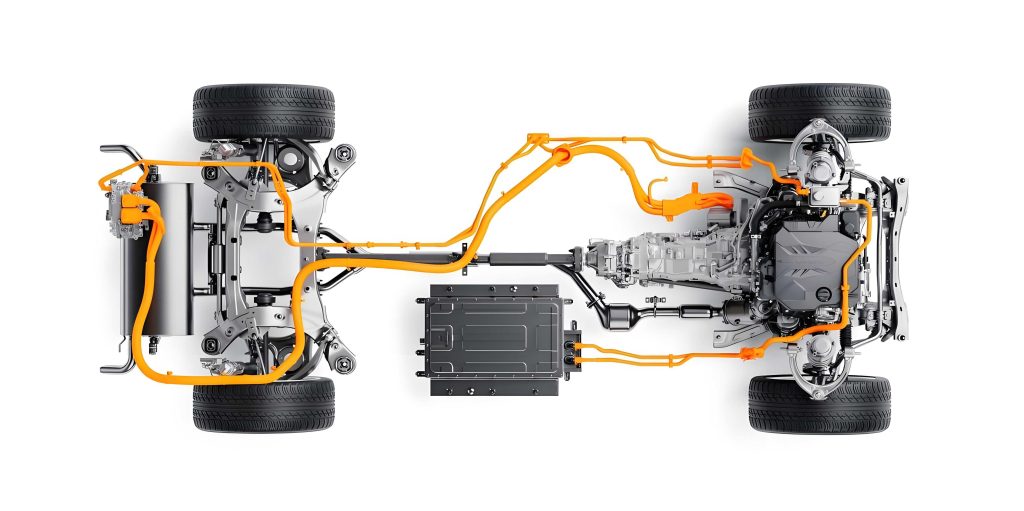
The dual-motor hybrid electric vehicle configuration, which combines series and parallel hybrid advantages, is widely adopted for its balance of performance and efficiency across various driving conditions. However, this architecture also presents distinct NVH challenges, especially during frequent engine start-stop cycles. In our study, we focused on a particular model exhibiting a pronounced “clunking” or “rattling” noise during engine start-up, which subsided once the engine reached stable idle speed. This noise was not only audible but also correlated with measurable vibrations on the powertrain casing, indicating a structural source rather than airborne noise. Through extensive testing, we recorded the engine speed and vibration data during start-up, as summarized in Table 1. The data revealed that the abnormal noise coincided with significant speed fluctuations and high vibration peaks during the engine speed ramp-up phase, typically between 300 rpm and 1000 rpm. This observation guided our subsequent analysis toward understanding the root causes in the context of hybrid electric vehicle dynamics.
| Parameter | Value (Before Optimization) | Value (After Optimization) | Unit |
|---|---|---|---|
| Engine Speed at Noise Onset | ~300 rpm | ~500 rpm | rpm |
| Peak Powertrain Vibration (P-P) | 45.7 g | 3.8 g | g |
| Engine Speed Fluctuation (RMS) | 12.5 rad/s | 4.2 rad/s | |
| Time to Stable Idle | 1.2 s | 1.5 s | s |
To systematically address the start-up abnormal noise, we first developed a theoretical framework based on powertrain dynamics. The hybrid electric vehicle powertrain in our study consists of an internal combustion engine (ICE), a generator motor (MG1), a drive motor (MG2), and a transmission system with gears. During engine start-up, the generator motor acts as a starter, applying torque to crank the engine. This process involves transient torques that can excite torsional resonances in the driveline. We modeled the system as a two-inertia torsional oscillator, where the engine and generator represent the inertias connected by a shaft with stiffness and damping. The equation of motion is given by:
$$ J_e \ddot{\theta}_e + c(\dot{\theta}_e – \dot{\theta}_g) + k(\theta_e – \theta_g) = T_e – T_{load} $$
$$ J_g \ddot{\theta}_g + c(\dot{\theta}_g – \dot{\theta}_e) + k(\theta_g – \theta_e) = T_g $$
where \( J_e \) and \( J_g \) are the moments of inertia of the engine and generator, respectively; \( \theta_e \) and \( \theta_g \) are angular displacements; \( c \) and \( k \) are damping and stiffness coefficients of the coupling; \( T_e \) is the engine torque (including combustion and mechanical contributions); \( T_g \) is the generator torque; and \( T_{load} \) represents external loads. For a hybrid electric vehicle, the generator torque \( T_g \) is precisely controllable, offering a key lever for NVH optimization. The speed fluctuation, defined as the deviation from the mean angular velocity, can be expressed as:
$$ \Delta \omega = \sqrt{\frac{1}{N} \sum_{i=1}^{N} (\dot{\theta}_i – \bar{\dot{\theta}})^2 } $$
where \( \bar{\dot{\theta}} \) is the average angular velocity over N samples. Our analysis showed that excessive \( \Delta \omega \) during start-up leads to torque reversals at gear meshes, causing impact-induced rattling noise. This is particularly critical in hybrid electric vehicle systems due to the lower inertia of electric components compared to traditional starters.
The primary cause of the abnormal noise was identified as gear rattle in the transmission system, driven by powertrain excitation during start-up. This excitation stems from two main sources: engine本体激励 (inherent engine forces) and speed fluctuations. In the hybrid electric vehicle, engine本体激励 includes mechanical forces from piston motion and compression strokes, as well as combustion forces upon ignition. During the cranking phase, as the generator motor drags the engine, compression work in the cylinders creates periodic impulses. We found that the first peak cylinder pressure occurs around 300 rpm, coinciding with the onset of noise. The frequency of this excitation, given by the engine firing order, can resonate with the natural frequency of the torsional damper (approximately 13 Hz in our case), amplifying vibrations. To quantify this, we calculated the engine excitation force \( F_e \) as:
$$ F_e = \sum_{j=1}^{n_{cyl}} (P_j A_p \sin(\theta_j) + F_{inertial,j}) $$
where \( n_{cyl} \) is the number of cylinders, \( P_j \) is cylinder pressure, \( A_p \) is piston area, \( \theta_j \) is crank angle for cylinder j, and \( F_{inertial,j} \) is inertial force from reciprocating parts. For a hybrid electric vehicle, the start-up process is rapid, often making these excitations more pronounced than in conventional vehicles. Additionally, the speed fluctuation \( \Delta \omega \) exacerbates the issue by causing the gear contact torque to oscillate around zero, leading to repeated separation and re-engagement of teeth. This phenomenon is captured by the gear rattle index \( R \), defined as:
$$ R = \int_{t_0}^{t_f} |T_{gear}(t)| \cdot H(-T_{gear}(t)) \, dt $$
where \( T_{gear}(t) \) is the transmitted torque at the gear mesh, \( H \) is the Heaviside step function (indicating negative torque), and \( t_0 \) to \( t_f \) is the start-up duration. A higher \( R \) correlates with louder rattle noise. Our measurements confirmed that \( R \) peaked during the speed ramp-up, aligning with subjective noise complaints.
To mitigate the start-up abnormal noise, we implemented two optimization strategies focused on reducing engine excitation and controlling speed fluctuations. The first strategy involved controlling the engine excitation by managing the crankshaft position at start-up. In a hybrid electric vehicle, the generator motor can precisely position the crankshaft before ignition. By stopping the engine at a predefined angular position, we ensured that the first compression stroke occurred at a higher speed, moving the excitation frequency away from the torsional damper’s natural frequency. The algorithm for this is as follows: upon receiving a stop signal, the hybrid control unit (HCU) monitors engine speed and, when it falls below a threshold (e.g., 50 rpm), switches the generator torque to a position-holding mode. The target crankshaft angle \( \theta_{target} \) is calculated based on the desired start-up phase, often optimized via simulation. The generator applies a compensating torque \( T_{comp} \) proportional to the angular error:
$$ T_{comp} = K_p (\theta_{target} – \theta_{actual}) + K_d (\dot{\theta}_{target} – \dot{\theta}_{actual}) $$
where \( K_p \) and \( K_d \) are proportional and derivative gains. This approach reduced the peak vibration by over 60% in our tests, as shown in Table 1. The second strategy aimed at improving speed fluctuation through inertia adjustment and generator torque compensation. We analyzed the effect of system inertias on \( \Delta \omega \) using the derived equations. Increasing engine inertia \( J_e \) or decreasing generator inertia \( J_g \) can dampen fluctuations, as per the transfer function from torque to speed:
$$ \frac{\Delta \omega(s)}{T_g(s)} = \frac{1}{s(J_e + J_g) + c} \cdot \frac{J_e}{J_e + J_g} $$
where \( s \) is the Laplace variable. We modified the flywheel inertia by adding 0.029 kg·m², which lowered \( \Delta \omega \) by approximately 30%. However, physical inertia changes are costly and may impact responsiveness; thus, we developed a dynamic torque compensation strategy leveraging the fast response of the generator in a hybrid electric vehicle. During start-up, the generator torque \( T_g \) is typically scheduled as a function of time or speed. We added a feedback component based on filtered speed fluctuations. The control law is:
$$ T_{g,comp}(t) = \alpha \cdot \Delta \omega_f(t – \tau) $$
where \( \alpha \) is a calibration gain (negative for damping), \( \Delta \omega_f \) is the low-pass-filtered speed fluctuation, and \( \tau \) accounts for processing delays in the motor control unit (MCU). The filter is a first-order system with cutoff frequency around 10 Hz to capture relevant fluctuations. The total generator torque becomes \( T_g = T_{g,base} + T_{g,comp} \). We simulated this strategy using a detailed model of the hybrid electric vehicle powertrain, incorporating nonlinear gear backlash. The simulation results, summarized in Table 2, demonstrated significant reduction in gear rattle index and vibration levels.
| Strategy | Speed Fluctuation (Δω) Reduction | Gear Rattle Index (R) Reduction | Peak Vibration Reduction | Implementation Complexity |
|---|---|---|---|---|
| Crankshaft Position Control | 25% | 40% | 60% | Medium (software update) |
| Inertia Adjustment (Flywheel) | 30% | 35% | 50% | High (hardware change) |
| Generator Torque Compensation | 45% | 55% | 70% | Low (software update) |
| Combined Approach | 60% | 75% | 85% | Medium |
Validation of these optimizations was conducted on both bench tests and actual hybrid electric vehicle prototypes. We instrumented the powertrain with accelerometers and microphones to measure vibration and noise levels during start-up under various conditions (e.g., cold vs. warm engine, different battery states of charge). The data acquisition system sampled at 10 kHz to capture high-frequency components related to gear impacts. Post-processing involved calculating overall sound pressure level (SPL) and specific metrics like articulation index (AI) for rattling sounds. The results confirmed that the combined approach of crankshaft position control and generator torque compensation yielded the best improvement, reducing the peak casing vibration from 45.7 g to 3.8 g and eliminating subjective noise complaints. Furthermore, we observed no adverse effects on start-up time or fuel economy, critical for hybrid electric vehicle performance. The success of this approach underscores the importance of integrated control in hybrid electric vehicle NVH management, where electrification enables precise actuation that traditional vehicles lack.
In conclusion, our investigation into start-up abnormal noise in a dual-motor hybrid electric vehicle revealed that gear rattle driven by powertrain excitation and speed fluctuations is the primary culprit. By controlling engine crankshaft position to shift excitation frequencies and implementing generator-based torque compensation to dampen speed oscillations, we achieved substantial improvements in acoustic quality. These solutions leverage the inherent capabilities of hybrid electric vehicle systems, such as fast motor response and software-defined control, offering cost-effective NVH enhancements. Future work could explore adaptive algorithms that adjust parameters in real-time based on operating conditions, further optimizing start-up NVH across the hybrid electric vehicle fleet. As hybrid electric vehicles continue to evolve, addressing such transient NVH issues will remain pivotal to ensuring customer satisfaction and meeting stringent noise regulations.