
Driven by the global “Dual Carbon” targets, the automotive market is witnessing a rapid expansion of various new energy vehicle types. Among these, Plug-in Hybrid Electric Vehicles (PHEVs) have gained significant consumer acceptance, largely due to their advantage in eliminating range anxiety. Emission and fuel consumption regulations have established specific testing requirements for hybrid electric vehicle models, which are notably more complex and stringent than those for conventional internal combustion engine vehicles. The PHEV architecture, characterized by a high-capacity battery, allows for more flexible and strategic operation of the internal combustion engine, often involving frequent engine starts and stops to maximize fuel efficiency. However, these frequent cold-start events, where the engine and its aftertreatment system are not fully warmed, exert considerable pressure on pollutant and particulate matter (PM) emissions. Therefore, effective exhaust aftertreatment systems, primarily comprising an advanced Three-Way Catalyst (TWC) and a Gasoline Particulate Filter (GPF), are critical as the primary measure for off-engine purification. As emission regulations become increasingly strict, demands on these aftertreatment devices intensify. Utilizing substrates with lower thermal mass (e.g., ultra-thin-wall designs) enables faster heating. Simultaneously, optimizing washcoat formulations and precious metal distribution strategies is crucial for improving cold-start performance. Furthermore, the high cost of platinum group metals (PGMs)—Platinum (Pt), Palladium (Pd), and Rhodium (Rh)—necessitates the adoption of new aftertreatment technologies that can reduce the overall PGM loading, thereby lowering development and production costs and enhancing the competitiveness of vehicle models.
This research is based on a foundational powertrain platform project for a plug-in hybrid electric vehicle, focusing on the matching and development of its emission aftertreatment system. The evaluation commenced with a detailed assessment of performance on an engine test bench. We compared the bench performance and subsequent full-vehicle emission results of several new washcoat technologies applied on ultra-thin-wall substrates. The objective was to screen for a low-cost, high-performance emission aftertreatment solution capable of meeting the current stringent China 6b standards, including Real Driving Emissions (RDE) compliance. The study protocol involved comparing key bench performance metrics such as light-off temperature, oxygen storage capacity (OSC), and backpressure for different catalyst formulations. The most promising candidates identified from the bench tests were then subjected to full-vehicle emission testing over the Worldwide Harmonized Light Vehicles Test Cycle (WLTC) and RDE procedures. Additionally, we contrasted the operational characteristics of the hybrid electric vehicle’s engine with those of a traditional vehicle and summarized the specific considerations for aftertreatment selection and development in the context of hybrid electric vehicles. The aim is to provide targeted recommendations for aftertreatment system selection for hybrid electric vehicles, achieve cost reduction for platform models, and reserve new technological solutions for future regulatory upgrades.
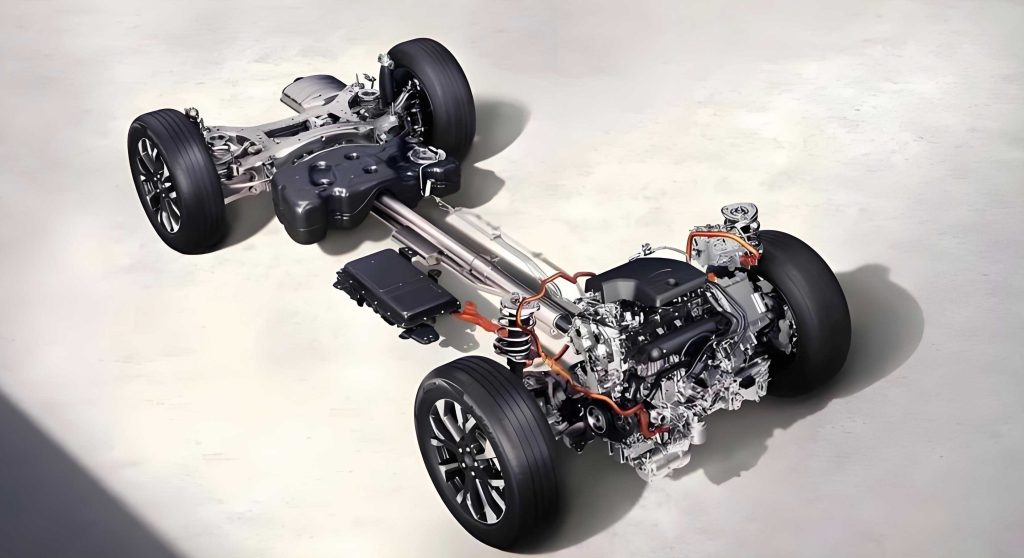
The Plug-in Hybrid Electric Vehicle (PHEV) has seen迅猛 development in recent years, distinguished by advantages such as low operating costs, absence of range anxiety, eligibility for green license plates in many regions, and significant power enhancement. The powertrain of a hybrid electric vehicle can derive energy from the battery, the internal combustion engine, or both simultaneously, enabling various driving modes: pure electric drive, series hybrid drive, parallel hybrid drive (motor and engine combined), and direct engine drive. This flexibility allows for maximized optimization of energy sources to achieve optimal overall efficiency. Key features of a plug-in hybrid electric vehicle include a large battery capacity, plug-in charging capability, and a substantial all-electric range. Under favorable charging conditions, fuel consumption for small-displacement models can be below 2 L/100 km. As the electric motor and battery分担部分 of the driving power, the internal combustion engine operates more frequently within smooth, stable, and economically efficient points. However, a critical characteristic is that the frequency of engine starts and stops is significantly higher than in a conventional vehicle.
The emission aftertreatment system for a gasoline hybrid electric vehicle typically consists of two core components: the catalyst washcoat and the substrate. This study primarily investigates the washcoat technology while keeping the substrate configuration constant for a specific PHEV model. The design of the washcoat方案 was based on the unique operational profile of the hybrid electric vehicle, considering its start-stop strategy, engine displacement, and air-fuel ratio characteristics, and was informed by data from mass-production projects to define the target range for PGM content and the selection of washcoat technologies.
The primary aftertreatment system for the studied hybrid electric vehicle employs a close-coupled TWC followed by an underfloor GPF. The close-coupled positioning of the TWC, in proximity to the engine exhaust manifold, is beneficial for rapid catalyst light-off and improved pollutant conversion during the critical cold-start phase. The vehicle and aftertreatment specifications used in this study are summarized in the table below.
| Item | Parameter |
|---|---|
| Battery Capacity | 19 kWh |
| Engine | 1.5L TGDI |
| TWC Volume / CPSI / Wall Thickness | 0.82 L; 600/2 mil |
| GPF Volume / CPSI / Wall Thickness | 1.39 L; 300/8 mil |
| Base Vehicle (H) Curb Weight / Gross Weight | 1980 kg / 2406 kg |
| Derivative Vehicle (L) Curb Weight / Gross Weight | 2115 kg / 2590 kg |
The catalyst selection criteria were established as follows: preliminary screening was based on engine bench performance results. A candidate was deemed合格 if the aged catalyst’s emissions on the target vehicle were below 80% of the corresponding regulatory limits. The evaluation also considered fresh catalyst emission results, factoring in the recommended deterioration coefficients from the regulations.
Four distinct washcoat technology schemes, labeled A-1, B-1, C-1, and D-1, were selected for evaluation. Their key characteristics are as follows:
- A-1: Utilizes a next-generation washcoat material designed to broaden the effective conversion window of the catalyst.
- B-1: Employs a new washcoat technology characterized by improved PGM dispersion, enhancing Hydrocarbon (HC) conversion efficiency during cold start, which allows for a reduction in Pd content.
- C-1 & D-1: Share the same core washcoat technology but differ in total PGM loading. This technology is noted for superior light-off performance and dynamic oxygen storage capacity, leading to better pollutant conversion during cold start and at high/exhaust flow conditions.
All catalyst samples were subjected to an accelerated aging cycle (GMAC875) on the engine bench for 100 hours, simulating the equivalent of real-world aging based on empirical data and standard driving cycles (SRC). The technical specifications of the evaluated aftertreatment systems are detailed below.
| Powertrain Platform | TWC Technology | GPF Technology | PGM Loading (g) | Notes | ||
|---|---|---|---|---|---|---|
| Pt | Pd | Rh | ||||
| 1.5TGDI | A-1 | E-1 | 0.16 | 1.50 | 0.21 | Candidate |
| B-1 | E-2 | 0.16 | 1.25 | 0.16 | Candidate | |
| C-1 | F-1 | 0.00 | 1.82 | 0.14 | Candidate | |
| D-1 | F-2 | 0.00 | 1.58 | 0.14 | Candidate | |
Results and Analysis
This section analyzes the bench test results for the various technology schemes, followed by an evaluation of their full-vehicle emission performance. The goal is to identify the optimal technical solution for cost-effective product development and to reserve new coating technologies for future applications.
Bench Performance Comparison of Aftertreatment Schemes
The bench performance evaluation focused on three key metrics: light-off performance, oxygen storage capacity (OSC), and backpressure. The results from these tests were used to select the most promising candidates for further full-vehicle validation.
Light-Off Performance
The light-off temperature, specifically T50 (temperature at 50% conversion efficiency) and T90 (temperature at 90% conversion efficiency), was measured for Carbon Monoxide (CO), Total Hydrocarbons (THC), and Nitrogen Oxides (NOx). Lower T50 and T90 values indicate superior and faster catalyst activation.
The results, as shown in the comparative graphs of fresh and aged states, can be summarized as follows:
- Fresh Catalysts: Scheme C-1 showed a slight advantage in T50 for some pollutants. However, scheme B-1 demonstrated a clear advantage in T90, being 5-8°C lower than the high-PGM schemes A-1 and C-1.
- Aged Catalysts: Scheme B-1 exhibited the best overall light-off performance after aging. Its T50 and T90 values for all pollutants were approximately 5°C lower than those of schemes A-1 and C-1, with an 8°C advantage for NOx.
- Performance Degradation: Scheme B-1 showed the smallest increase (degradation) in T50 after aging.
Based on bench light-off performance, scheme B-1 proved optimal, and it also featured a lower total PGM loading.
Oxygen Storage Capacity (OSC) Performance
OSC is critical for handling transient air-fuel ratio fluctuations and improving the conversion of CO and NOx under high exhaust flow conditions. It was measured at two different operating points: a low-temperature/low-flow condition (500°C, 40 kg/h) and a high-temperature/high-flow condition (670°C, 80 kg/h). The OSC value can be conceptually related to the dynamic oxygen buffer, crucial for maintaining high conversion efficiency during engine transients common in a hybrid electric vehicle’s operation.
The results are summarized below:
| Condition | Metric | A-1 | B-1 | C-1 | D-1 |
|---|---|---|---|---|---|
| 40 kg/h & 500°C | Fresh OSC (mg) | 646 | 865 | 742 | 717 |
| Aged OSC (mg) | 613 | 733 | 594 | 587 | |
| Degradation Rate | 5.2% | 15.2% | 20.0% | 18.2% | |
| 80 kg/h & 670°C | Fresh OSC (mg) | 636 | 861 | 805 | 698 |
| Aged OSC (mg) | 582 | 725 | 585 | 572 | |
| Degradation Rate | 8.6% | 15.9% | 27.3% | 18.1% |
- Fresh Catalysts: Scheme B-1 had the highest OSC at both test conditions.
- Aged Catalysts: Scheme B-1 maintained the highest aged OSC, approximately 20% higher than the other schemes.
- Degradation Rate: Schemes A-1 and B-1 exhibited lower overall OSC degradation compared to schemes C-1 and D-1.
The superior OSC of B-1, especially after aging, indicates robustness for the transient-rich operation of a hybrid electric vehicle.
Backpressure Performance
The backpressure of the GPF section was measured at a standardized condition (inlet gas temperature of 850°C, flow rate of 300 kg/h). Backpressure directly impacts engine pumping losses and fuel efficiency, making it a critical parameter for a fuel-efficient hybrid electric vehicle.
The results are presented below:
| Sample State | E-1 | E-2 | F-1 | F-2 |
|---|---|---|---|---|
| Fresh GPF Backpressure (kPa) | 15.35 | 15.21 | 19.88 | 19.43 |
| Aged GPF Backpressure (kPa) | 15.64 | 15.30 | 26.54 | 24.28 |
| Backpressure Increase Rate | 1.9% | 0.6% | 33.5% | 25.0% |
- GPFs using E-series coating technology (E-1, E-2) showed significantly lower initial backpressure and minimal increase after aging.
- GPFs using F-series coating technology (F-1, F-2) had higher initial backpressure, which increased dramatically (25-33.5%) after aging. This is attributed to their coating formulation and loading, which are designed for higher particulate matter (PM) filtration efficiency but at the cost of higher flow restriction.
Bench Performance Summary: Technology scheme B-1/E-2 demonstrated optimal light-off performance, superior oxygen storage capacity, and favorable GPF backpressure characteristics. The F-series GPF technology, while offering high filtration efficiency, resulted in significantly higher backpressure and a substantial increase after aging. Considering both performance and PGM loading, the combinations B-1/E-2 and D-1/F-2 were selected for the subsequent full-vehicle emission validation tests.
Full-Vehicle Emission Performance Comparison
The selected aftertreatment combinations (B-1/E-2 and D-1/F-2) were installed on the base vehicle (H) and a derivative, heavier vehicle (L) for WLTC emission testing. The primary development target was for aged emissions to remain below 80% of the legal limit.
The aged emission results, expressed as a percentage of the respective regulatory limits, are summarized below:
| Pollutant | B-1/E-2 on Vehicle H | D-1/F-2 on Vehicle H | B-1/E-2 on Vehicle L | D-1/F-2 on Vehicle L | Target (< 80%) |
|---|---|---|---|---|---|
| CO | ~35% | ~32% | ~48% | ~45% | Pass |
| THC | ~22% | ~18% | ~28% | ~25% | Pass |
| NOx | ~15% | ~14% | ~20% | ~18% | Pass |
| PN | ~10% | ~8% | ~12% | ~9% | Pass |
Both aftertreatment schemes comfortably met the 80% development target on both vehicles. Scheme D-1/F-2 showed a slight advantage in Non-Methane Hydrocarbon (NMHC) emissions, likely due to its specific washcoat formulation. Emissions were primarily concentrated during the first few cold-start events of the test cycle. Considering that the D-1/F-2 scheme’s GPF contributed to higher engine backpressure and had a marginally higher PGM cost than B-1/E-2, the B-1/E-2 combination was deemed more suitable for the 1.5TGDI hybrid electric vehicle platform.
Real Driving Emissions (RDE) Performance
The selected B-1/E-2 scheme underwent comprehensive RDE testing on Vehicle H under various driving modes (Normal, Sport, ECO) with the air conditioning activated, using both fresh and aged catalysts. The results, compared against the RDE conformity factor (CF) limits, are shown below.
| Test Mode / Catalyst State | NOx (mg/km) | % of RDE Limit | PN (#/km) | % of RDE Limit |
|---|---|---|---|---|
| Normal Mode (Fresh) | 1.9 | 3.3% | 3.5E+10 | 2.8% |
| Sport Mode (Fresh) | 9.8 | 16.8% | 2.4E+10 | 1.9% |
| ECO Mode (Fresh) | 2.9 | 4.9% | 4.8E+10 | 3.8% |
| Normal Mode (Aged) | 19.1 | 18.2% | 1.9E+10 | 1.6% |
| Sport Mode (Aged) | 19.9 | 19.0% | 1.2E+10 | 0.9% |
The B-1/E-2 scheme demonstrated exceptional RDE compliance. Even under the most demanding Sport mode with an aged system, NOx and PN emissions remained below 20% and 2% of their respective RDE limits. Peak emissions were observed during cold-start catalyst heating phases and during aggressive acceleration/gear shift transients where air-fuel ratio control fluctuated. Given the substantial margin to the legal limits, the low PGM loading, and the favorable backpressure characteristics, the B-1/E-2 scheme was confirmed as the optimal low-cost, high-performance solution for meeting current RDE regulations for this hybrid electric vehicle.
Operational Characteristics of Hybrid Electric Vehicles and Implications for Aftertreatment Selection
The operational profile of the internal combustion engine in a hybrid electric vehicle differs fundamentally from that in a conventional vehicle, directly impacting aftertreatment requirements. Analysis of engine operating point maps during RDE tests reveals distinct patterns:
- Hybrid Electric Vehicle: The engine operating points (speed vs. load) are more concentrated, primarily clustered within regions of high thermal efficiency. The electric motor assists during low-speed/low-load conditions and provides boost during high-load demands, preventing the engine from frequently operating at its maximum output (full-load envelope) or in fuel-enrichment zones for component protection.
- Conventional Vehicle: The engine operating points are more dispersed across the map, frequently extending to higher loads and speeds near the full-load curve, resulting in greater load fluctuations.
These differences have direct implications for aftertreatment design in a hybrid electric vehicle:
- Challenge Shift: The CO and NOx conversion challenge is generally reduced in a hybrid electric vehicle as the engine less frequently enters high-load, fuel-enrichment regimes where NOx conversion efficiency drops and CO emissions rise. However, the challenge for THC/NMHC emissions is heightened due to the increased frequency of cold-start events.
- Aftertreatment Strategy: Consequently, the TWC for a hybrid electric vehicle should prioritize excellent cold-start light-off performance. The zonal distribution of PGMs within the catalyst brick can also be optimized for faster heating. Since the engine experiences periods of high exhaust space velocity less frequently, the Rhodium content in the close-coupled TWC, critical for NOx conversion at high temperatures, could potentially be optimized or adjusted based on detailed modeling. Similarly, the contribution of the underfloor GPF to overall NOx conversion under high-speed conditions may be less critical.
- Aging Considerations: The different engine operating profile also affects the thermal aging of the catalyst. Standard aging cycles based on conventional vehicle operation may be overly severe for a hybrid electric vehicle application. Therefore, the accelerated aging protocol used for durability validation could be tailored, potentially reducing the required aging time, which aligns with real-world, less severe thermal exposure.
The fundamental conversion efficiency of a catalyst can be described by its rate equation, often following an Arrhenius-type relationship, where the conversion rate $k$ is:
$$ k = A e^{-E_a/(RT)} $$
where $A$ is the pre-exponential factor, $E_a$ is the activation energy, $R$ is the universal gas constant, and $T$ is the catalyst temperature. For a hybrid electric vehicle with frequent cold starts, achieving a low $E_a$ for HC/CO oxidation and a high effective $A$ through improved PGM dispersion (as in scheme B-1) is paramount.
The oxygen storage capacity can be modeled as a dynamic buffer, with its consumption and replenishment rates critical during transients. A simplified mass balance for oxygen storage ($\Theta_{OSC}$) can be expressed as:
$$ \frac{d\Theta_{OSC}}{dt} = k_{store} \cdot (λ – 1)_{rich} – k_{release} \cdot (1 – λ)_{lean} $$
where $λ$ is the normalised air-fuel ratio, and $k_{store}$, $k_{release}$ are rate constants. A high maximum $\Theta_{OSC}$, as seen in scheme B-1, provides a larger buffer for the rapid air-fuel ratio switches common in hybrid electric vehicle operation.
The pressure drop across the GPF, a key concern for fuel economy, can be estimated using models that include terms for viscous losses in the channels and Darcy flow through the porous wall:
$$ \Delta P_{GPF} = f(Re) \cdot \frac{L}{D_h} \cdot \frac{\rho u^2}{2} + \frac{\mu}{k} \cdot u \cdot w $$
where $Re$ is Reynolds number, $L$ is channel length, $D_h$ is hydraulic diameter, $\rho$ is density, $u$ is velocity, $\mu$ is viscosity, $k$ is wall permeability, and $w$ is wall thickness. The F-series technology’s higher initial $\Delta P$ and its increase with aging suggest lower effective permeability $k$ and/or increased flow resistance due to pore blockage.
Conclusions
- The emission aftertreatment selection process for the hybrid electric vehicle platform began with a comparative evaluation of candidate technologies on an engine test bench. Schemes B-1/E-2 and D-1/F-2, featuring lower precious metal group (PGM) loadings, demonstrated superior light-off temperature and oxygen storage capacity (OSC) performance. However, the F-2 GPF technology was associated with significantly higher backpressure and a large backpressure increase rate after aging. This technology is better suited for applications with inherently high engine-out particulate matter (PM) emissions requiring superior filtration efficiency and can be reserved as a technical solution for future, more stringent PM/PN regulations or for different engine types.
- The most promising aftertreatment schemes were validated through full-vehicle WLTC and RDE emission tests. Both selected schemes met the development target of emissions below 80% of the WLTC regulatory limit. The B-1/E-2 scheme, in particular, demonstrated exceptional RDE performance, with emissions from an aged system remaining below 20% of the applicable RDE limits. This confirms that the B-1/E-2 combination satisfies the emission control requirements for the target hybrid electric vehicle while representing the lowest-cost technical solution among those evaluated.
- The unique operational profile of a plug-in hybrid electric vehicle, characterized by frequent engine starts/stops and engine operation concentrated in high-efficiency zones, necessitates a tailored approach to aftertreatment selection. Priority should be given to catalyst technologies with excellent cold-start light-off performance to address the heightened HC challenge. Given the reduced occurrence of high exhaust space velocity operation, the precious metal distribution, especially Rhodium content in certain catalyst sections, can be optimized. Furthermore, the accelerated aging protocols used for durability validation should be re-evaluated and potentially adjusted to reflect the less severe thermal duty cycle of the engine in a hybrid electric vehicle application, enabling a more cost- and performance-optimized aftertreatment system.