
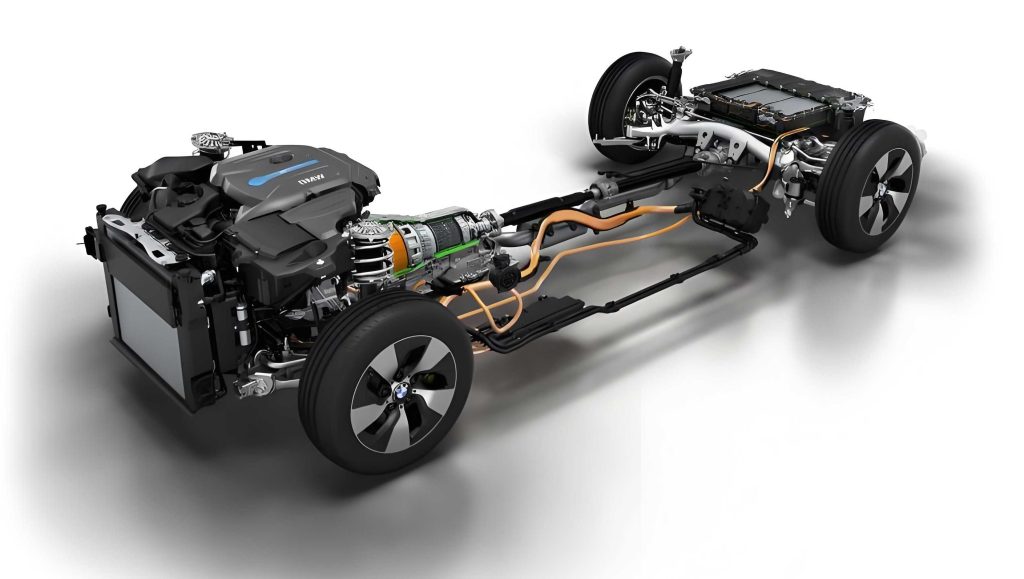
The pursuit of carbon peak and carbon neutrality goals has placed the transportation sector, a significant contributor to greenhouse gas emissions and atmospheric pollutants, under intense scrutiny. The development of new energy vehicles (NEVs) stands as a pivotal strategy in this transition. Among various NEV technologies, the hybrid electric vehicle (HEV) offers a pragmatic bridge towards full electrification by combining an internal combustion engine (ICE) with an electric motor, thereby achieving notable improvements in fuel economy and a reduction in carbon dioxide emissions. However, the environmental benefits of a hybrid electric vehicle, particularly concerning criteria air pollutants like carbon monoxide (CO), nitrogen oxides (NOx), and particulate matter (PM), are not as straightforward as its fuel-saving prowess. The energy management strategy of a hybrid electric vehicle, which dictates the interplay between the ICE and the electric drivetrain based on driving demands and battery state-of-charge (SOC), leads to engine operation patterns that differ fundamentally from those of conventional vehicles. Consequently, the real-world emission characteristics of a hybrid electric vehicle require dedicated investigation beyond standardized laboratory tests.
Standardized driving cycles, such as the Worldwide Harmonized Light Vehicles Test Cycle (WLTC), are designed for certification and comparative purposes but often fail to capture the complexity of actual urban traffic, which is characterized by frequent idling, acceleration events, and congestion. This discrepancy necessitates the construction of representative real-world driving cycles (RWDCs) that reflect local traffic conditions, road networks, and driver behavior. Furthermore, the portable emissions measurement system (PEMS) has become the gold standard for assessing real driving emissions (RDE), providing second-by-second data on pollutant emission rates under genuine on-road conditions. The integration of a locally representative RWDC with high-resolution PEMS data offers a powerful methodology to accurately estimate the true environmental footprint of vehicles in specific operational contexts. This study, therefore, focuses on a specific class of hybrid electric vehicles operating in charge-sustaining (CS) mode. It aims to: (1) construct a representative urban driving cycle based on extensive GPS trajectory data collected from a fleet of hybrid electric vehicles; (2) analyze the transient emission rates of CO, NOx, and particle number (PN) obtained from RDE tests on hybrid electric vehicles; and (3) synthesize this information to derive and evaluate emission factors for these hybrid electric vehicles under authentic city driving scenarios.
1. Methodology
1.1 Data Collection and Vehicle Information
Two parallel data collection campaigns were conducted. The first aimed at constructing a real-world driving cycle. The movement trajectories of 20 light-duty hybrid electric vehicles used primarily for commuting and social activities in a metropolitan environment were recorded. A Columbus V-990 MARK II GPS logger was installed in each vehicle to collect second-by-second (1 Hz) positional data, including latitude, longitude, altitude, and instantaneous speed, over a continuous period of 14 days per vehicle.
The second campaign involved real-driving emission tests. Four light-duty hybrid electric vehicles, compliant with China 6 emission standards, were selected as test subjects. Their specifications are summarized in Table 1. Prior to testing, the battery of each hybrid electric vehicle was pre-conditioned to achieve a stable state-of-charge, ensuring operation in charge-sustaining (CS) mode throughout the RDE test.
| Parameter | Vehicle V1 | Vehicle V2 | Vehicle V3 | Vehicle V4 |
|---|---|---|---|---|
| Engine Displacement (L) | 1.5 | 1.5 | 1.5 | 2.0 |
| Fuel Injection | Electronic Port Injection | Electronic Port Injection | Electronic Port Injection | Electronic Port Injection |
| Curb Weight (kg) | 1500 | 1790 | 1500 | 1989 |
| Engine Power (kW) | 78 | 78 | 78 | 107 |
| Electric Motor Power (kW) | 132 | 145 | 145 | 135 |
| Emission Standard | China VI | China VI | China VI | China VI |
Table 1: Specifications of the hybrid electric vehicles used for RDE testing.
The PEMS setup consisted of a HORIBA OBS-ONE gas analyzer for measuring CO (via non-dispersive infrared detection) and NO/NOx (via chemiluminescence detection), a condensation particle counter (CPC) for measuring particle number (PN) concentration, an exhaust mass flow meter, a GPS unit, and a weather station. An on-board diagnostic (OBD) interface was used to record vehicle parameters such as engine speed and vehicle speed. The RDE tests were conducted on a predefined route that included urban (speed < 60 km/h), rural (60 ≤ speed ≤ 90 km/h), and motorway (speed > 90 km/h) sections, conforming to the regulatory RDE trip requirements regarding distance proportion and elevation difference.
1.2 Construction of the Real-World Driving Cycle
The construction of the representative driving cycle involved a multi-step statistical process applied to the collected GPS data.
Step 1: Micro-Trip Segmentation and Feature Parameter Extraction. The continuous velocity-time data streams were divided into discrete “micro-trips.” A micro-trip is defined as a driving segment that starts and ends with a vehicle idle period (speed = 0 km/h) and contains phases of acceleration, cruising, and deceleration in between. After data cleaning to remove GPS errors and invalid segments, a total of 11,675 valid micro-trips were identified. For each micro-trip, 16 kinematic parameters were calculated to characterize its driving dynamics. These parameters included:
$$ \text{Duration } (T), \text{ Distance } (D), \text{ Average Speed } (v_{avg}), \text{ Average Running Speed } (v_{run}), $$
$$ \text{Standard Deviation of Speed } (\sigma_v), \text{ Maximum Speed } (v_{max}), \text{ Average Positive Acceleration } (a_{+avg}), $$
$$ \text{Idling Time Proportion } (P_{idle}), \text{ Acceleration Time Proportion } (P_{acc}), \text{ Cruising Time Proportion } (P_{cruise}), \text{ Deceleration Time Proportion } (P_{dec}), $$
and other statistical moments of speed and acceleration.
Step 2: Data Reduction and Micro-Trip Clustering. Given the high dimensionality of the feature set (16 parameters), Principal Component Analysis (PCA) was employed to reduce redundancy and highlight the primary sources of variation. The PCA transformed the original 16-dimensional feature matrix into a new set of uncorrelated variables, the principal components (PCs). The first five PCs were retained, as they cumulatively explained over 80% of the total variance in the data, effectively reducing the dimensionality from 16 to 5 while preserving most of the information.
Subsequently, the K-means clustering algorithm was applied to the 5-dimensional PC score matrix to group the micro-trips into distinct clusters based on their kinematic similarity. The optimal number of clusters (k=3) was determined using the elbow method and silhouette coefficient analysis. The three clusters represented fundamentally different driving patterns:
- Cluster 1 (Congested Urban): Characterized by very low average speed (~2.26 km/h) and a high proportion of idling time.
- Cluster 2 (Fluid Urban): Representing moderate-speed urban driving (~9.90 km/h) with less frequent stops.
- Cluster 3 (Extra-Urban/Highway): Featuring high average speed (~27.86 km/h) and longer trip durations, typical of free-flow traffic on arterials and highways.
Step 3: Driving Cycle Synthesis. To construct a synthetic driving cycle with a total target duration of approximately 1800 seconds (aligned with common test cycles like WLTC), the time contribution from each cluster was determined by its proportional representation in the entire micro-trip database. The calculated durations were 302 s for Cluster 1, 316 s for Cluster 2, and 1182 s for Cluster 3. Representative micro-trips from each cluster were then selected and concatenated. The selection criterion was based on the correlation coefficient between the candidate micro-trip’s feature vector and the cluster’s centroid; micro-trips with the highest correlation (r ≥ 0.9) were chosen to best represent their cluster’s characteristics. The final driving cycle was assembled by sequentially joining the selected micro-trips from the three clusters.
1.3 Emission Rate Analysis and Emission Factor Calculation
To link driving behavior with emissions, the concept of Vehicle Specific Power (VSP) was employed as a key parameter for defining micro-operating modes. VSP is a load-based parameter that approximates the instantaneous power demand per unit vehicle mass. It is calculated as:
$$ VSP = v \times (1.1a + 9.81 \times \sin\theta + 0.132) + 3.02 \times 10^{-4} \times v^3 $$
where \( v \) is the instantaneous speed (m/s), \( a \) is the instantaneous acceleration (m/s²), and \( \theta \) is the road grade angle (assumed 0 for this study). Based on VSP and instantaneous speed (\( v \)), each second of driving data from the RDE tests was classified into one of several discrete “bins” or micro-operating modes. A standard binning structure for light-duty vehicles was adopted, creating 28 unique bins (Bin0, Bin1, Bin11-19, Bin21-2Y, Bin35-3Y) as outlined in Table 2. Bin0 specifically represents braking events.
| VSP (kW/t) | Vehicle Speed, v (km/h) | |||
|---|---|---|---|---|
| v < 1.6 (Idling) | 1.6 ≤ v < 40 (Low) | 40 ≤ v < 80 (Medium) | v ≥ 80 (High) | |
| VSP < -4 | Bin1 | Bin11 | Bin21 | Bin35 |
| -4 ≤ VSP < -2 | Bin12 | Bin22 | ||
| -2 ≤ VSP < 0 | Bin13 | Bin23 | ||
| 0 ≤ VSP < 2 | Bin14 | Bin24 | ||
| 2 ≤ VSP < 4 | Bin15 | Bin25 | ||
| 4 ≤ VSP < 6 | Bin16 | Bin26 | Bin36 | |
| 6 ≤ VSP < 8 | Bin17 | Bin27 | Bin37 | |
| 8 ≤ VSP < 10 | Bin18 | Bin28 | Bin38 | |
| 10 ≤ VSP < 12 | Bin29 | |||
| 12 ≤ VSP < 14 | Bin2X | Bin39 | ||
| 14 ≤ VSP < 16 | Bin2Y | |||
| 16 ≤ VSP < 20 | Bin3X | |||
| VSP ≥ 20 | Bin3Y | |||
| Braking* | Bin0 | |||
Table 2: Definition of micro-operating mode bins based on Vehicle Specific Power (VSP) and instantaneous speed. (*Braking defined as a < -0.89 m/s² or a < -0.44 m/s² for three consecutive seconds).
For each micro-operating mode \( i \) and pollutant \( j \), the average emission rate \( \overline{ER}_{i,j} \) was calculated from the RDE data:
$$ \overline{ER}_{i,j} = \frac{1}{T_i} \sum_{t=1}^{T_i} ER_{i,j,t} $$
where \( T_i \) is the total time spent in bin \( i \) during the RDE tests, and \( ER_{i,j,t} \) is the instantaneous emission rate at second \( t \).
Finally, the emission factor \( EF_{j} \) for the synthesized real-world driving cycle was estimated by coupling the time distribution of micro-operating modes in the constructed cycle with the corresponding average emission rates:
$$ EF_{j} = \frac{3600 \times \sum_i (\overline{ER}_{i,j} \cdot N_i)}{\bar{v}_{cycle}} $$
where \( N_i \) is the number of one-second intervals classified into bin \( i \) within the constructed driving cycle, and \( \bar{v}_{cycle} \) is the average speed of the driving cycle (km/h). The factor 3600 converts grams per second to grams per hour.
2. Results and Discussion
2.1 Characteristics of the Constructed Real-World Driving Cycle
The synthesized real-world driving cycle (RWDC) for the hybrid electric vehicle fleet has a total duration of 1809 seconds and an average speed of 30.24 km/h, with a maximum speed reaching 98 km/h. The cycle was assembled from 12 micro-trips (3 from Cluster 1, 5 from Cluster 2, and 4 from Cluster 3). The high correlation coefficient (0.999) between the kinematic parameters of the constructed cycle and the entire GPS dataset confirms its representativeness.
A critical feature of this urban-focused RWDC is its velocity distribution. Nearly one-third (30.24%) of the cycle’s time is spent at speeds below 10 km/h, highlighting the prevalence of congestion and stop-and-go traffic in the city’s driving patterns. The acceleration profile is predominantly within the range of -2 to 2 m/s², indicating typical urban driving dynamics without extreme maneuvers.
The micro-mode analysis, based on the VSP binning scheme, provides deeper insight. The time distribution across bins reveals a heavy concentration in low-speed operations (v < 40 km/h). Idling (Bin1) alone accounts for approximately 25% of the total cycle time. Other significant contributors are low-speed, low-power modes like Bin14 and Bin13, as well as braking events (Bin0, ~6.5%). In contrast, medium-speed (40-80 km/h) and high-speed (≥80 km/h) bins collectively represent a much smaller fraction of the cycle. This distribution starkly contrasts with standardized cycles like the WLTC, which have significantly less idling and a more balanced representation of speed phases, underscoring the importance of using localized real-world data for accurate emission assessment of a hybrid electric vehicle.
2.2 Emission Rates from RDE Tests on Hybrid Electric Vehicles
The analysis of second-by-second PEMS data from the hybrid electric vehicles in CS mode reveals distinct patterns for different pollutants.
Transient Emission Patterns: The emission rates of CO and PN show their highest peaks predominantly in the low-to-medium speed range of 20 to 50 km/h. For instance, a peak CO emission rate of 303.07 mg/s was observed at 14.45 km/h during a deceleration event (a = -0.57 m/s²). Similarly, the highest PN emission rate reached 7.95×10¹¹ #/s at 32.85 km/h. This contrasts with NOx emissions, where the most significant peaks are concentrated in the high-speed range of 90 to 110 km/h, with a maximum rate of 0.045 mg/s at 93.23 km/h. The frequent engine starts and stops of a hybrid electric vehicle in urban driving, where the electric motor often handles low-power demands, can lead to repeated “engine-on” events that resemble cold-start conditions, potentially explaining the observed CO and PN spikes at lower speeds.
Emission Rates by Micro-Operating Mode: Examining average emission rates within each VSP/speed bin (Table 2 structure) elucidates the load dependency. For a given speed interval, the emission rates of CO, NOx, and PN all exhibit a clear increasing trend with rising VSP (i.e., moving from lower-numbered to higher-numbered bins within the same speed column). For example, within the low-speed interval, the CO emission rate in Bin18 (higher power demand) was approximately double that in Bin11. This trend is most pronounced for CO and is also evident for NOx in the medium-speed range and for PN in the low-speed range. Comparing across different speed intervals, CO and PN average emission rates in the high-speed bins (v ≥ 80 km/h) are generally higher than those in low-speed bins, whereas NOx rates are comparable across high and medium speeds but nearly negligible in many low-speed, low-VSP bins where the engine may be off. This complex behavior underscores how the emission profile of a hybrid electric vehicle is not solely a function of vehicle kinematics but is intricately modulated by its energy management strategy, which decides when and how intensively the ICE operates.
2.3 Fitted Emission Factors for the Real-World Driving Cycle
By integrating the time distribution of the constructed RWDC with the bin-specific average emission rates from the RDE tests, the real-world emission factors for the hybrid electric vehicles in CS mode were estimated. The results are as follows:
$$ EF_{CO} = 194.38 \text{ mg/km} $$
$$ EF_{NO_x} = 10.89 \text{ mg/km} $$
$$ EF_{PN} = 4.13 \times 10^{10} \text{ \#/km} $$
All values are well below the China 6 regulatory limits (CO: 500 mg/km, NOx: 35 mg/km, PN: 6.0×10¹¹ \#/km) for type-approval, indicating compliance in a real-world context for the tested conditions.
Table 3 places these fitted emission factors in context by comparing them with findings from other RDE studies on both hybrid electric vehicles and conventional gasoline vehicles (GVs).
| Vehicle Type | Study / Standard | Test Context | CO (mg/km) | NOx (mg/km) | PN (\#/km) |
|---|---|---|---|---|---|
| Hybrid Electric Vehicle (This Study & Others) | China VI Limit | WLTC (Lab) | 500 | 35 | 6.0×10¹¹ |
| This Study (Fitted) | Constructed RWDC | 194.38 | 10.89 | 4.13×10¹⁰ | |
| Huang et al. | RDE, China V HEV | ~280 | ~8.1 | ~8.5×10¹¹ | |
| Wang et al. | RDE, China VI HEV | – | – | ~1.63×10¹¹ | |
| Yu et al. | RDE, China 5 HEV | 168.56 | 10.00 | 1.29×10¹² | |
| Conventional Gasoline Vehicle | Ma et al. | RDE, China VI GV | 77.9 | 7.70 | 2.39×10¹¹ |
| Pielecha et al. | RDE, Euro 6 GV | 95 | 10.9 | 5.20×10⁹ | |
| Suarez-Bertoa et al. | RDE, Euro 6 GV | 161.0 | 19.5 | 1.90×10¹⁰ | |
| Victor et al. | RDE, Euro 6d GV | 215.0 | 7.50 | – |
Table 3: Comparison of real-world emission factors from this study with literature values for hybrid electric vehicles and gasoline vehicles.
The fitted CO and NOx factors for the hybrid electric vehicle align reasonably well with other RDE measurements on similar vehicles. However, a critical observation emerges when comparing the hybrid electric vehicle results to those of modern conventional gasoline vehicles. The CO emission factor (194.38 mg/km) is higher than those reported for several China VI and Euro 6 gasoline vehicles. More strikingly, the PN emission factor for the hybrid electric vehicle is an order of magnitude higher than that found in some studies on gasoline vehicles (e.g., 4.13×10¹⁰ vs. 5.20×10⁹ \#/km). This suggests that the hybrid electric vehicle operating in CS mode does not necessarily offer a clear advantage over a modern gasoline vehicle in terms of these two pollutants under real-world urban driving conditions. The frequent engine starts and extended periods of low-load operation in a hybrid electric vehicle can lead to incomplete combustion and lower exhaust temperatures, potentially reducing the efficiency of the three-way catalyst (TWC) and increasing emissions of CO and particulates during these transient phases. The NOx performance appears more favorable, being comparable to or lower than many gasoline vehicle results, which may be attributed to the engine operating at more efficient, higher-load points when it is active, or to effective after-treatment management.
3. Conclusion
This study presents a comprehensive framework for assessing the real-world emissions of hybrid electric vehicles by synergizing the construction of a representative urban driving cycle with high-resolution portable emission measurements. The key findings are summarized as follows:
- The constructed real-world driving cycle, derived from extensive GPS data of a hybrid electric vehicle fleet, is characterized by a low average speed (30.24 km/h) and a significant proportion of time spent in idling (~25%) and low-speed operations, accurately reflecting the congested nature of urban traffic. This cycle provides a more relevant benchmark for evaluating urban emissions than standardized laboratory cycles.
- Real-driving emission tests on hybrid electric vehicles in charge-sustaining mode reveal distinct pollutant-specific patterns. High emission rate peaks for CO and particle number are frequently observed in the low-to-medium speed range (20-50 km/h), likely linked to frequent engine start-stop events. In contrast, high NOx emission rates are concentrated at high speeds (90-110 km/h). Within defined speed intervals, emission rates for all pollutants increase with vehicle specific power (VSP), demonstrating the load-dependent nature of the internal combustion engine’s emission behavior, even within the complex control architecture of a hybrid electric vehicle.
- The emission factors fitted for the constructed real-world cycle are 194.38 mg/km for CO, 10.89 mg/km for NOx, and 4.13×10¹⁰ \#/km for PN. While compliant with regulations, comparative analysis indicates that the CO and PN emission factors for the tested hybrid electric vehicles in CS mode can be higher than those reported for modern conventional gasoline vehicles. This highlights a potential trade-off, where the significant fuel economy benefit of the hybrid electric vehicle may come with less pronounced—or even worse—gaseous and particulate emission performance under certain real-world urban driving conditions.
The findings underscore the importance of evaluating hybrid electric vehicle emissions under realistic operating conditions that trigger their unique energy management strategies. Future work should expand to include testing in charge-depleting (CD) mode and should investigate a broader range of hybrid electric vehicle models and energy management calibrations. Furthermore, the impact of frequent engine starts on catalyst thermal management and the resulting emission implications warrant deeper investigation to guide the optimization of next-generation hybrid electric vehicle powertrains for both carbon and criteria pollutant reduction.