
As a researcher focused on automotive thermal management systems, I have long been intrigued by the persistent challenge of enhancing the thermal efficiency of internal combustion engines (ICEs), especially within the context of modern hybrid electric vehicles (HEVs). Despite over a century of development, incremental improvements through design modifications have become exceedingly difficult and costly. A promising alternative lies in modifying the coolant itself to reduce the temperature differential between it and the engine oil, thereby creating a low-differential engine that minimizes thermal losses. This article presents a comprehensive investigation into the effects of a novel high-temperature resistant nano-coolant on the operational thermal efficiency of a hybrid electric vehicle, based on rigorous bench testing and thermodynamic analysis.
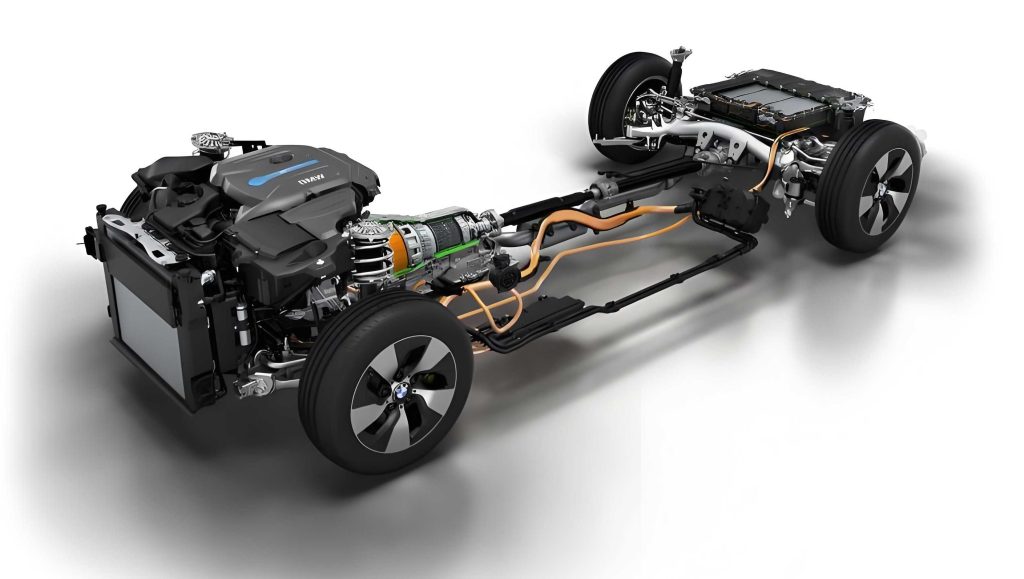
The integration of an internal combustion engine with an electric drivetrain in a hybrid electric vehicle creates unique thermal management demands. The engine in a hybrid electric vehicle often operates in transient states, and its efficiency directly impacts the overall energy consumption and electric power generation capability. Recent advancements in nanofluid technology have opened new avenues for cooling systems. Specifically, nano-fluids—base fluids with suspended nanometer-sized particles—exhibit superior thermal conductivity and heat transfer coefficients compared to conventional coolants. The nano-coolant evaluated in this study, designated for high-temperature applications, represents a significant leap forward. Its potential to improve the thermal performance of a hybrid electric vehicle’s engine could lead to substantial gains in fuel economy and reduced emissions, which are critical for the sustainability of hybrid electric vehicle technology.
This study employs a controlled bench-test methodology to isolate and evaluate the performance of this nano-coolant under varying operational parameters of a hybrid electric vehicle’s power unit. The core hypothesis is that by enabling the engine to operate safely at higher temperatures with reduced parasitic losses, the nano-coolant can enhance the thermal efficiency of the hybrid electric vehicle system. The following sections detail the experimental approach, present results through quantitative data tables and mathematical formulations, discuss the underlying physical mechanisms, and conclude with implications for the future of thermal management in hybrid electric vehicles.
Experimental Methodology and Setup
The evaluation was conducted on a test bench simulating the internal combustion engine component of a series-type hybrid electric vehicle. The primary goal was to assess the coolant’s performance under controlled conditions of inlet temperature, engine speed, and load power. Two coolant samples were used: the test sample was the advanced nano-coolant (boiling point ~120°C), and the reference sample was a conventional glycol-based antifreeze coolant (boiling point ~104°C).
The test matrix involved varying the engine coolant inlet temperature (90°C and 95°C), rotational speed (approximately 1800, 2000, and 2500 rpm), and output power (10, 15, and 20 kW). The engine load was maintained below 80% of its maximum capacity for all tests. For each combination of parameters, after the engine reached stable operation, data was collected continuously for 30 minutes, with recordings taken at 5-minute intervals. The key parameters logged were:
– Coolant temperature at engine inlet ($T_{in}$)
– Coolant temperature at engine outlet ($T_{out}$)
– Electrical power generated by the engine-generator unit ($P$)
– Fuel consumption rate ($Q$)
The following formulas were used to calculate the comparative performance metrics:
The change in engine outlet temperature upon switching to the nano-coolant is given by:
$$\Delta T = T_{nano} – T_{ref}$$
where $T_{nano}$ is the outlet temperature with nano-coolant and $T_{ref}$ is the outlet temperature with reference coolant.
The relative change in power generation efficiency is expressed as:
$$\Delta \eta = \frac{P_{nano} – P_{ref}}{P_{ref}} \times 100\%$$
where $P_{nano}$ and $P_{ref}$ are the generated electrical powers with nano-coolant and reference coolant, respectively.
The relative change in fuel consumption is calculated as:
$$\Delta Q = \frac{Q_{nano} – Q_{ref}}{Q_{ref}} \times 100\%$$
where $Q_{nano}$ and $Q_{ref}$ are the fuel consumption rates.
These formulas provide a foundational framework for quantifying the impact of the nano-coolant on the hybrid electric vehicle’s thermal system.
Results: Performance Data under Varied Operating Conditions
The bench test results systematically reveal the influence of the nano-coolant. The data is summarized in the table below, which aggregates average values from multiple test runs for each condition. Notably, at an inlet temperature of 95°C and 15 kW power, two out of six test runs triggered engine shutdown due to over-temperature, indicating operation near the system’s thermal limit under those specific controlled conditions.
| Engine Power & Speed | Coolant Type | Avg. Inlet Temp. (°C) | Avg. Outlet Temp. (°C) | Avg. Power (kW) | Avg. Fuel Consumption (mL/5 min) | $\Delta T$ (°C) | $\Delta \eta$ (%) | $\Delta Q$ (%) |
|---|---|---|---|---|---|---|---|---|
| 10 kW, ~1750 rpm | Reference | 90.10 | 99.67 | 8.88 | 284.84 | +1.50 | +4.06 | +7.56 |
| Nano-Coolant | 90.27 | 101.17 | 9.24 | 305.53 | ||||
| 15 kW, ~2015 rpm | Reference | 90.40 | 101.00 | 13.91 | 282.33 | +3.00 | +5.74 | -4.32 |
| Nano-Coolant | 90.03 | 104.00 | 14.70 | 269.84 | ||||
| 20 kW, ~2450 rpm | Reference | 90.18 | 100.83 | 20.64 | 274.04 | +3.17 | +2.11 | +3.37 |
| Nano-Coolant | 90.03 | 104.00 | 20.94 | 287.55 | ||||
| 10 kW, ~1750 rpm | Reference | 95.00 | 96.17 | 9.29 | 334.34 | +11.00 | +0.37 | -5.59 |
| Nano-Coolant | 95.40 | 107.17 | 9.31 | 314.58 | ||||
| 15 kW, ~2015 rpm* | Reference | 95.00 | 99.50 | 14.45 | 341.71 | +9.25 | +0.67 | -18.10 |
| Nano-Coolant | 95.18 | 108.75 | 14.54 | 279.90 |
*Data averaged from 4 stable runs; 2 runs resulted in over-temperature shutdown.
To further analyze the effect of increasing the operational temperature baseline, the following table compares the average fuel consumption and power generation at the two primary inlet temperatures for the 10 kW and 15 kW power settings.
| Coolant Type | Parameter | At 90°C Inlet | At 95°C Inlet | Increment (95°C – 90°C) |
|---|---|---|---|---|
| Reference Coolant | Avg. Fuel Cons. (mL/5min) | 283.04 | 338.03 | +54.99 |
| Avg. Power (kW) | 11.40 | 11.79 | +0.39 | |
| Nano-Coolant | Avg. Fuel Cons. (mL/5min) | 287.64 | 297.40 | +9.76 |
| Avg. Power (kW) | 11.97 | 11.93 | -0.04 |
Discussion: Mechanisms Underlying Thermal Efficiency Enhancement
The data unequivocally demonstrates that the application of the nano-coolant significantly alters the thermal dynamics of the hybrid electric vehicle’s engine. The effects can be synthesized into several key mechanisms, each contributing to the overall improvement in system efficiency.
1. Elevation of Cylinder Working Temperature and Thermal Efficiency
The most pronounced effect is the substantial increase in engine outlet temperature facilitated by the nano-coolant, particularly at higher set points. When the inlet temperature was raised from 90°C to 95°C, the average outlet temperature difference ($\Delta T$) between the nano-coolant and the reference coolant surged to approximately +9.29°C. This indicates that the nano-coolant enables the engine metal and combustion chambers to operate at a significantly higher temperature. According to fundamental thermodynamic principles, the ideal efficiency of a heat engine, such as the ICE in a hybrid electric vehicle, is governed by the Carnot efficiency relation:
$$\eta_{th} \leq 1 – \frac{T_C}{T_H}$$
where $T_H$ is the absolute temperature of the heat source (combustion) and $T_C$ is the absolute temperature of the heat sink (coolant/exhaust). While a real engine does not operate on the Carnot cycle, this relation illustrates that a higher $T_H$ relative to $T_C$ favors greater thermal efficiency. By allowing the cylinder walls to sustain a higher temperature, the nano-coolant effectively raises the average $T_H$ for the working cycle, thereby reducing the relative heat loss to the coolant and improving the conversion of fuel energy into useful work. This is directly evidenced by the dramatic reduction in fuel consumption ($\Delta Q$) at the 95°C inlet condition, reaching a maximum reduction of -18.1%. The hybrid electric vehicle’s engine, with the nano-coolant, approaches a more optimal combustion temperature profile.
2. Reduction of Vaporization Losses and Flow Resistance
The second critical mechanism involves the thermophysical properties of the coolant itself. The conventional antifreeze, with a boiling point near 104°C, operates perilously close to its phase change boundary at the observed outlet temperatures around 100°C. Near-boiling conditions lead to two major parasitic losses: latent heat of vaporization and increased flow resistance due to vapor bubble formation (cavitation or “vapor lock”). The energy required for vaporization is drawn from the engine, constituting a direct heat loss. Furthermore, two-phase flow increases the pump work needed to circulate the coolant. The nano-coolant, with its elevated boiling point of approximately 120°C, maintains a single-phase liquid state throughout the operating range, even at outlet temperatures up to 108-109°C. This eliminates or drastically reduces these parasitic losses. The data in Table 2 powerfully supports this: when the inlet temperature was increased by 5°C, the reference coolant’s fuel consumption increased by about 55 mL/5min, whereas the nano-coolant’s increased by only about 10 mL/5min—a mere 20% of the increase seen with the conventional coolant. This stark difference underscores the significant energy penalty associated with coolant vaporization in a standard hybrid electric vehicle cooling system and the advantage offered by the high-boiling-point nano-fluid.
The reduction in pumping power can be conceptually related to the pressure drop $\Delta P$ in the cooling circuit. For a single-phase liquid, the pressure drop is primarily a function of viscous friction. The onset of vaporization introduces a compressible, less dense phase, drastically increasing flow instability and resistance. While not directly measured here, the reduced thermal load from avoiding vaporization implies less work for the coolant pump, contributing to net system efficiency gains for the hybrid electric vehicle.
3. Enhancement of Power Generation Efficiency
The hybrid electric vehicle’s ability to generate electricity is paramount. The data shows a consistent, though variable, positive change in generated electrical power ($\Delta \eta$) when using the nano-coolant. The average increase was +2.25% across the 90°C inlet tests. At the higher 95°C inlet, the increase was more modest at +0.52%. This improvement in power generation efficiency stems from the previously described thermal efficiency gain. A more efficient engine converts more fuel energy into mechanical shaft work. Since the generator converts this mechanical work into electricity, its output naturally increases for a given fuel input, assuming generator efficiency remains constant. The relationship can be simplified as:
$$P_{gen} = \eta_{gen} \cdot \eta_{eng} \cdot \dot{m}_{fuel} \cdot LHV$$
where $P_{gen}$ is the generated electrical power, $\eta_{gen}$ is the generator efficiency, $\eta_{eng}$ is the engine thermal efficiency, $\dot{m}_{fuel}$ is the fuel mass flow rate, and $LHV$ is the fuel’s lower heating value. The nano-coolant’s role in increasing $\eta_{eng}$ directly boosts $P_{gen}$, enhancing the self-sufficiency of the hybrid electric vehicle’s electrical system.
4. The Cyclic Thermal Balance Operating Mechanism
The ultimate success of running an engine at higher temperatures depends on the cooling system’s ability to reject the increased heat load to the environment. This is where the enhanced heat transfer properties of nano-fluids become crucial. Nano-fluids are known to exhibit superior thermal conductivity and convective heat transfer coefficients compared to base fluids. This translates to a more efficient radiator (heat exchanger). The proposed operating mechanism for a hybrid electric vehicle using this nano-coolant is a dynamic, cyclic heat balance:
“Engine High-Temperature Combustion → Radiator Rapid Heat Dissipation → Engine High-Temperature Combustion”.
In this cycle, the nano-coolant absorbs a large amount of heat at the engine block, reaching a high temperature (e.g., 108°C). It then flows to the radiator, where its enhanced heat transfer properties enable it to release this heat to the ambient air more quickly and effectively than a conventional coolant. This rapid cooling brings the fluid temperature back down efficiently, preparing it to absorb more heat in the next cycle. This mechanism allows the engine to sustain a higher average operating temperature without the risk of overheating, maximizing efficiency.
The over-temperature shutdowns observed during testing at 95°C inlet and 15 kW power are instructive. They occurred because the experimental setup artificially held the engine inlet temperature constant at the set point. In a real hybrid electric vehicle cooling circuit, the radiator’s cooling capacity determines the inlet temperature. By fixing the inlet, the test protocol prevented the nano-coolant’s rapid radiator cooling effect from manifesting within the closed loop. Consequently, with a fixed high inlet temperature and high load, the outlet temperature climbed to the critical limit. In an actual vehicle, the radiator, aided by the nano-fluid’s high heat transfer rate, would lower the returning coolant temperature sufficiently to maintain a safe and stable high-temperature cycle. The system’s stability condition can be expressed as a heat balance:
$$\dot{Q}_{engine} = \dot{Q}_{radiator} = h_{rad} \cdot A \cdot (T_{coolant,avg} – T_{ambient})$$
where $\dot{Q}_{engine}$ is the heat rejected to the coolant, $\dot{Q}_{radiator}$ is the heat dissipated by the radiator, $h_{rad}$ is the overall heat transfer coefficient of the radiator, $A$ is its surface area, $T_{coolant,avg}$ is the average coolant temperature in the radiator, and $T_{ambient}$ is the ambient air temperature. The nano-coolant increases $h_{rad}$, allowing $\dot{Q}_{radiator}$ to match a higher $\dot{Q}_{engine}$ at a lower $\Delta T = (T_{coolant,avg} – T_{ambient})$, or conversely, to handle the same $\dot{Q}_{engine}$ with a smaller radiator or lower fan power. This balance is essential for the reliable high-efficiency operation of a hybrid electric vehicle.
Extended Analysis and Future Implications for Hybrid Electric Vehicles
The implications of integrating such a nano-coolant into hybrid electric vehicle platforms are profound. Beyond the immediate fuel savings and efficiency gains, several broader aspects warrant consideration.
System-Level Energy Integration: A hybrid electric vehicle manages multiple energy flows: chemical (fuel), mechanical (engine, wheels), and electrical (battery, motor/generator). The thermal management system interacts with all of them. A more efficient engine reduces fuel consumption directly. The associated increase in electrical generation can either charge the battery faster or reduce the drain on it during demanding operations, potentially allowing for a smaller, lighter battery pack without compromising performance. This system-level optimization is key to advancing hybrid electric vehicle design. The efficiency gain $\Delta \eta_{sys}$ from the coolant can be modeled as a contribution to the overall vehicle well-to-wheel efficiency.
Emissions Reduction: Higher and more stable combustion chamber temperatures typically lead to more complete combustion, reducing the formation of unburned hydrocarbons (HC) and carbon monoxide (CO). While not measured in this bench test, this is a well-established correlation. For hybrid electric vehicles operating in urban environments where the ICE may start and stop frequently, maintaining optimal temperature quickly is crucial for minimizing cold-start emissions. The nano-coolant’s reported property of shortening cold-start times aligns perfectly with this need, further enhancing the environmental profile of the hybrid electric vehicle.
Material and Durability Considerations: Operating at higher temperatures may raise concerns about material stress and long-term durability of engine components. However, modern engines are designed with significant safety margins. The temperature increases observed (up to ~108°C) are well within the operational limits of standard engine materials like aluminum alloys. Furthermore, the reduction in thermal cycling stress—due to a more stable high-temperature operation rather than frequent large swings—could potentially improve component longevity in a hybrid electric vehicle’s often transient operation.
Scalability and Application: The principles demonstrated here are not limited to one type of hybrid electric vehicle. They apply to series, parallel, and power-split hybrids, as all utilize an internal combustion engine. The technology could also be beneficial for plug-in hybrid electric vehicles (PHEVs) and even range-extender electric vehicles (REEVs), where engine efficiency during generation phases is critical. The mathematical framework for assessing the benefit across different driving cycles would involve integrating the instantaneous efficiency improvement over the cycle:
$$\text{Total Fuel Saved} = \int_{cycle} \left( \dot{m}_{fuel,ref}(t) – \dot{m}_{fuel,nano}(t) \right) dt$$
where the fuel flow rates are functions of the engine’s operating point and its enhanced efficiency with the nano-coolant.
Conclusion
This detailed investigation, conducted from a first-person research perspective, substantiates the significant positive impact of a high-temperature resistant nano-coolant on the thermal efficiency of a hybrid electric vehicle’s internal combustion engine. Through controlled bench testing, we observed that the nano-coolant enables the engine to operate safely at substantially higher cylinder temperatures, evidenced by outlet temperature increases exceeding 9°C compared to conventional coolant at elevated inlet temperatures. This directly translated to a remarkable reduction in average fuel consumption by up to 11.85%, with a maximum observed reduction of 18.1%, and a concurrent improvement in electrical power generation efficiency. The mechanisms driving these improvements are tripartite: (1) the elevation of the engine’s working temperature towards its thermodynamic optimum, (2) the elimination of vaporization-related heat and pumping losses due to the coolant’s high boiling point and maintained single-phase state, and (3) the establishment of a sustainable high-efficiency cycle powered by the nano-fluid’s enhanced heat transfer properties facilitating rapid radiator dissipation.
The occasional over-temperature events in the test protocol were artifacts of the fixed inlet temperature condition, which impeded the natural operation of the “high-temperature combustion → rapid heat dissipation” cyclic balance inherent in a real hybrid electric vehicle cooling system. When the system is allowed to self-regulate, the nano-coolant’s superior heat rejection capability ensures stable high-temperature operation. The integration of this advanced thermal management fluid presents a straightforward yet highly effective pathway to improve the fuel economy, reduce emissions, and enhance the overall energy efficiency of hybrid electric vehicles. It underscores the importance of continued innovation in auxiliary systems, like cooling, to unlock further performance gains in complex, integrated powertrains such as those found in modern hybrid electric vehicles. Future work should focus on full-vehicle integration testing under dynamic driving cycles to quantify the real-world benefits for the hybrid electric vehicle platform.