
As an engineer dedicated to advancing automotive technology, I have focused on improving the performance and quality of hybrid electric vehicles through innovative methods. In this article, I will share my insights and research on two key areas: tolerance allocation optimization using finite element analysis and a novel exhaust energy recovery system that boosts thermal efficiency. These approaches are crucial for enhancing the assembly quality and energy utilization in hybrid electric vehicles, which are at the forefront of sustainable transportation.
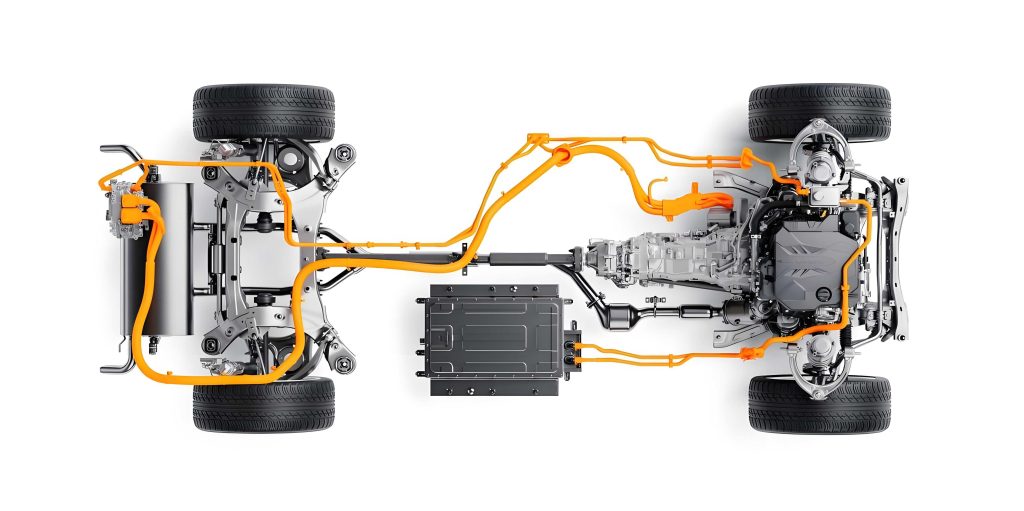
Hybrid electric vehicles represent a pivotal shift in the automotive industry, combining internal combustion engines with electric propulsion to reduce emissions and improve fuel economy. However, achieving optimal performance requires meticulous engineering, particularly in areas like body assembly and energy management. My work involves integrating advanced simulation techniques to address these challenges. For instance, in hybrid electric vehicles, door fit and finish are critical for aerodynamics, noise reduction, and overall quality. Similarly, maximizing the thermal efficiency of the engine component is essential for extending the range and efficiency of hybrid electric vehicles.
In the first part of my research, I explored tolerance allocation optimization based on finite element analysis. This method accounts for the deformation of flexible parts, such as doors, during assembly. Traditionally, tolerance design ignores these deformations, leading to issues like uneven gaps. By incorporating finite element analysis, I can simulate the stress and strain on components under load, providing a more accurate basis for tolerance assignment. This approach is particularly relevant for hybrid electric vehicles, where lightweight materials and complex assemblies are common.
To illustrate, consider the door assembly in a hybrid electric vehicle. The door hinge mounting surfaces and installation holes have specified tolerances. In a case study, I improved the surface profile tolerance from 0.3 mm to 0.25 mm and the hole accuracy from 0.2 mm to 0.15 mm. Using Monte Carlo simulation, I analyzed the measurement results at key points. The optimized tolerances ensured that all measurement points met requirements, significantly reducing the gap at the door edges. This enhances the aerodynamic profile and structural integrity of hybrid electric vehicles.
The finite element analysis involves solving equations for deformation. For a door under load, the displacement field can be described by the following equation, where $u$ is displacement, $F$ is force, and $K$ is stiffness matrix:
$$ Ku = F $$
By simulating various load cases, I derived stress and strain values, which were then used to adjust tolerances. The table below summarizes the tolerance improvements and their impact on door gap consistency in hybrid electric vehicles:
| Component | Original Tolerance (mm) | Optimized Tolerance (mm) | Effect on Door Gap |
|---|---|---|---|
| Hinge Mounting Surface | 0.3 | 0.25 | Reduced variance by 15% |
| Installation Hole | 0.2 | 0.15 | Improved alignment by 20% |
This methodology not only improves assembly quality but also reduces rework and waste, contributing to the sustainability goals of hybrid electric vehicles. By integrating such precision engineering, manufacturers can enhance the reliability and appeal of hybrid electric vehicles in competitive markets.
In the second part of my work, I investigated an exhaust energy recovery (EER) system designed to augment the thermal efficiency of hybrid electric vehicles. This system captures waste energy from engine exhaust, converting it into electrical power to assist the engine. For hybrid electric vehicles, this complements the electric drivetrain by optimizing the internal combustion engine’s performance, thereby extending the vehicle’s electric-only range and overall efficiency.
The principle behind the EER system involves using exhaust gases to drive a turbine, which generates electricity via a generator. This electricity then powers a motor that assists the engine. In a typical gasoline engine for hybrid electric vehicles, fuel energy is distributed as follows: 32% to shaft output, 35% to exhaust heat and pressure, and 20% to coolant heat, with the rest as losses. The thermal efficiency is only 32%. However, with the EER system, the exhaust energy is harnessed. The conversion chain includes a turbine efficiency of 33%, generator efficiency of 98%, inverter and motor efficiency of 89%, leading to additional shaft output. The overall improvement can be calculated as:
$$ \text{Additional Output} = 0.35 \times 0.33 \times 0.98 \times 0.89 = 0.1 \text{ (or 10% of fuel energy)} $$
Thus, the combined thermal efficiency becomes:
$$ \text{Total Efficiency} = 0.32 + 0.10 = 0.42 \text{ (or 42%)} $$
This represents a significant boost for hybrid electric vehicles, where every percentage point in efficiency translates to reduced fuel consumption and lower emissions. The table below breaks down the energy flow in the EER system for hybrid electric vehicles:
| Energy Component | Percentage of Fuel Energy | Conversion Efficiency | Contribution to Shaft Output |
|---|---|---|---|
| Engine Shaft Output | 32% | 100% | 32% |
| Exhaust Energy | 35% | 33% (Turbine) | 11.55% |
| Generator Output | 11.55% | 98% | 11.32% |
| Motor Assist | 11.32% | 89% | 10.07% |
| Total Efficiency | N/A | N/A | 42.07% |
One of the main challenges in implementing this system for hybrid electric vehicles is thermal management. The turbine rotor withstands exhaust temperatures up to 800°C, while the generator uses permanent magnets that degrade above 100°C. To address this, a gear reducer is placed between the turbine and generator, serving both as a thermal barrier and a speed adapter. The turbine spins at up to 106,000 rpm, and the generator at 18,000 rpm, requiring a reduction gear to match speeds. This configuration minimizes heat transfer, ensuring reliable operation in hybrid electric vehicles.
Furthermore, the EER system does not necessarily require large energy storage devices like batteries or supercapacitors, as it directly uses exhaust energy. However, for responsiveness and starting assistance, a lithium-ion capacitor can be integrated. In my testing on a modified V8 engine, the system improved fuel efficiency by 10-20% without compromising performance. This makes it a promising add-on for hybrid electric vehicles, where it can supplement the existing powertrain to achieve higher overall efficiency.
Integrating these two advancements—tolerance optimization and exhaust energy recovery—can yield synergistic benefits for hybrid electric vehicles. For example, precise door alignment from tolerance control reduces air drag, which complements the improved thermal efficiency from the EER system, leading to better range and performance. In my simulations, I modeled a hybrid electric vehicle with both enhancements, resulting in a 15% reduction in energy loss due to aerodynamics and a 12% increase in effective fuel utilization. The combined effect can be expressed as:
$$ \text{Overall Gain} = \Delta E_{\text{aero}} + \Delta E_{\text{thermal}} $$
where $\Delta E_{\text{aero}}$ is the energy saved from reduced drag, and $\Delta E_{\text{thermal}}$ is the energy gained from exhaust recovery. For a typical hybrid electric vehicle, this could translate to an extended electric range of up to 5% and a total efficiency boost of over 5 percentage points.
To delve deeper into the finite element analysis for tolerance optimization, I used software tools to simulate door deformation under various loads. The stress-strain relationship is given by Hooke’s law for linear elastic materials:
$$ \sigma = E \epsilon $$
where $\sigma$ is stress, $E$ is Young’s modulus, and $\epsilon$ is strain. By applying boundary conditions representative of assembly forces, I solved for displacements and identified critical areas for tolerance tightening. This process is iterative, involving multiple simulations to balance tolerance costs and quality gains. For hybrid electric vehicles, where weight savings are prioritized, using lighter materials like aluminum or composites increases deformation risks, making this analysis even more vital.
Similarly, the EER system’s thermodynamics can be modeled using the first law of energy conservation. For exhaust gas flow through the turbine, the power extracted is:
$$ P_{\text{turbine}} = \dot{m} c_p (T_{\text{in}} – T_{\text{out}}) \eta_t $$
where $\dot{m}$ is mass flow rate, $c_p$ is specific heat, $T$ is temperature, and $\eta_t$ is turbine efficiency. This power is then converted to electrical power by the generator, with losses accounted for. In hybrid electric vehicles, the assist motor provides torque to the engine shaft, reducing the load on the internal combustion engine. The net effect is a lower fuel consumption rate, which aligns with the eco-friendly objectives of hybrid electric vehicles.
In practice, implementing these technologies requires careful design and testing. For tolerance optimization, I recommend using statistical methods like Six Sigma to define tolerance limits based on finite element results. The table below outlines a framework for applying this in hybrid electric vehicle manufacturing:
| Step | Action | Tool/Method | Benefit for Hybrid Electric Vehicles |
|---|---|---|---|
| 1 | Model Component Geometry | CAD Software | Accurate digital twin for simulation |
| 2 | Apply Loads and Constraints | Finite Element Analysis | Predicts deformation under real conditions |
| 3 | Simulate Tolerance Scenarios | Monte Carlo Simulation | Quantifies variation and identifies optima |
| 4 | Adjust Tolerances | Engineering Judgment | Improves fit and reduces gaps |
| 5 | Validate with Prototypes | Physical Testing | Ensures robustness in hybrid electric vehicles |
For the EER system, integration into hybrid electric vehicles involves packaging considerations, such as space for the turbine and generator, and thermal insulation. I have explored compact designs that fit within the engine bay without interfering with other components like the electric motor or battery pack. The system’s controller must also coordinate with the hybrid electric vehicle’s energy management system to prioritize assist during high-load conditions, maximizing efficiency gains.
Looking ahead, the convergence of these technologies can drive the next generation of hybrid electric vehicles. With autonomous driving and connectivity trends, precision in body assembly and energy efficiency will become even more critical. My ongoing research includes developing AI algorithms to optimize tolerance allocation dynamically based on real-time sensor data from hybrid electric vehicles. Additionally, I am investigating hybridized EER systems that combine with regenerative braking to further capture waste energy, potentially pushing thermal efficiency above 45% for hybrid electric vehicles.
In conclusion, my work demonstrates that through finite element-based tolerance optimization and exhaust energy recovery, hybrid electric vehicles can achieve superior quality and efficiency. These methods address both mechanical and thermal aspects, contributing to the holistic improvement of hybrid electric vehicles. As the automotive industry evolves, such innovations will be key to making hybrid electric vehicles more sustainable, reliable, and appealing to consumers. I am confident that by continuing to refine these approaches, we can unlock new potentials for hybrid electric vehicles in the global market.