
Reflecting on the trajectory of automotive electrification, I have observed a significant, pragmatic shift in focus within the industry. While the vision of a fully electric future remains compelling, the immediate challenges surrounding energy storage, infrastructure, and total cost of ownership have prompted a reevaluation of the most viable path forward. From my perspective, the technology that currently best bridges the gap between ambition and reality, that most effectively “meets the market where it is,” is the plug-in hybrid electric vehicle (PHEV). This analysis delves into the multi-faceted advantages of the hybrid electric vehicle platform, particularly its plug-in variant, using empirical data and comparative models to substantiate its role as the cornerstone of sustainable mobility in the present decade.
The core challenge inhibiting the mass adoption of pure Battery Electric Vehicles (BEVs) is intrinsically linked to the physics and economics of contemporary battery technology. The ideal energy storage unit for a car would possess high specific energy (Wh/kg), high specific power (W/kg), excellent safety, long cycle life, and low cost. Current lithium-ion chemistries force a painful trade-off among these parameters. We can express the fundamental range challenge for a BEV with a simple formula:
$$ R_{BEV} = \frac{E_{pack}}{C_{vehicle}} $$
Where \( R_{BEV} \) is the vehicle’s range, \( E_{pack} \) is the total usable energy of the battery pack in watt-hours, and \( C_{vehicle} \) is the vehicle’s consumption in watt-hours per kilometer. To increase range (\( R \)), one must increase \( E_{pack} \). However, this leads to a nonlinear increase in mass, cost, and packaging complexity. The energy required to move the vehicle itself includes overcoming the mass of the battery, creating a diminishing returns scenario:
$$ C_{vehicle} = C_{rolling} + C_{aero} + C_{mass} $$
$$ C_{mass} \propto m \cdot a \cdot d $$
Here, \( C_{rolling} \), \( C_{aero} \), and \( C_{mass} \) are the power consumptions due to rolling resistance, aerodynamic drag, and accelerating mass, respectively. \( m \) is the total vehicle mass, \( a \) is acceleration, and \( d \) is distance. A heavier battery increases \( m \), which in turn increases \( C_{vehicle} \), thereby partially negating the benefit of a larger \( E_{pack} \). This is why long-range BEVs often carry battery packs weighing 500-700 kg, representing a massive capital cost and resource investment for capacity that is unused in the vast majority of daily trips.
The plug-in hybrid electric vehicle elegantly sidesteps this dilemma through an optimized system architecture. A PHEV employs a significantly smaller battery pack, sized specifically for the statistical daily driving distance. In North America and Europe, this is typically between 40 to 80 kilometers. For this primary use case, the vehicle operates as a pure electric car. The internal combustion engine (ICE) serves not as the primary mover, but as a “range extender,” activated only for journeys beyond the battery’s capability. This decouples the vehicle’s maximum range from the battery’s energy density. The system efficiency \( \eta_{PHEV} \) can be modeled as a function of driving distance \( x \):
$$ \eta_{PHEV}(x) = \begin{cases}
\eta_{electric} & \text{if } x \leq D_{electric} \\
\frac{D_{electric} \cdot \eta_{electric} + (x – D_{electric}) \cdot \eta_{hybrid}}{x} & \text{if } x > D_{electric}
\end{cases} $$
Where \( D_{electric} \) is the all-electric range, \( \eta_{electric} \) is the tank-to-wheel efficiency in electric mode, and \( \eta_{hybrid} \) is the efficiency in charge-sustaining hybrid mode. This dual-mode operation provides a seamless user experience without “range anxiety.”
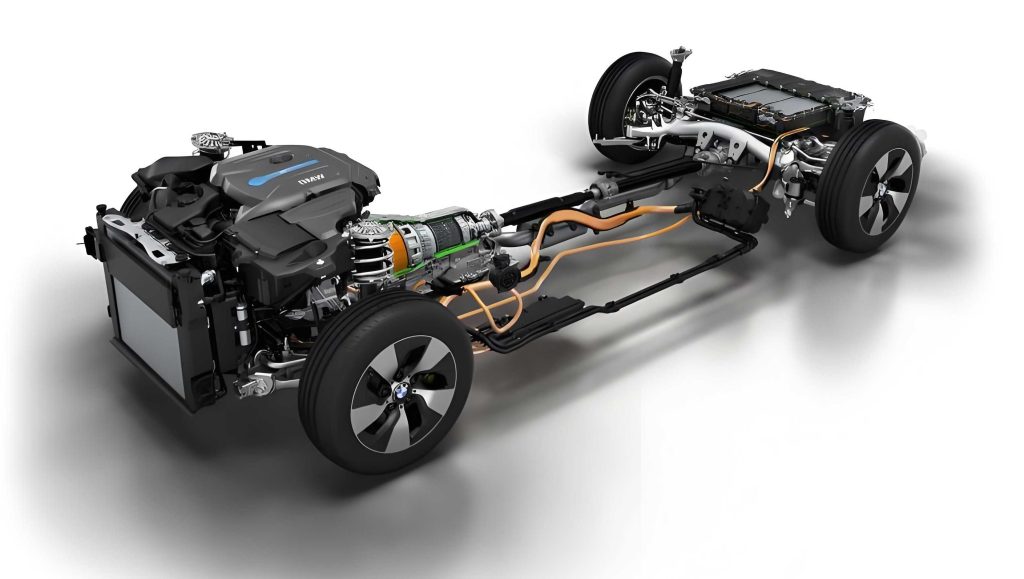
Let’s quantify the comparative advantages using a series of structured analyses. The following table contrasts key performance and consumer-centric metrics between a typical midsize BEV and a comparable PHEV.
| Parameter | Battery Electric Vehicle (BEV) | Plug-in Hybrid Electric Vehicle (PHEV) | Implication |
|---|---|---|---|
| Battery Capacity | 75 – 100 kWh | 15 – 20 kWh | PHEV uses 75-80% less critical minerals (Li, Co, Ni, Mn, Graphite). |
| Battery Mass | ~500 kg | ~100 kg | Significantly reduced vehicle curb weight, improving efficiency and reducing tire/brake wear. |
| All-Electric Range | 400-500 km | 50-80 km | PHEV range covers >80% of daily trips. BEV capacity is vastly underutilized daily. |
| Total Vehicle Range | 400-500 km | 700-900 km (combined) | PHEV eliminates distance-travel constraints for all users. |
| Upfront Cost Premium (vs. ICE) | High ($10k-$20k) | Moderate ($4k-$8k) | PHEV price point is closer to mainstream affordability. |
| Energy Source Flexibility | 100% Grid Electricity | Grid Electricity + Liquid Fuel | PHEV is not constrained by charging infrastructure availability on long trips. |
| Charging Demand | High-power, fast-charging required for practicality. | Can fully charge overnight on Level 1 (120V) AC. | PHEV minimizes grid upgrade costs and removes home electrical upgrade barrier. |
The resource argument is paramount in a world with constrained supply chains. A standard 75 kWh BEV battery pack requires approximately 8-10 kg of lithium, 35-50 kg of nickel, 10-15 kg of manganese, 8-10 kg of cobalt, and 60-80 kg of graphite. Scaling BEV production to tens of millions of units annually presents severe supply chain, geopolitical, and environmental challenges, particularly for mining and processing. In contrast, a hybrid electric vehicle with a 15 kWh pack reduces demand for these materials by about 80%. This is not an incremental improvement but a revolutionary reduction in resource intensity per vehicle, allowing sustainable electrification to scale much faster without overwhelming raw material markets.
The economic case for the consumer is equally powerful. We can model the Total Cost of Ownership (TCO) over a period \( T \) (e.g., 5 years):
$$ TCO = P + \sum_{t=1}^{T} \left( \frac{F_t}{(1+r)^t} + \frac{M_t}{(1+r)^t} + \frac{I_t}{(1+r)^t} \right) – \frac{R}{(1+r)^T} $$
Where \( P \) is purchase price, \( F_t \) is annual fuel/electricity cost, \( M_t \) is maintenance, \( I_t \) is insurance, \( r \) is discount rate, and \( R \) is residual value. For a PHEV, \( F_t \) is lower than for an ICE due to electric daily driving, but \( P \) is higher. However, \( P_{PHEV} < P_{BEV} \). Maintenance cost \( M_t \) for a hybrid electric vehicle is often lower than for an ICE due to reduced brake wear (from regen braking) and less strained engine operation. The residual value \( R \) of PHEVs is proving robust due to their flexibility. When government incentives are applied to the purchase price \( P \), the TCO of a PHEV frequently reaches parity with or beats both ICE and BEV alternatives for average users, especially those with access to home charging.
From an energy systems and infrastructure perspective, the hybrid electric vehicle presents a manageable pathway. The widespread adoption of BEVs necessitates a monumental, parallel build-out of high-power charging networks and a massive reinforcement of the electrical grid at the distribution level. The peak power demand of a 350 kW fast charger is equivalent to that of hundreds of homes. Deploying these at scale is slow and capital-intensive. PHEVs, with their small batteries, primarily charge at home, at work, or on standard low-power public chargers. Their charging profile is slow and predictable, often at night, which can help balance grid load rather than strain it. The infrastructure cost per vehicle electrified is dramatically lower for a PHEV fleet.
Furthermore, the well-to-wheel environmental impact must be considered holistically. In regions where the electrical grid is heavily dependent on coal, the marginal emissions from charging a large BEV battery can be significant. The efficiency of a thermal power plant \( \eta_{plant} \) (~33-40%) multiplied by grid transmission losses \( \eta_{grid} \) (~93-95%) and vehicle efficiency \( \eta_{charge/discharge} \cdot \eta_{motor} \) (~80-85%) results in a well-to-wheel efficiency for electricity:
$$ \eta_{WTW, elec} = \eta_{plant} \cdot \eta_{grid} \cdot \eta_{charge/discharge} \cdot \eta_{motor} \approx 0.35 \cdot 0.94 \cdot 0.82 \approx 0.27 $$
For a PHEV operating in hybrid mode, the well-to-wheel efficiency of modern gasoline engines in optimal load conditions (as part of a series or parallel hybrid system) can be surprisingly competitive, especially when considering the energy cost of producing and carrying a 500 kg battery. The PHEV’s ability to use its efficient electric mode for most local miles, where ICEs are least efficient, maximizes overall system efficiency and minimizes localized urban emissions—a key public health benefit.
The regulatory and strategic landscape is increasingly acknowledging this logic. Corporate Average Fuel Economy (CAFE) and CO₂ standards worldwide are becoming so stringent that they are effectively mandates for electrification. The most cost-effective and rapid way for manufacturers to meet these targets is not by selling a small number of expensive, long-range BEVs, but by widely普及ating efficient hybrid electric vehicle technology across their fleet. PHEVs deliver massive emission reductions in real-world urban driving while ensuring customer acceptance and market growth. They serve as a crucial technological and consumer adoption bridge, building familiarity with charging, refining electric drivetrain components, and driving down costs for the broader ecosystem.
In conclusion, the engineering and economic evidence strongly favors the plug-in hybrid electric vehicle as the dominant and most pragmatic form of electrification for the current era. It represents a systems-optimization solution that maximizes utility and minimizes critical bottlenecks: battery resource constraints, consumer range anxiety, high upfront cost, and charging infrastructure deficits. It is not a compromise but an intelligent application of hybridization principles to solve real-world problems today. As battery technology gradually improves in energy density, safety, and cost, the all-electric range of PHEVs will naturally extend, and the role of the internal combustion range-extender may evolve or diminish. But for the foreseeable future, the path to a sustainable automotive future will be paved not by a single technology, but by the versatile, practical, and rapidly scalable platform of the plug-in hybrid electric vehicle. It is the embodiment of a market-ready, resource-conscious, and consumer-friendly strategy for meaningful decarbonization of personal transportation.